
AHOY Studios Interview
8 min. read
interactive tools is gaining fresh design power from the Big Apple: we are entering a strategic partnership with the studios of New York design agency AHOY. AHOY is known for international branding projects and design ‘across all communication channels'.
How this came about and why this partnership also makes sense for clients is explained by AHOY founder Connie Koch in conversation with our managing director Klaus Cloppenburg.
AHOY – a New York success story
What are AHOY Studios and what is your expertise?
Connie: AHOY is an international design agency headquartered in New York with offices in Zurich and Berlin. After 20 years of AHOY, we work across a broad range but with a strong focus on branding. Brand building, corporate design, identities. And we carry these through into the various applications.
What kind of clients do you work for?
Connie: We have been working with the United Nations for many years. We have just completed the first corporate design for the ‘UN Country Teams' in 165 countries. That was a very demanding and rewarding project.
Besides that, we design a lot for events, art fairs, design fairs and the government sector. Large NGOs. Overall, though, they are always projects that serve a purpose we personally find meaningful.
How did the partnership with interactive tools come about?
Connie: I studied in Berlin, at what is now the Universität der Künste. Klaus and I met on the first day of our studies, and we've been friends ever since and quickly delivered our first joint projects together. For the UN, the German National Tourist Board and the Jewish Museum in Berlin.
Transatlantic partnership – how user experience and brand experience come together
Why is interactive tools expanding its branding expertise through this partnership?
Klaus: we do user experience – that's where we come from. However, we often find with our clients that a website relaunch can turn into a brand discovery process that sometimes takes three years. It happens that clients suddenly realise mid-project: "oh, we have lots of different logos and different colours are used internationally." And then the clients say: "well, if you're already working on the website, we might as well define this now and add it to our design manual."
In about half the jobs we see, it would be extremely smart to start with branding questions and define things pragmatically.
For us, the partnership is a chance to support our clients even more comprehensively and internationally in this area.
Connie: Answering these branding questions is a win for any brand. But it needs to be analysed: where do you come from? What do you actually need? What makes sense? You have to be effective about it, ideally with a modular concept. How far does a comprehensive rethink really need to go? In some cases everything is already great: fantastic logo, fantastic look. But then the imagery is inappropriate or interchangeable. And if a company wants to achieve individuality, it needs to think that through.
Klaus: This pragmatic approach suits us and our clients well. The topic of brand is so fraught with problems and fear. Clients think that if we open this can, we'll never get the lid back on. We often need a smart, simple approach that fits our agile way of working. Without hot air and lots of fuss. Pragmatic and international. Not on the meta level, but with common sense.
And how does interactive tools complement AHOY's work?
Connie: We're designers. We create brand experience. We don't have developers and don't have the experience with digital transformation that interactive tools has. But our clients are increasingly asking for digital solutions. Naturally, we want to offer the same high quality they're used to from us. Interactive tools offers that. And we enjoy working with you. Of course. It's meant to be fun, too.
Branding 2019 – What matters for brand building in a globalised world?
Why does the topic of brand and brand design carry such weight?
Connie: There's often a lot of confusion and frustration in this area. We see it in client presentations. They say: "Here are our values. We know who we are. But we don't know what we look like."
In these meetings and workshops, we experiment. We fill the conference table with all sorts of things, and then it becomes tangible for clients. There's a lot of potential for excitement in that. And then we see how relieved clients are. Like at Christmas, everyone sits at the full table and says: "Hey, great, that's us!"
Design simply has an enormous impact.
What do you find the biggest challenge in brand management in an international context?
Connie: There's a nice word for it: blanding. That means bland branding, in other words the creation of an expressionless, meaningless brand. Because of how we experience brands today, via Instagram for example, this system has become increasingly uniform. You see it a lot in Silicon Valley: turquoise. A bit of purple. And a sans-serif font. Add an infographic and, for many, that already forms a brand.
Brands are becoming ever more interchangeable. Few really do it well and shape themselves as a unique experience. People try to do it like everyone else, so they end up with a nice, trendy airbnb look.
You have to be careful there, because that can't be the solution – investing money and time only to end up with a look that looks much the same as everyone else's.
Emotional connection matters everywhere – even in B2B, because we're all human, after all.
Klaus: Our clients are often world market leaders. Success is defined beyond the saturated markets in Germany. That's often about people. Personnel, recruiting, key accounts, etc. And these people want to know what a brand is like. So the brand also has to work internationally.
Connie: Another topic is speed. The attention you can still hope for has shrunk to about two seconds. That's where design matters. Before I can make a rational decision, the emotional one has already been made. That's down to the speed of the website but also to the first impression. Authenticity matters too. Or sometimes a surprise. Because emotional connection matters everywhere – even in B2B, because we're all human, after all.
Klaus: When we test our clients' websites in our UX lab, the UX researcher's first question is often: “How does this feel to you? What's your first impression?” Then we hear: this is modern, this is fresh. Or not. If we find in testing that half the participants say a site looks dated, that's something we need to address.
What interests us is that design helps people understand something better. Good-looking. Unique. Functional, and doesn't get in my way.
Connie: On the contrary, it provides structure.
Klaus: And it needs to be future-proof. A corporate design has to adapt to the times. Today it's no longer rigid and fixed. Digital media in particular require adjustments that strengthen the brand and keep it feeling contemporary.
Cooperation – benefits and approach
What do clients get from us now working together?
Connie: The most important thing is that both agencies talk and work with each other. Often these are separate areas: they do digital, we do design. That creates competitive thinking. That's not an issue for us, since we complement each other perfectly, have known each other for a long time and have already enjoyed great collaboration. At the end of a project, we don't say: "Good luck! Now you can carry on with it on your own." Instead, we want to create a continuous level of exchange. Our shared goal is to deliver the best possible results for our clients.
Klaus: Looking beyond your own horizon is important too. With New York and Berlin, we sit on two key arteries in America and Europe. A change of perspective is always a theme in our projects – and an international perspective is interesting for many of our clients.
What does the cooperation look like in practice? How do joint projects start?
Connie: For example, with a design audit.
Klaus: Yes, a brand check or CI check.
Connie: When we start projects, we first do an analysis. We look at everything. Five years of brand history or more, ideally. Then it quickly becomes obvious to us what works and what doesn't. And then we decide what the client really needs. Perhaps a brand update or brand refresh. We look at: Is the typography outdated? Have the colours been seen a hundred times already? What does the imagery look like?
We take a visual approach. That's our expertise.
Klaus: Why not also run a design thinking workshop or a workshop preview: clients give us three to five days, we go into the workshop together and show them how we work and what comes out of it. Quick initial results, creating prototypes, making something tangible – that does our clients good.
What do you wish for the collaboration and the future?
Connie: I hope that, alongside the UN project, we take on other projects together. There are many existing clients we can serve better through this partnership.
Klaus: And it's not just existing clients who benefit – combining our expertise makes sense for new clients too. I hope we continue working together this well, and that the exchange between Berlin and New York is a real asset for our teams as well.
Selected AHOY projects
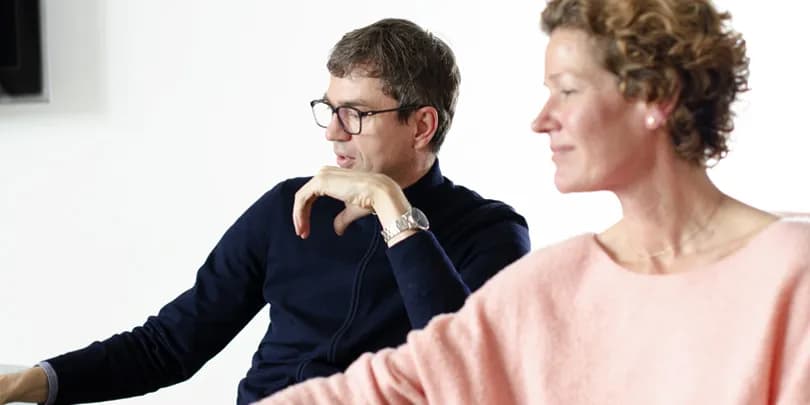
- Klaus Cloppenburg
Managementsynaigy
Show phone numberShow email address