



#148 - 8 hours autonomous, 100x cheaper: What AI can do today, nobody would have believed a year ago
In this insights! episode, tech investor Pip Klöckner analyzes with Joubin Rahimi what has changed in 10 months of AI development. Topics: execution windows of up to 12 hours, inference costs that have fallen by a factor of 100, the end of classic outsourcing models, AI-first startups as a parallel economy to the German Mittelstand, and proprietary data as Europe's last line of defense. An unsparing diagnosis of why hidden champions, DAX corporations and even strategy consultants underestimate the speed of development, and which concrete fields of action this creates for CEOs, CIOs and CDOs.
 Joubin RahimiManaging Partner · synaigy
9 min. read
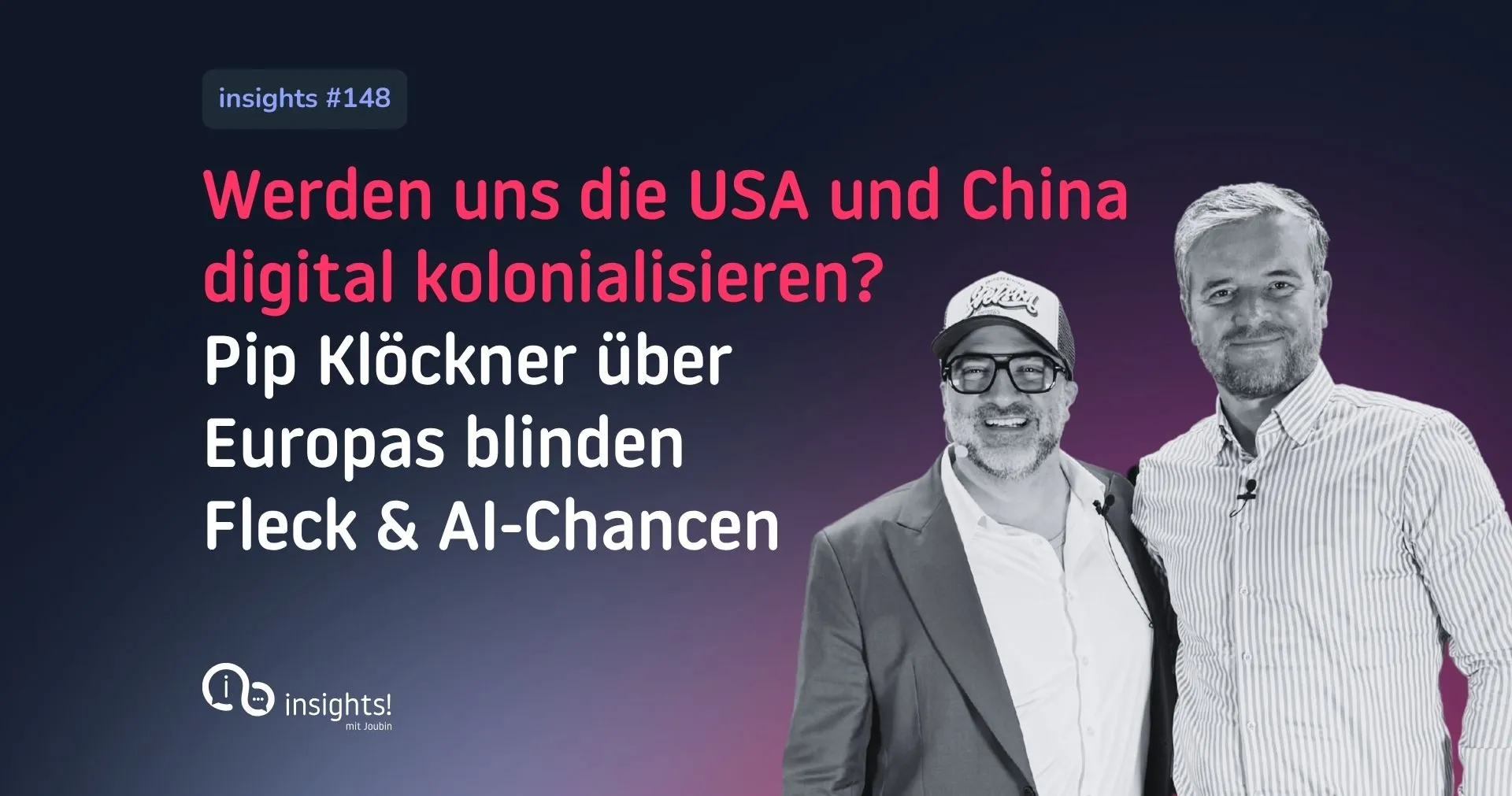
The danger is that the positive effects of AI, or the returns from it, are heavily concentrated in the hands of a few tech companies and their shareholders. And that the negative effects – possible job losses, distraction, addictive behavior – are spread across the broad population and socialized. So the risks get socialized and the profits privatized, if politics doesn't act. With digitalization we haven't managed it all that well so far.
10 months of AI: more change than in 10 years of digitalization
If you want to know how much has changed in the AI world over the past 10 months, don't ask the strategist in the next consulting pitch. Ask someone who watches markets, models and capital flows every day. Pip Klöckner was a guest on insights!, Joubin Rahimi's videocast, for the third time, live from INSIGHTS the Conference. His assessment is uncompromising: more has happened than in the 10 years before.
Three drivers stand out for Klöckner: First, the sharply expanded execution window of current frontier models. Second, the dramatic collapse in inference costs. Third, a new leap in image models that combine reasoning and generation. These three points sound technical, but they have tangible consequences for every business model based on knowledge, content or software.
A 12-hour execution window: when AI works longer than your board sleeps
A year ago, models could maybe write code or handle research tasks autonomously for three minutes. Today, according to Klöckner, current Anthropic models work autonomously for 8 to 12 hours. You give them a task in the evening, go to bed, and in the morning the first draft of an app, a piece of research or a prototype is waiting for you. The completion rate is around 50 percent, meaning not every run is a hit, but the sheer order of magnitude is new.
At the same time, inference costs – the running cost per token when using AI – have fallen by a factor of 100. That opens two doors at once: models can think longer and deeper, because the budget per task becomes affordable. And several agents can work side by side like an orchestra, because parallelization becomes economically viable. Taken together, this creates a new level of speed that is barely manageable in a classic line organization.
What resonates between the lines with Klöckner: speed itself becomes the strategic advantage. Whoever has a prototype at the customer in two days instead of three months wins not through better slides, but through visible substance in the first meeting.
Solutions have become cheap, problems are expensive
The most important mental shift Klöckner triggers concerns scarcity. For decades the rule was: solutions are laborious, identifying good problems is comparatively easy. Today that is reversing. When a model delivers a prototype in 30 minutes, the solution is no longer the bottleneck. The bottleneck is having someone formulate the right problem precisely and sharply.
That also shifts the constraint to the market side. If everyone can write Hollywood movies or build computer games overnight, nobody goes to the cinema more often or plays more anyway. Demand has a limit, which Klöckner describes as the real bottleneck in many markets. Whoever reaches customers better and understands problems better wins. Whoever only produces solutions has a distribution problem.
Concretely, this means for your company: invest less in the next AI demo and more in the question of which real, valuable problem in your market is still unsolved today. That is the critical resource of the AI economy.
The uncomfortable truth: your strategy consultants often don't use the AI they sell
Another of Klöckner's statements concerns the big strategy firms. In the German Mittelstand, among hidden champions and in MDAX and DAX corporations, he sees no company-wide AI agent in operational use. Nor at the large consultancies currently selling AI transformation as their top product. Internally there is rarely an agent that consolidates the knowledge of all clients and projects, while at the same time the topic sits right at the top of the sales pitch. That's an uncomfortable point, because it addresses a common business model. It doesn't mean external consulting is worthless. But it does mean that as a client you should look very closely at how deeply the provider itself uses AI before you let someone sell you an AI strategy. A simple test question: what does the AI workflow look like in the account team that serves you? The consequence is that AI-first startups operate in a parallel economy. They hire fewer people, need fewer cross-functional roles and reach unicorn valuations with smaller teams. Classic companies that buy AI only via external consultants, by contrast, compete with a structural speed disadvantage.
Outsourcing to India? That model is dying right now
Another area Klöckner categorizes with razor sharpness is classic outsourcing. The workbench logic of the last 20 years – shifting simple developer, data maintenance and call center activities to low-wage countries – is collapsing in real time. Mass layoffs at the large Indian outsourcing providers and pressure on Philippine call center structures are his examples.
The consequence reaches deep into the strategy decks of German mid-sized companies that are still discussing site expansion in Southeast Asia today. Joubin Rahimi reports in the conversation how synaigy deliberately buried a similar plan. The logic: if a product manager on a 200,000 euro annual salary with a token budget of 2 million for AI delivers more output than 40 to 50 developers in an offshore hub, then it's not just the personnel costs that disappear, but also HR, recruiting, payroll and the entire complexity overhead of a globally distributed organization.
So anyone currently planning a site should ask: are we building up AI assistants here who will be obsolete in 24 months? Or are we really building proximity to our customers?
Data is the new gold – and the German Mittelstand is sleeping on the treasure
If you want to make only one strategic bet in the DACH region, Klöckner bets on proprietary data. Publicly available data has long since been absorbed into the models. The asset only you have is the data in your operational business. That is exactly where he sees the lever with which European hidden champions can win.
Concrete examples that Klöckner mentions or that follow directly from this:
Anonymized driver assistance system data from automotive suppliers for better self-driving
Industrial production data and wear data from machine fleets
Predictive maintenance on wind turbines, machine tools and logistics fleets
Medical data in regulated care structures
Fleet and delivery data from retail chains
The prerequisite for monetizing this data, however, is unsexy: data classification, clean taxonomies, rights management, data protection. Klöckner points to the US provider Palantir, whose actual business is precisely the normalization of this data landscape. The model is not the bottleneck, the infrastructure beneath it is.
If you don't take this step yourself, others will take it for you. Joint ventures between US AI providers and private equity structures are already in preparation, according to Klöckner, with the goal of getting at exactly this data and these use cases. In the end, value creation flows to wherever data sovereignty lies.
Will the USA and China digitally colonize us?
Joubin Rahimi asks a deliberately provocative question in the conversation: are we currently in a phase of digital colonization by the USA and China? Klöckner doesn't take the edge off it. In his view, some form of digital protectionism could ultimately be the only pragmatic option for regulating market access for US providers and securing our own value creation.
He is explicitly a fan of globalized markets and still calls the position realistic. The background: AI-driven value creation in the white-collar sector and robotics-driven value creation in the blue-collar sector favor countries with plenty of energy and plenty of raw materials. China and Russia have both, Europe does not. So the answer cannot be to copy the same energy and raw materials battle, but to buy time in which Europe builds its own solutions with open source, its own robotics and its own data sovereignty.
What Europe really still has: talent, open source and a limited window of time
As uncomfortable as the diagnosis is, the hope Klöckner formulates is just as clear. In the research papers of the big AI labs and at the major conferences, a great many German and Austrian names appear. The talent is there, well trained and in many cases ready to build. On the other hand, there is currently more emigration from the USA than almost ever before, and in part even return migration to European countries.
From this follows a concrete task for every leader in the DACH region: you have to keep the talent, with attractive assignments, honest responsibility and a real chance to help build open source solutions. That's not just an HR topic, it's strategy. Whoever manages to build a data-rich platform asset of their own in the next 24 to 36 months has a real chance of staying visible in the next stage of AI value creation.
What you should do now
The episode with Pip Klöckner is not a feel-good episode. It's a hard stocktaking. But it also delivers a framework for action you can already orient yourself by today, without waiting for the next strategy meeting.
Three concrete steps:
Audit your own AI reality: which AI tools do your top performers really use, and what does their token budget look like? If the answer is "none", that's your baseline.
Data cartography: which proprietary data do you have that nobody else has? Classify it by value, accessibility and rights situation. Where are the unearthed treasures?
Speed as a KPI: from today, stop measuring only output and start measuring time-to-first-prototype and time-to-first-customer-feedback. This is exactly where the new competitive advantage arises.
You'll find the full episode with all the details, examples and counterpositions in the insights! videocast by synaigy and the TIMETOACT GROUP. It's one of the most honest assessments of Europe's AI situation you can listen to right now.
Would you like to listen to the full episode?
You can find the podcast of the interview here:
Please accept the corresponding cookies to view this embedded content.
Would you rather watch the episode? No problem!
You can find a recording of the interview here:
Please accept functional cookies to watch this video.
Would you rather read?
Joubin Rahimi
Great to have you back for a new episode of insights! And today from INSIGHTS the Conference. My name is Joubin, Joubin Rahimi, and with me is Pip Klöckner. Hi Pip!
Philipp Klöckner
Hello, I'm glad to be here.
Joubin Rahimi
Absolutely, because at the event – and we're doing this for the third time now, the first time we had a different name – you've been there every time, and it's also the case that many people say: Is Pip here again? And so on. So thank you for that constant too, that we always have you here with us.
Philipp Klöckner
I'm happy to try. It's become a good tradition.
Joubin Rahimi
Yes, and it's also the case that you always bring updates from year to year. And that's where I'd like to start today. Last year we were together in June, so not quite 12 months, a bit less. How much has changed in your view in those 10 months?
Philipp Klöckner
An enormous amount.
Joubin Rahimi
Did you bring along a talk with 3 new slides?
Philipp Klöckner
Exactly, I'll come back to that in more detail. But it's really hard to imagine where we were a year ago. So much has happened, especially in terms of the capabilities of these large language models. I think the biggest, or the 2 or 3 biggest changes are, first, the execution window, meaning how long these models can work independently. A year ago it was such that they could write a bit of code for maybe 3 minutes or do a research task. Today it's the case that the newest Anthropic models can work autonomously for half a day. So you can go to bed in the evening, give them a task: build me a project, do research, build an app independently – and they really work for 8 to 12 hours, and the completion rate is still about 50/50. It can happen that they fail, but they can work autonomously for basically half a day. That's a big change, and of course they also produce an enormous number of tokens in that time. That gets more expensive too, the costs rise. At the same time the cost per token is simply falling. That's why they can work longer too. That's why they can think in even more complicated ways or have different agents work side by side like an orchestra, because the cost per token has in some cases become a factor of 100 cheaper within a year. So-called inference, querying the AI, keeps getting cheaper. That's a big driver and also leads to even more usage. And very recently there's been another huge breakthrough in image generation. The Images 2 model from ChatGPT came out. They've otherwise let Anthropic take a lot of the wind out of their sails lately, especially in B2B revenue. But this new image model is really impressive. Within minutes you can go from hidden object pictures to infographics, social media tiles, historical posters, maps – not perfect. There too, small hallucinated errors are sometimes still hidden. But compared to those other image models of the last generation, Midjourney and so on or Black Forest Labs, it's a huge quantum leap, you have to say, because the model combines image creation with reasoning. So you can say, make me a LinkedIn announcement for the Insights, and it looks up by itself: what date is that? Is it at the Smart Village? Who are you actually? What's your background? And builds from that basically what a small social media team would otherwise have done in maybe 1 or 2 hours.
Joubin Rahimi
And funnily enough, we also have – the big difference – the curation of the event, for example. We now have over 100 talks here, so quite a lot. But we had over 200 on the list and of course everyone wanted to be part of it. And how do you manage it and how do you arrange it and how do you fit it into streams? That was something where I first fell back on old patterns, looked at everything, printed it out, made snippets. I'm really not making progress and I probably need a week just to do this. And then I thought, ah, let me try it in Claude. So I fired up Claude – and I'm looking slightly past the camera here, because Patricia is over there, she suffers from this sometimes too. And then I said, okay, I have this challenge, what is our ICP, what do we want to achieve as a company? What generated enthusiasm last time? Here's all the feedback on it. Please build the thing. And it did. And then I realized: actually not that clever. Please build me 5 versions with different orientations.
Philipp Klöckner
Exactly.
Joubin Rahimi
And then: awesome! And now the fun begins. And it then built for half an hour or so. I kept watching. Why is it taking so long? No, this is different.
Philipp Klöckner
But if you'd done it yourself, it would have taken 4 or 5 hours or even longer. I have a nice example too. I just wanted to generate a matrix as a background. So I said, the thesis is, the AI market is not one market, it's actually consumer, professionals, B2B. And then there are people who expect free, people who want to pay a subscription, and then there's consumption-based, so API billing per token, so to speak. And let's just build that as a matrix. And then I wanted to enter the possible winners, and then this model fully automatically already put all the players in the individual segments in there for me. I hadn't even asked for that, but it basically filled in this basic structure immediately. So what a junior consultant or analyst would normally research for 2 or 3 hours, it simply finished building within 2 minutes. That meant the slide was done. There were far more logos in it than I actually wanted. Now I can see which players are actually active in the free consumer market or in the B2B market. I found that impressive too.
Joubin Rahimi
How do you think companies and roles will change as a result? Do you look at that too, or are you more on the finance and tech level only?
Philipp Klöckner
I think that differs very strongly depending on the profile of the company. I think at conventional, older companies, maybe also public bodies or typical mid-sized companies, there will again be a transformation process that may take a decade, simply because in the end it's about changing the habits of people and organizations, structures, and that takes time. If you look at digitalization, which still isn't finished today and has been dragging on for 20 years, then I think it will be similar in companies. And, again very much in parallel to digitalization: the startups being founded today, or the freelancers starting out today with AI. The students leaving university today – for certain roles they simply wouldn't hire people at all anymore. They'd have purchasing handled by AI, a large part of legal work, accounting handled by AI, a large part of marketing handled by AI. And I think there are good statistics on this too, showing that to build a unicorn you need fewer and fewer employees. There aren't any one-person billion-dollar companies yet. But what you can already see very clearly in the numbers is that far fewer people are being hired to reach 100 million in revenue or a unicorn valuation. That means there will be a kind of parallel economy, I believe, in that it will be very hard to transform the older companies. And at the same time danger is looming from very, very fast-growing young companies that work incredibly dynamically.
Joubin Rahimi
And which typically don't come from Europe, right?
Philipp Klöckner
In principle I'd say it's a global phenomenon, but the biggest, fastest-growing companies, the best-financed companies, are of course in the USA and certainly in China too.
Joubin Rahimi
I want to come back to people again. We then have fewer staff doing certain things. We have a base and applications or solutions – you build, what do I know, 100 a year in a company. But now with AI you can do 100,000.
Philipp Klöckner
Theoretically.
Joubin Rahimi
Theoretically, exactly, with the same crew. Some will shrink the crew, others might say, I'll use all of it. The question is, how finite is that, or what actually comes after? That's the question I keep asking myself. I've digitalized all the solutions for our customers. Is that it then, or what's the next level? Lots of thoughts.
Philipp Klöckner
Well, you can already see it a bit at Anthropic, when you look at the speed at which new features, products, launches, security updates come to market there. Basically 2 or 3 bigger ones every week.
Joubin Rahimi
With design now as well.
Philipp Klöckner
Exactly, design, cowork. Every week a new profession gets attacked, a new startup category gets attacked. You wouldn't have seen that development speed at a normal company. But because Anthropic basically built software itself first, and now the software has built the software or strongly supported people, they have insane speed. What follows from that is: it's more important to find problems than solutions. So solutions will probably be easier to build than problems are to find in the future. And what the constraint will be, I think, is that finding demand will keep getting harder. So a lot of things – you could say, for example, if you think about image and video creation, that Hollywood and the gaming industry are under heavy attack; I think I said that here last year too. That basically anyone who has never programmed can build a computer game overnight. That's true too and it will become ever more so. People will also be able to write their own Hollywood movies more or less in the future. The problem is that this doesn't make a single person go to the cinema more. People still don't have more time to watch television or watch movies. Which means in the end demand is the constraint. It comes down to who still reaches customers best with their products.
Joubin Rahimi
That's how it is – when I look at television, there's still Netflix, streaming media still exists. Now with Insta and co., so all the snippets exist too. We humans actually spend more and more time on those things, because otherwise we have to work less. Or, well, those are the kinds of considerations: what does it do to our society?
Philipp Klöckner
There too I think there will be a huge divide between creators or builders, as you might say in English, meaning people who build something with AI, and consumers. So there will be – and I mean this as a tendency – there will be relatively passive people who are mainly consumers.
Joubin Rahimi
A bit like The Matrix, right?
Philipp Klöckner
Exactly.
Joubin Rahimi
Are you plugged in and—
Philipp Klöckner
Exactly, simply even more social media – of course the content will become even more addictive. The algorithms will get even better and people, some people won't be able to tear themselves away from it at all. And for others it will be an explosion of creativity. They can realize even more, build even more. They'll spend even more time per day generating products and solutions. And of course there will be all kinds of phenomena in between. But the split will happen, of course.
Joubin Rahimi
And then the question is, what does the cycle of capital look like – not just of capital, of value creation too. You do doomscrolling, hardly work anymore because you don't have to, but you're supplied with dopamine and basically happy. Do we reproduce?
Philipp Klöckner
Well, if you asked in Silicon Valley now, the narrative would of course be that this will be a whole new era of autonomy, everyone can do everything at once. In my opinion that's not how it will turn out. Just as with the internet or digitalization. It will most likely lead to even more concentration of capital. We've always been told the opposite. With the internet there was the long tail, the story went that thanks to Amazon, thanks to Netflix, small independent films could now get bigger too. That's nonsense of course, the opposite happened. We all watch the same series, we all listen to the same things, we all listen to Taylor Swift a billion times instead of some independent artists. And that concentration, which is greatly amplified by algorithms, will come through AI too. And the danger is that the positive effects of AI, which of course exist, are heavily concentrated in the hands of – or rather the returns from them are heavily concentrated in the hands of a few tech companies and their shareholders, and that the negative effects, possible job losses, distraction, addictive behavior and so on, are then spread and socialized across the broad population. So the risks get socialized and the profits privatized, if politics doesn't act.
Joubin Rahimi
No different.
Philipp Klöckner
That's a big challenge. With digitalization we haven't managed it all that well so far. Concentration is rising, the middle class is at least tending not to get richer, no longer participates in it, but the people who hold stakes in tech companies of course become incredibly rich.
Joubin Rahimi
But in Europe – when I look at Southeast Asia, the middle class is growing there.
Philipp Klöckner
Exactly, that's true as well. In Asia, Southeast Asia, China, it's still the case that over the past decades more and more people have been lifted out of absolute poverty in a relatively sustainable and linear way. That's definitely good in any case. It's a big opportunity for them too. Although interestingly, precisely – or at least for some of them – their jobs are now under attack. For example, if we look at the developer market, it's not the developers who build software for VW at Cariad or somewhere who lose their jobs, but the first to lose their jobs are these typical outsourcing providers in India, InfoSec or InfoTech or whatever they're called, or Tata Consulting, who employ hundreds of thousands of developers you can buy in, who then maybe do lots of database integrations or scrape lots of websites for clients, for market makers, marketplaces or whatever. And you can already see that mass layoffs are happening there, because those jobs really can be done fully autonomously with AI quite well by now. That means, or call center agents – many of them were in the Philippines for example, because they speak English fairly well and other languages too. They're massively threatened by AI, unfortunately, too.
Joubin Rahimi
We have – we're 1,700 employees, we also have sites in Malaysia, Singapore. I was over there 2 years ago and then again a year ago. The idea was to build up something for our digital agency arm too, for synaigy. Fortunately, because we have enough business, we then thought, okay, how can we grow there? That was still before Claude. And then today we also presented our AI Factory and that was really our experiment. Can we do a huge amount with AI? And it was an amazingly cool result. In the process we realized this is going to change a lot. And with that, the idea that we'd go to Southeast Asia or Brazil or wherever was immediately dropped: Nope, we're not doing that, because those people would then only be operating AI. So we'd have another layer in there. Yes, it may be cheaper in terms of cost, but where do we want to move? We said, our added value is being able to sit in a room directly with the customer and discuss things, much closer. And so let's produce that out of Germany – or Germany is maybe the wrong way to put it, from wherever the customer is.
Philipp Klöckner
Exactly.
Joubin Rahimi
And whoosh, that idea went from 100 to 0. You're backing that up right now, aren't you? But do you see it that way too?
Philipp Klöckner
Yes, I think this – well, in the past people tried to outsource a kind of workbench. And that workbench can now, not completely yet, but increasingly be done by AI. And in fact, if you assume that a developer supported by AI, or a product manager supported by AI, can simply build significantly more solutions, then of course it matters far less what this one person costs, because in the end the token budget they need – we'll get to the point where you pay a product manager 150,000, maybe 200,000 a year if they're really productive. But they'll burn through maybe 2 million in token budget for AI. Whereas in the past they might have had a 40 or 50 person developer organization behind them. That won't be needed anymore. And with that, of course, it's not just the costs for the human developers that disappear, but the cross-functional roles too. I don't need recruiting anymore, I don't need HR admin anymore, I don't need payroll in other countries anymore, which is very laborious. There are solutions for that too, but it simply also has advantages in terms of complexity. It's of course much easier to lead an organization of 50, 100, maybe 200 people than having to employ 2,000, 3,000 people spread around the world.
Joubin Rahimi
Absolutely.
Philipp Klöckner
And the speed. It's always very much about costs, complexity, but the real gain is of course the speed. That I can make the first pitch to customers after 2 days, meaning show prototypes. Actually, if the customer is fast enough to have another meeting. So the customer will probably become the bottleneck for sharing the results fast enough.
Joubin Rahimi
We noticed that too. We had that at Kloeckner. We were finished and the customer said, but we still need 3 months. And we had already done a lot with AI and they hadn't yet. And really great people too, but they simply had other barriers, let's say, structural barriers in the company. And they couldn't move the way the smart minds there actually wanted to.
Philipp Klöckner
And that's what I mean about why the transformation – even though Kloeckner is already doing a lot with its own incubators and so on – why the transformation will take longer, because these forces of inertia in existing organizations tend to be underestimated. Even if you as a service provider or partner can work incredibly fast there and realize things, until it's signed off, reviewed by legal and so on, it may still take just as long at the customer as it used to, and that makes this change proceed far more ponderously than you'd think.
Joubin Rahimi
How many companies have you come across that say: I have a token budget for a developer or per team in Germany?
Philipp Klöckner
In the youngest cohort of startups, I'd say the ones founded in the last 2 or 3 years or just very recently, it's almost standard, I'd say. There are maybe two more cases. There are those that aren't really AI-first. There it's individual people who may already be doing a lot with Claude under the hood. There really are people, I don't want to name anyone, who basically say two thirds of my job is done by Claude, but I still supervise it and that's a job too.
Joubin Rahimi
That's totally fine.
Philipp Klöckner
But actually there are constantly 3 or 4 processes running that I've started, where I'm waiting for results. That means those exist, it happens a bit under the hood, but there are also some who quite clearly make it their company philosophy or their modus operandi to work AI-first. In large companies – if we take the German Mittelstand now, typical hidden champions, MDAX and DAX companies – I haven't seen that at all yet, of course. Nor at the consulting firms that sell it. So the ones, I'll name them all now, I don't mean any specific one, it could be Accenture, could be Deloitte, a BCG, McKinsey or whoever. In some cases they don't even use the solution internally themselves; whether there's a company-wide agent that internalizes the knowledge of the whole company and all clients, I don't know. I don't have the impression that's the case. At the same time they're trying to sell it to others as a solution.
Joubin Rahimi
Yes, the problem often is: do I have the data? We have nine brands, to share a bit of an inside story. We have 9 brands and we said, reference situations. So which references do we have for which customer case? First we have to open up, and in the past it was always: we keep the data as tightly held as possible. Not all data for everyone. I'd say references aren't all that secret, but it led to folder structures and so on always being blocked off in departments and divisions.
Philipp Klöckner
Rights management is incredibly important for AI, because you don't want everyone – the doorman, to exaggerate, the doorman being able to ask the company AI what the CEO earns.
Joubin Rahimi
That's fine. But on the other hand, when you say references, you want access to everything you can possibly get. And I think there's a lot to do there, because exactly, do I then work in the structures we know, meaning it's a folder, you're allowed in there, not there, or do I shuffle it around, or does the AI know what it's even allowed to pass on? And of course there's data protection.
Philipp Klöckner
Yes, we'll come back to that in a moment. Access rights really – who is allowed to access what with which purpose or which intent? That's incredibly hard. And what I completely share is that the consulting and integration work currently being done at the larger clients is actually all still data infrastructure work, because that's where it still falls short: for AI to work with data, the data has to be optimized to be machine-readable for AI. What it can't do is automatically understand the taxonomy of the spreadsheet the CFO has been working with for 20 years. The data isn't uniform enough for that yet. If everyone stuck to a shared terminology or a shared taxonomy, AI could handle it quite well. But first learning that and normalizing data – that's what Palantir does, for example, in the USA and by now very successfully worldwide: they first send people into the company who normalize the data that way, add taxonomies, so that it becomes machine-readable and machine-analyzable. And then AI can work with it relatively autonomously. The errors happen mainly because of bad data. The technology actually isn't bad at all.
Joubin Rahimi
And that's of course one of the core topics in companies, extracting that data. What would you do as a business leader in Europe? So if you were CEO of a hidden champion, what would be one or two thoughts you'd have, where you'd go straight in?
Philipp Klöckner
That hasn't changed all that much, but maybe it's become even clearer and more important. Namely that proprietary data, data that nobody else has, is the real gold. Data is oil, people have always said that a bit. These models have basically inhaled everything that's publicly available in digital data. That's been learned by the AI by now, so to speak. Now it comes down to: do you have any data that nobody else has? So does a Bosch perhaps have anonymized data from the driver assistance systems of cars that you could use to build even better self-driving? Or do you, as a Siemens, have industrial production data or consumption data, wind generators, data on wear or something. All of that can become valuable, because you can't learn it from the internet. The big providers can't build competition for it that easily. But it can become incredibly valuable. You can resell it to others as a solution. It can be medical data. As I said, anything to do with maintenance. Predictive maintenance is always a topic. Wear, fleet optimization – it's always hard for other providers to get in there, because nobody knows how REWE optimizes its fleet of delivery vehicles, for instance. For that you need the company data itself and that's the pool, and you can potentially generate the value creation from it yourself with your own solutions, with open source solutions in German, European data centers, and then we also have the value creation, the profits get taxed in Germany, Europe, and that's something super important for our future, because the opposite, what would be looming, is that in the future all this work is done by US companies like Palantir, but also OpenAI, Anthropic – they all want to do partnerships in the future with private equity companies to get at the data, to get at the use cases, in order to distribute the software too or distribute the models. And then the value creation will of course largely land with them as well, and then it will be withdrawn from the European Union and Germany via tax havens, unfortunately. That's already very foreseeable. The company headquarters of Anthropic and OpenAI are once again in Ireland. Of course not because of the exciting tech infrastructure in Ireland, but because of the exciting taxes.
Joubin Rahimi
The exciting tax regulation.
Philipp Klöckner
Exactly, in Ireland. Exactly, that's why it's our job, both politically and as leadership for Deutschland AG or the companies involved.
Joubin Rahimi
I have one closing question, because in a moment there'll be some serious drumming going on here and then people probably won't hear us at all. The Europeans at some point conquered America, physically, a few hundred years ago. My impression is that the Americans, but also the Chinese, are basically doing the reverse with Europe, only now on the digital level. Can you see it that way, or is that completely off? Because that is quite a harsh and militaristic way to put it, or confrontational. But that's my impression, that the data we have in our hidden champions is simply being sucked out, without the companies keeping an eye on it.
Philipp Klöckner
It could well be that in the end we have no other option than to do a kind of protectionism. Really, and then to block market access. I'm a big fan of globalized markets, don't get me wrong, but you do have to consider what is ultimately pragmatic and realistic for us. And if we want to prevent that – that the value creation via AI and robotics, you could say AI would skim off the white-collar sector, robotics would skim off a great deal in the industrial sector, in the blue-collar sector over time, that will of course take a few decades. And maybe we have to buy ourselves time by basically drawing borders and saying, we'll solve this ourselves with open source, we'll solve this ourselves with robotics. The problem, though, is that we have little energy in Europe, at least so far, and we have few resources. Which means the countries predestined for an AI age, where marginal costs fall very sharply, are the ones with a lot of energy and a lot of resources. Unfortunately those are China and Russia. That's not really a good outlook.
Joubin Rahimi
I don't want to end on that at all.
Philipp Klöckner
I understand that.
Joubin Rahimi
It's so negative. But yes, okay, you have to work at it.
Philipp Klöckner
But how do you recognize a positive picture?
Joubin Rahimi
Last year you said we have great computer scientists.
Philipp Klöckner
Exactly. Well, again and again, when I read these technical papers from the AI labs or see the presentations from the big US tech firms, you see an enormous number of German names. At the big conferences there are Germans. Peter Steinberger, an Austrian, just built this OpenClaw, which was incredibly important for adoption and pushed the technology far forward in distribution. That means we still have the talent, we have smart, well-educated people, creative people too, people who want to build. We have to keep them here. You can see, we've seen in recent years that the political offering, the societal offering, plays a role too. In the USA there's currently more emigration than ever before. In some cases you have immigration into European countries again. Many people are applying for an Irish passport again, in that case not because of taxes but to secure a second base in case the USA tips even further. That means we have to build a complete offering out of the various advantages Europe still has. To keep the talent here – then, with the help of open source technology, we hopefully do still have a chance.
Joubin Rahimi
Thank you. Thanks for your time. We'll see each other on stage in a moment, and if you have questions, do you answer questions on LinkedIn or do you simply not get around to it anymore?
Philipp Klöckner
Exactly, just comment under my LinkedIn post or send a message, happy to hear from you.
Joubin Rahimi
Great, thanks. Then, we're looking forward to later. And thanks for watching.
Do you have questions or feedback?
Then feel free to contact us directly.
- Joubin Rahimi
Managing Partnersynaigy
Show phone numberShow mobile numberShow email address
Subscribe to the blog now and never miss any news
✔️free ✔️news every week ✔️expert knowledge
Please accept the corresponding cookies to view this embedded content.