

EmpCo guideline
6 min read
From 27 September 2026, blanket environmental claims such as "climate-neutral", "environmentally friendly" or "sustainable" are prohibited without robust evidence. This is based on the EU's Empowering Consumers Directive, which Germany implemented via the Third UWG Amendment Act. There is no transition period. Violations can result in warnings and fines of up to 4% of annual turnover.
For most companies with sustainability communications, this means: their own website must be fully reviewed in the coming weeks. In our client projects, we regularly see the same effect. The task is significantly bigger than expected, because critical statements are found not only in product texts, but also in metadata, PDFs, alt texts and seal graphics.
Do you want to know how many critical environmental claims are on your website and how to get a handle on the topic before the deadline?
Then get in touch with us!
Briefly explained: What is the EmpCo directive?
EmpCo Directive (Directive (EU) 2024/825, "Empowering Consumers for the Green Transition") is EU law against misleading environmental and sustainability claims in consumer communication. It extends blacklist of prohibited business practices in UCP Directive: whatever is on this list is impermissible without case-by-case review. Whether anyone was actually deceived in specific case plays no role.
The directive applies to all companies with B2C communication in the EU, regardless of size and turnover. In Germany, the rules become binding via the UWG from 27 September 2026.
Green Claims Directive halted, EmpCo applies regardless
Biggest confusion currently lies here. The Green Claims Directive (GCD), meant to prescribe detailed verification procedures for environmental claims, is suspended. The EU Commission announced it will withdraw the proposal. Many decision-makers concluded from this that greenwashing regulation is off the table.
The opposite is the case. The EmpCo Directive is independent of the GCD, has already been transposed into German law and comes into force as planned. It is the binding minimum standard for all green claims, whereas the GCD would have been an additional set of rules. Anyone who put their sustainability communication on hold because of GCD news should now reprioritise the topic.
Which environmental claims are banned
Overview of the key case groups:
Vague environmental terms without evidence
Terms such as "environmentally friendly", "green", "ecological" or "biodegradable" are only permitted if proof is directly accessible, on same medium. Certificate sitting somewhere on website isn't enough. Exception applies for products with recognised outstanding environmental performance, such as EU Ecolabel.
Climate neutrality through offsetting
Claims such as "climate-neutral" or "CO₂-neutral" are prohibited if based solely on the purchase of certificates. This also affects "climate-neutral shipping" at checkout, one of the most common claims in e-commerce overall.
Own sustainability seals
Self-designed badges without an independent certification system are not permitted. Official seals and certified systems with third-party verification, where the system owner and testing body are legally separate, remain allowed.
Future promises without a plan
"Climate-neutral by 2030" needs a publicly accessible, externally audited implementation plan with measurable interim targets. Without this plan the claim is not permitted.
Partial aspect as overall statement
Anyone who only manufactures the packaging from recycled material may not advertise the whole product as "recycled". The relevant part must be clearly stated.
In addition, there are rules for comparative environmental claims as well as new information obligations regarding durability, repairability and software updates. According to the EU Commission's updated interpretive FAQ from May 2026, even brand and company names containing terms such as "green" or "eco" fall within scope if consumers infer an environmental benefit from them.
What's still allowed
The EmpCo Directive doesn't ban sustainability communication. It requires concrete, true and evidence-based claims. Still permitted, for example:
Specific details on a clearly named aspect, e.g. "The packaging is made of 90% recycled PET"
Measurable reduction figures with evidence, e.g. "CO₂ emissions reduced by 25% since 2020, externally verified"
Transparent contribution statements without neutrality promises, such as funding a specific environmental project
Recognised labels such as the EU Ecolabel or environmental label per EN ISO 14024
For companies with genuine sustainability work, that's good news. Concrete communication is more credible than any empty phrase and can be legally secured.
The blind spot: environmental claims are also ranking keywords
There's one aspect almost no one discusses in the compliance debate. Many of the terms now under scrutiny are also relevant search terms. Anyone ranking for "sustainable packaging" or "climate-neutral shipping" has anchored these terms in titles, headings and category texts for years.
The obvious reaction of simply deleting critical terms solves the legal problem and creates a new one. The rankings for exactly the search queries through which sustainability-affine target groups arrive are lost. The same applies to visibility in AI systems: AI Overviews, ChatGPT and Perplexity cite pages that answer search intents precisely. Sustainability content cut without replacement disappears there too.
The task therefore has three dimensions at once: phrasing it in a legally compliant way, continuing to serve the search intent, and building a clean evidence structure. In practice, "climate-neutral" is replaced with concrete, substantiated statements that cover the same search intent. We examined how AI answer systems affect organic visibility in our analysis of Google AI Overviews.
How to proceed in a structured way
Stocktaking: record all environmental claims, including in titles, meta descriptions, alt texts, linked PDFs and seal graphics. On larger websites this isn't manually feasible; a crawl with systematic claim detection provides the data basis
Classify risk: separate formulations banned per se, statements requiring evidence and uncritical content. This creates a prioritised work list
Assign or rephrase evidence: check for every claim requiring evidence whether the proof is directly accessible. If not, refine or replace it, with a view to search intent
Establish approval process: Marketing, sustainability and legal will coordinate new claims in future before they go live. An internal guide prevents new risks after the clean-up
Monitor continuously: new product pages and posts bring new claims. A regular control crawl against the approval list keeps compliance status
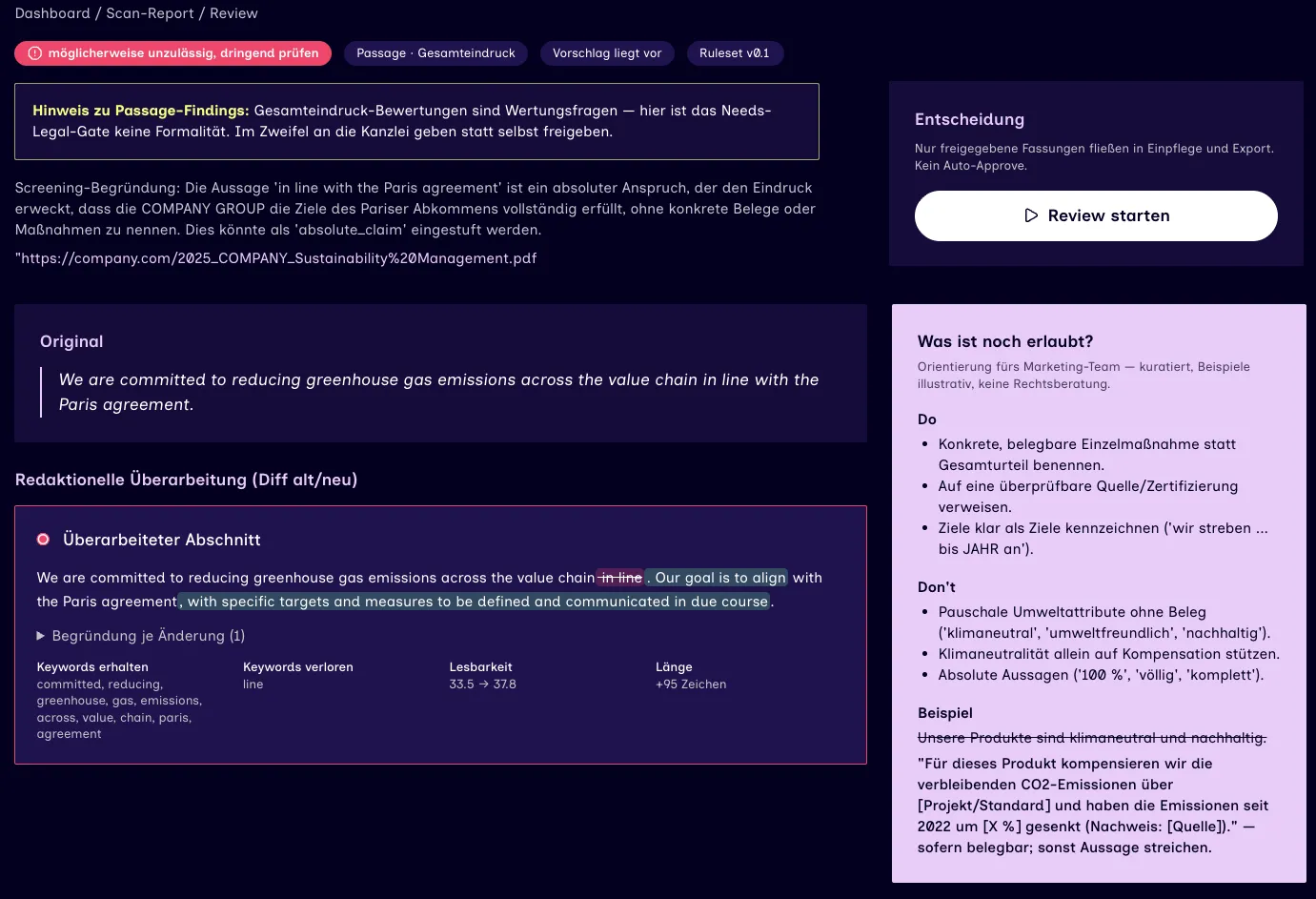
For these steps, we use our own screening tool with our clients (see example screenshot above). It captures the entire presence across all pages, meta data, linked documents and image elements, classifies each finding according to the EmpCo case groups, and works with a client-specific rule set that takes into account, for example, approved wording and your own terminology. We deliver the results as a prioritised work list in the format used by your legal department, or directly into the CMS.
Frequently asked questions about the EmpCo policy
When does the EmpCo directive apply in Germany?
From 27 September 2026, implemented via the Third UWG Amendment Act. There's no transition period for existing content.
Am I still allowed to advertise as "climate-neutral"?
Only if the claim isn't based on compensation alone. Substantiated statements on actual emission reductions within one's own operations or supply chain are permitted.
Does the directive also affect B2B companies?
The tightened prohibitions target consumer communication. For B2B, the general prohibition on misleading practices under the UWG still applies, and competitors can issue warnings. Added to this is the reputational risk from public greenwashing accusations.
Is it enough to remove critical terms from the website?
Legally yes, commercially usually not. Many environmental terms are ranking keywords. It's more sensible to rephrase into concrete, substantiated statements that serve the same search intent.
Conclusion
The EmpCo Directive ends the era of vague green advertising promises, and the remaining time until the deadline is enough for a structured transition. The order is decisive: first record systematically, then reformulate by priority, then safeguard. Companies that also think about their visibility in the process turn the compliance obligation into a communication advantage.
This article is not legal advice. The legal assessment of individual statements is the responsibility of your legal department or a specialised law firm. We provide the technical screening, rewording and implementation.
Sources:
Your contact person
- Nico Hübner
Consultingsynaigy
Show phone numberShow email address