



#143 - NPS 84: how Flaconi builds the happiest customer experience in German e-commerce
In this episode of insights!, Joubin Rahimi meets Bastian Siebers, CEO of Flaconi - the number 1 in the digital premium beauty segment in Germany. Bastian brings 25 years of e-commerce experience, and transformed Flaconi into one of Germany's fastest-growing beauty leaders in three and a half years. In the conversation you'll learn why the classic USP idea is a lie, how an NPS of 84 is realistically achievable, what's behind the WE-Commerce concept and why the motto 'Day One' means everything for Flaconi in 2026.
 Joubin RahimiManaging Partner · synaigy
7 min read
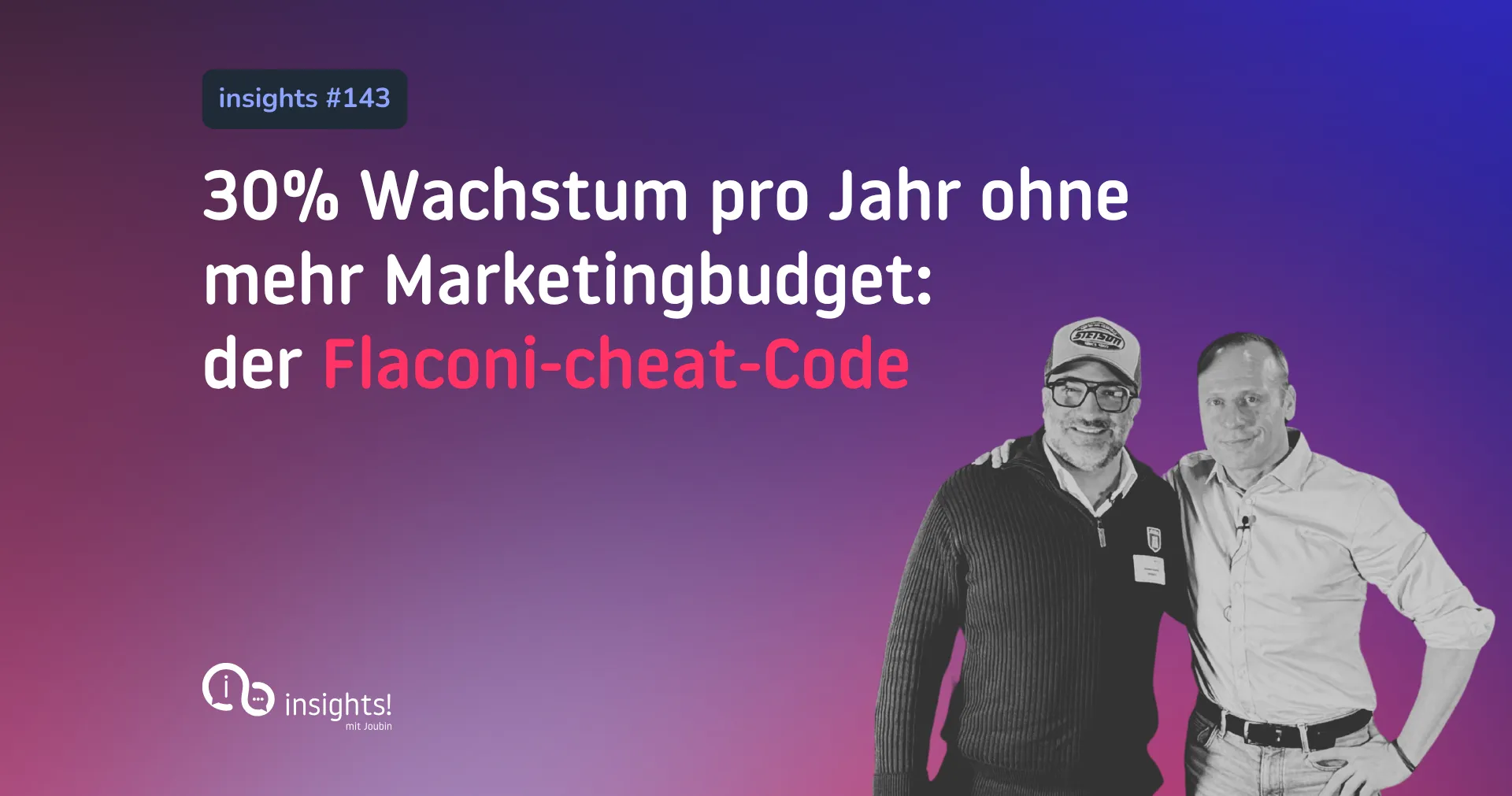
"I don't know, I've been in the industry for 25 years and everyone keeps saying the lie is being different – and I stand there thinking, they're not all there, are they. Being different isn't worth anything. Being different means putting one over on the customer somehow. What we say is, there are so-called fitness factors that really make the difference for the customer. And if you're really good at those, the customer sees it, and then the customer's satisfied afterwards – and if they're satisfied, they come back, and then you earn money from it too, because you don't have to do expensive new-customer marketing."
Value selling instead of USP: the lie keeping the industry alive
Bastian has been in e-commerce for 25 years. He has seen corporate structures from the inside, has led several companies and knows the industry's mantras inside out. One of them never convinced him, namely the idea that you need to "stand out" from the competition, be "unique" or develop a "distinctive positioning". "No customer searches for a different retailer," he says. "The customer searches for the better offer."
At Flaconi the counter-model is called the "Value Selling Proposition". Be better at the things that really make the difference for the customer, such as range, pricing, technology, service. Bastian calls these areas "fitness factors". And fitness, his argument goes, is something the customer sees. Satisfied customers come back. And those who come back don't need to be won over again at great expense. Not a groundbreaking insight, but Flaconi lives it more consistently than almost anyone else.
Double the revenue. Same budget. How does that actually work?
The numbers Bastian mentions in the conversation are remarkable. Flaconi has doubled its revenue over the past three years. 30 percent growth per year, while the rest of e-commerce has barely grown since 2022. And all of this with the same marketing budget that was already available three and a half years ago. How does that work? The answer lies at the core of his philosophy. Retention is the lever. Those who retain customers need less budget to grow. Those who delight customers get referrals, and for free. And those who invest in a better customer experience instead of ever more expensive performance marketing build something that pays off in the long run. 40 percent of Flaconi's total revenue now comes via its own app. The key growth drivers at Flaconi at a glance: - Consistent focus on NPS as the master metric across the entire company - Retention strategy instead of new-customer marketing as the primary growth lever - Mobile first: Beauty in your pocket instead of Beauty in a Store - AI-powered customer service for scaling without loss of quality - Long-term partnerships with brands instead of short-term price wars
NPS 84: The number that changes everything
Anyone into Net Promoter Score knows: 50 count as good. 60 as gold standard. 70 as platinum. 80 hardly anyone see in own practice. Flaconi run NPS of 84 on average, 86 in February. Bastian Siebers call this figure his "master metric".
This means that more than 84 percent of Flaconi customers would actively recommend the company. This figure is the result of an organisation that works every day to get better for the customer. And it explains why Flaconi doesn't need expensive new-customer marketing. Satisfied customers take care of that.
WE Commerce and Gerda AI: when humanity and technology aren't a contradiction
Flaconi doesn't talk about e-commerce, but about WE Commerce. The interplay between customers, employees and partners is at the heart of the entire strategy. It sounds like one of those nice-sounding framework terms from a strategy slide, but Bastian fills it with substance. One example: their own AI, Gerda. The name was deliberately chosen to be low-key. Gerda answers the "boring" questions in customer service automatically: Where's my parcel? When's my delivery arriving? Today, Gerda handles 20 to 25 percent of all enquiries - fully automated, friendly and fast. What makes the difference is what happens with the resources this frees up. Flaconi doesn't invest them in cost-cutting, but in more humanity where customers need genuine human contact. That's the logic behind WE Commerce, because technology creates space for what really matters.
Day three instead of a hundred days: courage as leadership strategy
When Bastian joined Flaconi as CEO three and a half years ago, he'd planned to spend 100 days analysing before acting. After two days he was done. On the third day he called the entire workforce together and gave a brutally honest stocktake. Just clarity. That was the Ruhr region speaking through him - direct, unfiltered, honest. For the Berlin-based Flaconi employees, that was unfamiliar at first. But Bastian is convinced that in every transformation, in every digitalisation, speed and honesty are decisive. Those who wait too long waste time and trust. His advice for anyone facing similar situations: - Be fast. Analysis is good, but paralysis is worse than a mistake. - Be honest with your employees. Everyone should know where they stand. - Accept that not everyone will come along - and that's fine. - Build on those who stay and want to pull together. His role model for the opposite? Karstadt Quelle. 120,000 employees, great concepts, huge ranges, and yet failed spectacularly. "They didn't get the horsepower onto the road," says Bastian. "Because they lacked courage and speed."
Day One: the biggest fear of a successful CEO
Three and a half years of success, doubled revenue, record NPS scores. You might think Bastian Siebers would now sit back and relax. The opposite is true. Flaconi's motto for 2026 is: "Day One".
Whoever think of Amazon, right – philosophy related. But Bastian give it own note. Day One at Flaconi mean: hunger. Curiosity. Readiness to question everything that yesterday still counted as success recipe. His biggest fear not competition, not market situation, not next economic downturn. His biggest fear that his employees start take success for granted. "Then I come round corner, pull your ear and say: nothing self-evident."
He also links this attitude to AI. For him, seizing the opportunities of artificial intelligence quickly is just as much part of the day-one mentality as the hunger for the next growth step. Those who wait lose. Those who act win – or learn. Both are fine.
What you can take from this episode
The conversation with Bastian Siebers is invitation to rethink. Not for everyone, but for anyone who honestly asks whether their company is truly better than the competition or just different. Key takeaways at a glance:
Forget USP. Ask yourself: in which fitness factors are you truly better than the competition?
Measure your NPS. Not once a year, but as a master metric that drives daily action.
Invest in retention, not new customer acquisition. Satisfied customers are the cheapest marketing channel.
Use AI to create space for humanity - not to cut costs.
Act quickly. Analysis is important, but paralysis costs more than any mistake.
Keep the „Day One“ hunger - even when you're successful. Especially then.
Give and take: why ownership is the decisive leadership principle
Another point that keeps coming through in this conversation: how do you hand over responsibility without giving up your standards? Tim describes an approach that many leaders talk about but rarely live consistently. Give freedom, enable development, let employees discover things themselves. At the same time, clearly demand that everyone carries their part. Not pushing it away. Not delegating just to offload yourself. But creating genuine ownership.
That sounds like common sense. And yet in many digital organisations it's the real bottleneck. Not the budget, not the technology, but the question of whether someone truly stands behind something. Whoever solves that has the decisive advantage in digital competition. Tim Wiese shows what that looks like when it's lived out.
Would you like to listen to the full episode?
Find the podcast of the interview here:
Please accept the corresponding cookies to view this embedded content.
Prefer to watch the episode? No problem!
You'll find a recording of the interview here:
Please accept functional cookies to watch this video.
Prefer to read?
Joubin Rahimi
Great to have you back for a new episode of insights! My name is Joubin Rahimi, and today we're at the ECC Forum in the SANAA building, joined by Bastian Siebers, managing director of Flaconi. I'm really pleased that we can spend some time together today and have a chat.
Bastian Siebers
I'm very pleased too.
Joubin Rahimi
Could you say a couple of sentences about yourself? You're certainly known in this community too, but there might be some who haven't heard you speak yet.
Bastian Siebers
Okay, so the short version. Bastian, 50 years old, married, two children, I've been in e-commerce for over 25 years. That means I did my last internship in 2001 at Quelle in the new advertising channels department. That was the internet, and it never let go of me since. 7 years at the Karstadt Quelle group, 14 years doing e-commerce at Tengelmann Venture Commerce. I think I took on my first CEO position at 33, and after that I could never, I'd say, settle for a number two spot again. From then on I basically only wanted a number one position. For three and a half years now, I've had the great honour of running Flaconi in Berlin. Great company in beauty, and it's a lot of fun.
Joubin Rahimi
I saw you for the first time when I was in the audience, you were also at a similar event to this one. That was a Garten Company thing.
Bastian Siebers
Garten XXL.
Joubin Rahimi
And I can still say exactly what you said. Namely, the new experience you have on the internet is tomorrow's standard.
Bastian Siebers
That's right.
Joubin Rahimi
You probably phrased it much more eloquently, but that's a great sentence, I heard it from you for the very first time there. Yes, that's how it is.
Bastian Siebers
And I still see it exactly the same way. That means, when we look at performance, particularly now at Flaconi, that's our mindset. We say we have to be the best at what we do. And that means, incidentally: be better than the competition, be it for the customer's benefit, and indeed your performance is in turn the bar you have to clear again next time. That's exactly what I felt back then at Garten XXL. And I still feel it exactly the same way today. So this competitive factor, this not standing still, getting better – if there's anything that drives me, it's exactly that.
Joubin Rahimi
And who are the competitors? Douglas Parfümerie Pieper or entirely different ones?
Bastian Siebers
It's exactly as you describe, to put it again, we're the number 1 in the digital beauty premium segment. That means, I'd say, we start where a drugstore actually ends, so Rossmann, Amazon and also somehow a DM, they do great business, there you can buy shampoo, there you can buy a cheap perfume somehow. And then somehow a Jil Thunder is roughly where it ends, and we start where Jil Thunder, so to speak, stops. That means we go right to the top towards Dior, Chanel, the really expensive brands, and right into the niche, as we call it. And accordingly we're in competition with Douglas, with a Pipier. There are international competitors, there's Notino, a big provider in Czechia, there's Lyko, a big provider in Sweden or in the Nordics. We're somehow in competition with, I'd say, partners again like Sephora, who are very strong in France. So at the end of the day, you name it. We ultimately have to be better for the benefit of the customer. Otherwise there's no reason to shop with us.
Joubin Rahimi
Just to understand once more. You're also in this luxury segment above that, where, I don't know, Diptyque, Safran, whatever the brands are called, that aren't actually available at Douglas anymore.
Bastian Siebers
So there too, I'd say, a lot of things also exist at Douglas. I believe there's still Niche Beauty, which is more or less a subsidiary of Douglas, that has really positioned itself specifically in this niche area. And everything they have, we offer too. That is, our ambition is to always make a superior offer, both in range, in pricing and in technology. So we call this value selling proposition, not USP, not be different from the rest of the world, but simply be better, because that's what actually interests a customer. No customer searches for a different retailer, the customer searches for the better offer.
Joubin Rahimi
And how much USP can you really have in your and my industry anyway? I think you have to be better there.
Bastian Siebers
Yes, but imagine that, I don't know, been in industry for 25 years and everyone tells themselves the lie is different, and I stand there thinking they're not quite right in head. Being different isn't worth anything at all. Being different means pulling wool over customer's eyes somehow. What we say is, there are so-called fitness factors that really make difference for customer. And if you're really good there, customer sees it, and then customer is satisfied afterwards, and if satisfied, comes back, and then you earn money with it too, because you don't need expensive new-customer marketing. Retention, that's lever that makes us successful.
Joubin Rahimi
And at the start you said, okay, you have a benchmark with the team, you as a company, and year on year you raise it a little, always going above. Where did you find the benchmark at the start, and was that culture already there? Could you build on it, or was that the first task?
Bastian Siebers
It was my expectation. The company had existed for eleven years at that point, it had made over 300 million euros in revenue and it was a name like thunder. That is, my feeling was, I'm now taking over Hertha BSC, they're not so successful right now, but they can play football, they're in good shape, they're fit and well-trained, and that was somehow my idea. And then I came to Berlin and actually found people who were really good at beauty, but who weren't actually competitive in e-commerce. And that was a huge surprise for me. That is, my thought was, viewed from outside, they must actually be much better, otherwise they couldn't have got this far. But I found they'd got this far with great beauty expertise alone. And if you now combine that with my ambition, my competitiveness and also the experience I bring from e-commerce from many years, then that's probably somehow, I'd say a topic. I have a colleague, we started at the same time, and my colleague comes from Sephora, so very much from beauty, and I came from the Ruhr area, from the topic of execution strength. And at the start we then said, the Beauty and the Beast together,
Joubin Rahimi
You weren't the beauty
Bastian Siebers
I was the beast and I am.
Joubin Rahimi
Okay, but the Ruhr area also has much clearer and more direct language than Berlin. That's how I'm picking it up. What was it like, culturally did they say, finally someone's saying it straight out, or how did you deal with that?
Bastian Siebers
I don't think people were used to that much clarity. And accordingly it was hard at the beginning. But I decided very early on, honestly after three days, or actually at the beginning of the third day, at 4 in the morning, I decided to drop the nice approach and simply do a completely unvarnished stocktake for all employees. And I think that was hard for everyone, including me, because it also represented a risk. But I think it was very healing for everyone. I think everyone knew where they stood. Everyone knew from the start whether they believed me or not, or said what Bastian says is right, but they knew exactly, I don't hold back. That would also be my recommendation in every transformation, every digitalisation. There's no point doing it slowly. Be fast, be bold, fall flat on your face sometimes, mistakes can happen, but be very honest and very open towards all colleagues. Then everyone can decide for themselves whether they want to be part of it or leave. There were also a few people who didn't fit. There were a few people who left, but honestly, there weren't many. I'd say 95 percent of the company are the same people they were before. We just work together very differently now. It's like a football team that now plays a very high press, that goes hard on the man in possession, that really maintains a completely different game, or a completely different business, by now. And that was a good and necessary address.
Joubin Rahimi
Okay, that was on day three. You said you wanted to look at 100 days or so, the old Bastian and the new one.
Bastian Siebers
I'd planned it, and I'd also agreed this with the shareholders, 100 days of analysis and then implementation. But after two days I really realised I'd analysed enough. That is, it was clear to me that the actual problem was how people worked together, and accepting another 98 days of that dynamic being wrong was not something I could do. I was the wrong person for that, so I chose action and change instead. Who knows, maybe I just needed a reason to fall back into my old habits, I'd say. But I was 100 percent certain it was the right thing to do. And in the end, looking back three and a half years later,
Joubin Rahimi
The story not quite so bad.
Bastian Siebers
It was right, it was right.
Joubin Rahimi
Culture is changing. And I think culture is changing again right now in some areas. AI is changing the way we work. I see a huge amount on LinkedIn, where you're with the team, you celebrate together. Work hard, party hard, yes, that's part of it and great. That's just my perception, without us having talked about it. Now the topic of AI, how do you deal with it? I mean using it yourself in particular. I'm not concerned with the next feature or whatever, but the ways of working are changing.
Bastian Siebers
Yes, but I'd like to disagree. I believe culture doesn't change. If you have the culture, you have what I'd call the foundation to embrace technology, tools, changes in the market, pick them up and perhaps be among the first to actually turn them into better performance for the customer in the right way. And better performance can mean offering the customer something they didn't have before, or for example a point that used to cost me money but which I no longer have afterwards thanks to automation. And in turn I can offer the customer, for whom it's absolutely essential, more humanity again. That means I actually need to understand where the customer needs human contact, where that costs me money, what I can actually do to make it better. And how do I build an organisation that does exactly that, namely an organisation that learns. An organisation that wants to change, an organisation that wants to understand a customer. And that was honestly exactly what was somewhat missing at the time. I think there was an organisation that was very beauty-centred. That is, the story told was, we're the best in beauty and that was all very good. But honestly that's not enough if you want to be a beauty e-commerce company, then you also need to be the best in beauty and in e-commerce. And what we added on top, we also wrote this into the mission at the time, we put together and said, we need to be the best in beauty expertise on the topic of e-commerce competence. And we added the topic of customer centricity on top. That means for us it was absolutely crucial that we deliver this added value for the customer, and we live that every day. And I think, let's take AI again. Tools are coming now, topics are emerging that simply mean the market, the customers, are developing even faster. And what you have to look at is whether we're able to react to that faster than the competition. And I told you about my competitors and honestly, yes, we're so much faster. So why are we so much more successful? Because we react so much faster for the benefit of the customer and keep producing new customer value. We've doubled revenue in three years, that means while the rest of e-commerce has more or less stagnated, since 2022 we've averaged 30 percent growth every year and earned more money every year. So there are other examples where everyone invests in marketing. My marketing budget is still the same size as three and a half years ago. That means I'm now doing double the revenue with the same marketing budget, the same team, and guess what.
Joubin Rahimi
Exciting point, using AI to create more time so you can be better for the customer. What do you do? Well, we have lots of customers who say, I want to use AI above all to answer customer enquiries automatically, faster, maybe even at a better quality. Now you're in the beauty sector, do you want to do that too, or is it more that people really go into direct communication?
Bastian Siebers
Well, maybe starting from the front again. We have a concept, we call it WE Commerce, not e-commerce, but the WE, the togetherness, that's what decides it, or that's actually what makes the difference. And within our WeCommerce concept we have three stakeholder groups. One is the customers. Topic customer orientation. Everyone claims it, everyone still gets it wrong, we do it best. The next is centring on the Flaconis, meaning the employees. Meaning, these are people, it's about long-term relationships with one another. When you get to know each other better, we respond and work much, much better. And the third is the partners, meaning the brands or also our technology partners and everyone else. So that means this long-term relationship and long-term optimisation. That's the first thing to mention. And let me pick out an example. The topic of customer service is the simplest example. We use an in-house developed AI. Essentially it's called Gerda AI. By the way, we said back then, let's find some kind of boring German name that in a way best reflects who can possibly, in inverted commas, answer these kind of boring questions in inverted commas. Where's my parcel? You don't need a human for that, what you need as a customer is you want a very quick answer to your question and you just need to look in the database, need to have the right data actually available somewhere and you get an automated, very friendly answer. Here's the tracking link, there's the thing, your parcel will probably be with you tomorrow and the customer is very happy. We currently handle 20 to 25 percent of all enquiries we receive automatically with Gerda. That means 75 percent are still handled manually. But what we can do is that these 25 percent we now have free, we can use again. So there are two options. Either we say invest in a better customer experience or we say in costs. What we did is we invested in customer experience and are significantly increasing NPS there. That means for us customer satisfaction. Honestly the master metric across the whole company, Net Promoter Score, you can guess how high ours is.
Joubin Rahimi
8, 5,
Bastian Siebers
So what's the highest number you've ever seen in the company?
Joubin Rahimi
Everything with 8 is already mega cool.
Bastian Siebers
I don't think there's anyone with 8 that I really know. I've been dealing with this whole topic for over ten years, and earlier for me it was always Garten XXL and so on. 50 you're already doing well, meaning more than 50 percent of people would recommend you. Mega. 60 percent gold standard, 70 percent platinum, 80 percent never seen. And now here it comes, we average 84 and in February we had 86. So customers are super, super, super satisfied, and that's why they come back.
Joubin Rahimi
Okay, you're doing something fundamentally different from many others too,
Bastian Siebers
That come at a cost. Absolutely.
Joubin Rahimi
That's definitely exciting, even in today's climate, because everyone says cut costs, cut costs,
Bastian Siebers
I believe they actually don't think about the day after tomorrow. So while we say retention is the lever and retention is predicted very strongly by, let's say, NPS or satisfaction. And the higher your satisfaction, the higher the probability that you won't go somewhere else. You automatically come back to me, you use my app. 40 per cent of our revenue comes through the app. So it's an investment in customer satisfaction and, honestly, that pays off for us in the long run and we think long-term about that.
Joubin Rahimi
What I also found exciting, you said, I need customers. Customer centricity, relationships between people, so long-term relationships, also with partners, that's all always about trust. You're actually building trust everywhere.
Bastian Siebers
We have a value in the company, maybe let's go through the company values quickly, so we always start with. Customer Centric, first value, then Living Data, meaning only decide with the right data, then we move towards Embrace Change, meaning again change isn't something bad, always a bit better than the day before. That's our DNA. Then my favourite value, Build fast to last, meaning ultimately, get into execution but build something that has long-term success. And then last but not least, Trust in people. Trust in people means, again, we're talking about people here and honestly, that's a flywheel that keeps accelerating and getting bigger, because the longer we know each other, the better we actually know each other both privately and professionally, what your strengths are, maybe also what your weaknesses are, the faster and the better we actually work together, and that's why we say very, very clearly, this long term thing is actually the great power that everyone underestimates, and that's why short-term optimisation to earn the next million, others can have long-term success. That's us
Joubin Rahimi
Speed through trust, you know that book, right?
Bastian Siebers
Absolutely, that's right. So it's worth reading, the book, that's my recommendation too. So three and a half years ago, we didn't yet have this whole e-commerce concept, there wasn't even a worked-out strategy yet. Back then there was a slide that said on day three: courage and speed. And that's actually still, ultimately, topic number one even now. Over the years, we've actually always had a tagline for each year. And I can tell you again, maybe. Back then we had a fitness phase, that was the first three months. Focus on what really makes the difference for the customer. Be the best at that. Step one. After that we expanded our strategy. Beauty in your pocket. That's simply a mobile-first strategy. Bring people to the shop, ideally turn them into app customers in connection with social media. Brilliant topic. Beauty in your pocket. Sort of the counterpart to beauty in a store. There, we're beauty in a pocket. Then we created the we-commerce concept. The whole long-term theme, the togetherness, we'd already been doing all of that before, but we put it into words. Corporate values. Then we said 2025 was next level. That means we took everything we'd implemented and brought it to a new theme again, and now you can guess what this year's tagline is. Any idea?
Joubin Rahimi
AI for the customer.
Bastian Siebers
True. Could have taken that. What we took is Day One. We actually went through it once again and said, okay, now I want to feel that hunger, that curiosity, I'd say really feel like the first day again, because as I said, at some point you get complacent yourself and end up in a situation where you say, okay, it's somehow a given that we always win. And that's my biggest fear, that people really take things for granted. That's where I come round the corner, tug your ear and tell you, nothing is a given, we need to be like Day One again. And that also means, by the way, that we recognise and seize the opportunities of AI and artificial intelligence for ourselves very, very quickly, and don't say okay, no idea, others can do that, but rather this mindset – that's what makes the difference.
Joubin Rahimi
One more question, when you say courage and speed were the motto. When I talk to other business leaders, some say, but professionalism, quality, speed isn't professional. That's not you, I know that.
Bastian Siebers
I would strongly disagree.
Joubin Rahimi
What would you say?
Bastian Siebers
My experience is 7 years at the Karstadt Quelle group. It was a prime example of the things you just described. Great people, brilliant concepts, huge ranges, I don't know, 120,000 employees who could actually have done anything. But they didn't. They didn't get it onto the road. Why? Because they lacked courage and speed. So of course you make mistakes with courage and speed, but it's relatively simple. There's this idea that either we win or we learn, or as I like to say, falling flat on your face is still forward motion. So make that your friend and then it's really something you can be very successful with. Does that work everywhere? I don't think so. I think you really have to find out whether that's the right path for you, and you also have to check whether your team is capable of operating with courage and speed. I know many companies that I think it would tear apart. Honestly though, it would probably do them good to be torn apart a bit. Exactly. And possibly not even a transformation, but a disruption. We know that old phrase of creative destruction after Schumpeter, so I'm a big fan of that.
Joubin Rahimi
Makes sense, and after Darwin you'd say be agile, change yourself. It's not the strongest that's quick. Yes, but it's the change.
Bastian Siebers
Exactly. Size and strength are worth less and less in our world. It's about adaptability and it's about speed, and that's ultimately the new currency that really matters.
Joubin Rahimi
And I'd say that's a great close with courage and speed and the new currency, adoption. Thank you.
Have questions or feedback?
Then feel free to contact us directly.
- Joubin Rahimi
Managing Partnersynaigy
Show phone numberShow mobile numberShow email address
Subscribe to the blog now and never miss any news
✔️free of charge ✔️weekly news ✔️expert knowledge
Please accept the corresponding cookies to view this embedded content.