



insights! episode #12: brand experience and strategy
 Joubin RahimiManaging Partner · synaigy
2 min read
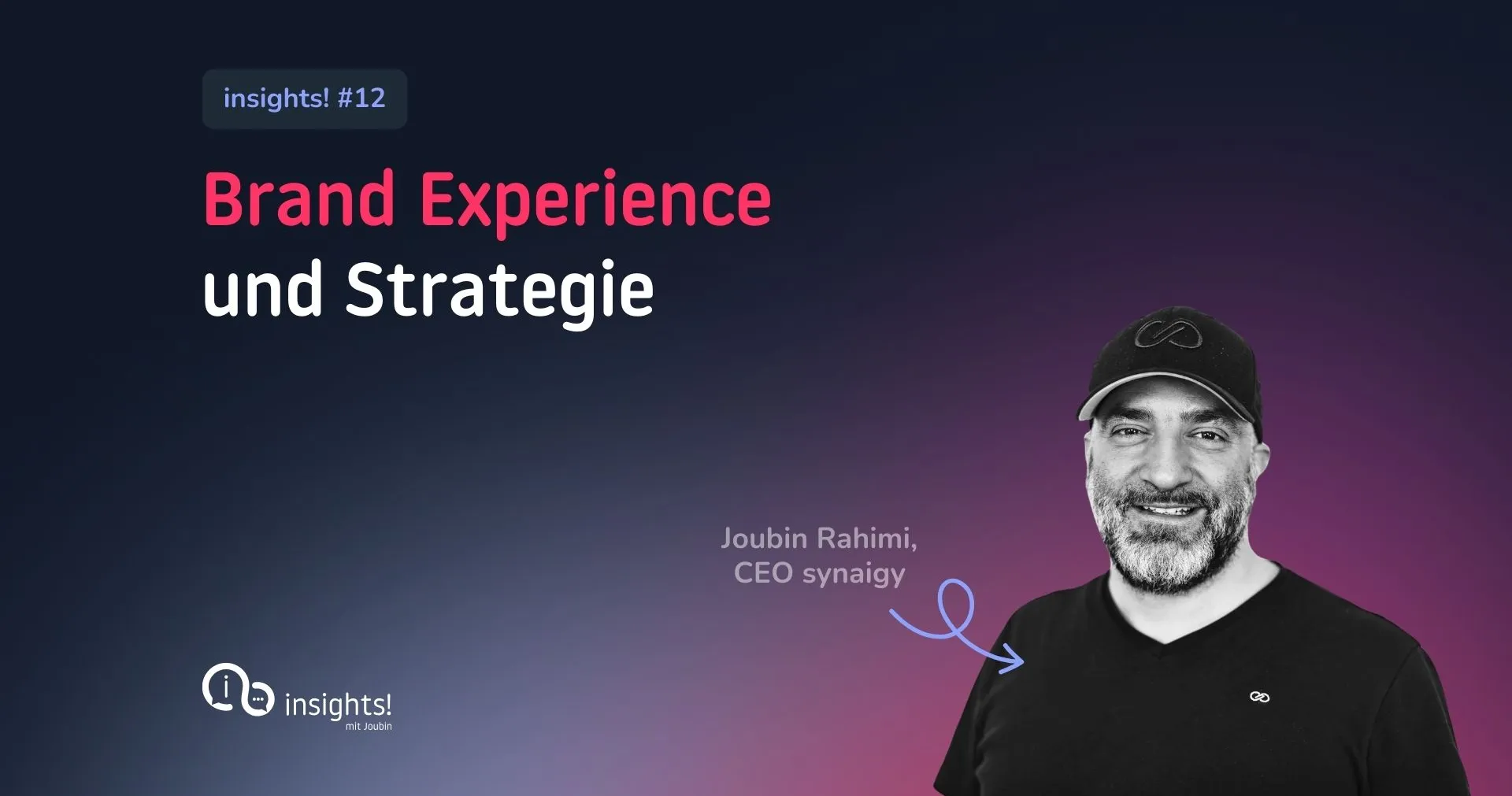
The longer you wait with D2C, the greater the dependency on retailers.
Direct-to-Consumer: The direct path to customer loyalty
Companies wanting to sell goods online quickly feel drawn to marketplaces like Amazon. That's the easy route, but it doesn't get you direct access to the end customer.
The overarching goal should rather be to draw the customer into a holistic customer experience. It's logical that as a brand you say, I now want to approach the customer myself, rather than leaving margins with the retailer. D2C, meaning direct-to-consumer, is by no means new anymore; in the US alone, revenue in this segment rose from seven to 21 billion dollars between 2017 and 2021. The key to success lies in a cleverly thought-through customer experience. Success stories such as Apple's or Lego's are often accompanied by completely different concepts. Apple's core idea was and is to position the customer experience at the level of the world's best hotels. Consequently, the be-all and end-all for the Californians is the Net Promoter Score, NPS for short, which leading hotels also use to measure customer satisfaction. At Lego, on the other hand, alongside a well-thought-out customer experience, the idea of service in particular stands out as a special feature. I advise companies to get into the topic of D2C as quickly as possible when developing a brand experience. The longer you wait with this step, the greater your dependency on retailers will become. The question now is how the leap into freedom can be managed.
There's no one-size-fits-all solution. Some try targeted marketing campaigns, others go the route of newly created luxury segments available only in their own web shop, and others again go the route of building a new brand.
Therefore: strengthens the own webshop. If this doesn't yet exist, brands need to prepare for a lot of work and relatively high investment. This means you need to take care of various disciplines, from digital marketing, through SEO and technical implementation, right through to the overall customer process including payment systems, delivery and warranty.
This is a long and sometimes rocky road to new shores, but it's a successful path, as the figures show.
Would you like to listen to the full episode?
Find the podcast here:
Please accept the corresponding cookies to view this embedded content.
Prefer to watch the episode?
No problem!
Here's a recording:
Please accept functional cookies to watch this video.
Prefer to read?
Brands are in a difficult situation.
Retailers are using their position with customers more and more intensively.
Data is collected and the customer experience can be shaped. Brands don't have these options so easily. Retailers are now increasingly moving in with their own brands, creating them and are able to position them really well. And often they also have the higher margins in the process. On the other hand, these retailers often have very great bargaining power, so that, as in the past, small trade wars keep breaking out. On the other hand, the brand that's been created is worth a great deal. The logical consequence is that, as a brand, you say, I now want to benefit myself from going directly to the customer. That's D2C, direct-to-consumer. Entering that space isn't a new trend, it's one that has, in effect, already gained momentum. In the US, in e-commerce, there was growth of around 14 billion dollars between 2017 and 2021, from 7 billion dollars in revenue to 21 billion dollars in e-commerce revenue from D2C products. That's not much in itself if you look at the overall market, but it does already show a very clear trend. E-commerce is often the first step, but doesn't have to be. Let's look at some D2C examples: one of the oldest is Adidas. Adidas sells directly online, but has also built up a lot of stores and retail capacity. If you look at the flagship stores, for example in New York, you experience the whole Adidas experience, compared with other retailers who also sell Adidas.
But also where new products are trialled or simply B-stock is sold, all the outlet stores. Adidas has been doing that for many years and has strongly verticalised there.
Another good example is Apple. Apple is actually a computer manufacturer that plays the entire verticalisation chain ever harder. And the move into retail or direct sales was guided by a core idea: Apple wants customer experience to be as good as the best hotels in the world. And so they introduced the Net Promoter Score, which measures how satisfied customers are and how willing they are to recommend the company.
The KPIs typically important to retailers in a store are revenue per square metre, staff count per square metre, staff count per revenue – those aren't Apple's KPIs, that's the Net Promoter Score.
Why is that possible?
Apple, of course, also has the entire value chain and, based on this gigantic margin, other possibilities than a classic retailer. That's why a retailer also tries to bring its own products to market.
Lego is also a great example, often not mentioned in this context. But Lego has built an entire customer experience. For Lego, it's not just about convincing a person of a product at a given moment. Rather, Lego is an experience, from toddlers aged two or three right through to adults. And that's what's special and great about Lego, that they think through this entire customer experience. How can I accompany boys and girls with different interests across this whole chain? Lego doesn't just do this in flagship stores in New York, Cologne or other cities, but also through the apps the company has developed, and direct sales over the internet. It's really the service mindset that Lego pushes much more strongly, alongside the ability to sell.
But what are the most important steps for you as a brand?
A) Is it the direct sale?
B) Is it the cannibalisation topic, and how do I handle the retailer and their resistance?
C) What about the supply chain and logistics?
Let's start with logistics. Logistics basically consist of three, four points: I must dispatch, I must hold stock, I have returns management, I must handle whole thing, pick & pack and co. All these topics important and hygiene factors towards customer. You want receive quick, you have Amazon mindset: I order today, get it tomorrow, latest day after. All these topics should be kept too. Good thing is, you not really need worry about it yourself.
That's something logistics providers can handle very well, like DHL and co., who take care of it all for you. The second point, and this is far more important, is to think through this cannibalisation. It's fairly difficult, but that's exactly why you should get into it. Naturally, retailers have no interest in you selling directly to the customer. But the longer you wait to take these steps into D2C, the greater your dependency on their customers becomes. So the first important point: get to grips with it!
How exactly do you get there today?
There isn't one solution for everyone, it's always very specific. One approach is a marketing campaign – I sell directly but in return strengthen the retailer through promotions, for example. The second approach is to create special luxury segments, such as Christian Dior, which offers utterly exclusive perfumes, either only under the CD label in their own online store, or exclusively for certain retailers, saying these fantastic rare fragrances are only sold at Lafayette in Paris and in a different shop in New York.
The third part is something you can pick up quite well from the P&Gs, they simply built the brand-building process just for direct-to-customer. Whether you don't take the same product and sell it through that channel, but even build your own brand on top. The build-up is complex and it's well known that it's not just a bit of marketing activity. That's why we won't go deeper into it here.
Sales, that's the point that matters. How do you actually get your goods to the user?
How do you get the attraction on it? I have already talked about physical stores versus internet stores, and using Lego and Apple as examples you can derive very well what works and what does not work. And Lego is a very nice example, because it is not just about selling, it is actually also a marketing instrument. But not everyone has as much money as Lego, with such a great patent on it, so one of our quickest tips is: it is about what scales, and that is currently digital. And since your brand is already known, do not necessarily look at a marketplace.
You can feed the marketplace too, but it doesn't give you direct contact with the customer. So strengthen your own webshop if you already have one. If you want to build one, you need to take care of several disciplines – digital marketing is important, SEO/SEA is important, the technology for implementation, UX & design so it's appealing. You need to integrate with an ERP system so you can handle all payment processing smoothly and without manual processes. And ultimately, you also need to address the overall customer journey: How does the customer get to your website? How do you excite them? How do they use the product? The experience doesn't end after the purchase either. Are there further processes downstream? Returns processes, warranty processes, which you can present very well, because customers expect you, as a brand, to be perfectly set up for that too.
You've already worked through the strategy, the brand and the product, now it's essential to look after the holistic customer experience of your end customer. That's the core. And yes, it makes sense to look into this with a properly sound business plan, in which you've already set the cornerstones, the guardrails, and on the other side backed the whole thing with a budget that's big enough to go down this path. It won't work overnight, it'll be a longer journey. It'll be a journey to new shores, and you have to take it. It's a successful path, as the figures show. And the details are ultimately essential, the icing on the cake.
So, grab, and that's one of the main tips, the real skills in the market, the real drivers that can move you forward. That's the only way you can build the team you need to really succeed.
Have fun with it!
Thanks for listening, have a great day or evening!
You can subscribe to this podcast via all common channels.
Erzähle auch deinen Kollegen und Freunden davon. Je größer die Community wird, desto mehr Inhalt und Diskussion können wir für dich transportieren und erstellen.
Have questions or feedback?
Then feel free to contact us directly.
- Joubin Rahimi
Managing Partnersynaigy
Show phone numberShow mobile numberShow email address

Subscribe to the blog now and never miss any news
✔️free of charge ✔️weekly news ✔️expert knowledge
Please accept the corresponding cookies to view this embedded content.