



insights! podcast episode #13: D2C - a clear trend
 Joubin RahimiManaging Partner · synaigy
2 min read
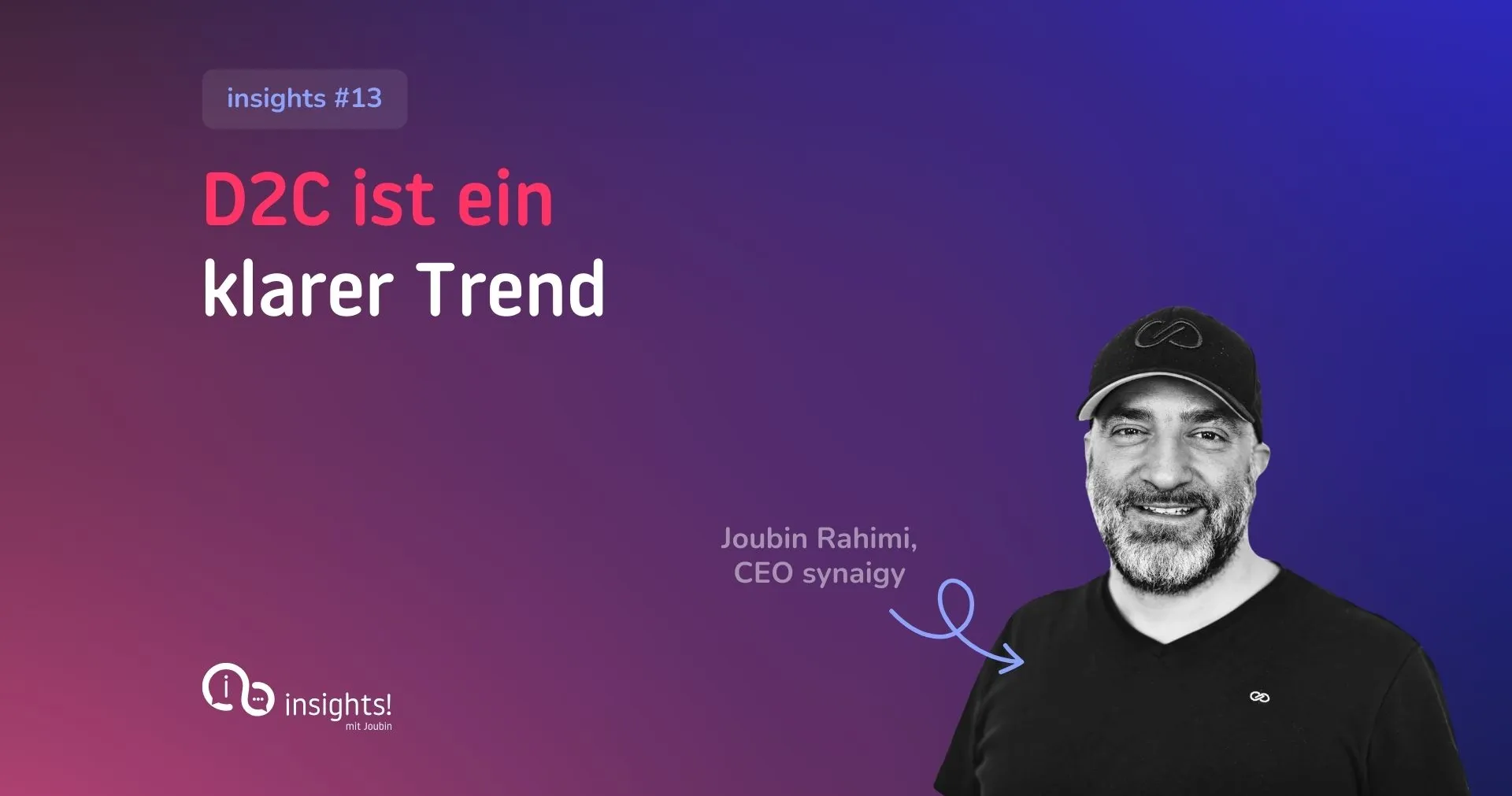
With Amazon and co. behind you, selling is relatively easy, but the holistic customer experience falls by the wayside. I therefore recommend the direct-to-customer route, D2C for short.
Building a brand doesn't happen with a few ad spots.
Companies wanting to sell goods online quickly feel drawn to marketplaces like Amazon. That's the easy route, but it doesn't get you direct access to the end customer.
Which manufacturer doesn't dream of selling directly to the end customer, without detours via intermediaries?
This not only increases margins, it also allows the overall customer experience to be shaped independently. Market studies show that consumers like to turn to private labels. Direct-to-consumer business, D2C for short, is expected to see steady growth over the coming years. However, entering or switching to D2C should be planned with foresight.
As a manufacturer, you have to become a brand, and above all you need the whole supply chain and logistics behind it. Building a brand in particular happens through countless small interactions. That can't be done with a few adverts. How should sales be handled? Via stores or via your own website? Stores offer a great physical experience but don't scale well. So is your own webshop better after all? If you're confident your product works, then yes. For anyone still in doubt, I'd recommend the detour via the marketplace.
That brings in a lot of traffic and you quickly see whether the product works.
Ultimately, the question also arises as to whether, as a manufacturer, you trust yourself to build the entire online process in-house, or whether you hand this step over to external service providers.
If you want to do it yourself, you need to understand topics such as digital marketing, web design or backend processes.
In any case, a sound business plan with sufficient budget should be set up. Furthermore, the right people need to be brought on board for the shift to D2C.
Would you like to listen to the full episode?
Listen in directly and find out more:
Please accept the corresponding cookies to view this embedded content.
Prefer to watch the episode? No problem!
Here's a recording:
Please accept functional cookies to watch this video.
Prefer to read?
Manufacturers are currently in a difficult situation.
Retailers are using their position with customers ever more intensively. What does that mean?
Data is collected and the customer experience can be shaped. The retailer is directly in touch with the customer. Manufacturers don't actually have this option.
On the other hand, retailers are increasingly entering the market with their own brands, which they create themselves. They can position these own brands more effectively. They come with higher margins, giving retailers a strong interest in pushing them. An IFH study shows that German consumers are happy to buy retailers' own-label brands.
In most product groups, in fact only a quarter or a fifth decide against private label products. In that respect, it becomes clear relatively quickly that manufacturers have this problem. On top of that, manufacturers can also become interchangeable increasingly quickly. With a simultaneously low number of customers, that is threatening for the company. So a logical consequence at present is to move into the direct-to-consumer business, D2C for short. That is not a new trend; the D2C market in America grew between 2017 and 2021 from seven billion dollars in e-commerce to 21 billion dollars.
These are still fairly small numbers for this huge market.
But this market will grow significantly, in these four years it has already tripled.
E-commerce is often the first step, but it doesn't have to be. There are several D2C examples from well-known brands, for instance Royal Canin, which offers products around pet food and now also services, or Procter & Gamble, which builds and pushes its own D2C brands.
But what are the most important steps for you?
On one hand, as a manufacturer you have to become a brand, you have to sell directly, and you need the supply chain and the logistics behind it. Let's start with the first part, which isn't easy but is the most logical, and can often be outsourced too: logistics. You have to be ready to handle the shipping and fulfilment of many small parcels to many customers. You have to stock the products accordingly, you have to have returns management under control, and ultimately deliver quickly and achieve transparency towards the customer. You can build this yourself, but you can also hand it off relatively easily via partners.
In the end, that's just a hygiene factor and it has to be done.
It has to be good, and it won't set you apart from others.
The second thing, and this is very, very difficult, is brand building, because as a manufacturer you're actually used to supplying a handful of companies, maybe ten. Building your brand in this environment is a completely different matter. Now you have to position your brand in the end-customer business and make it known there, and that doesn't work with a few ad spots.
Yes, they're helpful, but ultimately it comes down to a thousand small interactions.
The special thing here is the change within the company: KPIs that were previously perfectly clear are no longer valid now, certainly not for building marketing. Because it's something completely different, and it's precisely the management and owners of the company who have to rethink.
The investments aren't immediately visible in the market, even if you try to measure them. You need staying power, even if you're fast. Ultimately it usually fails because people don't have that staying power. The third point is sales, physical or via the internet, direct or via a marketplace, or via stores, i.e. in the shop. Those are many questions that come up at the start. But we can give a few cornerstones straight away: stores offer a totally physical experience. Stores are also good when accompanied by media, because it's something tangible. It's valuable, you can learn a lot from direct physical interaction too. But stores don't scale strongly. So stores aren't always the first step, often it's your own webshop or marketplace. You actually have to split that into two areas.
The marketplace brings a lot of traffic and you can quickly see whether these products work. Good point. But if you're confident your product is good, because you're already a manufacturer and know how things work, how the game is played, then look more towards your own shop instead.
Your own shop will push your brand far more strongly than marketplaces such as Amazon, eBay, Galaxus and co. If you want to build your own web shop, you need the following: digital marketing, SEO/SEA, performance optimisation for it. You need to master the technology, you need a web shop that can handle the entire fulfilment process. You need to understand and optimise UX design, you need integration and the back-end processes,
Perhaps you also need an ERP or a system to handle the many small invoices and returns. How do you handle payment? These are new processes for you too.
Ultimately, it's also the holistic customer process, you have to get to grips with that and get into it. Ultimately, we'd start with strategy, brand, product and a holistic customer experience. That has to be solid.
So, what do I offer? Who is my target audience? What is the product really? What is the product's added value?
Point is to achieve a holistic customer experience. Makes sense to engage with it. But a really important tip is to set up a sensible business plan backed by a large budget. Because especially this brand building will be intensive, will also take longer and will cost money. So point one, business plan, backed with plenty of budget. Point two, bring right people on board who can go along with this change in this area, because that's necessary. You'll have to lead this project, this area, differently. And third, you have to accompany this change among all employees of current business that brings you money, that brings you security, so that they also go along this new path together. You won't just run one track then, but several, and that has to be accompanied.
Great fun!
Thanks for listening, have a great day or evening! You can subscribe to this podcast on all common channels.
Erzähle auch deinen Kollegen und Freunden davon. Je größer die Community wird, desto mehr Inhalt und Diskussion können wir für Dich transportieren und erstellen
Have questions or feedback?
Then feel free to contact us directly.
- Joubin Rahimi
Managing Partnersynaigy
Show phone numberShow mobile numberShow email address

Subscribe to the blog now and never miss any news
✔️free of charge ✔️weekly news ✔️expert knowledge
Please accept the corresponding cookies to view this embedded content.