



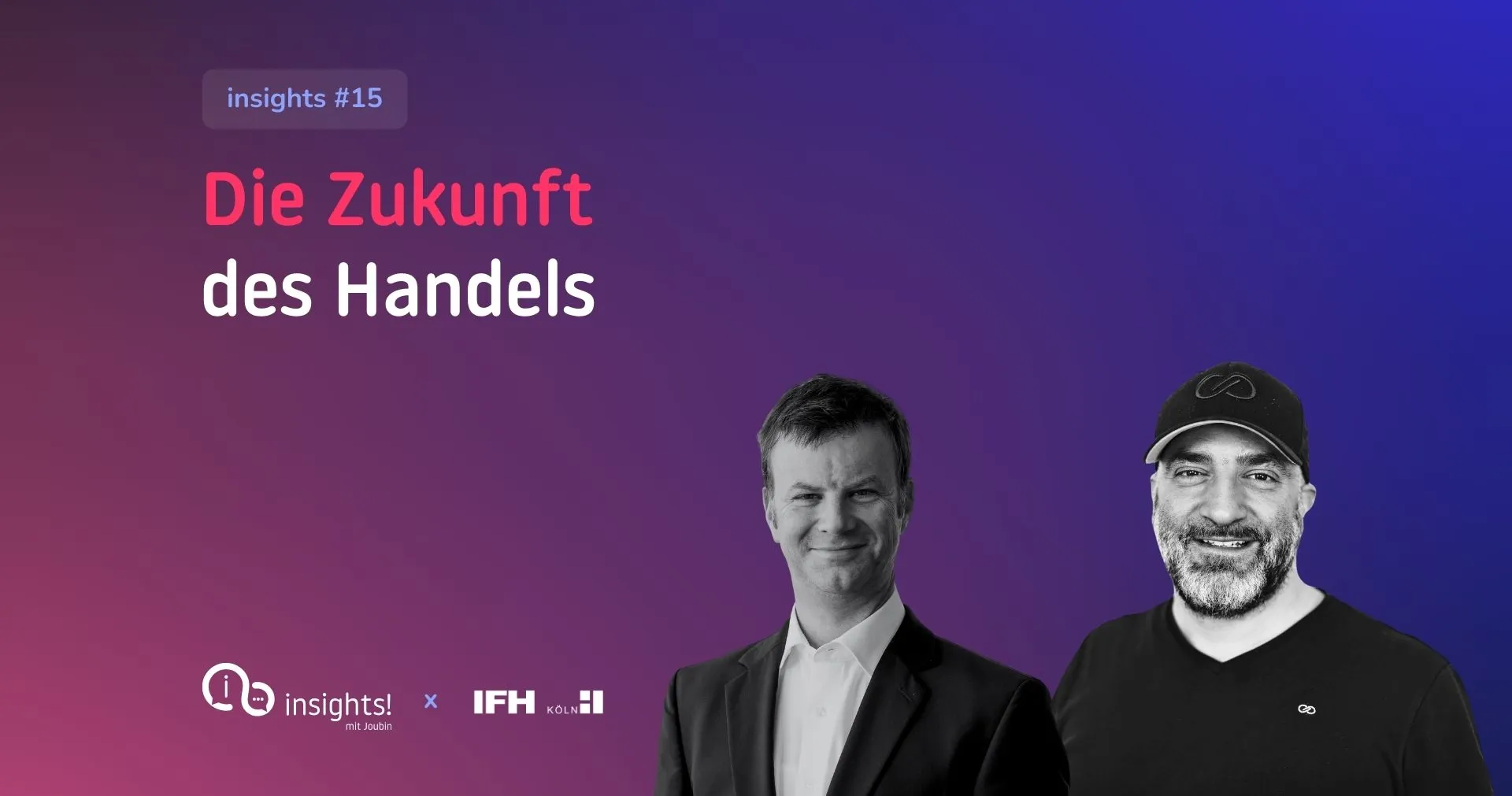
insights! episode #15: the future of retail – with Dr Kai Hudetz from IFH KÖLN
We've brought a concentrated dose of expertise into the studio for today's insights! podcast: Dr. Kai Hudetz has been Managing Director of the Cologne Institute for Retail Research IFH since August 2009 and a founding member of the E-Commerce Center ECC. The economist and guest lecturer at various universities has spent decades exploring how retail and the digital age come together. In the conversation, he explains, among other things, why there's no going back for retail, what's often still lacking in German companies, and that the human factor is by no means losing value.
 Joubin RahimiManaging Partner · synaigy
4 min read
Many companies only rethink when it's already too late.
From wholesale to end customer: manufacturers' new mindset
In the past, manufacturers mainly focused on their direct sales partners – wholesalers, retailers and other intermediaries. The end customer often played a subordinate role in this chain. But that has changed fundamentally. As Kai emphasises, today it's all about understanding the end customer: how do they think? What do they want? And above all: how do they influence the purchase decision?
For many manufacturers this is new territory, having relied on their multi-tier distribution for decades. But to stay competitive today, they need to change their perspective and engage directly with the end customer. Gardena is a striking example of this. Despite a strong brand and high-quality products, Gardena failed to convince in the digital customer journey. Navigation on their website was complicated, information hard to access, and in the end there was no way to simply buy the desired product. This experience shows how important it is to put customer needs at the centre and make the customer journey seamless and simple.
Platforms, channels and the battle for the customer
Another key theme in our conversation was the importance of platforms and the associated channel conflict. Manufacturers today face the challenge of distributing their products across various platforms without alienating their traditional sales partners. The question of who owns the customer and who controls access to the customer is often a delicate matter. Kai explains that it's crucial for manufacturers to face these challenges while maintaining balance. The transparency the internet brings makes it essential to better understand and directly address the end customer. That also means manufacturers must not only develop their products further, but also rethink how they market and sell them.
The importance of customer experience for success
A central point Kai keeps emphasising is the need to think about customer experience (CX) consistently from the end customer's perspective. Manufacturers who ignore this risk losing market share - not only to other manufacturers, but also to large platforms such as Amazon, which put the end customer at the centre. A poor user experience, as in the Gardena example, can frustrate the customer and lead them to buy elsewhere next time.
New approaches and a look into the future
Kai also talks about the challenges arising from new technologies and standards. One example is the alliance between Google, Amazon and Apple, who are developing new standards such as Matter and Thread to further simplify the smart home. German companies, says Kai, often struggle to keep up in such areas because they rely too heavily on established systems such as KNX instead of developing new, customer-oriented solutions. Finally, Kai stresses that manufacturers need to rethink their organisational structures in order to become more agile and customer-oriented. It isn't enough to simply adapt existing structures – it's often more sensible to build new, independent units that operate separately from the traditional business and focus entirely on the end customer.
Conclusion: Keep the end customer in view
The days when manufacturers could rely solely on their multi-tier distribution are over. To succeed, they need to put the end customer at the centre of their strategy and create a seamless, positive customer experience. This requires not only a rethink in product development, but also in how they structure their organisations and how they engage with platforms and sales partners.
Would you like to listen to the full episode?
Find the podcast of the interview here:
Please accept the corresponding cookies to view this embedded content.
Prefer to watch the episode? No problem!
You'll find a recording of the interview here:
Please accept functional cookies to watch this video.
Prefer to read?
Joubin Rahimi:
Great to have you back for a new episode of insights!, today with Kai Hudetz from the Institute for Retail Research. Hello, Kai.
Dr Kai Hudetz:
Hello Joubin, greetings! Many thanks for invitation.
Joubin Rahimi:
Yes, gladly. What an honour. Really pleased you're finding time to talk with me about the future of retail. But before we get into that, perhaps you'd like to say two, three sentences about yourself and about IFH and ECC.
Dr Kai Hudetz:
Yes, future of retail, that sounds so exciting, couldn't resist of course. Why? Because at IFH Köln we deal with exactly that, day in day out. We do research and consulting for retail of future. We look at consumer behaviour, customer behaviour, we analyse and then give data-driven recommendations for action. And with ECC Köln we have a brand where we specifically picked up topic of e-commerce. We launched it in 1999, since then we've, I think, built a unique community with ECC Club. You're also a member with synaigy in our club. It's a great community with companies really moving forward – great exchange platform, events, insights, studies. Two things always matter to us, and we'll probably touch on those in a moment too, namely setting impulses and enabling networking.
Joubin Rahimi:
Absolutely. For now, networking, there are two of us here today. And the club's events have always been great.
Dr Kai Hudetz:
Oh yes, we're all longing for that too, and of course there will be events on-site with us again. Over the past two years we've been operating almost exclusively digitally. I think it's time again for us to stand together on a stage.
Joubin Rahimi:
And that's a great point: slowly time again to stand on stage together. That means we're then physically together, which of course is great after two years of abstinence from personal contact. Do you see that in the figures, you're very figures-driven, how this is changing, how the pandemic is affecting us? Will it be like before or completely different? Are there already trends there?
Dr Kai Hudetz:
Yes, we're actually very numbers-driven. During the pandemic we established an instrument with the Corona Consumer Check, with which we regularly take the pulse of consumers. How do they actually feel? And what we see, which we've now continued with the new Trend Check Handel, is of course high volatility. So things are still changing quite a lot, we feel like we're going from one crisis to the next. That of course makes it very hard to then estimate ahead how exactly this will develop. But what we can say with a hundred percent certainty: it will never again be like it was before the pandemic. So the hopes of anyone who might still believe that retail of the future will work like retail before the pandemic, we unfortunately have to disappoint them.
Joubin Rahimi:
The point in the background was that expertise is negotiated in the digital age.
Dr Kai Hudetz:
Absolutely, you know our study too — we always look at things from the consumer's perspective, what's changing there. And consumers have been digital for a long time now. The iPhone isn't a new invention any more either; at the latest with that, the internet started becoming mobile too. And that has shaped all of us, of course our information behaviour, but increasingly also our purchasing behaviour, which has shifted. And then a pandemic of unprecedented scale came along, with a lockdown. We could never have imagined that happening — that suddenly bricks-and-mortar shops couldn't be visited at all any more, aside from everyday essentials. And what that led to was a further acceleration in development. Now everyone has really understood: you can buy pretty much anything online, from A to Z. It gets delivered to your doorstep, you don't even need to go anywhere any more. The goods come to you. That naturally leads to enormous shifts, because we get used to it, of course. This is a period that's now lasted a good two years, this uncertainty among consumers. And so we've simply got used to these online options. And bricks-and-mortar retail has of course adapted to some extent too — take mobile payment, for example. Many found that quite difficult before the pandemic. Suddenly it works after all. We're now seeing the first checkout-free stores, which are rethinking retail too. And things will certainly keep moving in that direction.
Joubin Rahimi:
Who do you see as a pioneer, one that's really rethinking retail?
Dr Kai Hudetz:
Unfortunately, one has to say, if we stay with the last example of cashierless stores, that would indeed have been an innovation one would have wished for from German retailers. And in fact it came from Amazon, an outsider to the industry. That was quite surprising, actually. Perhaps we're not all that innovative with the big retailers by international comparison. We often look towards the UK or the US for that. But I believe there are many mid-sized companies that are indeed innovative, that even in industries under heavy pressure, like fashion, have managed to position themselves with a really cool Instagram presence, WhatsApp consultations, video consultations, corresponding online appointment booking, and so on. I think one of the larger retailers, Breuninger, can certainly be called a large mid-sized company, and they do a lot right. And why do they do a lot right? Technology at Breuninger is also never an end in itself, it's always about the customer. It's always about how do I manage, with technology, to offer real added value? Not pseudo added value, with which I can't differentiate myself in the competition at all, but really consistently thinking from the customer's perspective, and then deriving added value accordingly with technology.
Joubin Rahimi:
I'm a bit disappointed with Germany there too, that there's so little innovation. We have a project in Greece, they took Decathlon as a model and said, we want to do this better. Weaving in-store and digital together. From my point of view, there aren't many in Germany heading in that direction.
Dr Kai Hudetz:
Actually, if we discuss further, I would also have come to Decathlon. It's unfortunately a French company, currently also in the Hall of Shame, so I didn't necessarily want to name it. But they really do this fusion very well — others are probably further ahead there than we are. And I think that's partly because German retail is really spoilt by success. We've had extremely successful retailers, the best example being Mediamarkt and Saturn, who ultimately swept through consumer electronics retail across the whole of Europe, and in many cases then rested on their success for too long and, in the final analysis, didn't understand what was actually happening out there. And then shied away from the changes. The changes are, of course, painful — that's a lot of effort that has to be made. It also costs a bit of money. I have to change my mindset too. I have to part with cherished traditions here and there as well. And unfortunately many companies do this less out of opportunity — that's at least our observation — but often only when they have to. When you're already losing market share, when you see profit declining. And then it's perhaps already a bit late for innovative solutions. Then I already have to chase after the music.
Joubin Rahimi:
Regarding Amazon market shares, do you already have figures on what percentage of online revenue they generated last year?
Dr Kai Hudetz:
We don't actually have last year's figures yet, I'm waiting on the analysis more or less hourly. In the previous year, in 2020, they gained five percent in market share. Five percent, that's already incredible, from 48 to 53 percent. And here, of course, the marketplace is to be seen as the main driver above all — when we see that clearly more than two-thirds of Amazon's total online growth falls within the B2C sector, we'll also see that in last year's figures. That's already incredible then, and it also shows that you only stand a chance at all with an extremely high degree of professionalisation. Because for every one of our clients, whichever sector they come from, the question is always: how can I differentiate myself compared to Amazon? What can I do that Amazon can't? And those are very different things — it could be the service side, it could be cross-channel, it could be the curation of the range, it could be the brand. But I have to differentiate myself somehow, otherwise I'm in a price-based competition. The last figure I heard was that there were over 700 million products on the platform, so there's competition for everything there.
Joubin Rahimi:
Our purpose is that we believe in diversity in every respect, including in retail. And we're happy to hold up a mirror to everyone now and then. Imagine walking into a city centre and 52 percent of retail was one single shop — the Schildergasse in Cologne would be half Amazon. That would be dreadful.
Dr Kai Hudetz:
Yes, it would be, well, a bit toned down compared to what we're seeing now. Maybe it's a bit like shop-in-shop, if you look at it that way too. Years ago there was this big worry that marketplaces would cut retailers out entirely, that Amazon would just run its own business. What you actually see is this platform business is far more interesting for Amazon. It's much nicer if you say you're essentially the platform. But the platform is the one with customer access. At the end of the day, it's as if the big A hangs over half the high street, and at the end of the day you feel like you're buying from the big A. Whether there are other retailers in there selling things, the customer often doesn't even register that. And we do see a danger there, because it plays into the big theme of convenience. It's so incredibly easy for the customer to say, Amazon has everything, I'll find the product there somehow. Now I need a podcast mic, click, straight there. And I also need a charging cable, click. You get everything there in one place, which of course makes it incredibly easy for the customer. And that's why I'll have to find ways to counter Amazon on other levels, where they're not as strong. I think curation is a huge opportunity, because if you're looking for something specific, it's pretty hard to find in that sheer volume. A well-curated retailer I'd mention is Musikhaus Thomann. They do it brilliantly, developing that category, charging it emotionally, wrapping services around it. Why would I, as a professional, look at Amazon for that kind of product? I'd rather go straight to Thomann.
Joubin Rahimi:
We decided, for example, within our company, not to shop at Amazon where possible. And that's actually almost always possible. We also bought the microphone here from Thomann, or buy from Music Store. So, deliberately choosing shops, whether online or offline, that make an effort. But it's then an active decision, because Amazon does do things well, that's why it works so well. But we don't want to fuel that further. But I have a question for you, when you say retailers ask you what their differentiator is, or how they can work it out, from my view it often already fails at the hygiene factors, that it's just simple and trivial. Where I sometimes think, you have a basket, I fill it, but I only want to buy it the next day because I want to show my wife – bang, I'm gone. Then I'm just as quickly gone. I don't understand how it fails at something like that, even with the big players.
Dr Kai Hudetz:
Yes, absolutely right. You might know our success factors study. We saw exactly that there, customers simply no longer forgive mistakes. You don't offer the right payment method? Out! An experience like the one you just had, you normally won't have a second time, because it's too much hassle for you. You had your chance, done. We see that online retail is being played at a really, really strong level by many. And if you can't keep up there, customers have become so demanding by now that they won't forgive you these mistakes. You have to offer that, but it's not enough, because that's exactly where Amazon is very, very strong. Those are hygiene factors. You also need to reach the emotions somewhere, link the right services with that, I think there's a lot of potential there too. You can do everything, but if you don't fulfil the hygiene factors, you're out.
Joubin Rahimi:
You've released the success factors study, and not for the first time, I believe, but for the fifth or sixth time.
Dr Kai Hudetz:
We've brought them out even more often, I think. In the rear-view mirror the editions do blur together a fair bit. And there we've had Amazon every year in the top 100 online shops, always among the top 3. They manage that, but Thomann music store has won even more often, meaning there's a chance to hold your own. ZOOPLUS has also done a superb job here too. They've also been among the top 3 in recent years, they've really honed and fine-tuned these factors, and then every little screw gets adjusted. You know that better than me, by now you need absolute specialists, and of course you need the right software. And above all you have to keep the pressure on constantly. Bricks-and-mortar retail is a bit like cycling, you stop pedalling and you'll keep rolling for a while yet. E-commerce is like rowing, and against the current. You stop rowing and you go straight back. That's what we've always seen in the figures: if you let up the effort, but the others keep rowing, then you're immediately behind. And once you're behind and then have to catch up against the current, that's exhausting.
Joubin Rahimi:
No question. Are there two, three tips from the success factors study you'd say we can give our listeners directly as insights? Alongside the link where they can get them from you.
Dr Kai Hudetz:
Yes, let me try it in two or three sentences. We do a lot of research, also for companies, customer journey analyses. And that's where it already starts: for us every project begins with the question, what do you actually know about the customer? And if you don't know anything about the customer, then you can't work in a customer-centric way. It's as simple as that. Everyone says, yes, we work in a customer-centric way and the customer is always the focus — people used to add — and therefore always in the way. Thankfully people don't say that so much any more. But even so, in many cases there's far too little knowledge about the customer. I first have to look at what I actually know about my customers, about my current customers and about those who are meant to become my customers. Because in many cases it's also about whether you might even be able to open up new customer groups online. I think that's the first thing, really getting close to the customer, I need data, quantitative. The topic of loyalty cards has of course become more and more important, meanwhile they're mapped digitally, you no longer have the problem you used to have, that the wallet can't be made infinitely thick. And then you collect data and look at it. I think talking with customers always makes sense — customer advisory board, regular focus groups, to stay in exchange with customers, to really understand what's actually happening. It's super exciting. I've stood behind the glass myself with clients when their customers talk about them, and one or two faces have dropped. Of course, information always arrives filtered at management level. If you rely on what your staff say about the customer, then normally they'll say it's great. Sadly that's not the case at every company though. So really actively listening is one point. The second point is, services in many cases make the difference. Developing services very consistently from the customer's perspective and saying, what are services that our customers really appreciate and find so great that they might even be willing to pay for them? That doesn't have to be direct. The most successful programme in this respect, it really has to be said, is again Amazon Prime. Customers simply use the services. But at the end of the day I also want to earn money, and I'll be able to earn less and less money through the product itself. So I have to look at what services really differentiate. And there I can look directly or indirectly at earning money with that too. I think that's still a really, really important point. The third point is, do it with professionals. In the past you could still succeed with homegrown solutions. But nowadays you're competing against huge departments who turn every little screw and know exactly what they're doing. With a blunt spanner you don't stand a chance there. So you really have to operate with professionals. That's also what our ECC Club serves for, that we say, we have the professionals with us. We have those who can then help companies further. The image has often been used, but it's still not wrong, it's simply a shark tank.
Joubin Rahimi:
We've also seen this with customers who suddenly became very successful — having 2,000 customers a day and then suddenly 50,000 in a second. You have to be able to handle that too, the system has to hold up. That's quite something. One customer once told us that before, they had someone who tried their luck and asked colleagues if they knew anything about it. But that's become a different world by now.
Dr Kai Hudetz:
I have to add a fourth point, Joubin, which I already touched on earlier. I think that's a big problem: don't rely on today's success! You have to anticipate these developments early on, the ones that are coming. Otherwise it just gets more and more expensive, more and more difficult. And we're seeing the really tough fight from Mediamarkt and Saturn, who are now genuinely getting a lot right, developing lots of ideas, but of course still struggling nonetheless, because things have simply progressed very, very far already. So, definitely address these things early on. And above all, that would be point five, really question tried-and-tested mechanisms from yesterday. That saying, we've never done it that way, usually actually leads to ruin if I take it to heart. Because it's about new ways to reach the customer. And there's the wisdom, that would be number six, the bait has to appeal to the fish. Whether it appeals to the angler is completely irrelevant. But I assume you also experience this in discussions about social media channels, where TikTok gets talked down. Why? By people who are sometimes even older than me and simply don't understand what's happening there, and for whom this bait just doesn't appeal. But their target audience finds it nourishing. And that's why this consistent rethinking, reconsidering, thinking from the customer's perspective, really matters.
Joubin Rahimi:
About ten years ago you had a stage at the EuroCIS trade fair. And I got to give a talk there, and at the time I wasn't even aware of what useful insight came out of it: the person, essentially, is the new brand. Now with TikTok, as you just mentioned, even more so.
Dr Kai Hudetz:
Yes, absolutely. Impressive, you really have an extremely good memory, that's exactly how it was, really. And yes, that's of course also a bit the influencer topic. We see that without the right influencer, you can't get anywhere in the fashion sector today. And you can now extend that to many categories. I discussed this recently in B2B with a steel dealer too. I jokingly said, surely you have a Mister Steel as an influencer too. And he said, yes. So here too, indeed. I've often emphasised this in discussions, and I still fully stand behind it: in the digital age, the human factor doesn't become less important, but more important. The individual person. The demands in-store have of course also become much greater now. You've got people who are super well-informed, have high expectations, and you can only win them over through genuine empathy. So everywhere, people ultimately make the difference at the end of the day, whether they're in a management role in online retail, whether they're in a call centre, or whether they're in-store. The human factor is becoming more important.
Joubin Rahimi:
You're raising something I actually wanted to phrase as question. Take Thomann or Music Store here in Cologne. When I walk in, Music Store for example, got the enthusiasts there. Go into lighting section, got people who really know their stuff. And that's great, cause I can have proper chat, walk out and either buy right there or afterwards for sure, cause I had great experience. Now if I look at loads of other successful chains, fashion retail, I've stood in shop before and barely got served, cause there was one person. Are you on your own? Yeah, we're on our own. Not just Ernsting's, had similar at Gerry Weber too. Shame. Maybe still works alright for now, call it Bad Profit, cause you squeeze out last penny, counter-wave you mentioned, maybe not showing in numbers yet. But when it hits, people just don't come back.
Dr Kai Hudetz:
Absolutely. As long as we're still talking about staffing costs and staffing cost reduction and not about staffing investment, it won't work. If we look at who's being attacked or overrun, it's exactly those who can't counter with the staffing factor. Since at least the seventies, staff has been massively replaced by floor space – ever bigger spaces, fewer staff. I can look things up myself, that's not the issue. I need someone, like at the Music Store, who actually notices me first, who engages with me, gives me tips, advises me, maybe even acts as a problem solver. That line, 'I can order it for you' ... I can order it myself, I don't need anyone for that anymore these days. And that's fair, retail has to face the question of whether it's dug its own grave a little over the last few decades. As great as these concepts are, and Ernsting's is actually a really clearly designed and customer-oriented concept, but it's naturally seen more in the discount sector, more geared towards cost, and that gets increasingly difficult with customers who, even in the low-price and entry-level segment, definitely have expectations.
Joubin Rahimi:
Aldi too, they're redoing all stores, making them nicer.
Dr Kai Hudetz:
Exactly, you actually see it best in food retail, with the discounters. In my unpleasantly distant youth, it was the ultimate punishment having to go shopping at Pfannkuch at the weekend. Pfannkuch of course hasn't existed for a long time now, then it became a Spar, that's long gone too. Now it's probably become an Edeka or Rewe. But those were shops that, in terms of range, in terms of store layout, in terms of the queues at the tills, were dreadful. And if you look now at how goods are presented even in the discounters, how the ranges are laid out, how well the checkout processes work, the parking provision and so on and so forth, then I think a huge amount has genuinely changed. That's just retail, and that's where we see what competition actually achieves. In grocery retail especially we of course have really intense competition, and that forces retailers to keep developing, to get better. And I'd say, great for us, now it's not so bad any more if you still go shopping at the weekend, some even look forward to it directly. A great deal has changed there.
Joubin Rahimi:
From those three things, I think we worked out seven or eight in the process. But I'll point again to your studies, we'll link them in the comments below, always well worth reading. The ECC Club is also a great asset, that's the networking you mentioned. I can highly recommend it. And for the few thousand euros a year it costs, you get so much more back, so many tips from people who actually do it.
Dr Kai Hudetz:
That's lovely that you see it that way. Thank you, because you're also genuinely a real expert on the scene. As a Premium member with the ECC Club, that's only 1,200 euros. And since a study of the appropriate quality with us already costs around a thousand euros, that works out very nicely from a business perspective. But above all, this is meant to pay off for those who really want to move forward. Studies are always good, but you also need to combine them with expert knowledge. And that's where the Club comes in, that's where it unleashes its full power, because we bring together people who have the need with those who have the skills. And I find that exchange, taking things forward, incredibly enriching myself. This Club is genuinely the 30 seconds of advertising you granted me, it's really something close to my heart. That, overall, with Germany as a business location, we get a bit faster with companies, that we get better, that we become more customer-centric. I think some companies, particularly small ones, did very well during the pandemic. You saw the advantages compared with branch systems, which are more cumbersome to manage, that this is definitely also an opportunity and forced some to become more customer-centric again and to think about how they actually reach their customers. And they probably also noticed it's rather awkward not knowing anything about the customer if they don't just walk into the shop automatically. How do I reach them now? And so the circle closes, perhaps.
Joubin Rahimi:
Many thanks, Kai, for your time! Once again, a call to everyone to flood the comment field with questions. We'll review them all and give answers or forward them accordingly.
Dr Kai Hudetz:
Yes, I'd be delighted. Thanks very much for the invitation, it was a treat!
Have questions or feedback?
Then feel free to contact us directly.
- Joubin Rahimi
Managing Partnersynaigy
Show phone numberShow mobile numberShow email address
Subscribe to the blog now and never miss any news
✔️free of charge ✔️weekly news ✔️expert knowledge
Please accept the corresponding cookies to view this embedded content.