



insights! episode #20: digitalisation as a challenge for SME structures
 Joubin RahimiManaging Partner · synaigy
2 min read
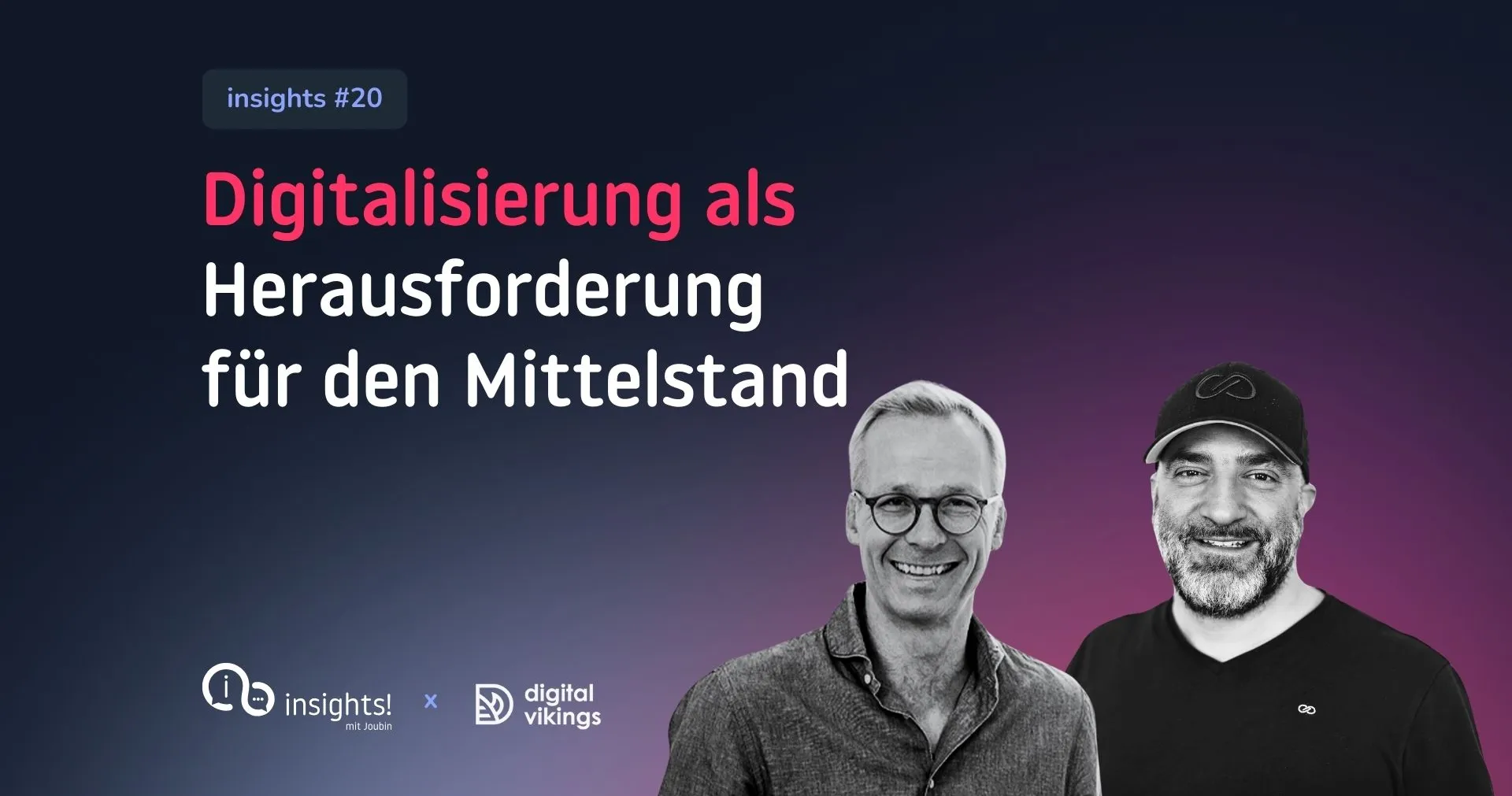
In today's podcast, two seasoned entrepreneurs of the digital age exchange views: synaigy managing director Joubin Rahimi and Digital Vikings co-founder Lars Rabe discuss topics such as modern organisational structure, the purpose of OKRs, and a still-rare error culture within organisations. One thing can already be revealed: the two found surprisingly many points of overlap in their respective company philosophies.
Employee management systems don't always really make sense
Well-funded corporations and hip start-ups are usually ahead of medium-sized companies in the digital shift towards future-proof organisational structures. The former, says Lars Rabe, have long been aware that "digitalisation is a strategic topic". Accordingly, they've built up structures quickly in recent years. Large parts of the SME sector, Rabe observes, have only recently jumped on the digital bandwagon. "They've successfully completed the first phase of digitalisation, with a webshop and initial service offerings." Now, however, they're realising that the train can no longer be stopped, "so professionalisation is the order of the day". And that has a direct impact on "how I need to organise myself as a company".
When suddenly new demands are placed on staff and previously unknown positions are created, the call for a management system for targeted staff leadership quickly follows. Lars Rabe warns, however, against hasty decisions. An Objectives and Key Results system, OKR for short, can make sense, but doesn't have to. In his own company, Digital Vikings, it was introduced, among other reasons, "to know how our customers tick". Because they can all be assigned to the digital environment. And wherever the term OKR comes up, the buzzword "agile working" usually isn't far behind. That sounds quite lively to many, but requires "firm structures and a lot of discipline" from the company. Because if everything runs chaotically, you achieve the opposite.
As is well known, you learn from mistakes, and that's been true since long before the internet and Apple. In the working environment, however, Lars Rabe still misses this attitude in Germany. He feels there's a lack of fast-fail mentality here, as has long been lived out in companies in the US. “For me that's a really important point in the context of digitalisation topics.” Advancing technology even supports this culture further. “Because modern technology is quickly adaptable, mistakes can be corrected quickly,” says Lars Rabe. Especially companies operating in the service sector or around digital products should make a pronounced error culture a priority. And only in a second step comes the question of how the organisation should be structured.
Would you like to listen to the full episode?
Find the podcast of the interview here:
Please accept the corresponding cookies to view this embedded content.
Prefer to watch the episode? No problem!
You'll find a recording of the interview here:
Please accept functional cookies to watch this video.
Prefer to read?
Joubin Rahimi:
Great to have you back for a new episode of Insights! My name is Joubin Rahimi and today with me, Lars Rabe. Hello, Lars.
Lars Rabe:
Hi Joubin, great to see you.
Joubin Rahimi:
Yes, likewise. Likewise. Lars has also given talks at our customer events before. And Lars has a really exciting CV that fits perfectly with today's topic of organisational structure for companies going through digitalisation. Lars, your current company is Digital Vikings and you're an HR and organisational consultancy. That's correct for a start. But your career path is quite different. You actually come from marketing tech, as one would say today.
Lars Rabe:
Yes, yes, you could say that. I can't really do anything other than digital anyway. My first touchpoints were in online marketing. That was in 2000, I think, when the entire online marketing market in Germany was worth 100 million. And then at some point I had my own company, then switched towards eCommerce, at a company many will probably know: Demandware, now Salesforce Commerce Cloud. And there we built an organisational unit called Retail Practice. Back then we helped companies get their eCommerce out onto the road faster and better. And at the time it was always a bit of a challenge, we had a lot of branded manufacturers, also in the fashion space, who were just starting out with eCommerce and said, what do I even need for this? What do I actually have to do? And that's when this whole topic of organisation slowly came up, which people do I need, where do they even need to be? What qualifications do they need? Where do I even find them? And that was a topic that somehow never let go of me. Coming from the online marketing corner, moving towards eCommerce technology, and then you saw that technology is extremely important, but if I don't have the team around it, it gets me relatively little. And that's roughly where this whole organisation topic came from.
Joubin Rahimi:
And that's the challenge. You have to understand the technology. You have to understand the internet, you have to understand marketing. And bringing all of that together somehow. And yes, your CV shapes that.
Lars Rabe:
Yes, that's a bit of a passion of mine too. So, who are the right people? At which positions do I need to hire? There used to be this CIO topic, which was basically the box-shifter. Way back, in the 1990s, people said CIO stood for Career Is Over. Then when digitalisation came along, the CDO appeared. At some point this staff role attached to the CEO emerged. We didn't quite know what they should do yet, so let's get a Chief Digital Officer. They left again after two years because there was no business model. And somehow it's an ever-evolving topic, ultra exciting, because the whole digitalisation theme keeps developing further too.
Joubin Rahimi:
I had actually wanted to ask you the question, why organisational structure at all? And who describes it as such? You already describe exactly the problem: that everything changes very fast and this connection is necessary. And you said, okay CDO, that is really the maturity level of the organisation, when they say we have a CIO. But he is not on the executive board. CDO, staff function, can only bark, not bite.
Lars Rabe:
Exactly.
Joubin Rahimi:
But what should companies do then?
Lars Rabe:
Yes, that also depends a bit on where you currently stand, I think. Large companies and also many start-ups realised relatively early that digitalisation is strategic. Large companies could invest accordingly, built structures relatively quickly, and in between hung the whole SME sector. And these are companies that easily go up to 5000 employees. And they then had a CIO, come on, we want to digitalise now, go do it. He says, I have no idea. Ten years ago the whole cloud topic first came up. And then came the CDO, who had the business lens on. But meanwhile we're seeing a very clear shift here, that these two positions are actually merging into one another. The CDO has to be highly technological and the CIO has to be highly business-oriented. Because if one can't do the other, it's difficult. Then I'm either just the IT lead or the head of sales or something in the digital space.
Joubin Rahimi:
The printers and the controller.
Lars Rabe:
Yes, exactly. We see, particularly in the Mittelstand environment, a lot is happening. Many are giving this serious thought, they've been through the first phase of digitalisation. Built their first webshop, first digital service offerings. All worked. So now they notice it's growing like crazy and takes up a significant share of business volume. So it has to be professionalised extremely, because it's mission-critical. And that's not just eCommerce, it's every area, almost everything can be digitalised – in industry, in retail. In retail it only just started. There were waves of disruption everywhere. In retail that happened for a while, then the brand manufacturers came along and said, we'll do it ourselves. Then the retailer says, good grief! Now the whole banking sector is being completely digitalised, a lot is happening everywhere. And that has consequences for how a company ultimately has to organise itself.
Joubin Rahimi:
And a term keeps popping up alongside that: we need to be agile, we need OKRs, the Spotify model. I'd like to start with the basics first. What's your opinion on that? Does it make sense? Doesn't it?
Lars Rabe:
Yes, so ultimately it's a way to tackle important topics in a company as agilely as possible. OKR stands for Objectives and Key Results, meaning I need to have goals. I need a big goal, need to break it down into sub-goals at quarterly level, and manage my company on that basis. I'd say it can, in my view, be applied everywhere. But it's not necessarily sensible everywhere. If I'm operating in the industrial sector with very long cycles, then it might make less sense. Then I need a completely classic business plan and have my goals in view there and have many complex project plans. But OKRs of course also help to operate in an agile way, to think in this sprint methodology. But if I'm implementing a large ERP system, then I can hardly do that in an agile way, because so many other factors depend on it, so I can't put the thing online in two-week sprints or...
Joubin Rahimi:
...can adjust.
Lars Rabe:
...or adjust.
Joubin Rahimi:
Staying with OKRs. Industrial companies, as you said, have longer cycles they sometimes need. And with smaller firms it's like, whoa, that's not agile at all. And I said, why isn't that agile?
Lars Rabe:
Yes, that's interesting.
Joubin Rahimi:
It was only after a while that I understood why they say that. And for a very simple reason: they had no plan whatsoever beforehand. Then you don't need to think about how you go in either. But for many who are then in this very dynamic environment, it's rather the opposite, it's a kind of way of structuring.
Lars Rabe:
Yes, absolutely. Many people always think that agility, for example, is always so higgledy-piggledy. But agility always follows some framework, and that requires a high degree of discipline. We've also introduced OKRs...
Joubin Rahimi:
How many people are you?
Lars Rabe:
We now have over 20 people. We said we definitely wanted to do this too, because of course we also want to operate the way our clients do, who are active in the digital space. And we noticed that this needs good structure, needs discipline. Because if I want to be fast, that naturally has to follow a process. If it's totally chaotic, then I actually achieve nothing at all.
Joubin Rahimi:
Flexibility actually needs basic structure.
Lars Rabe: Exactly, I like that. Flexibility needs a structure.
Joubin Rahimi:
That actually sounds totally contrary. A few years back we also said, let's do the Spotify model. That came more from parts of the team, but it didn't work out for us. Now the question is why? But I don't want to get into that yet. I want to hear your experience first.
Lars Rabe:
Personally, I'm not a great fan of organisational theories. The Spotify model is also based on a theory, and the principle is certainly very sensible. But many companies then jump straight into some organisational form without even considering what actually makes sense. First you need to work out who your primary target group actually is as a company. Really, there is only ever one goal: I must rigorously align my company with my customers' needs, whether B2B or B2C. And usually that comes from the software development area — we need to move towards a Spotify model, i.e. no hierarchies. There are framework-setters, there are coaches in between. Work happens in squads. But that can be extremely disruptive in a company that has been in the market for 50 or 100 years, and naturally unsettle people too. And maybe it makes no sense at all. In my view it makes most sense to always ask: what business model do I actually have as a company? How quickly can that even turn? What organisation do I have? What is my degree of digitalisation? And then I can consider whether I might be able to take certain elements from it. A model that works at Spotify will probably not work at Volkswagen or Miele. Elements from it, perhaps yes.
Joubin Rahimi:
It didn't work for us, and as you say, it came from software development. Part of the team thought it was great at first. There was a framework, but not everyone was on board, not everyone came along. Ultimately it failed on two points, you've already mentioned one. If I have a Spotify model, I effectively have a product. Spotify essentially has a product.
Lars Rabe:
That's right.
Joubin Rahimi:
And we don't have our own product, we help our customers instead.
Lars Rabe:
Services.
Joubin Rahimi:
Right. So that doesn't quite fit that simply. And our model is of course also, to some extent, time for money. Then the model just doesn't fit either. It's also very hard to explain why certain squad meetings should be declined and why not. One could say we haven't tried hard enough. But I don't believe that for us. So in principle I can well imagine it, just not for us.
Lars Rabe:
I think you just made really important point there. I think what companies need to learn in context of digitalisation topics is that you need pronounced error culture within company. That you really say, okay, mistakes can happen, cause mistakes can also be corrected very quickly due to fact that technology's very quickly adaptable and so on. That came strongly from US too, this fast-fail mentality. In Germany, no, can't do that and so on. I think it's cultural topic, needs to actually be anchored in every company. If I build car, might be bit different, I've now built that into car, produced 10,000 units, then I've got huge recall. Doesn't work. But especially in service sector or if I offer digital products, that's first cultural topic, I think. And then I gotta think about how do I align whole organisation? Which metrics or which topics do I then align it by?
Joubin Rahimi:
Und auch die Frage: what kind of people am I dealing with? Is a software developer from 20 years ago still the same as today?
Lars Rabe:
Besides this fail-fast mentality, there's also this theme of thinking in departments. You actually have to think much more in terms of outcomes. For example, a software developer mustn't work in their silo, they have to collaborate with the requester and say, this is what I need. And not just throw it over the fence, please just do it, the way it used to be. I had specification documents, requirement documents, it was developed and then someone said, but I imagined this completely differently. And that's why they actually have to be jointly responsible for outcomes and for metrics, or ultimately for KPIs. And then it usually comes together. And that's been a really important change in many companies, that they said, hold on. You probably remember this from before too, Sales versus Marketing. Hey, they actually belong together. Or, those are the IT people. That's complete nonsense. The question then is, what does the customer want and what's your contribution to making that customer successful?
Joubin Rahimi:
And what's the journey behind that? I always perk up at the sales vs. marketing discussion, they used to be separate with us too. We've now merged them within synaigy, but that's not yet the case across the whole group. I say not yet, because I assume at some point it will be. Though those involved would now say, no.
Lars Rabe:
Do we need to cut that out?
Joubin Rahimi:
No, we'll leave that in. But the exciting thing about it is this convergence, that's one of the key learnings. And of course the new role definition. And I'd actually like to hand over to the listeners there, because we'll come back to that, we'll describe the product owner and a few other roles, so you know what that actually means and what makes sense. And what might be the no-gos in the search? So, stay tuned!
Lars Rabe:
Great.
Joubin Rahimi:
Thanks, Lars, for the time.
Lars Rabe:
Time flies, it's unbelievable.
Joubin Rahimi:
And as always, feel free to leave comments below or send us a message. We look forward to it! Thanks for listening. Thank you, Lars.
Lars Rabe:
Thanks, Joubin.
Have questions or feedback?
Then feel free to contact us directly.
- Joubin Rahimi
Managing Partnersynaigy
Show phone numberShow mobile numberShow email address
Subscribe to the blog now and never miss any news
✔️free of charge ✔️weekly news ✔️expert knowledge
Please accept the corresponding cookies to view this embedded content.