



insights! #82: MarTech boom, AI, real-time data connectivity – buzzword bingo?
In this insights! episode, Till Paschke from HCLSoftware brings you closer to cloud-native software stacks and the innovative „Integrated Composable Commerce“ approach. Driven by HCL's impressive clients Ferrari, HP and DHL, their digital solutions reflect this innovative strength. The current martech boom and the clever use of AI for real-time data networking are focus topics of this episode.
 Joubin RahimiManaging Partner · synaigy
4 min read
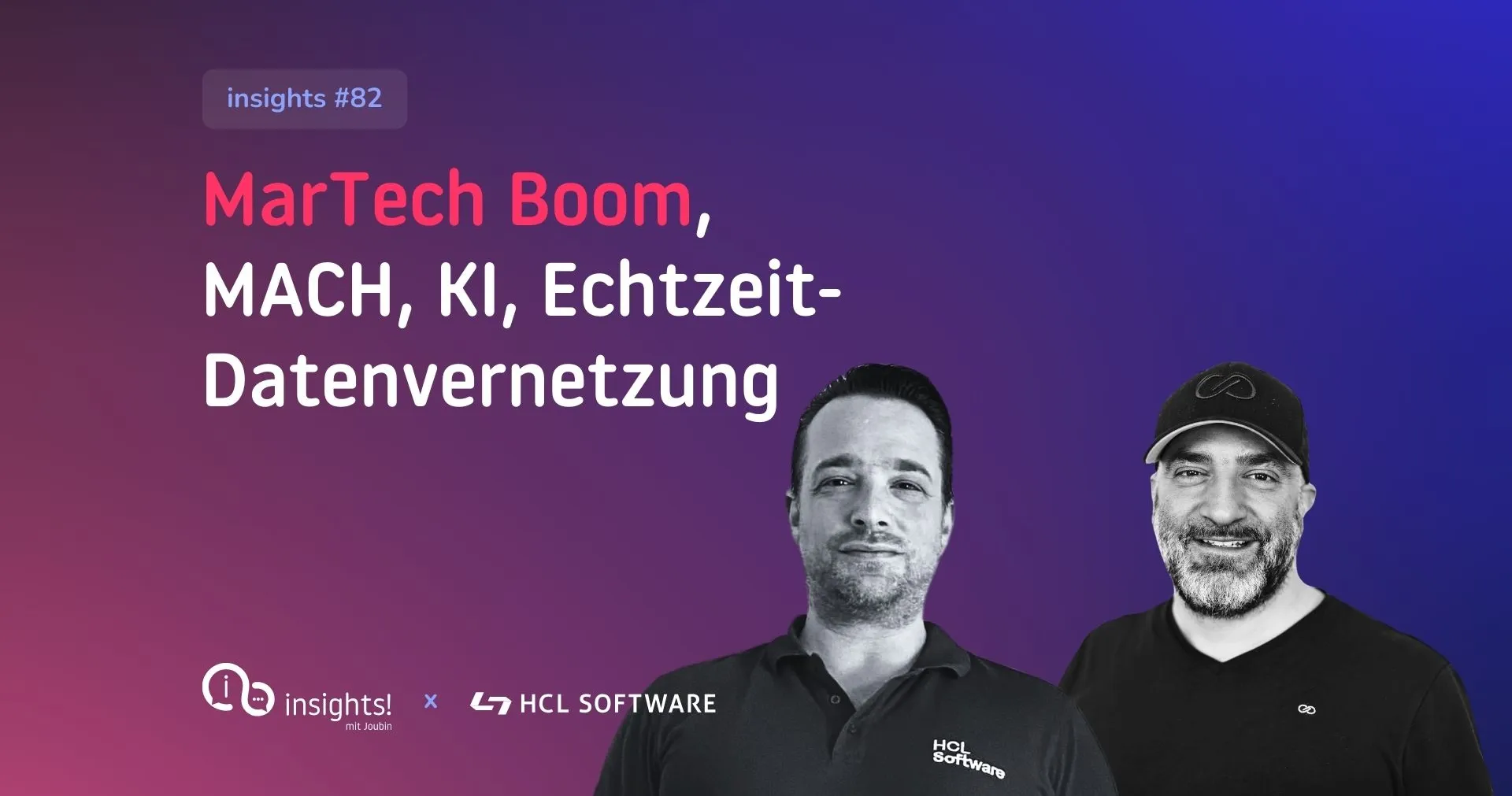
Currently it's around 270 billion US dollars flowing through our platforms. The largest share, of course, goes through the B2B e-commerce platforms.
HCL and its strong partnerships
HCL has been a fixture in the technology industry since 1976 and has grown into a true global player with over 230,000 employees. Particularly exciting is the development of HCL Software, which five years ago dared a fresh start by taking over IBM products and switching to a cloud-native stack. This modernisation enables HCL to implement innovations quickly and efficiently, which is highly valued by customers such as Ferrari, HP and DHL. HCL's ability to support on-premise as well as hybrid and cloud environments demonstrates their flexibility and adaptability to customers' varying needs. This creates seamless integration into heterogeneous IT landscapes, which is very positively received by customers.
Integrated composable commerce: a gamechanger
One highlight of the conversation was the "Integrated Composable Commerce" approach. This makes it possible to seamlessly integrate various customer experience components and deliver tailored solutions for complex business requirements. By combining B2B, B2C and API-first strategies, HCL creates flexible, scalable solutions that can be deployed both on-premise and in the cloud. HCL relies here on an innovative, cloud-native and fully containerised approach that allows it to respond quickly to market changes and continuously roll out new features and improvements. This strategy delivers substantial added value for organisations that need to hold their own in a dynamic, highly competitive environment.
Market developments and the boom in the martech sector
The current market situation shows a decline in classic e-commerce and retail, but in the B2B sector, and especially in the martech space, HCL is seeing a boom. New products such as the customer data platform HCL/CDP and deep behavioural insights with Discover contribute significantly to this development. These tools help organisations optimise their marketing strategies through more precise and personalised offers. HCL has managed to develop its martech solutions further so that they achieve a high fulfilment rate for demanding requirements. This is especially evident in large tenders, where HCL can often meet over 90% of requirements out of the box. The combination of Unica, a martech automation solution, and the new products CDP and Discover makes HCL a strong player in the martech market.
The role of artificial intelligence and data integration
Artificial intelligence plays a central role in HCL's innovation strategy. The 'AI on' platform makes it possible to connect data in real time and thereby gain valuable insights. This is particularly significant in the context of data governance and the integration of different data pools. HCL uses AI to make personalised and context-relevant offers to customers. An example from the banking sector illustrates how connecting data can create tailored offers that are better suited to customers' needs. The ability to integrate and analyse different data sets helps companies develop more efficient and targeted marketing campaigns.
The future of digitalisation
To close, Till stress importance of well-thought-out data integration strategy. Integrability of IT stack and avoiding data breaks essential to drive digitalisation forward successfully and turn data into strategic assets. HCL's focus lies in keeping control over own data while offering flexible and secure solutions. This include possibility to store and process data both on-premise and in cloud, to meet varying requirements and security concerns of customers. HCL's extensive experience and broad product portfolio enable efficient support even for complex business models and continuous delivery of innovative solutions.
Would you like to listen to the full episode?
Find the podcast of the interview here:
Please accept the corresponding cookies to view this embedded content.
Prefer to watch the episode? No problem!
You'll find a recording of the interview here:
Please accept functional cookies to watch this video.
Prefer to read?
Joubin Rahimi
Great that you're back for a new episode of insights! My name is Joubin Rahimi and today I get to welcome Till Vitus Paschke from HCL. Now I've said your full name, Till. Glad you're here. Would you like to say a couple of sentences about yourself and about HCL?
Till Paschke
Yes, gladly. Thanks Joubin for having me today. As I said, I'm Till. I've now been at HCL for four years, have had long career paths at various companies, was once at IBM, was once at Oracle, did this and that, and have been selling customer experience software for a long time now. Who is HCL? People don't immediately know HCL, especially not HCL Software. HCL itself has actually been around since 1976, and the HCL family now has over 230,000 employees, and we're a small business unit within it with 9,000 employees. HCL Software has existed for five years. We took over a few products from IBM, cut the old roots and moved everything onto a cloud-native stack so we can bring in as much innovation as possible.
Joubin Rahimi
And that's perhaps also our direct point of connection. We've now been doing the software stacks in HCL's portfolio, or largely in HCL's portfolio, for 20 years. And that's why, I'd say, the partnership with you, with some ex-IBMers, also with the new HCLers, feels like it's over 20 years old. But the technology has now become mega cool, so it's all the better that we're talking now, because none of it is old – it's all completely new. But let's dive straight in, because most people ultimately ask themselves: what's actually new now? Everyone talks about MACH and headless. From my point of view, opinions can differ on that. Where do you stand on the topic of MACH, and are you MACH or not? Or what's your direction?
Till Paschke
Yes, I'd already said it. We're cloud-native, fully containerised. Simply against backdrop that we wanted to, could and had to bring as many innovations into product in shortest time, and have done so too. Much also in collaboration with our large customers and of course also with medium and smaller customers. And we're also headless, we're very good at that. We can also do B2B, B2C, D2C, B2B2C and entire spectrum on one platform. We of course also have API-first approach. Quite clearly, we always come into heterogeneous IT landscapes. We must work with most varied PIM systems, ERP systems. But nice thing is, side benefit that emerged, that we can deploy everywhere for example: on-prem, hybrid, with every hyperscaler, in every cloud. Those are few very nice advantages and customers appreciate that very much too. We're moving bit away from MACH. We call that our product "Integrated Composable Commerce". New term, shapes market bit.
Joubin Rahimi
Right.
Till Paschke
But it does have a background after all — we have a large customer experience software portfolio. And for example, we can take parts out of our martech solution and dock them on, say when we talk about hyper-personalisation. We can add on the behavioural insights. And those are simply the added values that make up our product. Maybe also interesting for you — you know it already, but the listeners and viewers don't: when is HCL actually the right product for me? What we can handle very well is complexity. We also need a certain level of complexity for the solution to deliver the added value that the customer needs. That's a bit of our speciality.
Joubin Rahimi
Exactly that, when you say you have B2B models that are complex at checkout, or customers' contracts, you already have those things in place, you don't have to reinvent them. I find that mega, mega valuable, instead of saying: right, now I'll start from scratch. Contract types across countries and customers, customer logins, prices and all the terms, conditions, delivery terms. Which products can I see in which country for which employee? You've already solved that, and I think that's a really smart move. In that vein. That's why I'm looking forward to you now going out there, going out more, and spreading the word about it. In that vein you've also got... You've got a red colour on.
Till Paschke
Yes, that's Ferrari red here.
Joubin Rahimi
I also saw you at Ferrari, on the vehicle and of course at Dmexco too. You had the Ferrari standing there as well. That was a real magnet. But how did that come about, and what's the story behind it?
Till Paschke
Yes, well of course on one hand it's very important that we simply create a bit of awareness. Ferrari had already been long-standing customer of ours and then we actually shook hands and thought about where we could generate a bit of attention. And for one thing of course it's events, where we can also invite our customers. For what? It's above all an experience. I myself have also had privilege of being there at a weekend once. Was brilliant. Can only recommend it to everyone. And it's simply about it being a win-win situation for both. We advertise for Ferrari, Ferrari advertises for us, they then use our products more. That's simply a good partnership. And so from customer-vendor relationship a joint, multi-year partnership has actually emerged. And that's of course optimal. And Ferrari isn't cheap either.
Joubin Rahimi
But now, to get a feel for it, you have an e-commerce platform, among others also the DX and CMS platform and many more. But focusing on e-commerce: how much goes through your platform per year? Do you have a sense of that?
Till Paschke
Yes, we've actually had a significant increase since we took over the product. Currently it's around 270 billion US dollars, so 270 billion US dollars. The largest share naturally goes through the B2B e-commerce platforms, but of course we also have a few small players, but I think that's already quite a figure. And in the past we've always been a bit restrictive about it. Perhaps not always to our advantage, that we said: Who are our customers, actually? Nobody really knows where HCL is involved everywhere. Perhaps two or three examples you could give. We have, for instance, Lindegas, a large and long-standing customer with whom we also maintain a very, very good relationship, who actually now have over 40 stores in various countries for various verticals as well. And they also have, I'd say, 5% is actually B2C. So they've diversified a bit, particularly in the aquatics sector. Then we also have a few of the really big automotive companies here from Germany. There aren't that many of those. When I say a few, that's half of the large ones that exist. But those are, HP could be mentioned for example, who run both B2B and B2C entirely on our platform and so on. We also have a few, among others DHL, for whom we essentially set up the shops for their customers, with which they then set up logistics and other topics. Behind that there are another twelve other well-known brands.
Joubin Rahimi
And I do think you quickly forget who's actually involved everywhere. And I think everyone, or almost everyone, buys something from us via some platform too, which then runs through HCL Commerce.
Till Paschke
We're already involved very often in cases where even the companies themselves don't know they're using us, in the backend, or at least the business unit does. So of course, as I said, we still need to raise a bit of awareness about the Ferrari, and work a little more with customers on that. But I think we're on a pretty good path right now.
Joubin Rahimi
Then question about current market situation, even though we of course want to leave video up a bit longer. It's summer 2024, shortly before Euros. And I see it quite differently how areas currently stand. But where do you see market where customer invests more cautiously? Where do you see market where customer invests much more strongly?
Till Paschke
I have to say, what strikes us very strongly is that the classic e-commerce market, the retail market, is declining sharply. Margins are declining, simply due to the situations we had after Corona, with the Ukraine-Russia situation. It's become a bit subdued and we see more of a decline there. And currently the focus, and the projects that are coming in at the moment, tend to be more in the B2B sector, because people often don't believe it, but there's often still a lot of catching up to do at companies. And they're actively driving digitalisation forward, and that's of course also a central element, lifting the entire sales operation onto the platform in the B2B sector.
Joubin Rahimi
And of the components, it's then, okay, commerce is rather declining, except in B2B, I understood, but you still have the DX portfolio.
Till Paschke
Where we're currently seeing an absolute boom, because – I have to say rightly and proudly – the solution has become so complete, is the whole martech stack. There we have three products with Unica, which is a martech automation. Then we now have, brand new, a customer data platform, HCL/CDP, and we have deep behavioural insights with Discover. And this combination makes us enormously strong. We just had a very large tender in the public sector, where we had a very high degree of fulfilment, over 90% out of the box for genuinely difficult requirements. And I have to say, I'm quite proud of what we've created there over the last two, three years, turning such a well-known product as Unica into a real trailblazer. We were also just at the Gartner Symposium and got a lot of very, very positive feedback there too. And I think that's going to set the tone over the next 18 months.
Joubin Rahimi
Great. So marketing, martech, that sounds good. We're in that area too. What about savings and further digitalisation in other processes? Is that a topic or not? You do have industry solutions and so on, but... Yes, of course there's...
Till Paschke
We're seeing a very strong… we had a very strong push in the public sector. We also have very large and very many public sector customers, i.e. government bodies. But now we're seeing that the brakes have been applied again somewhat. It was very ambitious over the last two years, what was meant to be done there, and quite a bit has also been implemented. But there it's not technology that's the showstopper, but rather the resources and the projects themselves. You also still notice there's a bit of bureaucracy and a few pitfalls. But I still hope that, if we look at the education sector for example, we can step things up again here in future.
Joubin Rahimi
Great. The topic of AI affects everyone too, and everyone talks about it. What's your position on AI, but also, what always follows for me, is data governance and how these things can ultimately be run. Those are actually two topics, but …
Till Paschke
I knew that question was coming, Joubin. Let me draw a quick distinction there: for normal use, or for someone who doesn't come from the IT industry, the user or the person, it's generative AI. But that's actually not really the topic, I have to say. Rather, we actually have very, very strong AI components, because our parent company HCL Tech has developed a corresponding platform that we can attach to any of our solutions like a Lego brick. Meaning AI on – so at the push of a button, AI on. And what it's simply about is what we do: connecting data, in real time. Let's take an example: I've been a customer at a local bank for a very long time, and they also know I've graduated and so on and so forth. And I still keep getting offers for a student loan. Now you can imagine, my children are still too young for university, I'm not going to study again. So, and 95 percent of my capital-building activities take place outside their universe, as I've already told you before. Simply because they don't connect the data pools they have. And they'd have the information. They can identify me precisely when I put my card into the cash machine, or when I log in via my online login, and that way they could address me very, very precisely. And I think that's not yet the case, because these data pools aren't connected to one another. And that's what we do with AI, what used to be the classic topics of best offer, next best action. Or now, particularly in the commerce area: what do I actually want? What am I likely to buy? And what accessories do I buy to go with the product I'm interested in? And analysing that in real time and – hey, we're just waiting for the first-party cookies to go, the tracking cookies, and then first-party data will take on a completely different importance again. And that's where we see the great added value for AI.
Joubin Rahimi
And I think that's what you just said, for the whole of martech and online marketing that's so important. It's already restricting things. And I have applications that show that much, much better. Although the law is of course simply, a cookie law is also simply. Yes, I mean, I could just level all that out. But right, then one more question on data and where you keep the data. You said in passing at one point and I'd find your approach very interesting there. In passing you said, you can run it on the cloud, a public cloud, private cloud, on-prem. Do you want to keep doing it that way? Is that a strategy or is that a relic from the old days?
Till Paschke
No, it was simply a by-product of the move to cloud-native. Of course, if you look at the margins in the software business, the margin on a pure SaaS business is naturally higher. But we've found that for our customers it's often important that at least parts of such a complex solution, made up of selling, acquiring customers, holding customer data, are still kept on-prem. The classic example, I always say it, we have a Swiss bank as a customer and they actually keep the customer database in a safe, in the basement, on the server. All other applications are in the cloud, and then the data is given an alias, processed, enriched, and only an alias remains on the individual components in the cloud, partly to be GDPR-compliant, to have data integrity. But in the medium term we will definitely not be moving away from the on-prem model.
Joubin Rahimi
I think, personally I think it's exactly right. We also have other clients who say: "I'd really like it to stay in Germany, or to have data sovereignty." We also run it on OVHcloud or on others, but also on AWS, Azure and Google. So everything's covered there. But that, I think, is one of the genuine USPs you have, because others say: you have to do SaaS with us
Till Paschke
Yes, I mean, we have a market, and a few years ago. 10 years ago multi-tenancy was the big thing. Nowadays it's more that we're seeing a very strong trend towards single-private-tenancy. Of course that always comes with costs at the start, simply because you need the storage space in the cloud, whichever provider, whether Google, Microsoft, AWS, or even in some data centre, wherever. But I think that the control over your own solution and your own platform and the business-critical processes running on it, and accordingly also data security and integrity, which has become ever more important in recent years, is preserved as a result. And I think that's one of the real USPs you bring to the table. But you have another product too. So if I'm selling things, especially in B2B, that's great, but what happens when I'm selling machinery and so on, or I'm in the OEM space — I'm not going to get a shop system and rebuild everything around that. We read about that in the press, although that's no longer true. People told us that and we'd already drilled it into our heads, but let me let the cat out of the bag.
Till Paschke
Yes, so for the whole after-sales area, after-sales market, we acquired a new service lifecycle platform, which we've now started rebuilding and are already pretty much finished with, because we want a compatible stack. And there are actually two drivers. The first driver, if I look at a classic OEM, is of course that in after-sales you can earn significantly higher margins, namely 2.5 to 3 times. Makes sense, if I buy an indicator light, it's simply more expensive than when it's built into the car. That's the volume discount with the tyres and the seats and so on. And then it's also the case that especially these large manufacturers make almost 50% of their total margin in the after-sales area, and that's of course also fiercely contested. And the customer, no matter which car I drive for example, or whether it's on time or whatever, I expect the service processes, delivery processes to have the same transparency and quality, whether I'm sitting in Costa Rica or in Singapore or in North America or in Germany, especially with premium products. That's one thing. And the other big topic... Let me give you an example. Imagine you're already at a big newspaper publishing house, sitting there on a Sunday evening, and your press starts up and you've got a big headline for Monday morning. And suddenly the alarm goes off and the machine stops and starts to smoke. Now of course you're under insane time pressure. Now you first have to identify what it depends on. So which part is it? And then you have to think: is that a part or is it part of a group? And once you've identified that, you have to think: hold on, do I have that in stock or do I need to order it? And of course, here's where the application connects to the commerce system again, because we see this holistically, you press the button and you need to know availability, how long is shipping, how long does it take? Then it continues further: can you repair the thing yourself or do you need someone now? And afterwards you want to know: is it covered by warranty? Does it fall under your maintenance contract? You want the whole thing logged with a ticket and afterwards run an analysis on it. And that's what we do with the Aftermarket Cloud. And that's currently a massive topic among almost everyone, I'd say, in manufacturing. Whether you have a substation or an MRI machine or an excavator. Or imagine you have a huge crane and you're lifting a motorway bridge at night, swapping it out, and the thing stands still. What do you think the economic damage is? You know where this is heading, and the other big topic, when we talk to companies or especially with the CFO, is risk mitigation. That is, I want to minimise the risk, the downtime risk and the follow-up costs simply through digital processes, and that's where we come in.
Joubin Rahimi
Cool. I think it's brilliant what you've built out of five years, also the completeness across these areas. Amazing, because we used to have to knit together such products by hand.
Till Paschke
Yes, I know.
Joubin Rahimi
So that's great and of course we're also looking forward to the first joint project. Absolutely. That will come, but that's brilliant. Now to finish off: from your experience – you've been in this environment for a long time now and have seen many customer situations – what would you pass on to a CDO? Feel free to share a positive example or even a fuck-up where you say, that's something I or the customer learned from, that's something worth sharing.
Till Paschke
What I find very important is that you shouldn't always jump on every latest trend immediately, but rather look at what it actually is. I think what's very important is the integrability of the entire IT stack. And that's where we get to the topic of APIs and interfaces. That's one thing. The systems naturally need to be capable of that. Most modern software platforms can do that, but where many people – at least it feels that way – don't give it much thought is the area of: "How does my data actually flow through the systems?" This data flow diagram. It's also the case that in many tenders, RFPs, that we work on, we see that this hasn't been thought about at all. And then something gets built and later it's discovered: "Wait a minute, now we're seeing the gaps." And that's something where I simply... Data has become so important nowadays. People used to say data is the new oil, but oil doesn't generate oil, whereas data generates new data. And then also: "How do I bring this data together" I have a data lake, completely unstructured. I have a data warehouse that serves my ERP system, very structured. Nobody wants anyone near that. And how do I get all of that into one pot? And when I bring a new platform on board as part of digitalising my processes, it's very important: how does that fit in with what I already have, and which gaps does it fill, and how do the data connect up?
Joubin Rahimi
It's all about integration architecture. I said it again in English.
Till Paschke
Yes, exactly. Those are the software sellers, lots of anglicisms. Sorry about that.
Joubin Rahimi
If you want to emphasise it, you say it in English.
Till Paschke
Yes, thanks.
Joubin Rahimi
Thanks, Till, for all the insights on this. If there are questions, I assume everyone can reach you via LinkedIn, you'll be linked as always. Otherwise feel free to leave a comment here too. Thanks for your time and for the insights, Till.
Till Paschke
Many thanks to you. That was great. Thank you.
Joubin Rahimi
With pleasure. And thanks for listening, watching and for a good and wise decision for all of us. Yes, thanks. Bye.
Till Paschke
Bye.
Have questions or feedback?
Then feel free to contact us directly.
- Joubin Rahimi
Managing Partnersynaigy
Show phone numberShow mobile numberShow email address

Subscribe to the blog now and never miss any news
✔️free of charge ✔️weekly news ✔️expert knowledge
Please accept the corresponding cookies to view this embedded content.