



The symbiosis of PIM and ERP: efficient data management in a dynamic market environment
 Hanno KortmannE-Commerce Consultant | Data Protection Officer (DPO) · synaigy
5 min read

In a dynamic market environment, companies are continuously confronted with new business processes that challenge their internal systems. In particular, maintaining custom adaptations in ERP systems poses problems for many companies. The processes are often confusing, assigning information takes considerable effort, and at the latest when an update is due, time-consuming tests and adjustments have to be carried out. A PIM system can address these problems and is specifically designed to decouple and manage even complex product structure models from the core systems. Find out in this blog post how PIM and ERP systems differ from one another and what benefits a harmonious collaboration between the two systems brings.
Every company has some form of ERP system, whether in the form of ring binders, spreadsheets, a lean commercial system or a large software behemoth. Since the ERP system already holds key product and item master data, it seems logical to add and manage further information about one's own offerings there too. However, the modifications an ERP system tolerates are (rightly) limited – usually only technically skilled staff can extend data models and processes. Nor should everyone be given access to the ERP system. Partly because an ERP system stores confidential and sensitive information, and partly because the necessary user licences for most ERP systems are, frankly, rather generously priced.
So instead of increasingly diluting the core task area of an ERP system, it makes more sense – and in the long run also cheaper in terms of licensing, implementation, process and maintenance costs – to place a PIM system alongside the ERP that is optimised for product information management, and to keep the master data synchronised between the systems.
At core, boundaries matter …
To decide which processes are best housed in which system, the easiest approach is to first look at the systems' core business functions.
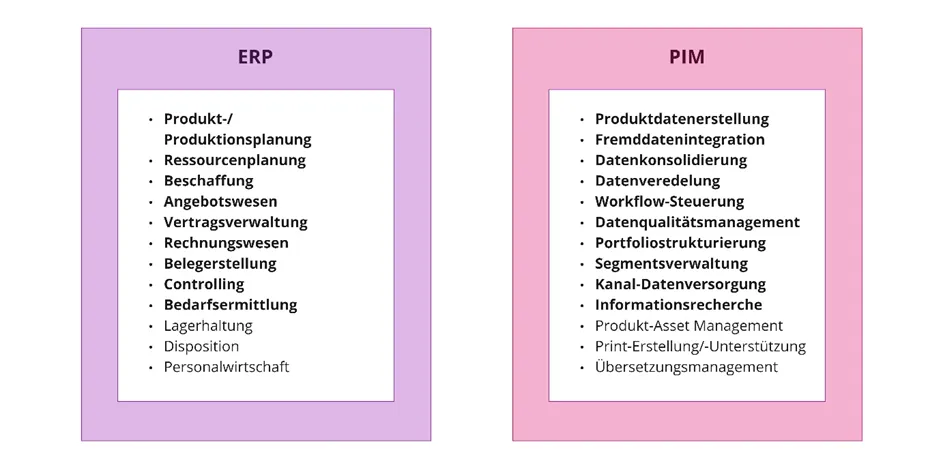
Even at first glance it is clear that the focus of ERP systems lies in the area of transactions, while PIM systems concentrate on the management, structuring and exchange of data. In addition, PIM systems are mainly used for managing sales products, while ERP systems also manage raw materials, purchasing and production materials, and resources.
Overlaps arise in the area of product master data management, portfolio management and connecting surrounding systems such as logistics and sales.
… just like bridges.
Ideally, the shared information is managed centrally in one place and passed on from there to the other relevant systems. Centralising product master data in the PIM system as the source has the advantage of being able to bundle and take into account the requirements of all downstream systems, so that the master data is always up to date, quality-assured and consistent across all systems. This also enables other systems to rely on each other having the identical product data status, which eliminates otherwise necessary checks and error-handling mechanisms in this area.
Particular attention should be paid to status information here, as the lifecycle of a product in product data management differs, for example, from that in the ERP business process:

The example shows where the workflows of ERP and PIM influence one another.
As a rule, these are the points in the process that should be safeguarded with (technical or manual) quality gates. Ideally, the workflows are then interlinked in such a way that they form a harmonious whole, and status changes in one system trigger the necessary follow-up steps in the other.
The benefits of combining ERP and PIM
A PIM can support an ERP system in several ways:
External data is brought into the ERP via just one interface – pre-checked, quality-assured and optimised for the ERP. This eliminates maintenance and adjustment of multiple interfaces as well as complex error handling within the ERP.
Objects, data and processes that don't belong in the ERP can be kept out of it. This removes the corresponding customising and maintenance effort, and customisations aren't needed at this point.
The interfaces to surrounding systems such as e-commerce, customer systems, marketplaces etc. can be reduced to the transactional data (prices, stock, orders etc.). The mapping of structures foreign to the ERP for supplying other systems is shifted to the specialised PIM system.
Access to ERP system no longer necessary for product management, marketing team, translators, or purely for research purposes. Licence scope can be optimised accordingly.
Workflow components and tools in the PIM are optimised for data and structure maintenance. Updating and extending structures and attribute sets to meet new requirements is simple, fast and flexible, with minimal effort (depending on the PIM system, even by the business departments), without any negative impact on the core business.
Conclusion
In a constantly changing market environment, ever new business processes are challenging the systems at the heart of the company. Mapping new business models is always tied to a multitude of implications, especially for the ERP. In addition, processes around data ingestion and data provisioning place high demands on an ERP system, especially when many changes are the order of the day.
The sheer maintenance of existing customisations in the ERP system presents many companies with challenges: the complex processes are often barely manageable, matching managed information to its purpose demands considerable oversight and documentation effort, and at the latest when an update is due, plenty of time often has to be set aside for testing and, if necessary, adjustments, to ensure operations run undisturbed.
PIM system can address many of these problem areas and, as specialist application for modelling even most complex product data structures, is designed to encapsulate this part of business logic away from core systems. With its functions as hub for product data, connection of external systems and channels is optimally supported – there too optimised for required or offered structures. And through disentangling business processes, focusing and optimising workflows become much easier and less risky due to reduced complexity.
Where the ERP system is the guarantor of a company's stability, robustness and reliability, the PIM system adds the ability to manage and exchange product data flexibly and dynamically. ERP and PIM therefore don't compete – they should be a dream team.
If you need help, we're happy to support you in selecting and introducing your PIM system. Just get in touch.
Have questions or feedback?
Then feel free to contact us directly.
- Hanno Kortmann
E-Commerce Consultant | Data Protection Officer (DPO)synaigy
Show phone numberShow mobile numberShow email address

Subscribe to the blog now and never miss any news
✔️free of charge ✔️weekly news ✔️expert knowledge
Please accept the corresponding cookies to view this embedded content.