

Prejudices towards agility
4 min read
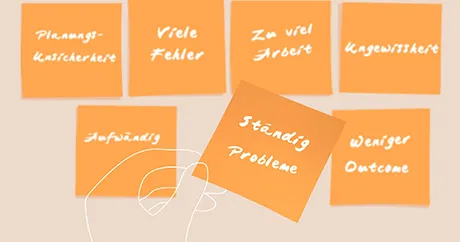
Agility may be a trending topic, but it's by no means a passing fad. Digital transformation is in full swing, and more and more industries and companies, even outside software development, are adopting agile core ideas. Yet some myths and prejudices against the "new" working methods persist stubbornly.
After several years of agile transformation at interactive tools, we compare seven typical prejudices with our experience. Our finding: they're all true, and they still have a positive impact on your project.
1. Customers get less
Yes, because more isn't necessarily better. We want to work out what's important and effective, and do it really well. Agile working starts with evaluating and prioritising: what are the functions that bring the greatest benefit? Which user stories have the highest business value? That's where we start.
There's no point doing lots of unimportant things. A hundred features aren't better than ten. Filtering out the most important ten and doing them really well — that's our job. Once we've designed and built them, it quickly becomes clear that 60 of the remaining features are unnecessary and don't need to be developed.
2. In agile projects you don't know what you're getting
We don't assume that we have the best ideas at the start of the project, but rather in the course of the collaboration: in conversations, through workshops, in design, development and testing, ideas will come to us. Ideas for how we can do things better. Because we work in an agile way, we can also implement the better ideas and don't have to keep following a poor plan made at the start of the project to achieve planning certainty.
The result: the website turns out different, different from what was originally wanted. Customers don't get what they pictured at the start. They get something better: something that solves the problems better, is more feasible with the budget, and benefits users more.
3. The customers do the agency's work
And it goes even further: they don't just do the agency's work, they do it better too. As an agency, we can't do everything. We're experts in digitalisation, design thinking, design, user experience, UX testing, code, scripting, templating and much more.
We understand little about many other things – at first. We bring in experts: them (the clients). Our clients are experts in their field. They've usually built up decades of experience and expertise. We admire, respect and draw on that.
Missing customer expertise and collaboration, we work alone, result stays well below its potential. Only when we combine both expertises and collaborate will the project ultimately succeed.
4. Customers don't get what they wished for
At the start of a project, clients usually have fairly clear ideas of what they want. That's good. But usually that's not what they actually need. Their ideas are shaped by what they already know. Their needs and judgements come from an inside view.
Agility helps us change perspective, look from the outside and put users at the centre. Suddenly the problems and needs are completely different. The change of perspective takes us away from the original assumptions and towards better design.
5. There are always problems with agile working
Yes, and that from the very start. And that's exactly what we want. Flushing problems to the surface early and making them visible is a vital part of agile methods. We don't want to conceal, ignore or sweep misunderstandings and problems under the carpet. When problems occur, that doesn't mean we've done something wrong or that we've failed. Problems are normal. Have you ever had a project with no problems at all?
We know problems will come up. We allow problems. If we spot them early, they're still small and we can simply solve them. So bring on the problems!
6. As a customer, do I have to constantly manage an agile project
Yes, because in agile projects customers are an integral part of the team. Their input matters to us. Customers carry the product vision, have the expertise in their field. Without their input, their assessment and their prioritisation, the end product won't be able to reach its full potential.
So if you don't have time to invest at least 1-2 days a week, and the project isn't important to you, then don't run an agile project.
Or the other way round: are there things in your life that turned out really well without you putting in effort and attention?
7. Agilität produziert so viele Fehler
Ja, Menschen machen Fehler. In klassischen Strukturen und in agilen Projekten. Allerdings sind sie beim agilen Arbeiten Teil der Methode. Denn aus jedem Fehler können wir etwas lernen. Jeder Fehler macht uns besser für die nächste Runde, aber nur wenn wir ihn erkennen. Eine positive Fehlerkultur entlastet die Teammitglieder von der Angst Fehler zu begehen und eröffnet Lernmöglichkeiten für das gesamte Team.
Durch regelmäßiges Testen können Fehler schnell gefunden und ausgebessert werden. Je mehr Fehler wir machen, erkennen und beheben, desto besser wird unser Produkt.
7. Agility produces so many mistakes
- Timo Wirth
Creationsynaigy
Show phone numberShow email address