

Remote design sprint
5 min read
Working together “remotely” via video conference is still associated by many with small, annoying technical problems and constant distraction from incoming messages. But above all: with less of the interpersonal magic that ensures that, in “real” design sprints in our rooms, tested prototypes emerge within 4 days, with even the stakeholders already on board.
But don't worry, there are now many good and simple tools for collaborative work. With the right preparation and facilitation, design sprints can be successfully run "remotely" too, giving your organisation exactly the innovation boost it needs right now.

Advantages of remote design sprints
Decision-makers are often easier to involve, as travel time is eliminated.
Scheduling is often easier, since all key stakeholders for the project only need to be together in a video workshop on 2 days, twice for 2 to 3 hours each.
Working with digital collaboration tools is sometimes faster, documentation is created as work happens, sticky-note consumption is genuinely zero, and travel costs are eliminated, along with the associated CO2 footprint.
Digital collaboration is often easier, less intimidating and more open due to the sense of anonymity. Good suggestions that are sometimes hard to voice face to face genuinely flourish on the digital whiteboard.
Room is not the limit. In the virtual workshop space, we can zoom from the highest meta level to the finest detail and back again with virtually a snap of the fingers. And "there's no room left" no longer exists – digital always has space for more ideas.
Remote design sprints let you involve more departments and bring in more expertise, no matter where in the world your staff are based. Even your sales team in China or your marketing expert in New York can join the design sprint team via video.
Why wait?
The best time to move your company decisively forward is always right now. Often the key stakeholders are hard to get around one table – a video conference makes that much easier.
Online collaboration is becoming ever more natural – and with a remote design sprint you now also get to learn new methods and tools yourself, which you can use to work together effectively, digitally and decentrally, across many areas of your company.
With the Remote Design Sprint, you experience and use the benefits of digitalisation while driving digitalisation forward yourself.
How does a remote design sprint work?
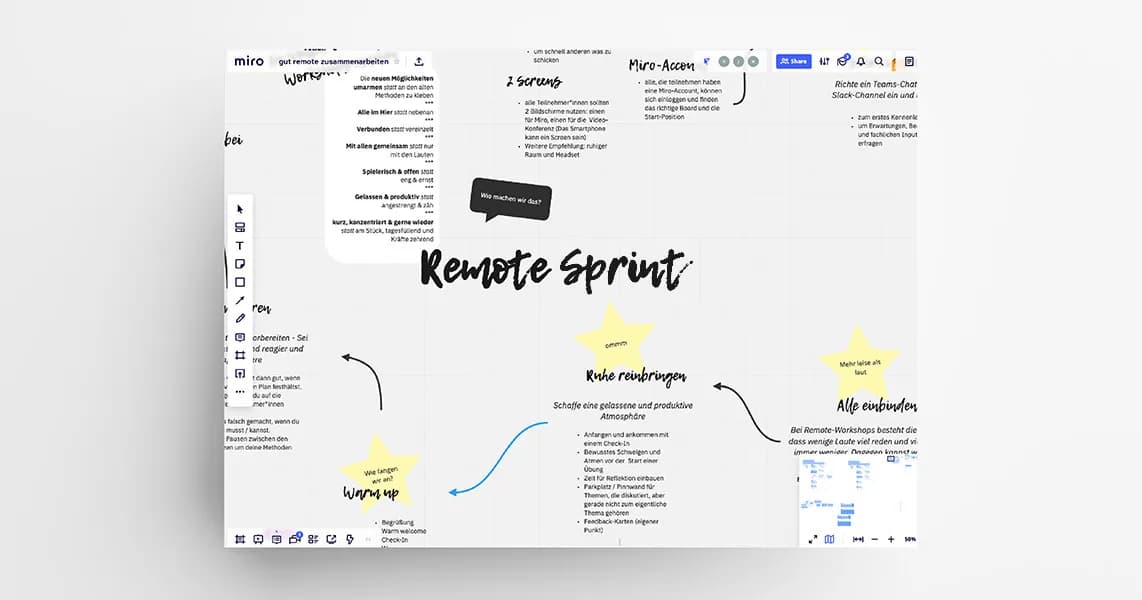
Preparation and onboarding matter for every workshop – with remote design sprints, especially so. Only here we don't prepare the room for workshop, but fill the digital collaboration tool. We also engage participants in advance, both through online surveys and playful introduction to tools, right at start of remote design sprint.
The design thinking mindset stays. Even remotely, we put users at the centre. Even via video, we deliberately break down hierarchies for the workshop and ensure that diverse expertise works together in iterative processes towards a particularly valuable outcome.
Collaboration tools replace the protected space. Of course it makes a difference whether we meet in person or in a digital space. But with the right facilitation and the right methods, we can make the best of it together.
Together alone is an important working principle even in "normal" design sprints. Remotely, this works even more efficiently, entirely independent of where you are and the space that's often missing in a workshop room when small groups want to work undisturbed.
No documentation work needed – we compile everything together digitally and it can be processed straight away.
Remote prototyping via Figma has long been standard for us in concept and design, even outside remote design sprints. This lets us turn workshop results directly into a testable prototype within a day.
Remote UX tests of the prototype complete the shift into the users' perspective. They also form the basis for meaningfully developing the resulting concepts further and prevent too much time or energy being spent on the wrong projects.
The results workshop again takes place via video and online collaboration. Here we gather all findings so you can decide how the results of the remote design sprint will be implemented.
Why is a remote design sprint right for your company?
When big ideas, achievable visions or the crucial next step are exactly what you need right now, use design sprints – the very methodology Google Ventures has used to bring over 2,000 innovations to market.
They want to get to know new methods of digital collaboration and test their practical suitability. A remote design sprint is exactly the format in which you experience everything yourself, from video workshops to online collaboration tools, peer design and remote UX testing.
Reducing opportunity costs. Instead of lengthy discussions, experience how digitally efficient decisions are reached.
No travel costs, no post-its. Remote design sprints may consume more electricity, but even that is generated sustainably for us, and otherwise you save time and the environment CO2.
Higher team engagement. The method brings even far-flung teams together instead of separating them.
Interested in a remote design sprint?
Want to realise a digital project? Want to develop new ideas together? Then get in touch with us.
Your contact person
- Marian Gertheim
Consultingsynaigy
Show phone numberShow email address