



#141 - Whoever doesn't invest now, loses: AI potential in B2B commerce and its barriers
What's really behind the AI figures in B2B commerce? In this episode, insights! sees Joubin Rahimi meet Dr Kai Hudetz — founder of ECC Köln and IFH Köln, and for almost 30 years one of the most renowned retail researchers in Germany. At the ECC FORUM, the two discuss the brand-new results of the B2Best Barometer 2026, the real barriers to AI adoption, digital sovereignty in times of geopolitical uncertainty, and what companies really need now to get through the winter resiliently.
 Joubin RahimiManaging Partner · synaigy
5 min read
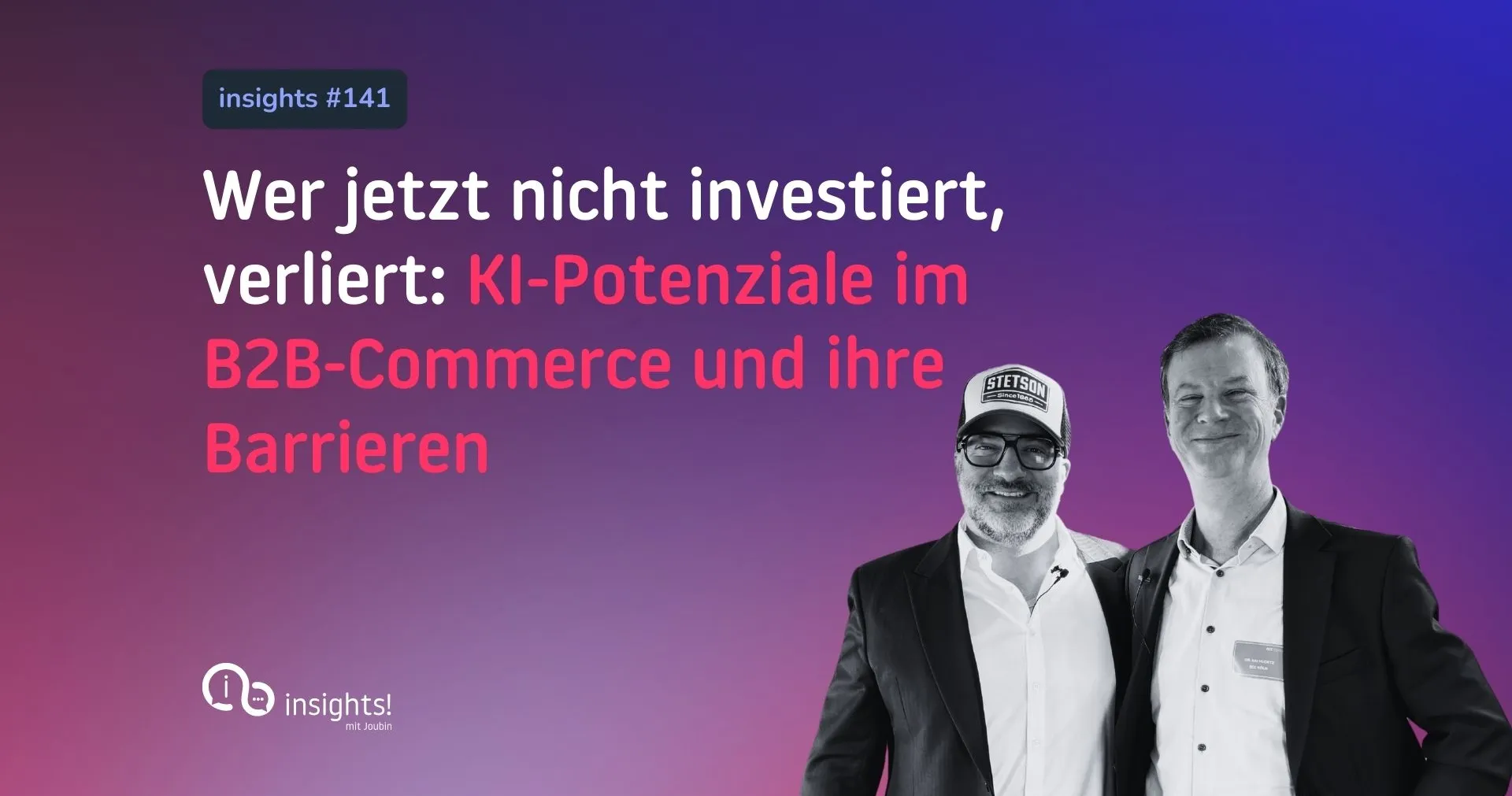
Digital infrastructure has become just as vital to survival as energy infrastructure. Imagine the American players cutting off our access to their data universes. That would be catastrophic. We genuinely lack digital sovereignty in Europe. And we need to change that before it's too late.
AI in B2B: recognised, celebrated and then? What the B2Best Barometer 2026 really says
At the ECC FORUM, we had the chance to interview Dr Kai Hudetz – one of Germany's best-known retail researchers. The conversation couldn't have been better timed. The B2Best Barometer 2026 – an annual study by IFH Köln and ECC Köln, this year together with us, among 200 wholesalers and manufacturers – had just closed the field. The first figures were in. Here we go.
Winter, resilience and why now is exactly the right moment
Joubin Rahimi opens the conversation with a metaphor that sticks. "Economy like seasons". Spring, summer, autumn and then winter. Many sectors of German retail are right in that winter right now. And that's not a disaster, if you know how to handle it.
In fact, statistics show: companies founded during economically hard times, or that fought their way through such phases, develop a resilience others don't have. They learn to navigate by sight, make decisions faster, have alternatives. Consumers have now learned this mode too. No more panic toilet-paper buying. No more mass share sell-offs at every news headline. The market has developed crisis resilience. That's actually encouraging.
B2Best Barometer 2026: the gap between recognising and acting
Let's turn to the figures that make you sit up: 77% of the B2B decision-makers surveyed believe that AI can help them with process efficiency. That sounds like good news at first. But look closer, and you see a gap that gives pause for thought.
On one side: recognised potential.
On other hand: hesitant, unstructured implementation.
A pilot project here, a small piece of automation there. A holistic AI strategy? That's rare. Yet the fields of application shown by the B2Best Barometer are anything but abstract:
Process efficiency through automated workflows
Marketing automation and personalised customer engagement
Better forecasts for inventory optimisation
Increasing customer satisfaction and NPS
Data-driven sales support
Potential real, measurable, actionable. Yet many companies still missing leap from insight to consequence. Kai sum up: everything still work in progress.
The real barrier: not a technical problem, but a mindset problem
Asked why so many companies hesitate despite recognising the potential, Kai gives an answer that should be a wake-up call. The biggest barrier isn't system integration (as important as that is). The biggest barrier is employees' mindset. More specifically, it's employees' fear. The question many quietly ask themselves is: if I feed my knowledge into AI now, am I securing my job or putting it at risk? That feeling isn't irrational. It's deeply human. And companies that overlook it or gloss over it will fail at AI transformation. We know this from our own experience at synaigy too. In our projects today, few presentations are created by hand any more, no code is written entirely by hand any more. The productivity gain is enormous. But the change doesn't happen by itself. It needs leadership. It needs conviction. And it needs open communication, as well as our great team.
Digital sovereignty: the overlooked survival issue
One topic runs through the conversation like a common thread: digital sovereignty. And here Kai Hudetz becomes particularly clear. His core statement hits home: digital infrastructure has now become just as important for survival as energy infrastructure. What does that mean in concrete terms? The vast majority of European companies use exclusively American providers for cloud, AI and data, and that without a plan B. Joubin doesn't pass judgement on that, but has a clear expectation: use what's useful to you, but have a fallback plan. The moment the price screw gets turned or political decisions threaten your ability to deliver, you want to be able to stand up and switch. Exactly this sovereignty – i.e. flexibility and the ability to switch quickly – is itself made easier by AI. Joubin gives a concrete example from practice. A customer switched from an e-commerce platform that was becoming more expensive to a new solution – thanks to AI support, at a fraction of the cost previously needed. What used to be a multi-year migration project suddenly became feasible.
Where is retail heading? An honest look ahead
Kai Hudetz is no pessimist. But he's no spin doctor either. His outlook for 2026 is shaped by a term he emphasises repeatedly: uncertainty. Not as paralysis, but as a new normal that one has to learn to deal with.
Since Covid, we've been living with profound volatility. Geopolitical crises, tariff debates, energy prices, AI disruption. The window of clear predictability has shrunk. Those waiting for calm to return will wait in vain. The companies that are ahead now have one thing in common: they've learned to navigate by sight and react quickly.
Three insights you should take away from this episode:
AI in B2B is no longer a topic for the future. Whoever waits now loses ground.
Transformation doesn't fail on technology, but on people. Leadership and culture work matter just as much as right tech stack.
Digital sovereignty is strategic capital. Whoever fails to build alternatives today loses freedom to act tomorrow.
Would you like to listen to the full episode?
Find the podcast of the interview here:
Please accept the corresponding cookies to view this embedded content.
Prefer to watch the episode? No problem!
You'll find a recording of the interview here:
Please accept functional cookies to watch this video.
Prefer to read?
Joubin Rahimi
Wonderful to have you back for a new episode of insights! My name is Joubin, Joubin Rahimi, and joining us today on the couch, Dr Kai Hudetz. Hello Kai
Kai Hudetz
Joubin, hi there.
Joubin Rahimi
We've known each other a while, and some of you from my bubble know you too, but we always want to bring new people into the community. So tell us two, three sentences about yourself and about IFH and ECC please.
Kai Hudetz
Yes, that's great. Thank you for the opportunity. Sometimes you think everyone must know one, because you're always caught up in your own bubble. I've been moving in my bubble for almost 30 years at IFH Cologne, formerly the Institute for Retail Research at the University of Cologne. So we're an institution that was actually spun out of the university, research for retail. We've now transformed quite significantly. That's also connected to the second brand. I founded ECC Cologne in 1999, and we then took up the topics of digitalisation, e-commerce, e-business, platforms, multichannel, omnichannel and so on. We picked that up, and there we advise, and we go a step further there, we provide recommendations for action and support retailers and manufacturers there at a strategic level, on how they need to keep developing.
Joubin Rahimi
And you also have this wonderfully great event here, which we're currently at. Day one: feedback from the speakers was brilliant. Bastian Siebers was also here already and got to contribute a bit as well.
Kai Hudetz
Yes, it was great. You're now also regular partners of this event. We're here, I find, in really inspiring spaces at Zeche Zollverein, where we see transformation clearly. A topic we talk about every year too. We also have a certain expansiveness here. The event room upstairs has a ceiling height of almost 10 metres. That lets you think a bit bigger and spread some optimism. I thought that was good yesterday, Bastian certainly conveyed that in conversation too. It's now about doing, it's about entrepreneurs, and even when conditions are difficult, we're allowed – I'll shortly be talking to Christian Kramer from Creditreform about the overall economic situation, and we all know that isn't easy, quite the opposite. But you have to move forward with confidence. If you do the right things, you'll come through these times well too.
Joubin Rahimi
Absolutely. Economy is like season here. You have spring, one thinks it's all quite easy. One sows what summer, one sees growth, in autumn one harvests, but at some point winter comes too. Many sectors are simply in winter and there are even statistics on it — if company was founded in winter and had to get through winter, it lives noticeably longer, because it's built on quite different resilience than those who go 'ah, topic's totally easy now and I can grow'.
Kai Hudetz
Really fascinating. I'll take a look at our founding certificate after this. We'll be turning 100 in 2029. I must check whether we were founded in winter too. I think with the weather, things are just becoming more short-term generally. I heard on the radio this morning that we're now talking about a brief high-pressure spell, with bright sunshine today. And I think that's what everyone's asking themselves right now. Whenever the sun breaks through a little, when a bit of confidence creeps back in, when you hear some good news again, then straight away there's a moment where, of course, we've got the Persian Gulf and everything hanging around that, this crisis situation, and you think to yourself, here comes the next low.
Joubin Rahimi
And I think, that's how it is. But we've also got a bigger climate picture. Global warming, despite all these high-low pressure systems coming in quick succession, is undeniable. And that we're pivoting to AI will fundamentally change us too. Simply raising the temperature a bit, in the truest sense of the word. In preparation, Microsoft is putting up a data centre the size of 500 football pitches that uses as much electricity as Seattle. So global warming, madness.
Kai Hudetz
But you can build wonderful bridges. I can still learn something from you, building wonderful bridges. That also builds the bridge to the B2Best Barometer, which you've kindly been supporting since this year. There we always have the survey too. We survey 200 wholesalers and manufacturers, and we always ask about the economic situation, and there we can already see that business leaders aren't burying their heads in the sand, but rather I think have a fairly realistic view, yet are also far away from panic mode. And what we do see is actually also the long-term line you mentioned, analogous to global warming – the willingness to invest in digitalisation. Yes, I think we're already seeing
Joubin Rahimi
How is she doing there? So how has she got on now? I don't know the results yet.
Kai Hudetz
I don't really know them well yet either, because we actually, I think the day before yesterday, closed the field, and my colleague, greetings to Julia Frings and the team, has provided a few initial results here too, very few things, and what we're actually seeing well, we have the vast majority, the vast majority of decision-makers have really recognised how big the potential is and are therefore investing in these technologies too. So they see potential then also from actually, process efficiency is of course absolutely in focus. 77 percent believe that AI can help them significantly there, rightly so I think one can say here too, but we also see that towards the customer better marketing automation, towards forecasts better forecasts here, reducing stock levels and so on and so forth. So we see that the advantages of AI as a cross-cutting technology have been recognised and that companies, just as we've also seen in the past, are doing everything possible here to really invest into it. The problem of course at the moment is willingness to invest overall, you know that too, is of course difficult at the moment, where a lot of companies are really struggling, and then you have to cut it from somewhere. So we're not in times where the pots are just lying around everywhere.
Joubin Rahimi
Really great last year there was a speaker here, I don't know if I'm allowed to say the name, so I won't say who it was, and we've been in touch a bit more the last few days, we also discussed AI and possibilities with him, and he'd just written to me the other day that it's not 20 percent efficiency improvement, 10 to 20, I'm five to ten times as fast, so completely different, and you can calculate ROI completely differently there, and that makes me wonder why, what are still the barriers that stop them saying, right, let's really get into this?
Kai Hudetz
Yes, we see that too, we've actually focused on that here with the B2Best Barometer. So it's definitely worth diving deeper into it. I think it'll be on 20 April, we'll have it
Joubin Rahimi
On 27 April
Kai Hudetz
You're better informed than I am
Joubin Rahimi
On the 23rd we had you on stage, didn't we.
Kai Hudetz
There we'll do the sneak peek. We can actually already reveal that here today. We do indeed see that companies clearly recognise this efficiency constraint. We also see over time, that's the nice thing about the B2Best Barometers, we've now carried them out for five years, that willingness to invest is then higher, that the potential is also assessed as higher. But we see, and this is the fly in the ointment, we still see enormous barriers. The barriers are first of all, well you know far more about this than I do on the technical side. So we're no longer talking about, I use a bit of ChatGPT to do something, but I'm talking about integrating AI into complex systems, enabling connection to existing systems. That's clearly the most important point. But we also still see a lot in the mindset, also among employees. We see the fear, we touched on this a bit yesterday too, there was the talk by Axel Berger from Haniel, that was also partly about the fear of being replaced myself by AI. And he addressed that too, how many positions will of course then be lost. And of course it's asking a lot of an employee to say, fine, I'm now feeding an AI with my knowledge so that the AI then replaces me.
Joubin Rahimi
The narrative is of course very understandable, that nobody feels like it.
Kai Hudetz
Exactly. And that's what they see. This often comes down to, and we also see this in the B2Best Barometer, a lack of knowledge. There's uncertainty about what's actually happening. Will colleague robot – and we're now also talking about humanoid robots, which are gaining significance too – really replace me, or is it simply my friend that takes the tedious work off my hands? That's a discussion happening right now, and we also see it in the figures, this Agentic versus Assisted debate. There's a lot to see in the numbers. Above all, you can see there's still a huge amount to do. We're really at the beginning.
Joubin Rahimi
Fear too, that AI or robotics will take a job away. Burger King has now developed this button in the ear that listens and is meant to give tips during orders. So for the staff. Shame on anyone who thinks ill of it. You're training the AI at the same time in the process, and I'd bet that this task will simply disappear sooner or later too. Why do you need a person entering that, when you've already got loads of voice messages anyway? And I think a lot more will get automated, and I see it in our own company too. We've got projects, we're presenting them on the 23rd too. We've got a project where nothing's coded, presentations aren't done by hand, everything's done far faster with AI. Do we still need people going forward? Yes. Do they do the same thing? No. And that, away from the technology, I think is the biggest issue of all. Everyone's changing, our jobs are changing too. Will the studies still exist in future? Will we be sitting together on the sofa? How will we run the company?
Kai Hudetz
So will the studies still exist? Yes, they're of course changing enormously. What it's really about, ultimately, is — we've already been working with digitalisation for decades. Nobody sits there any more with a slide rule calculating numbers. But at the moment, of course, these are often algorithms, dumb algorithms — clever, self-learning algorithms are of course an enormous advantage there, also an enormous efficiency lever. But it's of course also a lever into quality, if we learn to feed the AI properly. And I think that's it too. We covered that, by the way, in the B2Best Barometer, KPIs were also a topic there. And I found the picture somewhat sobering there too, because on the one hand it showed — yes, of course, they understood that. You can measure a great deal, from the simplest thing, which of course we hope for through marketing automation, more revenue, that's an ancient hat. You can of course start with costs, start with warehouse efficiency, start with topics — Bastian at least briefly wrote about this yesterday — customer satisfaction, NPS and so on. So there are lots of areas where you can start, but at the moment it's only being done very, very sporadically. A bit here, a bit there. So it's all still under construction, you can see that very clearly in the numbers.
Joubin Rahimi
So I'm curious, once we can see everything in this context now, how do you think things will develop this year, what's the feeling in the industry?
Kai Hudetz
Yes, it's actually, if you'd asked me this three weeks ago, I'd have said, there are now really, the signs are simply increasing that the light at the end of the tunnel now isn't the light of the oncoming train, but that we've really come through the trough and things are moving upward a bit. Now of course we've picked up another flashpoint again, which at the moment has unforeseeable consequences here too. And that's just the terrible thing, from my point of view, what's been accompanying us for six years now, starting with the Covid crisis in early 2020, is uncertainty. That's the bracket over everything. Consumers are unsettled, companies are unsettled, politics is unsettled. In principle everyone is unsettled. Now there's more uncertainty on top. Could well be that by the time this airs, the war is already over and everything has miraculously resolved itself so that we say, oh, that was actually good and created clarity too, that was the uncertainty. Is a nuclear weapon coming, is more coming here too? But of course it could just as easily be, and it's probably more likely, that it drags on longer, that the consequences are unforeseeable, and that it's not true that you win here faster than you ever believed you could win. And this uncertainty in the markets, we can read that off again at the petrol station prices. Also of course a topic where politics now has to watch closely, but which of course isn't within its immediate sphere of influence either. So all the measures being discussed at the moment are in principle just sticking a plaster on an open wound, where you don't know, did you need the plaster or is it just placebo anyway? And in that sense I think it'll stay difficult for now. But what I do think, and you could see that in the share prices too, now Mr Trump had deliberately timed the attack for the weekend, because then the markets also have time to process the information. And we were also far from panic, because by now all the actors involved have to some extent learned this crisis mode. And I mean, you also deal so much with companies, and companies have learned the lesson, they've learned to navigate by sight better. They've changed their supply chains, I discussed that yesterday with Markus from Amazon, supply chains in times of crisis, changed them too. So we've all, even the consumer has learned that, they're not panicking now either and dumping all their shares and buying toilet paper. We've learned to deal with crises and that gives me hope too. I think we also have great retail, I'd like to underline that too, because there's also a lot of bashing going on against companies. We've slept on it and certainly, keyword automotive industry, we've slept on a lot too, but on the other hand we have very, very good retailers, very, very, very successful retailers. Retail is an export product. If we look at successful retailers, an awful lot come from Germany and, we still do great business after all, because they're able to react quickly and flexibly to these changes too. And that's why fundamentally there's no need to worry. I believe things will go upward too, also via the, via the core of top companies that keep pulling forward. But it will remain, I'm afraid, for the foreseeable future, it will remain volatile. And we also have to see, I think, that what we're experiencing now is no coincidence, the most powerful man in the world has... Uncertainty is a business model. He says one thing and we don't know, does he mean it seriously, will he still mean it the same way the next day? Is the exact opposite of what he says actually true? And that's a strategy too. First announce tariffs, tariffs of course are poison too, especially for retail, which after all lives on being able to import products at reliable prices. I discussed that recently at an SPD Mittelstandsforum event too. Self-sufficiency isn't an option at all. So if we imagine, of course we could feed ourselves self-sufficiently in Germany too, but if we think that through, without the bananas and the pineapples and the oils from other countries and everything else there is, our lives would be pretty poor indeed.
Joubin Rahimi
But autarky is a hard form. Sovereignty now is this, I don't just mean data protection, but you can get up from the table and say, I have another course of action, and it doesn't matter whether it's oil from Russia or data centres from America. Something is already shifting in people's minds.
Kai Hudetz
100 percent. Exactly, that's a big difference. That's a big difference. And that's why – I really don't like commenting on individual companies – but what Lidl is doing there, I think is really great. Really great from my point of view. Lidl and Schwarz have genuinely learned the Amazon lesson. Develop away from being a retailer towards being an ecosystem, and do lots of things. And what we're currently building up here in the digital area, digital sovereignty is also a big topic with Schwarz, and I find that genuinely strong. And that's exactly what we're lacking in Europe, this digital sovereignty. If we imagine all the American players suddenly cutting off our access to their data universes here.
Joubin Rahimi
Oh, that would be fatal. What I find exciting is they do a lot. We're also a Stackit partner and we celebrate them. We're also an OVHcloud partner, who are also really big. We celebrate them too. The exciting thing is, very often it still comes down to the hyperscalers, and the hyperscalers do a mega job, have great services. We also have units that mainly support hyperscalers, and the discussion is still very emotional. It's very emotional in our own house too. But when you boil it down, I say, well, you can use the services you need from Amazon, AWS and co. But do have a fallback plan. Do have a plan. What if the price screw - we don't even need to start right at the top, with Trump switching that off - but if the price screw keeps getting turned up, can you actually just switch then? And I find that really exciting right now, because with AI you again have much faster ability to switch. And an example from one of our clients: they were on an e-commerce platform, and it kept getting more expensive. And we have the same example on the CMS platform - Adobe, in this case - which also kept getting more expensive. Whereas with the one, they had to raise prices to survive and the manufacturer has now gone bankrupt, filed for insolvency, the other one was able to switch for relatively little money thanks to AI. And with the big one, where it was about prices and monthly fees, they were able to do the same, so lower costs again. I find that's exactly it - on the one hand you're increasingly locked in, but with AI you increasingly have the ability to switch faster too. That gives me hope that we can make more sovereign decisions, and that customers can make sovereign decisions too.
Kai Hudetz
Yes, well I can build a bridge back to Be.inside here too. You'll remember the talk from Pip Klöckner, who also gave us hope that AI might solve the problems it's now causing. So if we look at water here, the enormous litres that go through the system per request, I believe. The energy consumption is madness. But I think we do have hope that AI, precisely because it's such an enormous efficiency lever, because you can get to a good result so much faster, will also help us solve these problems. You gave some great examples too. And I think this will become enormously important, because it's part of crisis resilience, and we need that so I can open up the corresponding alternatives, open them up quickly, so that when the world gets even crazier, in whatever respect. And we've seen that in logistics. We've seen it in energy supply. And if we see the same in the area of digital resources, then we need to be able to survive regardless. And we all know that by now digital infrastructure is just as important for survival as energy infrastructure.
Joubin Rahimi
And that's a great closing word. We touched on AI, we argued about the weather, volatility, sovereignty.
Kai Hudetz
We built bridges to INSIGHTS, where we then talk about the B2Best Barometer here. I'm pleased about that. You're involved there too, we'll present it here together
Joubin Rahimi
Together, or also with Klaus — we got reinforcement, and I'm looking forward to it, 27, then the full study will be great, and thanks for the support throughout.
Kai Hudetz
Thank you very much. It was fun. Thanks.
Have questions or feedback?
Then feel free to contact us directly.
- Joubin Rahimi
Managing Partnersynaigy
Show phone numberShow mobile numberShow email address
Subscribe to the blog now and never miss any news
✔️free of charge ✔️weekly news ✔️expert knowledge
Please accept the corresponding cookies to view this embedded content.