



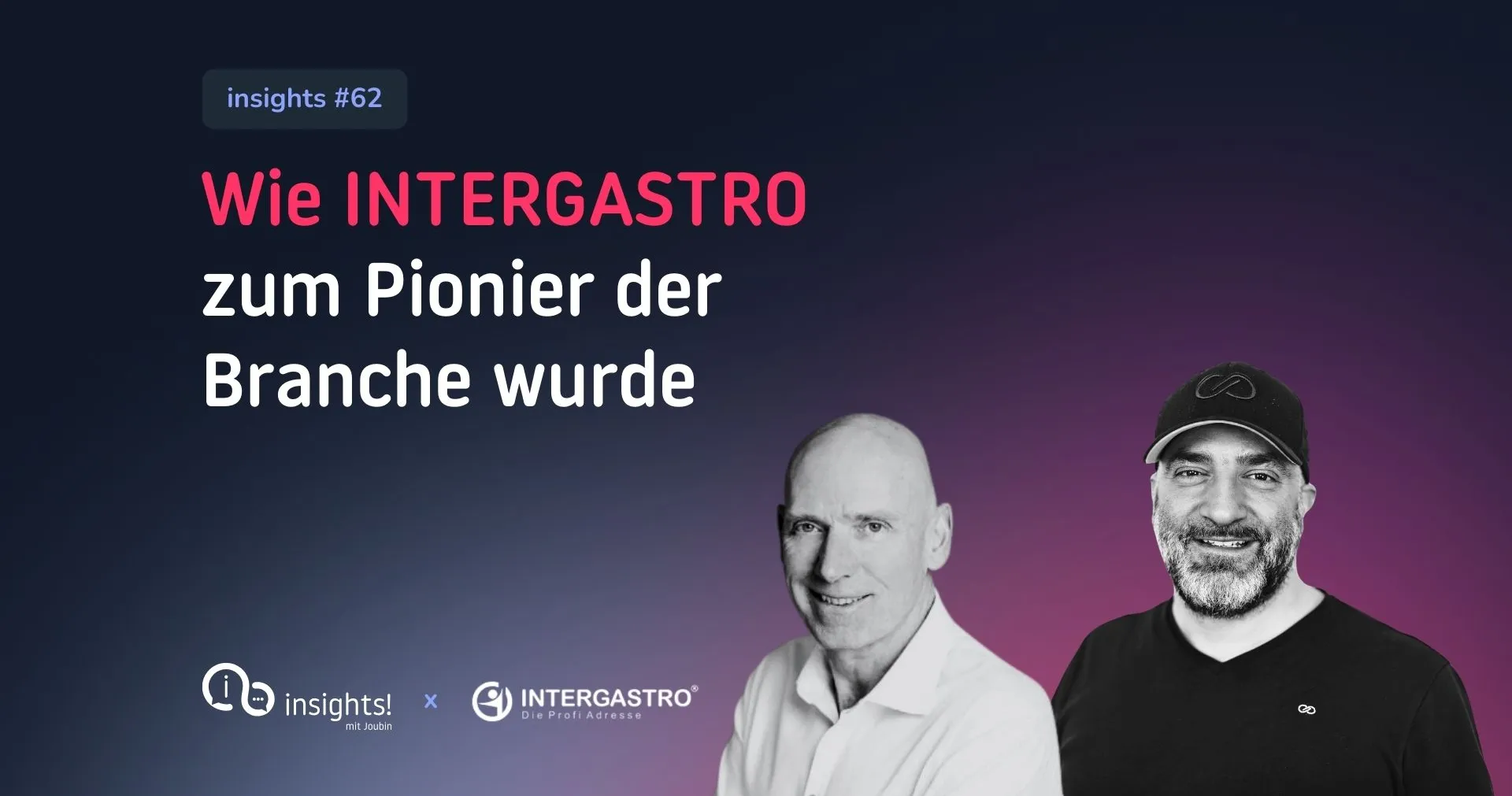
insights! episode #62: a success story in catering supplies: how Intergastro became a pioneer of the industry.
Stefan Plate, founder of "INTERGASTRO", a leading provider of catering supplies, discusses with Joubin Rahimi the origins and development of his company since 2000. INTERGASTRO has established itself successfully and supplies customers throughout Germany with non-food items for the catering industry. Stefan Plate highlights how his company remained adaptable even in uncertain times, such as during the Covid crisis, and continued to achieve success.
 Joubin RahimiManaging Partner · synaigy
4 min read
At 23 you have a company that's actually been around for a while. And statistically most go insolvent again after five, six, seven years.
The start of a success story: how it all began
When Stefan Plate founded Intergastro in 2000, the internet was still new territory, especially for the catering industry. The name 'Intergastro' — a combination of internet and gastronomy — was not only fitting at the time, but also completely fresh. But at that time, it was far from clear whether selling catering supplies over the internet would work at all. The first years were marked by uncertainty and experimentation. Stefan remembers selling the first deep fryer online — a small success that would only develop into a viable business model after a few years.
Pioneering spirit and in-house development: the first steps in e-commerce
In the early 2000s, building an online shop was a challenge few dared take on. Stefan and his team chose the difficult path of in-house development. At the time there were only a few providers of shop software, and the prices for ready-made solutions were simply too high. Instead, they developed their own ERP system and built their first online shop on top of it. This decision shaped Intergastro for many years and allowed the company to respond flexibly to market needs and continuously develop the platform further.
The switch to Intershop: flexibility and scalability as success factors
After more than 15 years on self-developed platform, Intergastro decided in 2017 to switch to Intershop, professional e-commerce platform. Reasons were clear: in-house development became increasingly costly, and requirements for flexibility and scalability kept growing. Intershop offered opportunity to significantly improve not only design but also functionality of shop. Key factor here was scalability, enabling Intergastro to tap new markets and business opportunities quickly and efficiently.
Mastering challenges: from SEO mishaps to the Corona crisis
Of course, not everything always went smoothly. The SEO area in particular proved to be a stumbling block when switching platforms. Due to technical errors, Intergastro temporarily lost important search engine rankings, leading to a significant drop in traffic. But Stefan and his team didn't let this discourage them. Through targeted measures, they managed to offset the losses within six months and restore the shop's visibility.
Corona crisis also posed major challenges for Intergastro. With customer base mainly consisting of hotels and catering businesses, crisis was tough test. But thanks to flexible cost structure and adaptability of business model, Intergastro survived crisis and emerged stronger.
The key to success: flexibility and innovation
What makes a company like Intergastro successful over so many years? Stefan is convinced it's above all the ability for flexibility and innovation. Whether banking crisis, Covid or the current challenges from interest rate rises – whoever stays flexible and remains willing to adapt their business model again and again can also endure in difficult times. For Stefan it's clear: as long as there's no 3D printer that can produce catering supplies more cheaply, Intergastro will continue to be successful.
Conclusion: agility as a recipe for success
Stefan Plate and his company Intergastro are a living example of how important agility and flexibility are in business life. In a constantly changing world, it's crucial not only to react to current challenges but also to proactively seize new opportunities. Intergastro's success story shows that it's not just about the right timing, but also about continuously working on the further development of the company.
Would you like to listen to the full episode?
Find the podcast of the interview here:
Please accept the corresponding cookies to view this embedded content.
Prefer to watch the episode?
No problem!
You'll find a recording of the interview here:
Please accept functional cookies to watch this video.
Prefer to read?
Joubin Rahimi:
Great to have you back for a new episode of insights. My name is Joubin Rahimi and today I get to welcome Stefan Plate from INTERGASTRO. Hello Stefan.
Stefan Plate:
Hello Joubin.
Joubin Rahimi:
First of all, we've been allowed to work on your shop for quite a while now and have accompanied you along the way. But shop can mean many things. Tell us a bit about INTERGASTRO and your really long history. It's not a startup from yesterday - you've built something substantial.
Stefan Plate:
Yes, we founded that in 2000. Back then it was still in its infancy. And then I thought, combination Inter and Gastro, meaning internet and hospitality, that fits quite well. And name was still free. So we called it INTERGASTRO and founded company, operate in hospitality supplies sector. That covers all sorts — hotels, canteens and so on. And we supply them from Dortmund across all Germany and beyond.
Joubin Rahimi:
You're about to hit 23 years. But in two years you'll have 25 years.
Stefan Plate:
Yes, exactly. There's a bit of backstory too. I already knew a bit about the industry from before. But then at some point the switch got flipped, and now we've been at it for 23 years.
Joubin Rahimi:
And if you look back, so basically the first one, two years you had, you sold via the internet, I assume, because …
Stefan Plate:
Yes, at the time it wasn’t clear at all that it would work. I mean, from today’s perspective, you don’t think twice about it. But in 2000, at some point I saw that the first deep fryer had been sold, and then it gradually rose. But at that point it wasn’t foreseeable to me that it would become a real mainstay – more that we said, let’s get involved and see how it develops. But it then took four, five years before we earned a bit of money with it.
Joubin Rahimi:
And did you then develop your own shop, or how did you get started?
Stefan Plate:
Exactly. We had, the ERP was always our own development and on that basis we also built the shop as an in-house development. Back then there weren't that many providers, or I had at some point got a quote made, it was absurdly expensive. So we said, we'll do it ourselves. And then we kept developing it ourselves for 15, 17 years.
Joubin Rahimi:
Where you say, absurdly expensive. I was also at a startup at that time and we were developing software there. That was always seven to eight figures, very quickly.
Stefan Plate:
Right. That was really expensive. Back then it was, I think, 250,000 they wanted, and that was out of range. Unless you'd had some investors maybe. But otherwise no ratio there if you're only making minimal revenue.
Joubin Rahimi:
Sure, it will have been our own money.
Stefan Plate:
Would have been our own money. And one couldn't simply assume that revenue would double, triple or quadruple within one or two years. That wasn't realistic either.
Joubin Rahimi:
You're not on shop platform you developed yourselves anymore back then. How often did you switch in that period? We never switched. I think we always changed hosting though. But otherwise we always kept going with this own development, which also worked well. So there are still shops today that look similar to 20 years ago, actually, and they're still successful. But we didn't switch and kept developing a design there, so to speak, which also worked well. So customers were fine with it, even if visually it looked a bit old-fashioned, it worked.
Joubin Rahimi:
You were probably used to it.
Stefan Plate:
They were used to it. And yes, what was, visually not so great, but it worked. And seven years ago we switched to Intershop. 2017. You looked at the market again back then, didn't you. Exactly. I had seen at the time, or the thinking is, if you develop everything yourself, the development costs don't really make sense, because these are things that are developed elsewhere for several customers and then the costs are shared, you don't have to pay for everything yourself. And then every development we did came with a bit of a stomach ache, where we said, actually we're paying far too much and we really ought to replace this. And then we looked at what's available on the market. And then I also looked for agencies, because I didn't yet know which software was available. And then I oriented myself towards agencies. Then I found you and then there were several options, several different shop systems. And we then decided on Intershop.
Joubin Rahimi:
You test drove it, I believe.
Stefan Plate:
There was sort of, you could take a look and then... Test drive. So it was presented a bit, yes, but not really properly test driven. The checkout was shown and it was tailored somewhat towards B2B. And I'm purely B2B-focused and that tipped the scales a bit towards deciding okay, we'll go with Intershop then. Though scalability mattered to me too. And scalability was there with Intershop without issues. So I can open a shop somewhere else tomorrow. That's all included in the package. And that was another important factor for me.
Joubin Rahimi:
With switch, that's basically your core business. If you say shop weren't there, no revenue comes in. So that's totally important. What else did you change with shop switch? Was it just the shop, or did you have to change something else too?
Stefan Plate:
No, I only switched shop systems and then we had to adapt the ERP. That was fairly involved, and we also developed a kind of PIM out of the ERP ourselves. We do that ourselves too. And that then had to be connected as well. That was pretty much a project in its own right. But yes, apart from that we haven't integrated anything else. We only have Intershop and the ERP. That's still plenty, because there isn't that much dynamism in it. In the ERP, you can really only improve things in a certain sense, making the processes more efficient. But otherwise there isn't much dynamism in accounting at all. It's been the same for 100 years. And yes, it's a bit more with the PIM system. But that's why it was important for us that the shop system had to be really scalable, so we could keep up with all new developments.
Joubin Rahimi:
And as said, keeping up with new developments has also led to a change in the interface. There's plenty of experience with that too. Now we want to bring the viewers and listeners along, since it's interesting for them too, what was good and what wasn't? Where would you say you'd pay closer attention if something like that came up again? Or if someone asked you, I want to switch my shop system from one platform to another?
Stefan Plate:
So what's worked very well is that we've now changed the whole design, and as a result the order value, the average one, has already, I'd say, moved up noticeably. So larger orders are coming in more often, which used to be rarer, because trust through the whole presentation is different now.
Joubin Rahimi:
I think SEO was another topic where we naturally had to take a proper look again.
Stefan Plate:
Right, SEO was another big point. That went a bit wrong for us during the migration. And it then took half a year until we'd sorted it out again. That's an important point, making sure you carry all your rankings across, which isn't a problem either, but it has to be properly prepared beforehand.
Joubin Rahimi:
Proper planning and so on. That’s also a maturity level for us. We come more from the technical side, but we have to factor this in and always ask everyone. Have you taken care of it? Do you have an SEO agency or something doing that kind of thing. That’s very important. Especially this SEO business. If you’re entering a completely new market, of course it doesn’t matter. But if you already have some visibility to defend, then you want to carry that forward too. And if you lose it due to technical issues, that’s obviously annoying. But you can win it back.
Stefan Plate:
So it's not something that, even if you've lost it once, you win it back. You just have to keep an eye on it.
Joubin Rahimi:
Now you've run the business for 23 years. How would you say the business environment has changed for you? Sure, the internet is now established. But how have your customers changed, or the market? Or has it changed at all?
Stefan Plate:
Maybe. I always assume so anyway. Yes, only now of course not. Now if you're in Munich, no worries about buying, say, catering supplies from Dortmund anymore. Maybe different five years ago, or fifteen years ago. But that's changed — local retailers barely exist that sense anymore. Everything online really. So that's maybe changed. Otherwise sure, acceptance and trust maybe bit bigger now, since it's common practice, wasn't so fifteen years back. But new providers keep entering market. Everyone want bigger market share.
Joubin Rahimi:
What about macroeconomic things like the Covid crisis? How was that for you?
Stefan Plate:
The Covid crisis was of course difficult, because that was our main clientele – hotels, hospitality. Many hotels really struggled. There were no bookings at all any more, and so on.
Joubin Rahimi:
And delivery services probably didn't compensate for that either? No. Judging by your face?
Stefan Plate:
No. No, in terms of volume. The canteens partly disappeared too, because everyone was working from home then. So that was more of a cut, was more of a cut, because we also had these lockdowns in Germany. They weren't the same in other countries, it wasn't quite like that in some places, where it's handled a bit more generously. But here with the lockdowns it was genuinely problematic. But somehow you get through it. Somehow you make it through and then it carries on. That's good.
Joubin Rahimi:
Well, at 23 years old you're already a company that's been around for a while. And most, I believe, go insolvent again after five, six, seven years.
Stefan Plate:
Yes, statistically speaking.
Joubin Rahimi:
Yes, we have customers in the sanitary sector and now, due to the interest rate rise and the increased construction costs, they have significantly fewer orders. So I really noticed that house and flat construction genuinely causes orders for them, positively speaking. Are these effects right now, let's say the interest rates, having any impact?
Stefan Plate:
Still say yes. Clear point. Not just construction sector, private too — financed ten years ago, need refinance now, could pay double if unlucky. Whoever pay double cuts gastronomy, cuts travel. Cycle. Notice it clear. Go supermarket — prices shift bit. Total. Don't track exact cost no more. But feel it standing at till…
Joubin Rahimi:
Yes that's a lot. Suddenly so little. And why is it so little?
Stefan Plate:
And that you can, you can only spend the money once.
Joubin Rahimi:
Correct. What tip would you have for other fresh entrepreneurs who've just started up? You've already been through a fair bit. Including crises, including 2007, the banking crisis. A lot happened there. But where would you say, that's why INTERGASTRO is still here?
Stefan Plate:
With crises, regarding crises you certainly need to be flexible — not adjusting the business model, but perhaps adjusting your cost structure and so on. Otherwise you just need to come up with a good business, think it through properly, and then hope it works and stick with it. So what I came up with seems to be working. And as long as there are no 3D printers making products cheaper than my manufacturers, the model will keep working too.
Joubin Rahimi:
Or you reinvent yourself again and have new opportunities.
Stefan Plate:
Well, then I see myself... Retired. But in retail, it's the case that retail will pretty much always work. You just need the right visibility and to be well positioned.
Joubin Rahimi:
Yes, nice closing line. See it in shoe industry too. Some shoot through roof, others go insolvent. Can't just blame market. I think, like you said, be flexible. Be flexible and agile and then at right moment really set accents again. That's a great closing word, because agility, I think, is really key to what you've achieved as success. Thanks for the chat.
Stefan Plate:
Thanks, Joubin.
Joubin Rahimi:
Sure.
Have questions or feedback?
Then feel free to contact us directly.
- Joubin Rahimi
Managing Partnersynaigy
Show phone numberShow mobile numberShow email address
Subscribe to the blog now and never miss any news
✔️free of charge ✔️weekly news ✔️expert knowledge
Please accept the corresponding cookies to view this embedded content.