

User-centred = SEO-centred
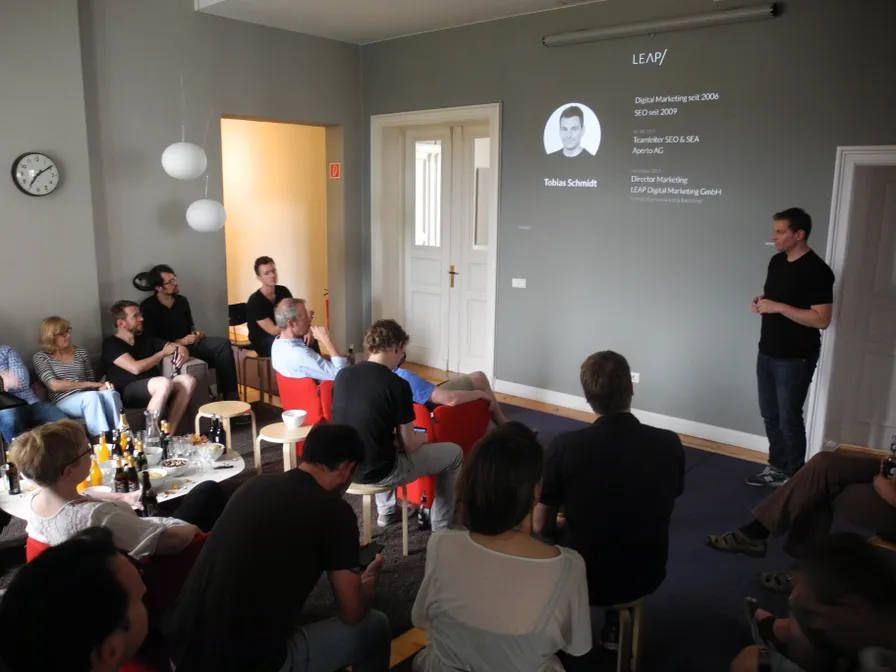
What’s new with the search engine optimization experts? Which strategies rank well, and what can cause a website to drop in Google search results? We spent an informative and interesting evening with Tobias Schmidt from Leap Digital Marketing GmbH discussing search engine optimization (SEO).
5 min read

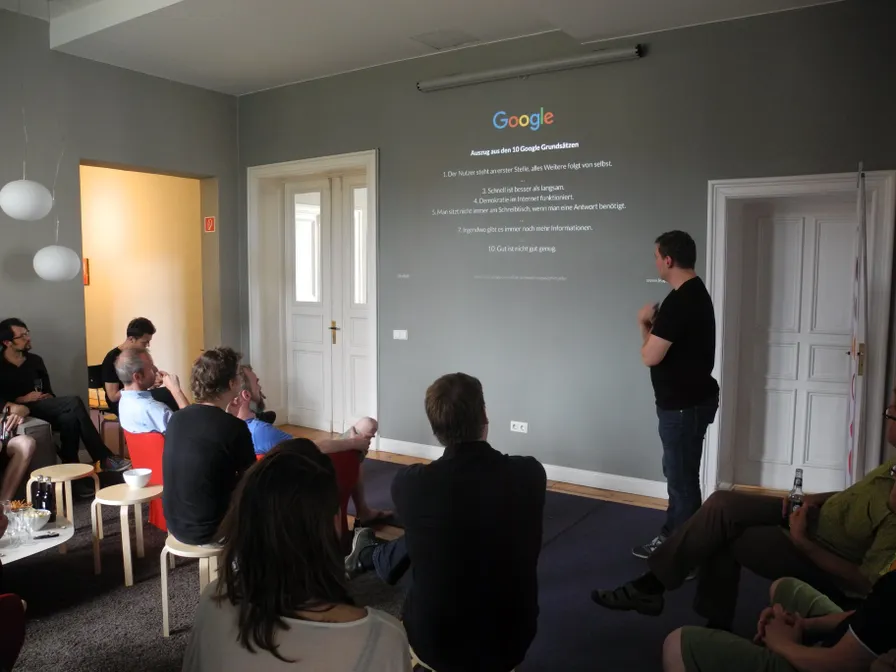
Google's 10 principles
Anyone involved in SEO must first familiarize themselves with Google. Google accounts for over 90 percent of search engine queries in the German market. So there’s no getting around Google. That’s why it helps to follow the “10 Google Principles.” They provide insight into how Google operates, as Tobias Schmidt explained.
“Google wants to understand the user: What is the user searching for, and how does the user search?” explains LEAP’s marketing director. This means that anyone involved in SEO must focus above all on the user, because “working in an SEO-centric way” means “working in a user-centric way.”
Fast loading times pay off
To rank well with a website, it needs the right keywords: the right keywords are the ones relevant to the user. To find these out, tools such as the Google Keyword Planner, Ubersuggest and AnswerThePublic are useful.
Google also places value on website speed – testable, for example, with PageSpeed Insights or Google's Test My Site. Users penalise slowness with disinterest, and Google penalises it with poor rankings. Of course, there are many more factors, the SEO expert noted, but those mentioned are fundamental.
Content is King
Tobias Schmidt advised against choosing an SEO strategy, suggesting instead that an SEO tactic be adopted - one that fits the product and the business model. For example, to avoid dry product descriptions, a furniture delivery service has developed a special program.
This program is connected to multiple servers, and once the raw product data is entered, it generates easy-to-read, continuous text with a customized product description - optimized for both users and SEO. Guided by the motto “Content is King,” this approach significantly improved the conversion rate, placed overview and product descriptions prominently, and supplemented them with infographics and how-to modules.
Holistic is King
Using an example from the healthcare sector, Schmidt, who headed the Search Marketing department at Aperto AG, explained the holistic tactic: the paragraphs of a landing page are aligned to the various variants or phrases of the keyword.
This gives the user a comprehensive answer to the search query they made - rather, the website comprehensively answers the variants of their search query.

Subheadings structure the text
The structure of websites should be clearly organised using subheadings: keyword-optimised and generally one per paragraph. Variants and related terms of the keyword should also be used.
The WDF*IDF (within document frequency*inverse document frequency) formula must also be sufficiently taken into account. The formula calculates the ratio of certain words within a website relative to all potential websites.
Creating value with W-questions
Where do I find…? How can I …? What's important with…? What do you need to watch out for with…? Answering so-called W-questions is another tactic for generating more traffic. Creating content with informative character is a highly effective approach. Because Google keeps learning, Google learns our language and can therefore also answer complex questions.
The SEO expert reported on a sales team that created numerous high-quality how-to videos, advice pieces, encyclopaedia entries and further (lifestyle tips) around its product. All of them target the W-questions and bring the website a great deal of traffic.
Link building: backlinks and internal links
The optimisations covered so far are onsite optimisations, because they can be changed directly on the website. But an important part of SEO is also measures outside one's own website, added Tobias Schmidt. He means so-called offsite optimisations, for example link building. Backlinks, i.e. links from others to one's own website, as well as internal links, can help the website gain more visibility.
However, these links should be set correctly. Backlinks from disreputable websites are penalised by Google and have a negative impact on your own ranking. Blind link campaigns are therefore inadvisable. Instead, links should be generated in a targeted way from websites with high domain popularity.
Domain popularity makes the difference
Domain popularity depends on how reputable the linking website is. For example, spiegel.de has higher domain popularity than lingscars.com. A link from spiegel.de to your own website therefore has a positive effect on your own ranking, while a link from lingscars.com has a negative one. Internal links between the landing pages themselves and the homepage – set with the right anchor text – can also help boost visibility.
The list of SEO optimisations, whether onsite, offsite or technical, is long, and the evening is finally over. We took away a lot of input, and it became clear: SEO tactics should be aligned with product and business model. And even once you have chosen your SEO tactic, different manoeuvres need to be carried out at different points to improve ranking.
ABOUT ISPIRATION
ISpiration is the lecture series by interactive tools. Once a quarter, selected experts inform and inspire on current topics from the digital world.
Your contact person
- Marian Gertheim
Consultingsynaigy
Show phone numberShow email address