
We're moving check-in
7 min read
How a simple question can turn agile robots back into people. An anti-robot programme.
When Scrum gets applied routinely in a team over a long period, it can easily start to feel like this: "We're the agile robots in our Scrum factory. Fed by tickets and backlogs. Steered by Jira we move in swim lanes. Automatically we meet every morning for our stand-ups, recite our sentences routinely: What did I do? Where are there problems? What am I doing next? … and so on and so forth ... We're the agile robots under control of our tools and processes … (inspired by: Damon Albarn's Everyday Robots).
But what was agile working actually about again?
About us as people: "individuals and interactions over processes and tools." (more on the agile manifesto). What sets people apart from robots? Emotions.
At interactive tools, we want to be human, we take people seriously. Let's bring the human element back into the agile process. Let's laugh, let's be weak, be in a bad mood, be stressed, moan about public transport, make mistakes, bring strawberries or talk about the sunshine. Robots can't do any of that. We don't need to destroy the whole agile process for that. It's enough to reactivate the human element and put it first.
#We-are-moving
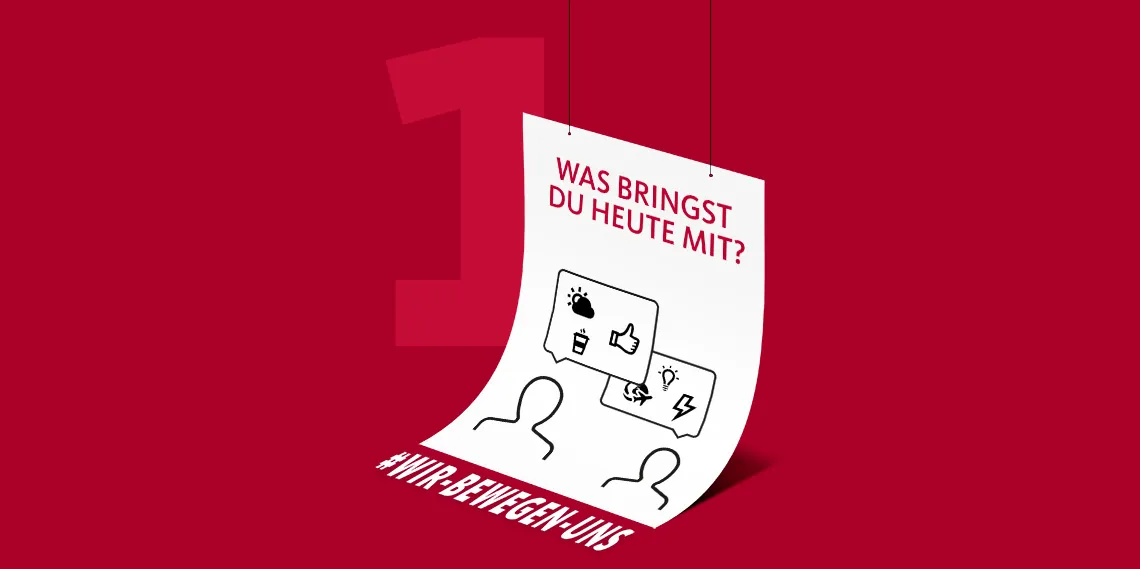
At interactive tools, we're moving towards becoming an evolutionary company. With #wir-bewegen-uns we label actions, workshops, methods and formats that help us work together better across disciplines - agile, self-organised, with shared and joint responsibility. The whole thing is a path along which we try out, develop and allow a lot. We are open and mindful. What matters to us here is that we don't install finished programmes from above, but move forward situationally and iteratively: understand, rethink, develop ideas, condense and try out. If the idea works, we spread it, or it spreads itself. In doing so, we keep questioning our way of working: how do we do this?
Starting with check-in for stand-up
A very simple way to bring more humanity into the agile process is to check in first at every stand-up. Simply put a question before the typical three questions (What did you do today? What's blocking you? What will you do next?): What have you brought today? Anything goes as a reply. Here are a few excerpts from real stand-ups with people:
"I bring good mood with me, finally sunshine!"
"I'm charged up - finally slept long enough for once."
"Sore muscles!"
"I'm totally annoyed, it took me over an hour to get here today with the rail replacement bus."
"I feel light, came by bike today and cruised easily through Mauerpark."
"Good news: the customer has ordered package 2."
"Feeling stressed. Not sure right now where to start."
People must not be left outside
Now one might conservatively object: what does the team, and each individual, get out of this? We're not running a self-help group here. Work is work. Private is private. People are supposed to just do their job. Yes, true. But they can do it better when people don't have to stay outside.
Even if we wanted to, we can't switch off our private selves. Our mind doesn't work like drawers: open the work drawer, close the private-life drawer. Our mind is a thinking machine that constantly links and produces, a network of thoughts, memories, worries, wishes and ideas.
We can fight against that and try to suppress our self by forcing ourselves into a seemingly professional work role, as has been demanded of us for centuries in the traditional world of work and is still demanded of us by most companies today. Or we can accept our self in its entirety and creatively harness the chaotic potential. Studies, experience reports and our own work at interactive tools show: employees work more productively and creatively as human beings in self-organised teams.
The team is now the focus, not the individual – work processes now move in loops rather than linearly, and the workplace becomes a flexible space for creative collaboration, no longer a place for lone wolves.
Check-in help bring team into focus and together: "Checking-in/out invites each member in a group to be present, seen and heard, and to express a reflection or a feeling. Checking-in emphasizes presence, focus and group commitment."
The anti-robot programme works
Checking in can be an important first building block for allowing wholeness and being human. This is how the anti-robot programme works:
1) Wholeness instead of role
Checking in gives everyone the feeling: I'm allowed to be human here. I don't have to put on an act. I don't have to hide behind a professional mask.
2) Emotions instead of objectivity
It's okay to be in a bad mood, annoyed or stressed. It's part of life to have had a bad night because, for example, the child was awake during the night. No one needs to hide anything. Conversely, it's wonderful when I bring joy and lightness to others, or when others in the team infect me with their good mood.
3) Understanding within the team instead of conflict potential as a lone fighter
Sharing a bad mood has two major benefits: (1) creating understanding (2) reducing potential for conflict. Hidden stress and suppressed fatigue provide plenty of material for conflicts on side issues.
Real project example: colleague came in fairly tight for stand-up each morning and was usually in bad mood. This led to uncertainty in team: some wondered, am I doing something wrong? Is he annoyed with me? Is something going wrong in project? Working with this colleague was difficult and team collaboration suffered.
When we introduced the check-in into the stand-up, it turned out: the cause of his bad mood was public transport. He mostly experienced his morning commute as a tutor. By being able to talk openly about it, he let off steam. It was okay to be annoyed, and just being allowed to share it already had a stress-reducing effect on him. The team could now handle it well, since everyone knew they weren't the cause of the bad mood. After a few days, it developed further into a running gag. Humour against stress: there's nothing better.
4) productive :-) instead of inefficient :-|
When people can be fully human, they feel better. It feels better for everyone and makes many things easier. If people have to hide their "self" in front of colleagues, because "after all, you're at work", it leads to constriction, heaviness, reluctance and unproductivity. When humanity and wholeness are allowed, it affects the whole team, both its productivity and its creativity. Laloux describes this productive sense of togetherness as magical.
Become part of our team now!
What happens then is magical. At some of these workplaces there's an energy and vibrancy (...). Colleagues discover, full of wonder, how much more life is in them.
We are the people
After the stand-up we carry on working together as people. Because that's what a stand-up is for. It's not about everyone reciting their sentences, but about establishing follow-up communication and organising collaboration quickly and easily: supporting, inspiring, to move forward together. By being human, we can make the team a safe space for productive and creative collaboration. Try to be human. Further means of putting people at the forefront:
Try to be human: the wholeness and empathy series
Reflections
Check-in as stand-up extension
Personal notes
Timo Wirth specialises in empathetic organisational development and is Programme Director for interdisciplinary collaboration and agile coach at interactive tools.
Your contact person
- Anne Geissler
People & Organisationsynaigy
Show phone numberShow email address