
We're moving reflections
5 min read
Who's afraid of feedback? Everyone. What would change if feedback weren't judgemental and delivered top-down? If, instead, feedback were shaped by appreciation and connection, given mutually and collaboratively within the team? Everything. Then feedback can become a driver of self-directed personal development.
How did we arrive at a format for direct, appreciative feedback?
At the start, there was an uneasy feeling. At interactive tools, as part of #wir-bewegen-uns, we had already done a lot for better collaboration in agile and self-organised teams. Classic annual employee appraisals, in which the manager evaluates the employee and gives feedback, simply no longer fit with that.
Interested? Join our team!
#We-are-moving
At interactive tools, we're moving towards becoming an evolutionary company. With #wir-bewegen-uns we label actions, workshops, methods and formats that help us work together better across disciplines - agile, self-organised, with shared and joint responsibility. The whole thing is a path along which we try out, develop and allow a lot. We are open and mindful. What matters to us here is that we don't install finished programmes from above, but move forward situationally and iteratively: understand, rethink, develop ideas, condense and try out. If the idea works, we spread it, or it spreads itself. In doing so, we keep questioning our way of working: how do we do this?
Moving away from old formats
We no longer need an employee review meeting focused on pleasing your team leader, presenting yourself well to fend off absurd targets, or negotiating a higher salary. We want a format that reflects our cooperative spirit. One that lets us give open, fair, appreciative and direct feedback – within the team and more often than once a year.
What if we tried to have these conversations not out of fear, but out of deep connection, genuine interest and true appreciation?
Philosophy & setting of a reflection
Inspired by Laloux's remarks on performance appraisal in "Reinventing Organizations", we developed a suitable feedback format for ourselves, which we call reflection. The basis for reflection within the group is connection, genuine interest and appreciation. The reflection is for and by the employees. It's meant to serve as a foundation or living space for personal and professional development.
The setting and atmosphere matter here: no one has to put on an act, pretend, or retreat into a role. No one has to fear being sanctioned for their openness or for voicing doubts. We talk and give each other feedback as people and colleagues. We give each other productive, mindful feedback. Productive feedback has no place for: judging, condemning, blame, detail discussions and justifications.
Step by step: how a reflection works
A reflection involves a group of 3-8 people.
Everyone who takes part receives and gives feedback. Feedback works like this:
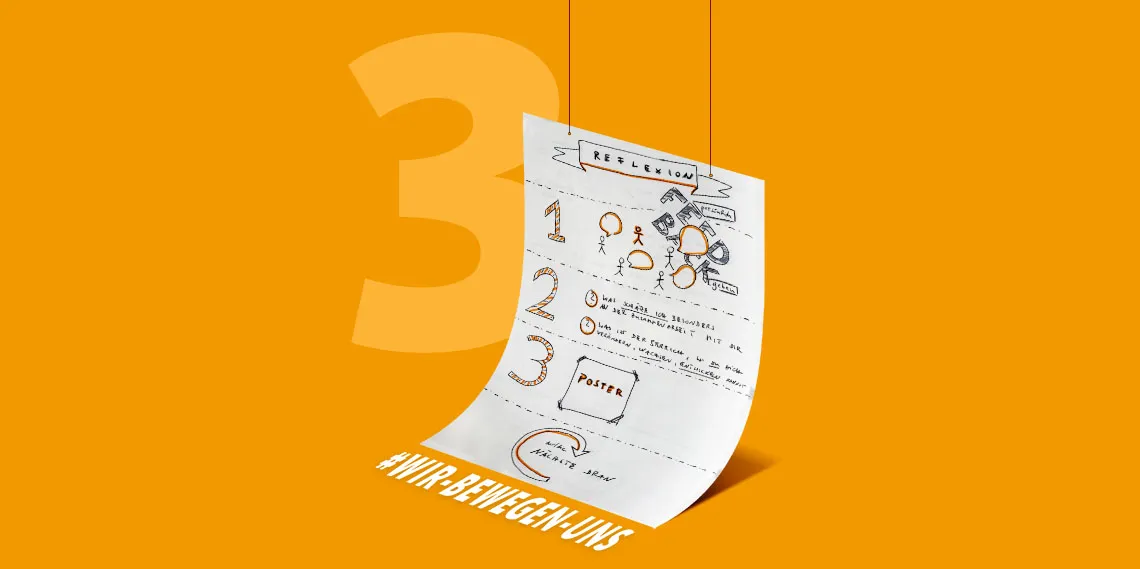
One person listens, everyone else gives them feedback in turn on 2 questions:
What do I particularly value about working with you?
What's the area in which you can develop or grow?
The feedback is subjective and draws on personal project experience. (It is not about judging or evaluating the other party as a whole.)
Once everyone has given their feedback, it's the next person's turn to listen.
In addition to the people from the team, there's a neutral person who puts what's said onto a poster.
Once everyone's done, we'll look at the posters together: everything legible, everything understandable, anything important missing.
The posters are the property of the employees. They can do what they like with them. No one takes photos or copies for the personnel file. Everyone can decide for themselves what to do with the feedback about them.
Here are a few guiding questions anyone can use to get more out of the posters and independently derive personal development:
What surprised you?
Is there anything you're still thinking about?
What do you take away from the conversations?
What would you like to focus your attention on in future?
In which direction would you like to develop further now?
A very special atmosphere
It's hard to describe what happens during a reflection session. You simply have to engage with it and experience it. Beforehand, and on a theoretical level, plenty can be questioned or viewed critically. Employees taking part for the first time in particular can easily find enough things that create unease or even fear in their minds. Once they take part in a reflection, they experience something completely different. In the safe space of the reflection, an energy field emerges shaped by appreciation and connection. Now feedback can be easily accepted and lead to personal, self-directed development. The participants can describe this much better.
Feedback upon feedback
At the end of each reflection we do a quick check-out: how did you find the method? Was the feedback helpful for you? Quotes we've gathered from various reflections:
"I've never done anything this esoteric, hippie-like before, it was really good"
"I'm almost overwhelmed by such constructive, wonderful feedback - you never get that otherwise.
"You say things you'd otherwise never say ... And that would be a shame"
"Strengthens trust within the team"
"That's balm!"
"Feels good to get feedback like that."
"Criticism becomes encouragement. And I can accept it"
"This constructive vision is great: we help each other get better.”
Timo Wirth specialises in empathetic organisational development and is Programme Director for interdisciplinary collaboration and agile coach at interactive tools.
Your contact person
- Anne Geissler
People & Organisationsynaigy
Show phone numberShow email address