
Who's the boss here?
9 min read

For several years we've been moving towards becoming an evolutionary organisation. Our managing directors, by their own account, are no longer bosses; there's hardly any control and no plan – but all the more trust, and encouragement towards self-organisation and good collaboration.
What does this mean for everyday working reality? Does it even pay off economically? In conversation with managing director Robert Birker and organisational developer Timo Wirth, we get to the bottom of these questions.
1. interactive tools has two managing directors, but no "bosses". How should that be understood?
Robert: We want our employees to actively help shape the agency. My business partner Klaus and I don't want to always have to determine and control everything. We believe that good things don't only emerge when we control everything. So we've said goodbye to the classic notion of being the boss. Our role as bosses is hopefully now only symbolic.
Timo: That doesn't mean the agency is unmanaged. We have neither chaos nor a leadership vacuum. What we have is collaboration in self-organised teams with shared responsibility.
Our leadership role is hopefully only symbolic now.
2. So there are no hierarchies?
Robert: No and yet. There are hardly any structural hierarchies based on position left. There are, however, natural hierarchies based on competence – these aren't rigid but shift within the team depending on the situation. This creates shared and joint responsibility. Classic leadership roles are obsolete for us – it's always teamwork with particular consideration of the needs and experiences of the individual.
3. Can employees build a career with you?
Timo: We no longer have a classic career path to offer.
It shouldn't be about which title I get printed on my business card next or which targets I have to meet to be allowed to move up.
Rather: it's about personal growth and professional development – intrinsically motivated and driven by the employees themselves.
4. How did you manage to achieve this development?
Robert: We still manage that. We've been working on it for several years and will keep working on it. There probably won't be a point where we say: now we're perfect.
It's many small steps. Important, for example, is our error culture. We want employees to engage and have the courage to try things out. But trying things out also means mistakes get made. These mistakes then just need to be recognised, and one must learn from them.
AppSec This is about letting go and allowing. It's not easy to let go sometimes and wait and watch and realise there are different ways of doing things right.
We also don't roll things out to the entire company from the top down. We try things out in project teams – that makes it faster. And if it works well, great. And if not, you can learn from it, and that's fine too.
5. What kind of mindset is that?
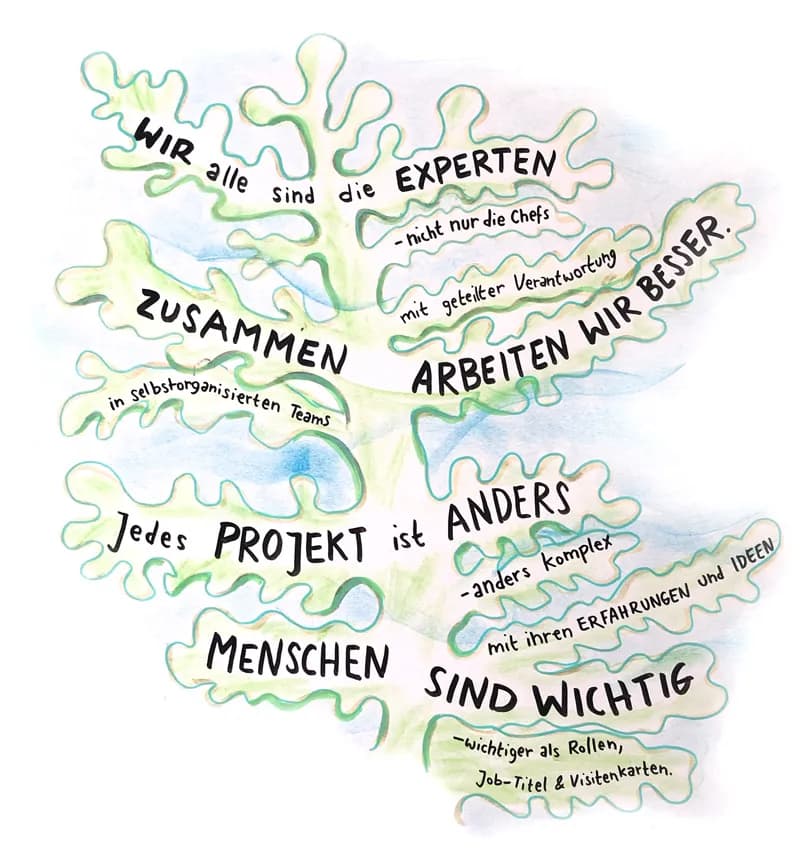
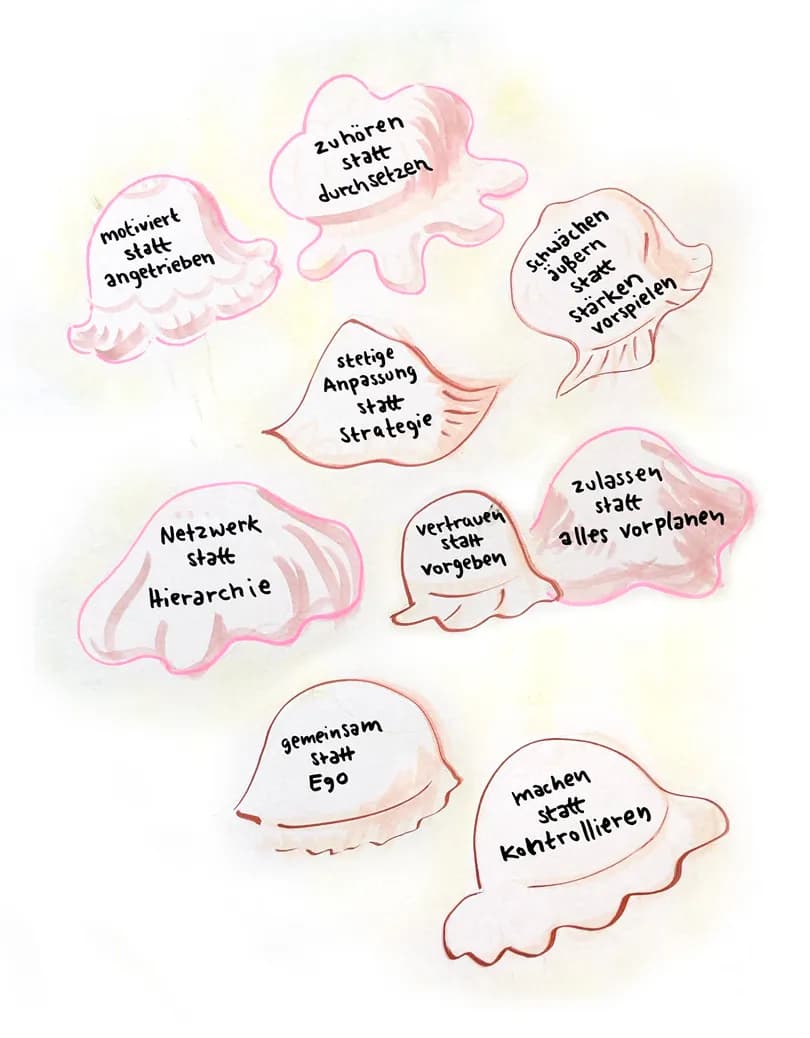
Timo: Instead of corporate philosophy PowerPoint presentations or complicated process charts, we have large posters in the agency on topics such as:
How we want to work together.
Being human.
How we want to make decisions.
What we believe in.
Then it says something like: "We believe in people, not roles and business cards."
Robert: And we're now extending this approach to clients as well. We have many clients who really value being able to work with us in a more open and relaxed way than perhaps within their own organisation.
Timo: One more addition: enthusiasm for diversity and teamwork in the team, that matters to us, that everyone can be themselves. That might sound esoteric to some at first, but it isn't. No one has to prove anything to themselves or others. No one has to seek profile. And no one is put under pressure by certain expectations or role attributions.
Enthusiasm for diversity and teamwork, that matters to us, that every person can be themselves.
6. What do you do with the especially engaged employees – the high performers? And how do you motivate those who participate less?
Robert: What do we do with particularly engaged employees? Nothing at all. There's no reward and no penalty. We give them the freedom to make their own decisions.
Timo: We no longer have that reward-and-drive model. What we have is space – an inspiring and, above all, safe space for everyone.
Nobody needs to be afraid of making mistakes, voicing doubts or pushing ideas forward. Regardless of position or experience.
Robert: A colleague put it quite well.
He said: "I don't need to be motivated to perform at my best. No boss and no client can demand more of me than I demand of myself."
Aside from that, team members also motivate each other. After all, everyone shares the same goal: doing things better and working well together.
There's no reward and no penalty. We give the freedom to make decisions independently.
7. Does this freedom extend to other areas too? Working hours, for example?
Robert: Part-time is no problem for us, it's a situation we handle as a matter of course. 40% of our staff work part-time for entirely different reasons, with different models. And no one should have to work significant overtime. On the contrary, we want no overtime to be worked at all. Yet I never had the feeling that this made our "human resources" worth less.
8. Does all this actually benefit the company? Are you now working more efficiently or profitably?
Robert: Some companies, this process about profitability or efficiency. Not my concern at all. Positive side effect though.
After the first year, which was very intense, the agency's economic performance also suffered under this development. But for two years now we've seen that we're also operating more profitably. Projects are handled in a more targeted way, and agile working also changes how you communicate with clients, because you work sensibly rather than clinging to supposed goals.
And then we reduced bureaucracy. Because the team also decides how it wants to do things. Through less control, we become more focused.
Timo: Control and requirements are always more expensive than freedom, trust and letting go.
This applies to the whole organisation as much as to every single employee.
Projects get handled in a more targeted way, and agile working also changes how you communicate with clients.
- Timo Wirth
Creationsynaigy
Show phone numberShow email address