

5 success factors in B2B marketing
7 min. reading time
Novel working concepts, the newsroom as a communications hub and connected data management – we report on trends that matter for your B2B marketing.

You experience it every day: globalisation and digitalisation are the major drivers of a profound transformation affecting every area of business. It often turns out that companies cannot react fast enough to digital trends or competing business models. Rigid structures make them sluggish.
Employees in digital communications also face numerous new challenges. Customer engagement today must work internationally while simultaneously reaching the desired target audiences nationally, regionally and locally.
How can you spot short-lived hypes, and behind which approach is there a trend you really shouldn't miss? As a digital agency and specialist for the B2B sector, we understand your challenges. Our experts engage intensively with the opportunities and risks of digital transformation.
Touchpoints with customers and prospects have multiplied in a very short time, and customers expect dialogue on equal terms and fast response times. All this is blurring the boundaries between corporate communications, marketing and sales. None of this is news to you, of course: but how can your company break free from traditional silo structures? How do you find out what your customers really need? And which trends in B2B marketing offer concrete solutions?
1. Network thinking: interdisciplinary teams instead of departmental silos
No more departmental boundaries, the manager not above but right in the middle: engineers, marketing specialists, sales colleagues, lawyers and HR staff work as one team. The concept of "network thinking" surely plays a key role in dismantling traditional silo structures within companies.
For Ulrich Weinberg of the Hasso Plattner Institute in Potsdam, a thought leader in network thinking, this approach stands for cross-disciplinary collaboration, de-hierarchisation and a consistent focus on customer needs. In practice, small, cross-departmental project teams develop new ideas and solutions, test them early, and aren't afraid to present unfinished work or make mistakes. The freedom enjoyed by these four- to six-strong teams unleashes creativity and drives innovation forward.
The result is new marketing strategies, unconventional approaches and ideas that enable companies to seize the opportunities of digitalisation. Large B2B companies such as Bosch are already relying on this new working concept.
So far, so good: but why exactly does the future lie in networked thinking and action? How can this approach be fostered? And where is network thinking already being practised? Arguments are needed. We support you in building the internal case and in implementation. Send us an email and follow the link for further information: Network Thinking with Ulrich Weinberg
Please accept functional cookies to watch this video.
True innovation today means bringing together as many different aspects as possible – that is, combining the thinking and practice of the most diverse disciplines.
2. Agile working: how network thinking is put into practice
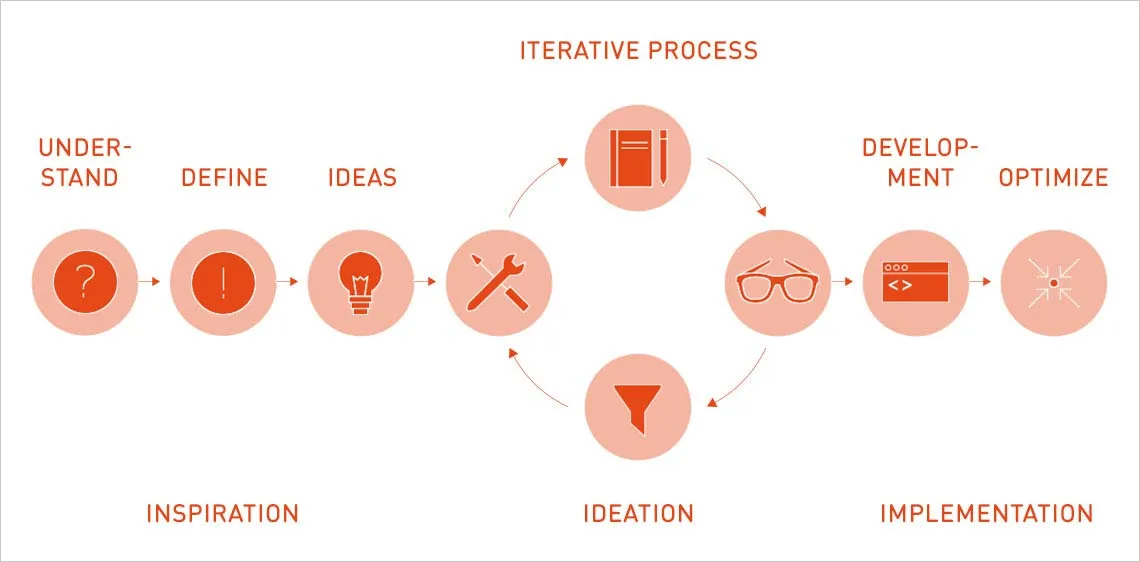
Have you overcome internal resistance and departmental boundaries? Are the teams ready to act in an interdisciplinary, self-directed way with flat hierarchies, in the spirit of "network thinking"? Then the following questions are sure to arise: what is the best way for cross-departmental project teams to collaborate? "Agile", of course. But what does that actually mean?
Agility emerges when you succeed in living and applying the concept of "network thinking". Connected working processes give you the ability to stay responsive in a dynamic market environment and to keep learning continuously. Learning effects and developments are then not confined to individual departments but benefit everyone. You remain flexible and adaptable at all times – in other words, "agile".
Short communication paths and physical proximity are important prerequisites for agile working. Many companies create a creative home for their interdisciplinary teams with room concepts specifically designed around "network thinking". For practical agile collaboration on projects, we recommend customer-centred methods such as "design thinking" and project management models such as "Scrum". Read our interview on the topic of design thinking with our expert Timo Wirth, which offers exciting insights.
What is the need behind an idea? This question is where agile, customer-centric thinking begins, opening up unimagined innovation potential.
3. Content for every channel: the newsroom as a communications hub in B2B marketing
A great example of "network thinking" in practice is the trend towards the newsroom. The number of channels through which customers engage with companies has multiplied in recent years.
Accordingly, the need has probably also arisen in your organisation to coordinate diverse communications and make them cost-efficient. This requires continuous coordination across all departments involved in communications within the organisation. And this is where the newsroom approach comes into play.
The newsroom acts as the organisation's central communications unit. The colleagues working there come from various departments and take on the practical implementation of the content strategy. All departments forward their information and content to the newsroom team. Rigid structures are broken down, knowledge is shared, and the newsroom becomes the hub of all communications – internal and external. From this 360-degree perspective, the team produces all content formats – text, images, videos, graphics, etc. – for all communication activities and channels.
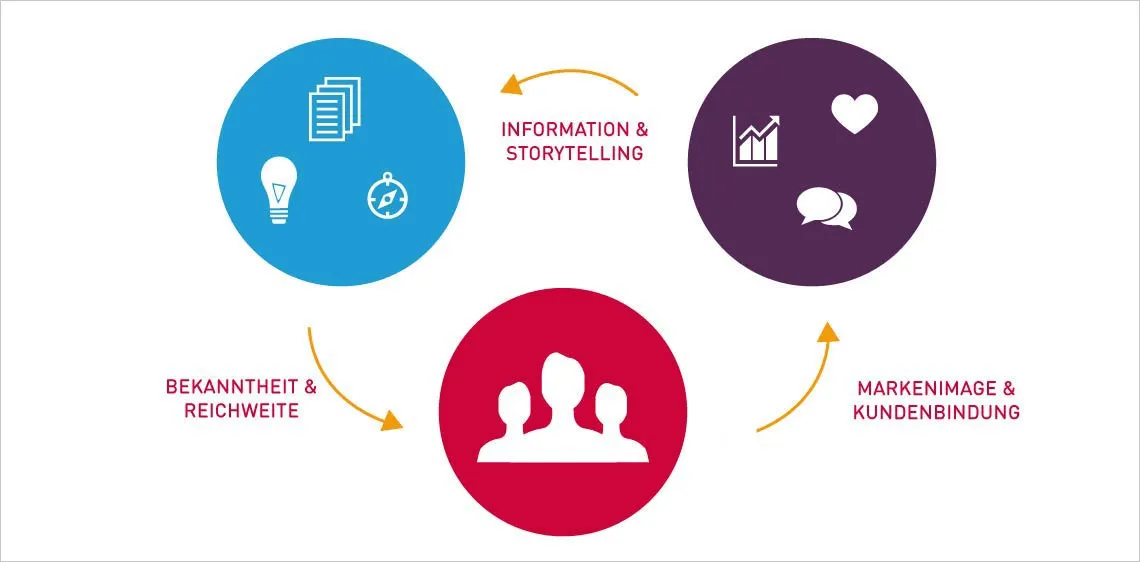
The content strategy is the compass for work in the newsroom. Our team supports you in developing your strategy and building the necessary editorial processes.
4. Content in B2B marketing: success with niche topics
Content marketing has long since become a fixed feature of the marketing mix. Storytelling geared to your target audiences' needs positions your company as a personal advisor, a reliable problem-solver and a useful source of information. In this way, content marketing helps you build brand awareness, manage your image, spark dialogue, generate leads, create sales impulses and build long-term customer relationships. B2B companies in particular stand a very good chance of reaching their target audiences with well-founded content.
With their often highly specialised niche topics, they can afford to neglect popular subject areas and sought-after keywords, and still achieve visibility and reach among their target audiences with relatively modest budgets. In our Content Marketing whitepaper, you'll learn in a practical and precise way how to convince your boss and colleagues of an integrated content strategy for your B2B marketing:
Download the Content Marketing whitepaper now!

For us, content marketing means authentic storytelling with high journalistic standards. We develop cross-media communication that responds to readers' needs and so builds bridges between your company and your target audiences.
5. Business Intelligence: Analysing data and using it profitably in B2B marketing
More and more data from various digital touchpoints – organisations face a veritable flood of data. But what business-relevant insights and recommendations for action can be gained from marketing, sales, support or service data?
To achieve this, organisations must identify the data that is right and important for them, connect it intelligently, and integrate it into a unified digital strategy. Here too, the aforementioned knowledge and data silos must be broken down, and the various systems – such as Product Information System (PiS), Customer Relationship Management (CRM), Enterprise Resource Planning (ERP) or the data collected from company channels – must be connected with one another.
Software solutions such as tableau help turn this flood of data into meaningful, visualised reports. On this basis, profitable decisions can be made and clear performance gains, cost reductions and process optimisations achieved.
Powerful tools are also already available with other web analytics programmes, with which traffic, dwell time, landing pages, interactions, bounce rates, social media interactions and other digital touchpoints can be measured.

Discussions about planning and further development quickly get lost in subjective perceptions. Meaningful data provides an objective view of the status quo.
Conclusion
Connected, agile thinking and action is becoming the decisive success factor for B2B companies in global competition. Only once companies succeed in breaking down traditional knowledge silos within their communications departments can they truly seize the opportunities of digitalisation.
Network thinking creates the opportunity to build interdisciplinary teams that consistently develop ideas and solutions around customer needs. Customer, corporate and sales communication can be synchronised. That, in turn, is the basis for successful content marketing and cross-departmental editorial processes, all the way to setting up a newsroom. Profitable data management across all touchpoints also requires connected collaboration. The five success factors presented here will have a lasting impact on digital B2B communication. Get in touch. We'd be glad to work with you to develop concepts for driving these trends forward in your company.

Your contact
- Klaus Cloppenburg
Managementsynaigy
Show phone numberShow email address