

Advantages of agile methods
15 min read
Scrum, Kanban and co. – we have been using agile working methods for several years now. Below, we present the best-known agile methods with their advantages and interpret the fundamental principles of agility for our projects and collaboration.
In our experience, it should generally be decided individually for each project which approach model best fits the requirements and the client. Agile methods and rules alone don't guarantee agile collaboration.

What is Scrum?
Scrum is an agile method, a project management framework.
Scrum consists of a few rules describing four events, three artefacts and three roles.
The goal is rapid, resource-efficient development of high-quality (digital) products.
Events: sprint planning, daily scrum, sprint review, sprint retrospective
Artefacts: product backlog, sprint backlog, increment
Roles: product owner, scrum master, scrum team
What is Kanban?
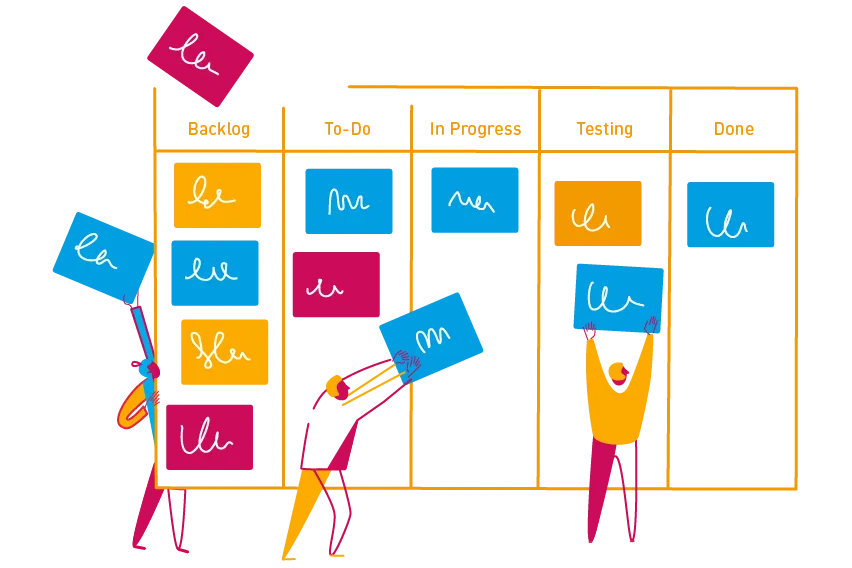
Kanban is an agile project management method.
Kanban, originally a method for flexibly controlling production processes in the automotive industry, manifests in many application development projects as a Kanban board: a visualisation of all processes of a project. The goal of Kanban is to reduce costs and resources in order to optimise the value creation of a product/service. Kanban pioneer David J. Anderson distinguishes four basic Kanban principles:
1. Start with what is now
2. Pursue incremental, evolutionary change
3. Take account of current processes/roles/responsibilities
4. Encourage leadership at every level
Other agile methods
We use different techniques depending on the project. Outside the Scrum or Kanban methodology toolkit, we use various formats to work better together. These formats create more empathy, mindfulness and consideration in complex projects. Sometimes we also develop our own methods.
Find out more about our own methods here:
Icke note appreciative feedback empathetic stand-up
Conclusion: the benefits of agile methods at a glance
Scrum, Kanban, Design Thinking and co. – agile ways of working have long since found their way into agencies and companies. In principle, though, it should be decided individually for each project which approach best fits the requirements and the client. A key point in favour of agile methods is that we regularly check as a team whether the method used brings an advantage to the project. This way we can quickly resolve problems that hinder project progress. In addition, interpersonal appreciation is an important part of teamwork in agile projects for us. Because every member complements the team with their skills, can actively contribute and drive change at every level. At the same time, clients are integrated into the development process from the start and become part of the team.
For our clients, this approach results in fundamental benefits:
Faster project start, as not all details need to be defined and decided at the outset.
Direct influence on the project course through participation in meetings, usability tests, sprint plannings and personal sign-off of sprint results.
More effective workflows and high flexibility in response to changing competitive requirements and customer and user needs.
Errors are identified and fixed at an early stage of the project.
Results tailored to customer and user needs.
Fast results and short time to market
The points mentioned mean that agile projects often lead to the goal most effectively. Because our clients get the opportunity to help shape, test and change their digital project. But above all, we give them a real competitive advantage: we start our projects quickly, implement them efficiently and develop digital products together with them that users genuinely need.

Three principles of agile working
We would like to take a closer look at three fundamental principles of agility below. For us, these principles are more important than methods and rules; they form the basis for our form of agile collaboration.
1. People are more important than processes and tools
2. Responding to change is more important than following a plan
3. Customer collaboration is more important than contract negotiation
1. People over processes and tools: leveraging employees' knowledge
Long process chains, for example approval and authorisation processes when purchasing materials and services, are common in many organisations. Budget rounds in the departments are often followed by lengthy tenders, decisions are often made across several hierarchy levels. The rules of such process chains leave hardly any room for manoeuvre, the evaluation criteria for purchasing office supplies often don't differ from purchasing complex software and consulting services, and in our experience they take the speed out of digital projects. Furthermore, there's no guarantee that the best possible solution for the organisation comes out in the end. Decision-makers and gatekeepers - management or central procurement - often lack the background to assess these offers.
Agile methods in companies: moving away from rigid processes
Agile companies are faster here mainly because they assume that employees in the specialist departments best understand what they need, and they encourage their employees to actively contribute. While agile companies also have hierarchy levels, budgets and decision-makers, these can act more freely and detached from rigid processes and often coordinate directly with one another.
Become part of our agile team!
That means for us in everyday life that every team member can initiate change if they think we as company, customers or respective project benefit from it. Employee speaks directly with those who'd be affected by change, gets their feedback, and can approach management with agreed proposal, or present it to customers. Important here are regular alignments at team or company level, or between project team and customers. Every team member is explicitly asked whether, from their view, there's something that could be done even better and what further approach should look like.
2. Responding to change: more than following a plan
In traditional "waterfall model", project work runs in sequential phases. Once one phase wraps, next follows, building on previous phase's results. With this method, those responsible plan every step, milestone and project stage upfront — from start to launch. Every single aspect of project gets examined, analysed and assigned a fixed price like in a spec sheet. This approach means project start gets delayed, since a complex plan first gets detailed out, then worked through point by point.
But what happens when new insights or unexpected problems arise during the course of the project? At this point, the "waterfall model" makes it hard to react to change. Adjusting a project plan once it's been drawn up costs time and money. Since the next phase can only start once the previous one has finished, strictly working through each phase also takes up unnecessary time. On top of that come potential holiday and sick days. In the worst case, this leads to such delays that the product no longer meets the competitive situation and crucial technical innovations can no longer be taken into account.
Agile vs. classic project management
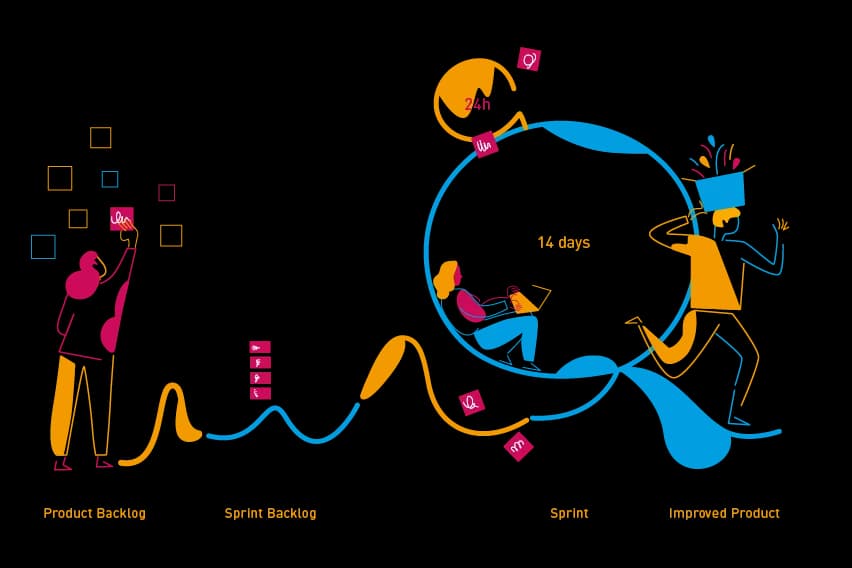
Agile methods such as Scrum, Kanban, Design Thinking and others are a counter-model to classic project management. Instead of overly detailed planning, we use clear goals and guidelines to get started faster and respond flexibly to both changes and new insights during the development process. That's why, for agile projects, we rely on short, manageable work packages ("sprints") and regular, brief exchanges on project progress ("daily").

We note all new tasks in a "backlog" and current tasks in the so-called "sprint backlog". This allows individual teams to organise themselves on how best to work through these backlogs. Instead of rigid plans and predefined workflows, the team's freedom to self-organise ensures greater efficiency. The customer is transparently involved in this process, able to influence task prioritisation or contribute new requirements during sprint meetings.
Through this freedom, the project team and its members bear responsibility for their approach and take on the detailed planning. Since some points can only be clarified during implementation, the agile approach is particularly suited to complex projects. This is because the work is carried out in small incremental steps. This allows us to react quickly and flexibly to obvious and necessary corrections that couldn't be foreseen at project start. Taking short-term changes in the competitive landscape into account is therefore also no problem. This way we develop a product tailored to the competitive situation and the needs of customers and users.
3. Collaboration with the client: more than contract handling
But how does one draft the contract for an agile project? In the conventional approach, the service provider prices a requirements specification and the work defined within it. If changes occur during the course of the project, or the original definition does not match the project's requirements, a process of so-called change requests is set in motion. These often cause stoppages in the project and lead to greater communication overhead.
For agile projects, in our experience, the use of agile budgets – often also referred to as an agile fixed price – has proven effective. In an initialisation phase, the scope of the project is first defined together through workshops and a prototype is developed. The service provider gives an expected range, and together a budget limit, a rough project plan and deliverables to be provided are defined. Once the rough requirements are in place, the detailed specification and prioritisation of tasks within the project takes place.
Customer is part of the team
Agile methods create transparency, outward and inward. We make individual tasks and process flows visible to customer, e.g. via a shared ticket system. Customer also has opportunity to take part in regular exchange and collaboration formats – such as stand-ups, prototyping and reviews. This way we integrate customer into our team, they get insight into development status, can approve interim results and provide new input.
Your contact person
- Timo Wirth
Creationsynaigy
Show phone numberShow email address