



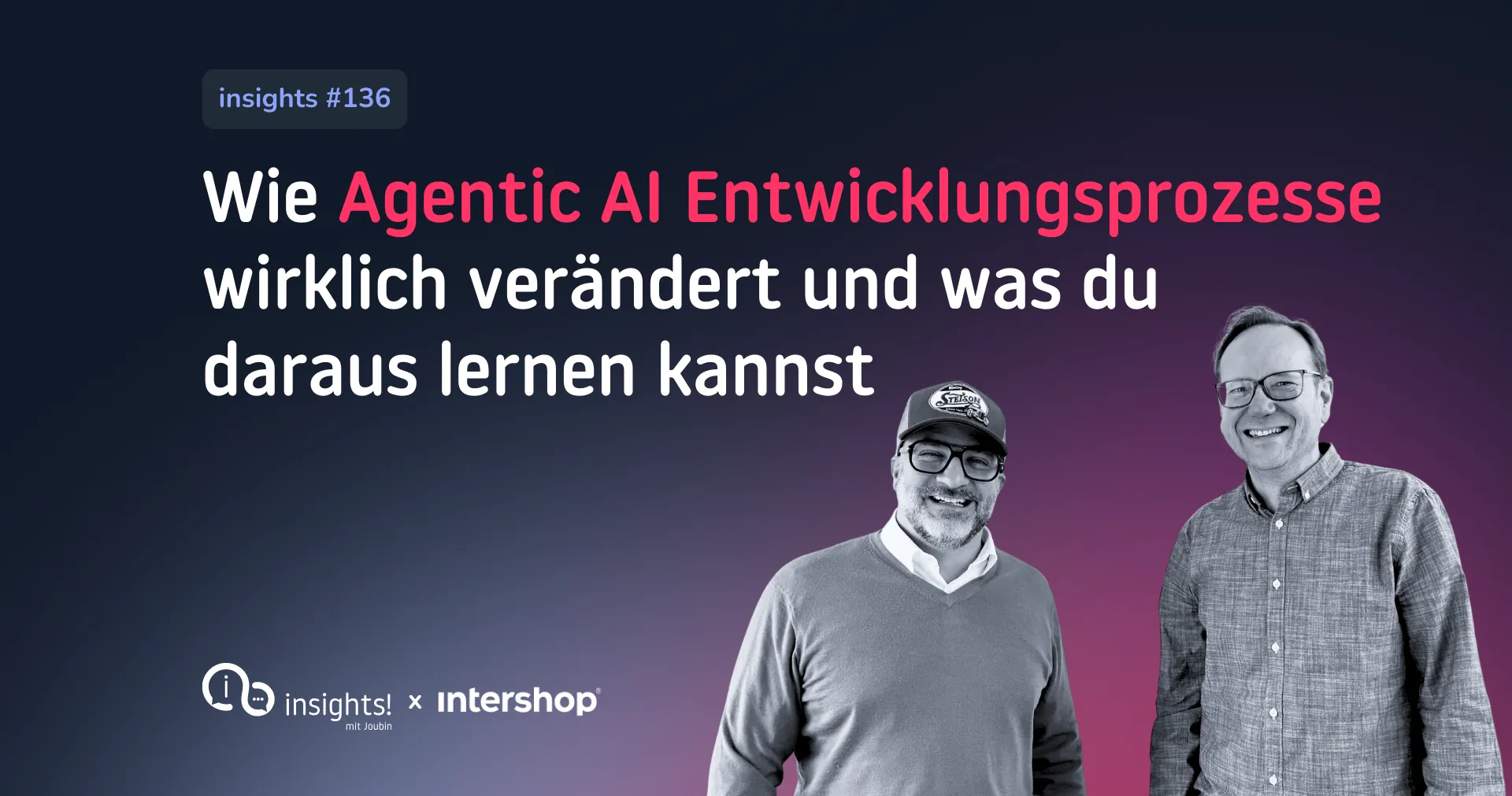
#136 - How Agentic AI Is Really Changing Development Processes and What You Can Learn From It
Agentic AI is massively changing how commerce platforms are built, operated and developed further. What still sounds like the future today has long been everyday work at Intershop: AI that writes code, prepares tickets and noticeably relieves teams. But instead of job fears, it's about new opportunities, faster results and smarter processes.
 Joubin RahimiManaging Partner · synaigy
5 min. reading time
How Agentic AI Is Changing Commerce and Why Real Developers Are Still Needed
The commerce world is turning faster than ever. While many companies are still busy modernising their system landscapes, some players are already taking the next big step: Agentic AI. A technology that doesn't just simplify processes, but transforms entire ways of working. One company that jumped on this train early is Intershop. And the exciting thing is: the journey is only just beginning.
The ideal case would be that the coding agent already fixes the bug in the background and then just raises a pull request, so that the human can say: Yes, looks good, let's do it that way.
Stability Meets the Future: Why Commerce Platforms Today Must Be Both
Commerce systems have evolved over decades. The foundation has to be solid, because without a robust structure the smartest AI won't get you anywhere. Intershop shows how modern the interplay between classic components and new AI layers can be.
The core idea is clear: a well-thought-out architecture creates the foundation on which agents, co-pilots and data-driven automations can build. Instead of sliding into a flood of microservices, Intershop relies on larger, interchangeable components that ideally combine stability and further development.
Between these building blocks, a system emerges that brings your organisation real advantages, for example through:
automated processing of order data,
intelligent enrichment of product information,
or agent-based workflows that handle routine processes independently.
Agents in the Engine Room: How Developers Are Transforming Their Work With AI
It gets exciting when you look behind the scenes. Intershop built its own AI team long before Agentic AI went mainstream. The goal is to relieve developers, increase speed and secure quality at the same time. One central building block is GitHub Copilot in Agent Mode. Developers no longer have to type every line of code themselves. Instead, they describe what needs to be achieved and the AI creates the matching implementation. Of course, this technology also has its limits. Especially in complex codebases that have grown over years, Copilot can sometimes still feel like a junior trying to understand 200,000 lines of Java on their first day. But this is exactly where Intershop comes in. With systematic knowledge building, documentation and AI training, the agent is meant to grow into a genuine senior developer. And the long-term goal is to build a coding agent that independently creates fixes and proposes them as a pull request. You'd only need to review and approve.
When Support Meets AI: What Happens When Tickets Suddenly "Think Along"?
A particularly tangible example of AI in use is ticket handling. Support cases are automatically prepared by an AI: it searches documentation, known bugs, similar cases and creates a structured overview including possible solutions.
The result:
support staff find the trail faster.
developers no longer start with a blank page.
gaps in knowledge or documentation become visible.
Of course, there are also moments when the AI simply talks nonsense, and the team happily laughs about recommendations that are completely off the mark. But it's exactly this mix of irritation and insight that makes knowledge gaps visible and improves processes. It becomes more valuable with every run.
How Developer Roles Are Changing and Why That's Not a Job Killer
When machines suddenly write code, one question arises automatically: Do we even still need humans? The answer is: absolutely. But differently. Roles are shifting. Developers are increasingly becoming "agent managers" who clearly define tasks, check quality and orchestrate systems. That might sound unfamiliar, but it's simply the logical consequence of smart automation. And honestly: many developers already know this. Some colleagues need extremely precise briefings to work efficiently. AI is hardly any different here – the better you guide it, the better the result. A nice side effect is that you can also use AI for your own briefing, by speaking ideas into your smartphone on the go and then having a neatly structured task package generated for you.
Growth Boost Through AI: How Much More Output Is Possible?
How much more productivity is possible is hard to put a figure on today. But the effects are becoming visible:
Faster bug fixes,
Bolder technology decisions,
a lower barrier to new programming languages,
More quality with less effort.
In our project business, we're already seeing 30 to 40 percent less effort, with higher quality at the same time. And at Intershop too, output is rising – exactly how much will only become clear over time. In any case, the potential is enormous.
What Organisations Should Do Now – Practical Advice From the AI Frontline
For organisations wanting to take the step towards Agentic Commerce, there are clear recommendations:
Buy first, then build: invest in solutions that already work solidly, instead of setting everything up completely from scratch.
Involve partners: many requirements are highly specific – implementation partners who work close to your processes can help here.
Prioritise use cases: not every AI application creates real value immediately. Start where the impact is noticeable.
Use AI workshops: gather problem areas, prioritise them and develop solution spaces together.
Want to listen to the full episode?
Here's the podcast of the interview:
Please accept the corresponding cookies to view this embedded content.
Would you rather watch the episode?
No problem!
You'll find a recording of the interview here:
Please accept functional cookies to watch this video.
Would you rather read it?
Joubin Rahimi
Fantastic to have you back for a new episode of insights! My name is Joubin, Joubin Rahimi, and joining us today: Nils Breitmann from Intershop. Hi Nils, great to have you here again.
Nils Breitmann
Hi Joubin, great to be here. So I'm Nils from Intershop. Intershop builds a commerce platform for Agentic B2B, that's what we call it. And I'm responsible there for AI, on the one hand how we deploy it in our products, but on the other hand also how we use it internally in our own development and processes. And we can talk a bit about that now.
Joubin Rahimi
Exactly, and that's the second point we'll get into today, but you have this Agentic AI commerce platform. I think you're one of the oldest platforms on the market. And there was a book, Elephant Can't Dance. You're not an elephant, but you've completely transformed and always kept pace with the times rather than standing still. Exactly.
Nils Breitmann
The solid foundation is of course still important. We say a composable commerce component is important first and foremost. We also don't go for the idea of 1,000 microservices, that's not our thing, but rather larger components where you can still swap things out, the right granularity is what matters. Of course, the data you can draw from that. With classic ordering alone you can already do an incredible amount. And on top of that then co-pilots and agents, co-pilots that support directly one-to-one, and agents that can then also carry out work, enriching product data.
Joubin Rahimi
Exactly, that's what it does, but the question is: how does it get in there? We talked about this beforehand: will agencies still exist in future? Will you as a manufacturer, and other manufacturers, still exist too, because I could just prompt everything and then a system creates a commerce platform like that for me. I actually think your model is more stable and robust than ours, but you're looking into this too.
Nils Breitmann
Exactly. So first of all. I see that at the moment it's still very much the case that we still need agencies, because we see that we provide the foundation for these agents, the whole infrastructure, the large language models, everything around it, chat flows, everything you need. But of course we see that there always has to be an agency that tailors this to the specific customer requirements. And it's precisely the customers who still come up with a great many ideas that we ourselves wouldn't even think of.
Joubin Rahimi
I like it when you're needed. Although, I've got another tangent in mind there, but let's not go there now. I'd like to move on to the second topic: you develop, right? You do develop, you have a product and you also look at how the product can be developed further and developed faster. Part of your team is there for that. Would you like to describe what exactly you do there and what the focus is?
Nils Breitmann
Over a year ago now perhaps, we introduced a dedicated AI team that also took care of internal matters. A first step was Gen AI for everyone, so to speak, like a ChatGPT. We used this LangDoc. That lets you very quickly give employees access. They can use it for all kinds of cases, generically. And then of course we deployed it for the developers. We then specifically used GitHub Copilot, rolled it out to everyone, and provided everyone with training too. And it's now become really good. So GitHub Copilot now also has this Agent Mode. That means you can simply write in natural language what I'm planning to do now, what I'd like. And GitHub Copilot then starts writing the code, and really all I have to do is press "Apply" and say I accept the change.
Joubin Rahimi
And is it really the case that you often press "Apply", or "Modify and apply"?
Nils Breitmann
Well, there are various forms this takes now. If you say you're now writing some small piece of new code, some service for something, then you can quite easily go in the direction of saying, I won't touch the code at all any more. I'll say I'll just keep prompting and start it, see if it runs. Of course, for us, Intershop is already a fairly large codebase. We have a Java-based system, there's a lot in there and it's a more complex matter. GitHub Copilot also has a bit of trouble recognising all the connections in there, naturally. That means there are also developers who say: this is now roughly at the level of a junior developer who isn't yet familiar with Intershop. And that's exactly the topic we're working on now, simply bringing in this knowledge about the codebase, and also what are the good paths, what are the bad ones, how do you use things, what are the customisation paths that are actually prescribed. There's documentation that then incorporates all of that, giving GitHub Copilot this as additional knowledge as well, so that it ultimately develops like a professional Intershop developer.
Joubin Rahimi
And how long do you think it will take your system to become exactly that type of developer?
Nils Breitmann
We're pushing very hard, because of course we see a huge opportunity to generate more output too. That means we also have a lot of maintenance work. We have many customers running on our platform. Problems crop up here and there. Problem tickets get escalated by support, they need to be resolved. It's about really making that faster. The ideal case right now would be for the coding agent to already produce the fix in the background, already write the code, quite calmly in the background, and then just submit a pull request, so that a human might then just say: yes, looks good, I'll accept it.
Joubin Rahimi
And I think it's great to have that vision, not "I do everything as before", but "the request comes in" or "the escalated ticket". We've always had a certain... We know this too, a certain quality. It's not just two lines, but a certain quality. And if that's fixed straight away, that would of course be smart.
Nils Breitmann
We see various stages towards that too. The first stage we've now implemented is that we now automatically enrich these tickets with AI, so AI has already done some research: what documentation is there for this? Have there perhaps already been bugs in this area before? And it then produces a nice problem statement, a possible solution proposal, and then also references, so that by the time the developer takes on the ticket, the preliminary research has already been done.
Joubin Rahimi
And is that already implemented for you? Yes. And what's your experience with it? What do the developers say? What does the support team say?
Nils Breitmann
Exactly, so the support team is more positive, they say: this thing points them to things they wouldn't have thought of themselves and wouldn't have found. The developer, though, also likes to say: look what nonsense it recommended here.
Joubin Rahimi
Always straight into the mistakes.
Nils Breitmann
Exactly. But my view is that you naturally have to take that seriously and look at how you might create more documentation … Perhaps the knowledge base is simply missing and it's poorly documented, and it's just a matter of addressing that, but the opportunities are simply too huge. What's happening there is simply too impressive.
Joubin Rahimi
I think the mindset is also hugely important. What you're describing, I naturally see that with us too, and at other companies. But this mindset that a colleague is allowed to make mistakes, but AI isn't. Right. But actually that's not really the point — it's: how can I improve the work and make it faster? And maybe I can teach the AI to do it better next time. Because of course people are afraid that their own job will disappear too. That's naturally the danger we see as well.
Nils Breitmann
Yes, and also that this job itself is changing, that you're no longer a developer who perhaps quietly writes a bit of code, but rather more someone managing agents, that you move up to more of a manager level, which maybe you don't want.
Joubin Rahimi
Yes exactly, you don't code, you're basically Manager of Agents.
Nils Breitmann
For me it's sometimes also like when I talk to it, it's a bit like with certain colleagues, where I'd say those colleagues also need everything spelled out exactly for them. There are colleagues who are very precise, who also want exact specifications, and you have to feed that in and then they code it. It's similar with the AI agent — I also have to give it that. The more I tell it, the better it can naturally fulfil the task.
Joubin Rahimi
But the really cool thing is, you can also use the AI to create such a briefing. I was often in the car in the mornings, can't type, and if I'm not on the phone and I have a topic, I brief OpenAI and it just creates a briefing for me that I can read through again, and then I can have it adjusted once or twice. Then I have a briefing document that I would otherwise never have had. That's this chaining of information.
Nils Breitmann
I find that amazing too. I've done that as well, on the way to work, discussing a topic like that in advance, and talking through the whole thing, you have to think it through, formulate it cleanly. And when you're then at work, I summarise it and then … Bang.
Joubin Rahimi
Amazing. How much more output do you think you get as a company?
Nils Breitmann
My boss, Markus, has great expectations. I can't say yet. I think there are many possibilities. But I can't put a percentage on it yet.
Joubin Rahimi
Yes, that's also difficult.
Nils Breitmann
And it also depends on which area it's in. Is it new development? That's sometimes especially impressive, what you can generate with vibe coding — complete applications with backend, frontend, this and that.
Joubin Rahimi
We say we're now cutting the effort in projects by 30, 40%, with higher quality. That's naturally huge too.
Nils Breitmann
And another effect is: you can suddenly do things you wouldn't have dared to before, perhaps with new programming languages or technologies. That's an effect you might not even factor in, because suddenly everything gets nicely recommended to you.
Joubin Rahimi
Yes, I think that's also a huge topic. Whoever's done Java always moves quickly into PHP and other things. But conversely, whoever's done PHP forever, onboarding onto your platform is also much easier when you have AI at your side. How do you handle the change? Because you said the employees will then take on a new role sooner or later. So are you already at the point where you say you have to actively take care of that? Or would you say you're still in the first phase, where you don't yet know where it's heading and that's why you'll manage the change later.
Nils Breitmann
We've already thought this through in advance. We've got a dedicated project manager for Internal AI, whose job it ultimately is to bring people along too. He also runs the odd workshop, gathers feedback, summarises it, simply to bring people along with it.
Joubin Rahimi
We ran an AI workshop at a larger steel trader, and the works council was involved too. The heads of department from all business areas were there, including the board. And the question was: how do we, as consultants, typically ensure that all employees are brought along? Of course that word "all" is always tricky. I'll never become a politician, I said: "Not at all." "All" never really works one way or the other. We humans are typically afraid of change, that's just how it is. We prefer stability to change. But what I'm seeing right now, not so much in the plants where people drive forklifts, but precisely here in "white collar work", is that everything's going to change massively there, and we need to work on getting that mindset in, so people say: okay, I'm open to it so that I change, very much in the spirit of Charles Darwin — not the fastest, not the strongest, not the cleverest, but the one who adapts best to this new situation. That's the one who'll survive, and we have to support that. That's quite a bombshell to drop in that meeting. Not sure, but you've been taking a breath here and there too.
Nils Breitmann
I'd say we have a bit of a top-down approach, in that we say we create the environment, we also source the tools and do what the developer further down might not be able to do at all. But of course they're also hugely important, so we do a bit of bottom-up too. They have great ideas and can quickly bolt a few things together, which even I'm amazed we're able to enable. But it's a tricky topic.
Joubin Rahimi
Do you also support customers with that? Because on the other side, for the e-commerce department it's also a change, with all your tools coming in. Or would you say you're a technology provider, and that's also a fair answer.
Nils Breitmann
What we've also already done is the typical AI workshop with customers, where you ask: what are actually your pain points here right now? Then prioritise the problem space a bit, then solution space, brainstorm, and of course bring your own technologies into it there too, so they can be used as well. That exists already, but we don't do it that intensively. That's more of a consulting activity from our partners.
Joubin Rahimi
Do you also think that right now, whispered in. There's something we still need to say there. We even have a change management department, because we believe it's important to see that in combination. What would you recommend to customers? We also have shared customers, and not all customers always have an IT department or a software development department somewhere in there — well, the bigger ones we have, that is. What would you recommend there to a VP Digitalization, CDO, CIO, from your experience that you bring to this now?
Nils Breitmann
Yes, of course, first look at what's already available on the market. I'm more of an advocate of this buy and build approach. You first buy a ready-made solution that already has a certain feature scope, one that simply fits. And on this basis you can then, of course, keep developing and address your own use cases or the company's use cases that really deliver something, that really bring value. And that's usually then done with an implementation partner who takes that on.
Joubin Rahimi
Always happy to hear that, thanks for the plug. But don't build it yourself, so don't start out by saying—
Nils Breitmann
We've also seen customers start building from zero, especially when they had their own teams, when they were bigger ones. Some customers have built things like product content enrichment themselves, but you also quickly see that it takes a lot of effort, of course, and it would have gone faster if they'd used the Intershop Product Content Agent, maybe with a bit of customisation — there's already a lot of knowledge built into that. In the end, it's not as trivial as you might think at first. It's really complex. You do have to do a kind of deep search first, because you know it from ChatGPT, they do that automatically in the background, but applying that via an API means you have to make a few more connections that you don't yet get as a ready-made service anywhere.
Joubin Rahimi
For another customer we got to tackle this product enrichment back in 2017, 2018. And the idea back then was that you go onto the internet and pull all the data. But that's now seven, eight years ago. It wasn't feasible with a reasonable amount of effort. So we found a workaround, which was quite funny, especially with new products — in the electrical field they always follow a certain pattern for these article and serial numbers. Recognising that, seeing how others are structured, and then you can put them together with the attributes, or generate the attributes again from that series. That was actually really cool, but we were too early. I'd like to wrap up this segment. Everything is always getting faster. This whole wheel keeps changing. It keeps getting faster with more results. What are the success secrets you see? You've been at Intershop for quite a while now. You've also clearly transformed again and again. You've always moved with the times, you could say. And I think that's really worth highlighting once, to say that's exactly why we're still doing so well.
Nils Breitmann
That's of course this megatrend topic. Intershop grew big back then with the internet hype.
Joubin Rahimi
I think Otto did that right at the very beginning.
Nils Breitmann
Exactly. It was like: Quelle, and now it's actually AI again. That's another megatrend that's going to keep us busy for many years to come. And recognising that first and then aligning yourself accordingly. Or otherwise, what I consider a recipe for success is always looking at practical applicability, not just AI in the abstract — you really have to get into the specifics, because the devil is always in the detail. And if you don't do that, you'll never get to that point.
Joubin Rahimi
And I think this — just get on with it, and be practical — that's the one I'll underline for you once more. Thanks for listening and watching. Nils, thank you for the insights and the great talk here, and all the side talks we had that you didn't see. And if you still have questions or points to discuss, feel free to leave comments or send us direct messages. We'd love to keep discussing it there.
Nils Breitmann
Nils, thank you very much. Exactly. Thanks for having me here. It was fun.
Joubin Rahimi
Great. Likewise, I enjoyed it too.
Do you have questions or feedback?
Then feel free to contact us directly.
- Joubin Rahimi
Managing Partnersynaigy
Show phone numberShow mobile numberShow email address

Subscribe to the blog now and never miss any news
✔️free ✔️weekly news ✔️expert knowledge
Please accept the corresponding cookies to view this embedded content.