



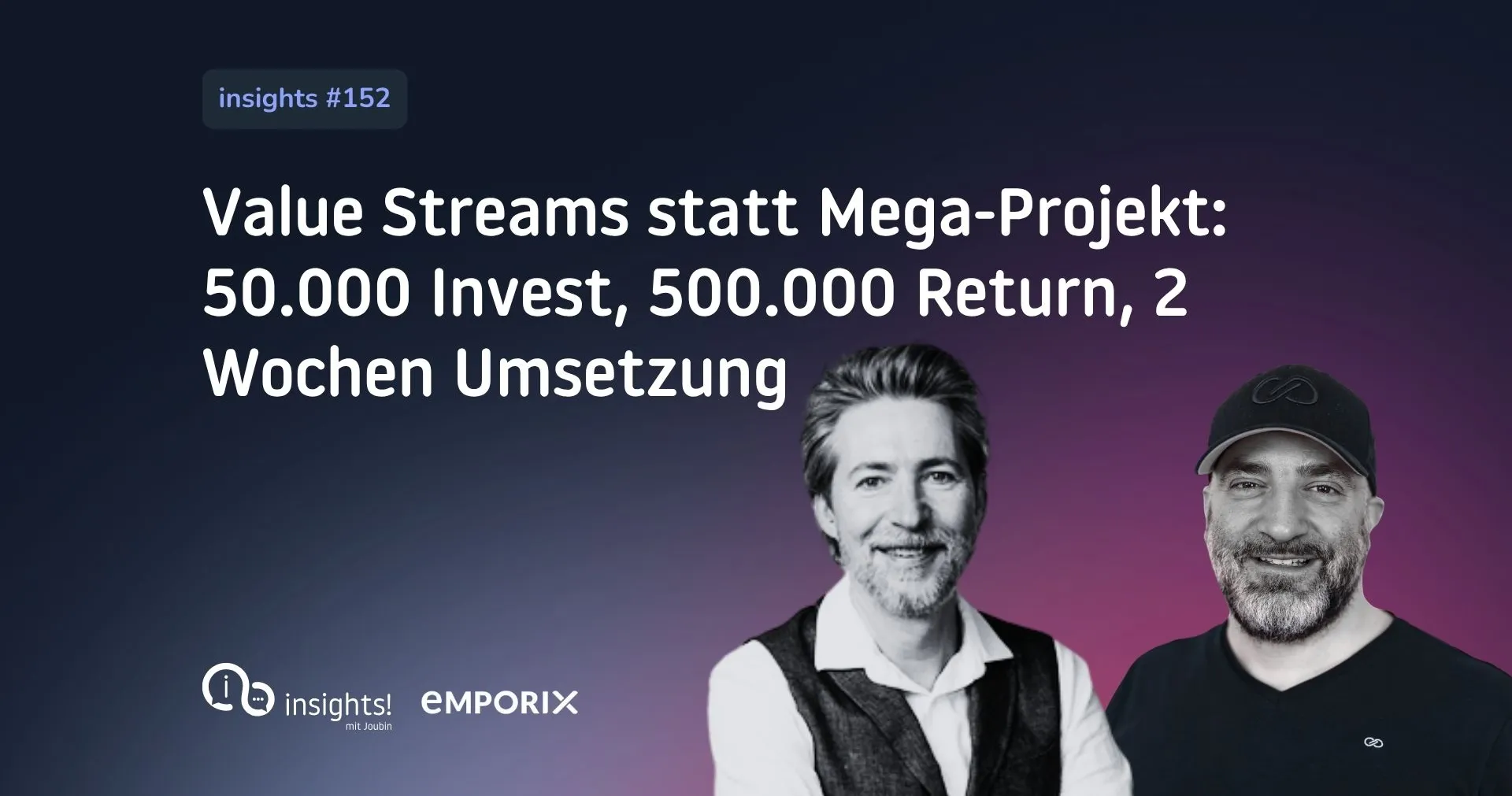
#152 - Value Streams instead of Mega-Projects: €50,000 Invest, €500,000 Return, 2-Week Implementation
Classic B2B commerce is under pressure. Many companies sink triple-digit million sums into maintaining outdated platforms, even though it has long been clear that these architectures stifle innovation. In this insights! episode, emporix CEO Mark Holenstein explains why value streams, composable commerce and AI orchestration are reshuffling the cards, and why the next customer journey is no longer being built for humans alone. The article summarises the key theses for CEOs, CIOs, Heads of E-Commerce and Marketing, and provides concrete pointers on where to start in your organisation now.
 Joubin RahimiManaging Partner · synaigy
6 min. reading time
94 percent of the C-level believe legacy is blocking their innovation. Individual companies spend up to 500 million to keep this legacy alive. It doesn't get better, it just carries on living. Like a patient in a coma. Lying there, not doing much, but costing a dramatic amount.
The uncomfortable diagnosis: legacy is eating innovation
One realisation from the conversation with Mark Holenstein sticks, whether you want it to or not. The vast majority of decision-makers in B2B have long known that their legacy systems are blocking innovation. And yet, often nothing moves for months. That's not a vague industry opinion, it's the reality in many boardrooms, where everyone present is actually thinking the same thing.
Mark uses an image that sticks: a patient in a coma. Individual companies spend up to €500 million keeping precisely these old platforms alive. They don't do this because they're poorly informed, but because the first cut is uncomfortable. And it's precisely this comfort that is currently turning into a strategic risk in B2B commerce.
Value streams instead of mega-projects: the new rhythm in B2B commerce
Anyone coming from the old world of monolithic e-commerce suites knows the pattern: three months of concept, six months of development, a year of implementation, followed by a release marathon that never ends. With emporix, Mark has set a radically different mode against this: value streams. Instead of working through tech roadmaps, you define a concrete business problem and solve it in days or weeks.
One example we went through in detail in the episode comes from the US. An industrial company wanted to automatically transfer email orders into the customer portal. Result: €50,000 invested, €500,000 return, two weeks to implement. Once you've seen numbers like that, you automatically start asking why classic project planning in B2B commerce is still thinking in quarters at all.
What's structurally behind a value stream?
Business-first logic: the value is defined first, the technology follows.
Low-code and no-code configuration instead of months of in-house development.
Integration into existing systems such as ERP, CRM and PIM, without replacing them.
Measurable results within a few weeks, not fewer quarters.
Stop Coding, Start Operating: why your IT department is currently relearning its job
One of Mark's most striking statements concerns the role of IT. His credo is Stop Coding, Start Operating. That's deliberately pointed, but it accurately describes what's happening in the market. Cockpits that development teams used to budget three to four months for are now built in a matter of hours. At an emporix partner day, a consultant built a complete value stream in around eight hours.
For CIOs and Heads of IT, this isn't a threat, it's a liberation. Anyone who takes their best people out of maintenance mode and redirects them into real value creation wins twice over: once with the customer, who gets better experiences, and once with the team, who finally get to work on things that matter strategically. Anyone who doesn't play this game, on the other hand, is funding at great personal expense what the competition has long since simply configured.
Three departments, one desperate customer
One of the most honest images from the conversation concerns classic departmental thinking. Marketing writes copy that sales rewrites. Sales promises things that service later has to explain. Everyone does their job professionally, and the customer simply flows straight over the top of it. Mark says, in essence: something breaks with every handover. I don't think you could describe the structural problem in B2B any more precisely.
This is where AI comes in as an orchestration layer. Instead of optimising each department individually, value streams coordinate across marketing, sales, service and e-commerce. When a service employee spots a buying signal in a conversation, the system automatically triggers the next steps. When a salesperson identifies cross-sell potential, the information moves to where it's needed without any CRM tetris. The customer notices nothing of this, except that the breaks finally disappear.
Digital body language: why good salespeople have always been AI
In the interview, Mark tells the story of a former snowboarding European champion who told him years ago: In my shop, I know within two minutes where a customer stands and what they need. That's exactly what I want online too. Over the years, that sentence has grown into the discipline we today call buyer intent or digital body language.
The punchline: a good salesperson has always done what we're now rebuilding with AI. They read signals, weigh them up, react. In the digital space, that means click paths, dwell time, search queries, repeat visits and contextual data are interpreted in real time. This creates a customer journey that no longer looks the same for everyone, but adapts live to each individual user's situation.
Agent experience: when your next customer is no longer human
The probably most provocative thesis of the episode concerns the future of the interface itself. Classic web shops remain relevant, Mark leaves no doubt about that. In the US, around 60 percent of B2B business still currently runs through classic, manual channels. At the same time, the first buyers are already sending out agents to find them the right spare part or the cheapest supplier.
That's why Mark no longer talks only about customer experience, but about agent experience. The question is no longer just whether your platform works for humans, but also whether machines can communicate with it reliably. Anyone who doesn't set up their APIs, product data and interfaces to be agent-ready today will simply be digitally invisible within a few years. And that's in a market where 60 percent of all B2B transactions still run traditionally today, but growth is clearly on the digital side.
What you should check concretely now:
Is your product data structured, complete and machine-readable?
Does your platform offer stable, documented APIs that third-party systems and agents can use?
Do you have mechanisms that can distinguish between a human user and an agent?
Are pricing, availability and logistics information available in real time?
What you need to take away as a decision-maker now!
If you're responsible for e-commerce, IT or customer experience in your organisation, it's worth answering three questions very honestly. First: how much of your IT budget goes into maintaining legacy, rather than into value creation? Second: where in your customer journey do you systematically lose information because marketing, sales and service aren't working in sync? Third: if the first shopping agent lands on your shop tomorrow, can it interact with you cleanly?
Mark ended the conversation with a sentence that needs no polish: people and technology can build beautiful things together. At its core, that's not a technological message, but a cultural one. And perhaps that's the most important takeaway from this episode: the next wave in B2B commerce won't be won by the platform with the most features, but by the organisation that has the courage to reorganise itself around the customer.
Would you like to listen to the full episode?
Here's the podcast of the interview:
Please accept the corresponding cookies to view this embedded content.
Would you rather watch the episode? No problem!
Here's a recording of the interview:
Please accept functional cookies to watch this video.
Prefer to read instead?
Joubin Rahimi
Great to have you back for a new episode of Insights. My name is Joubin, Joubin Rahimi, and today I have Mark with me, Mark Holenstein from emporix. You lead emporix, but perhaps you'd like to say a couple of sentences about yourself and about emporix.
Mark Holenstein
Yes, well first of all, thank you for having me, Joubin.
Joubin Rahimi
Gladly.
Mark Holenstein
Thanks also for having us here at the conference. It's really exciting for us. Yes, my name is Mark, I'm from Switzerland. I've been in e-commerce for about 30 years now, I think, and for the past year I've actually been CEO of Emporix. What we do, really based on experiences we had at Hybris, is take e-commerce to the next level. And that next level is really artificial intelligence, or AI-based e-commerce. And we do that pretty well, especially with a focus on B2B.
Joubin Rahimi
Let's dive into that. We're here at our Insights conference, we just had two talks and a panel, and through all the talks leading up to the panel we eventually got to this point: in future, the IT department won't just be writing things down anymore. So the IT department is going to change, and requirements won't come highly standardised anymore, but far more flexibly. And IT won't even be doing that anymore, the business unit will actually build the application or the solution itself. I know you're getting more and more new customers and you're mainly replacing large systems. How do your customers see this? Do they see it similarly? Is this just a wild idea from a conference, or what's your multi-million investment as a new software vendor actually based on? That was 3 questions at once.
Mark Holenstein
I'll try to... Well, I think we're 100% convinced that technology is important, but that the business conversation should actually come first. So I think that's a big difference from before, perhaps, that today people don't really talk about features, functions and APIs anymore, but about business value. So what's the concrete benefit I can achieve with this? We're absolute advocates of low-code/no-code, which really means that business people use technology to bring their knowledge into a system in a simple way. Together, of course, with people like synaigy, who I think also help break down that complexity a bit for them. But yes, I think business first, technology follows, is very important. And we invented something we call Value Stream. And Value Stream really already implies value. And Value Streams are, by definition, simply business-driven. That means they solve some business problem in a very simple, good way. And I, as the business owner, then configure that down to my needs. So yes, I think times have changed dramatically, but in a good way too. That business can say what they want and can actually implement it themselves, always with the help of IT, of course.
Joubin Rahimi
So who actually has the money then, and who decides?
Mark Holenstein
I believe so, yes.
Joubin Rahimi
Let me ask a question. Yes, I think that's a great question.
Mark Holenstein
And I think the answer's actually been the same for 30 years.
Joubin Rahimi
Always the business.
Mark Holenstein
The money actually tends to sit with the business, because they're the ones out in the market generating the business too. So I think ownership always lies with the business. Actually a good thing too, I think, when the business has ownership. And technology simply helps to implement that in a good way.
Joubin Rahimi
I fully agree, the business always has the money. I don't think I phrased my question precisely enough. Before, the business sat there and IT ran this selection process, so ERP, or 15 years ago software, ERP selection, no, e-commerce selection. IT was often very much involved there, though it was even more involved in ERP or really deep back-end systems, in terms of not just what it would be, but really leading throughout the whole process. So now the question is: is IT really still a strong decision-maker in this process? Or doesn't the business unit just say: these are the things I need anyway, because I have the money. You just have to put it in place. I'm the one implementing it. So, to put it bluntly: I'm implementing the whole thing too. You don't even need to code the process, because that's done by my department head, who handles incident resolution.
Mark Holenstein
Yes, well, if I look at who's sitting in these meetings today, I think it's still pretty much a fifty-fifty presence of people. Ultimately, the value of everything you do also depends on it being integrated with existing systems like an SAP system. And I think as soon as you plug in anywhere, IT naturally gets involved. Of course, or if you want to pull out any data, IT gets involved too. And that's important too, I think, so that everything runs properly, safely, and no risks are created. So I think today it's more like 50/50. In the past it was too strongly, I think, always IT-driven, which sometimes meant ownership was a bit lacking. That's why I actually don't think this 50/50 situation is so bad.
Joubin Rahimi
Do you see the Value Streams creating a shift like that in how people work with a tool like this? So you've been on the market for a few years now, gathered experience, and the first long-term tests are still fairly new.
Mark Holenstein
Exactly, they're quite new. They're actually quite new. What I find cool about these value streams, and I've always found this cool, is that you do something in 2 weeks. Or 2 hours.
Joubin Rahimi
What used to take me weeks.
Mark Holenstein
Exactly. And in the past you'd spend 3 months thinking about how this should even look. What do I actually do here? How do I implement this stuff? And then a value stream, for example ACA in the USA, 2 weeks of work, email orders get fully automated, essentially digitised, and then go straight up into the customer portal. 50,000 invested, 500,000 return. 2 weeks of effort. Those are the cool things, I find. But it still works in a larger context. So it's not just some submarine solution you quickly sneak in somewhere. I do think that's also a challenge for companies today, especially for IT — I'm an advocate of stop coding, start implementing, or start operating, and that actually forces people to develop less and configure more.
Joubin Rahimi
And we've seen it ourselves: software developers who worked with the big solutions and did so for a long time understood: the solutions bring a lot with them, I use that and don't develop everything from scratch. Now it's gone even further. It brings a lot with it. As a software developer I don't even need to use it myself, someone else does that now. I think that's probably a big difference in how things interact. I wanted to get to the enquiry now. You said value. But if someone says, this sounds exciting, but I already have an e-commerce system, because, let's say, the market is almost saturated. Almost every customer has already implemented something. Why should I put money on the table — because it's money, time, defocusing from something — to develop a new platform? So, value streams is one thing. Other companies might have a bit of that too. But what actually makes the difference? That companies really say: I'm switching platforms. What does that cost? In today's climate, saying I want to save money simply costs time, money, and defocuses you. Actually, in the winter of the e-commerce market, you said we're setting off.
Mark Holenstein
Yes, I think whether it's winter or spring.
Joubin Rahimi
You're now moving into spring.
Mark Holenstein
But we're on our second spring, I'd say. We're all old hands who've done this before.
Joubin Rahimi
You're doing it differently now, right?
Mark Holenstein
Yes, we're doing it completely differently. But I think people need to do it differently too, and we'll hear that today in the talk with Vaillant as well. There are findings that at C-level, 94% of C-level know that legacy is actually blocking innovation.
Joubin Rahimi
Worth remembering. I think.
Mark Holenstein
I think you should remember that. 94% of C-level think legacy is blocking their innovation. And you probably see that much more than we still do, right? Like, I don't know, Hybris times, 5 years of project development, 50 million in investment, and nothing really moves today. And the second thing is that companies then spend up to 500 million — just imagine that — up to 500 million individual companies spend to keep this legacy alive. It doesn't get any better. It just carries on living. Like a patient in a coma. Just lying there, not really doing much any more, but costing a dramatic amount. And I think that, combined today with the revolution coming through AI, means companies fundamentally have to change again. I'm 100% convinced of that. And it's true that we're now essentially coming with a message: hey, you need to renew yourselves, because with AI, everything about how you communicate with customers and do business with customers is going to change dramatically. And I think that requires a mental shift too. Can I organise myself around the customer instead of organising the customer around me? Because that's actually something we've wanted for a long time but never really managed. I believe with AI we'll manage to really organise ourselves around the customer, and then everyone will have to become dramatically more efficient.
Joubin Rahimi
And the behaviour has to change. While you were saying that — I was on the phone with a colleague of mine for 4, 5 hours, sometimes we talk in the evening in the car, driving. He called too, when I set off from Munich, and 3 hours later, three and a half, we hung up, and by then I was almost back in Cologne. And we talked about — we have SAP and we're introducing SAP at our place, but not only SAP, other systems too, to standardise things because of our growth. Completely right that we're doing that. But on the other hand I said: okay, you always want to force everyone into these standards, and now let's start from us as a company, and then we have a customer and we have a standard contract. That may be so, but customers have their own contracts too, and there are customers who say, "No, I won't do that." Or: "I want this payment term." Or: "I want these clauses in the works contract." So people have their own ideas. In a good customer journey, which we as a service provider should of course offer our customers, I don't want to force them into such a fixed process. And then a day later we had another really intense evening discussion like that. We actually need to structure this differently. The input parameter needs to be completely flexible, for sales too, or customer care. And that's when I thought about the value streams — that you can simply put in whatever you want, and the AI shapes it so it fits into a data model, and changes can be made quickly. And if the customer says I want this and that, and you need 10 internal approvals because it can't just be decided like that, a system handles that quickly in the background instead of you saying, right, okay, I'll be back in 2 weeks with the next proposal. Because of course not everything just gets nodded through, it gets discussed somehow. That's what I was thinking about, just now, but also after the drive — that you actually take the problem along with you. So handling that incidence there. Absolutely.
Mark Holenstein
Yes, I think one thing I always find exciting: we organise ourselves into marketing, sales, service, e-commerce, and those are actually — I was recently at a Forrester event, in the marketing track.
Joubin Rahimi
Exactly, that's all super tough.
Mark Holenstein
And marketing complained about sales, that they never use what marketing puts out in terms of copy. It doesn't get used by the sales people, and it gets changed, and so on. And then the service people say: yes, but sales promises all sorts of nonsense there. And it's actually quite interesting that we, probably to position ourselves professionally and do the job we're supposed to do, already do it well. But the customer really doesn't care that much about it.
Joubin Rahimi
We do it well, so professionally, department, right? Doc, doc, doc, doc. But the customer wants—
Mark Holenstein
Yes, they actually just flow straight over it, and with every handover something breaks.
Joubin Rahimi
It's Bambi.
Mark Holenstein
Exactly, it's like on the German motorway.
Joubin Rahimi
Oh, that hurts, that hurts. Then you might as well push the train along behind you too.
Mark Holenstein
Gladly, gladly. I'll bring that too.
Joubin Rahimi
But how could you think about it, for yourselves too? So they're departments, and it's already in the name, a department. I'm dividing something up.
Mark Holenstein
Yes, I hadn't even seen that.
Joubin Rahimi
But yes, it's already in the word.
Mark Holenstein
It's in the word. And I think, honestly, we as software vendors probably contributed to that too. Sure, we invented CRM and said that's for the sales people. Yes, and then we invented service applications, that's for the service people. Then we invented marketing automation, that's for marketing. At SAP we even tried to build a suite for that. We called it Customer Engagement Commerce. But we never made the effort. We built lovely slides saying it's important and so on. But we never made the effort to actually connect these systems.
Joubin Rahimi
And that was missing.
Mark Holenstein
Something was missing that does that all the way through.
Joubin Rahimi
Let's take Customer Relationship Management System. Okay, so managing the customer, I find, or somehow managing the customer relationship. Yes, but you have so many relations to the customer and connection points. Did you say service? I have an incident. That's also part of the connection. And suddenly that's a different system. That's totally on your side. You think about it differently. We had come across that.
Mark Holenstein
Yes, and we actually had a cool call this week with a large industrial company in Switzerland, and that's really exciting. We showed a bit of our vision. You really have to, the customer is dynamic out front, you have sales, service, e-commerce and marketing. And he says, I think that's cool. That's a cool vision, because I have service people who know much more about the customer than the sales people. So I do want it so that when the service person is chatting with the customer and identifies something somewhere, it immediately pings something somewhere.
Joubin Rahimi
Sees it immediately.
Mark Holenstein
Exactly, that he sees it immediately and sets the trigger and says, hey, something's happening here. And then everyone jumps on it in a coordinated way. I also thought your buyer intent was cool, I have to say. Yes, exactly. You've also built such cool software where you can somehow identify, hey. Yes, exactly. And I like that too, because you can actually take a bit of a look at that. As soon as the impulse comes, it triggers the value stream and that then coordinates things through so that the customer is genuinely helped professionally and quickly. That's something we absolutely want to build into our value stream now too.
Joubin Rahimi
We always call that digital body language. You have buyer intent. That's what I had. So we always say digital body language, because maybe it's not a buyer at all, just an information gatherer. You don't know that at all.
Mark Holenstein
Yes, I think that's really nice.
Joubin Rahimi
Could be anything.
Mark Holenstein
Very nice image.
Joubin Rahimi
The thought came up, well, we had used it at a bicycle retailer, and in that use case it's like this: there are so many people who simply enjoy buying from them because they ride road bikes or mountain bikes themselves. And then you spend hours on a website like that. I also enjoy road cycling. I can then genuinely spend hours just looking at shoes, or what combinations there are. Bike frames there, and a gear set from SRAM or whatever. And then if my wife says, you've still got a task for the kids, they still need rear lights, I'm still the same Joubin, but in a different mode. Okay, buy rear lights. And then I behave differently. And that's why we talk about reading this body language.
Mark Holenstein
But isn't that the art, right? Reading that body language— I always think Garfield Schuller was one of our first Hybris customers. He was European champion in snowboarding. And when I met him for the first time, I said: Marc, when someone comes into a store of mine, within 2 minutes I know exactly where they stand and what they need right now. And I want exactly that in the online shop from you too. And actually, a good salesperson or a good advisor senses that, don't they?
Joubin Rahimi
Yes, totally intuitively somehow.
Mark Holenstein
But now you're rebuilding that digitally, so that we actually have that knowledge online too.
Joubin Rahimi
Let's take that as another example, when you walk in somewhere. So for every event we do here, I always buy new shoes. Now we know why. For one thing, Patricia and Marc always say you can't keep walking around in the same things. They're completely right, too. I do have more clothes as well, but— Do you also need brand guidelines for the job here? Yes, of course. I basically just get dressed up like a doll here. But it's turned out well, I have to say. We laugh. Turned out well. Yes, that's great, but I buy the shoes right before an event. I picture what I'll wear, and then I'm fairly focused. And that's what happened this time too. I walked into a shop and the guy there just talked too much. He needs to leave me alone. He didn't read my body language. And at the other one I walked in and then scanned, scanned, scanned, and then he asked: If there's anything, I'm happy to help. I can see you know what you want. Bang! Where did I buy? Right there. But at the other one I said: I can't think. Stop talking.
Mark Holenstein
Yes, yes, yes, that's really true. And I think that's exactly a good example, isn't it? Customer journeys today are simply highly dynamic, and it's not always the same thing.
Joubin Rahimi
Totally.
Mark Holenstein
And you just have to be able to assess that. And I think that's exactly what we're trying to do, that first of all we can orchestrate Marketing, Sales, Service as a unit somewhere on the customer journey, we call that orchestrating, but of course Finance and Supply Chain also need to be consulted when it really comes down to it, here something also needs to be shipped and here creditworthiness also needs to be checked. So I think a company is already a complex construct, and the customer is even more complex. But I think with this orchestration, which is AI-driven, we've found something new here, I believe, which is simply important. That's why, by the way, I believe the early stage is going to become a dramatically beautiful summer. Maybe this summer, maybe next summer, we don't know exactly when yet. But companies need to change dramatically to catch this next wave.
Joubin Rahimi
Totally.
Mark Holenstein
And that starts with Composable. You have to move away from these old monoliths. You need an Orchestration Layer.
Joubin Rahimi
Actually it's not about Composable either, it's not about power either, that's all tech.
Mark Holenstein
That's all tech. But of course you need a certain foundation to then achieve the finishing touches on top with AI. I think you need certain foundations so that the AI on top can then also function dramatically freely.
Joubin Rahimi
So as a closing question: AI is also changing a lot on the customer side, and also how purchasing is done. How are you prepared for that? Because there's always the discussion that there won't be any webshops any more and so on. From my point of view that's total nonsense, because there are also still city centres and so on. There's simply another additional channel. How are you positioned as Emporix to support this Agentic Commerce as well?
Mark Holenstein
Well, by the way, I 100% believe what you're saying, I just had a look at the channels. In the US, 60% of B2B business is still running on traditional manual channels. It might shift a bit further still, but it's still a lot. Because of that I also believe agents will simply create a new, well we call it Agent Experience, so not Customer Experience, but Agent Experience. What exactly that will be, I think none of us really knows yet today. But we know that buyers will send out agents. Just find me the cheapest spare part for my machine here. And then you also need to be able to communicate with these agents. And that's what we're trying to lay the foundations for. And I think there are still certain solid technical foundations that you need to have. So that an AI on top can function dynamically. And we're fully convinced of that. So at some point the AI will probably dynamically assemble this website for you, because you don't want advice. You just want to have a look and then it will actually all be dynamically put together up front, without you having to piece things together yourself much—
Joubin Rahimi
If you just say in B2B, come on. One of my first really big B2B clients was Phoenix Contact, actually mine, we got to do things with them. I'm imagining this right now, a huge, massive industrial company, and you come to the website as Siemens, where one division builds power plants, and the trains division builds trains, and then it recognises that, and the AI then rebuilds all of that so it's ideal. That's actually what you just described.
Mark Holenstein
Yes, I believe indeed, I believe AI will help us really assemble things dynamically based on whatever signals we can pick up from impulses there. Be it a Customer Experience, be it a website, or be it for an agent, or be it also user interfaces. So I think the time is over when you needed 3, 4 months for, we build cockpits somewhere in 2 hours these days. And you say: okay, you want an Account Payable cockpit? Yes, here, look. Bang. Bang, built. Bene built a Value Stream at our partner day. Jesus Christ. That was crazy, what he put together there in 8 hours, wasn't it?
Joubin Rahimi
But why did he do it? They were really up for it. Why were they up for it? Because they say: technology is cool. And the people are cool that you can build this together with. They were simply fired up like hot fat in a chip pan.
Mark Holenstein
Yes, that's— I always thought your point at the end was actually great. Yes, in the end, I think, it's this community. Yes, that's what my Georg also just said, that it was a vibe, such a cool vibe, undefinable somewhere, a bit like here, when I walk in here. Yes, that's an undefinably positive vibe there.
Joubin Rahimi
I didn't make that up, that's exactly what we also want to live out here.
Mark Holenstein
Yes, and that's now something I've taken from you, actually for us too. Hey, alright, it's actually really cool when people sometimes meet each other again in the market, but everyone is here anyway and wants to dynamically create something new. Yes, and that was one of the big takeaways for me that I took from you there, from the Partner Summit, that we need to make sure we keep this community really alive and also nurture it. People will hopefully always be needed.
Joubin Rahimi
There will definitely continue to be one.
Mark Holenstein
And I think that's also what makes life worth living. Because of that: yes, all technology, but I believe people and technology together can then build beautiful things.
Joubin Rahimi
There's no more beautiful closing sentence. People and technology can build more beautiful things.
Mark Holenstein
Thank you.
Joubin Rahimi
Thank you.
Mark Holenstein
That was very exciting.
Joubin Rahimi
Totally. And if you have any questions, feel free to post them.
Mark Holenstein
That thing about the German motorway wasn't meant maliciously.
Joubin Rahimi
Yes, because you're right, that's the terrible thing. You are right. So, we're looking forward to a dialogue with you. Thank you for listening and watching. And Mark, thank you for your time and all the information.
Mark Holenstein
But thank you. Have a lovely day.
Joubin Rahimi
We'll have that.
Have questions or feedback?
Then feel free to contact us directly.
- Joubin Rahimi
Managing Partnersynaigy
Show phone numberShow mobile numberShow email address
Subscribe to the blog now and never miss any news
✔️free ✔️weekly news ✔️expert knowledge
Please accept the corresponding cookies to view this embedded content.