



insights! #122: AI, visibility, platform strategy – what you need to know now so you don't get left behind
In this episode of insights, Markus Dränert (COO of Intershop) and Joubin Rahimi talk about the shift in buying behavior – from classic search fields to dialog-oriented, intelligent systems. They discuss why familiar strategies such as classic SEO are losing their impact, what role social media will play in the future and how B2B platforms have to reposition themselves.
 Joubin RahimiManaging Partner · synaigy
4 min. read
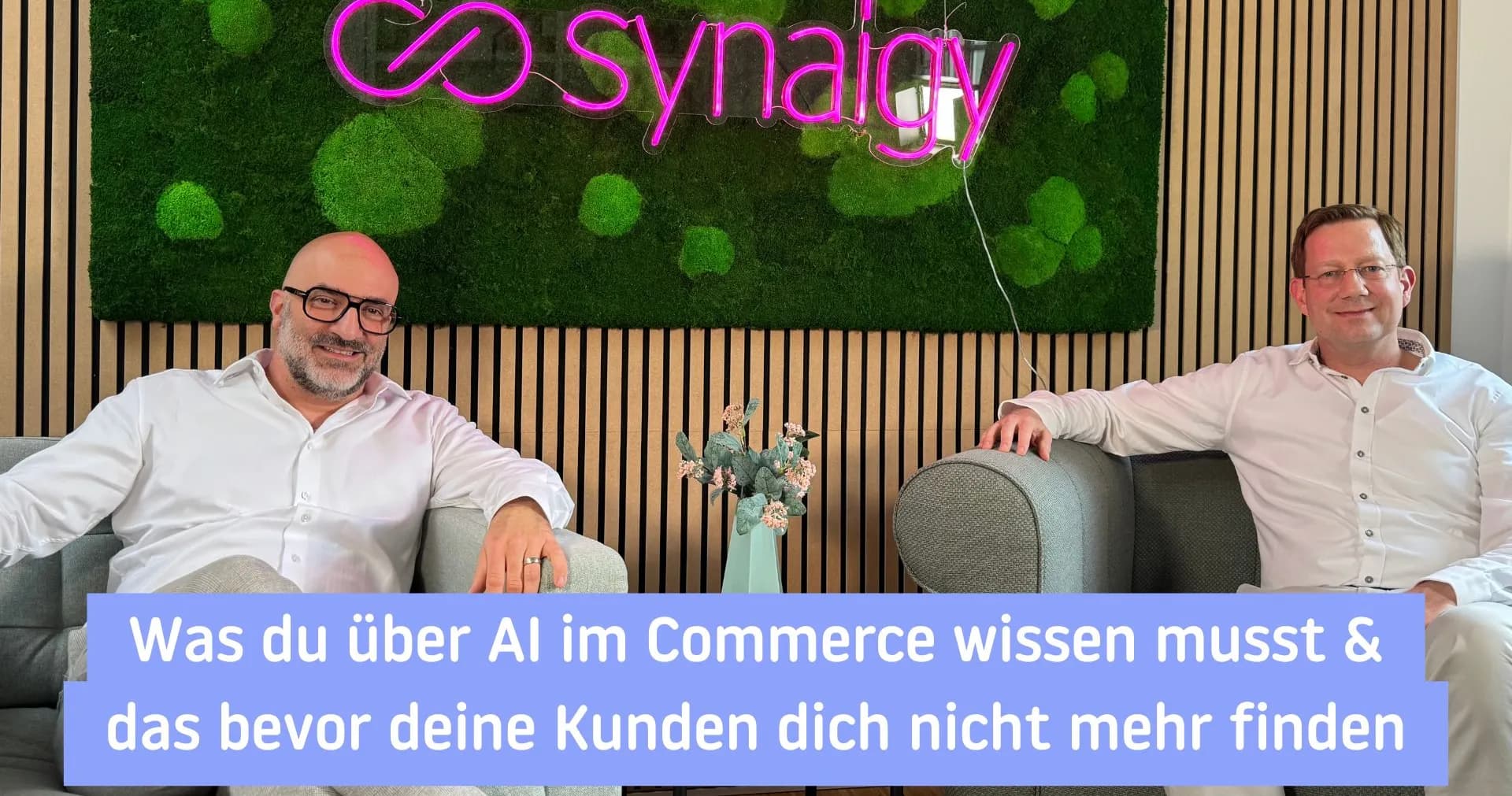
If today you get a precise answer in a chatbot that features only two providers instead of ten, then that's a different game. The classic Google search results page is disappearing – and with it the old ways in which visibility comes about.
We still google. But not for much longer. Digital buying, whether private or business, is facing a profound shift – and it isn't creeping up on us, it's arriving pretty rapidly. The classic search field is being replaced by dialog, decision processes are getting shorter, visibility is taking on a new meaning. Markus Dränert, COO of Intershop, explains exactly what is changing and why retailers should act now, putting some exciting ideas on the table that you shouldn't ignore.
From shop feature to solution: what customers really need today
In the past, e-commerce was all about functionality: categories, filters, product data. That was enough for a long time. Today people are no longer looking for products – they're looking for solutions. And as quickly as possible. Markus Dränert sums it up: customers no longer want to click through ten tabs or scroll through pages of hit lists. They want to state a problem – and receive a suitable solution. And that's exactly where Intershop comes in: instead of inflating the platform, it is extended intelligently. Not with quantity, but with quality. What does that mean? Intershop is building a platform that can be extended modularly – with carefully selected applications. Not 100 tools, not a playground. Instead clear features that help you reach your goal faster.
The new visibility: if you're not in the result, you don't exist
The rules for how customers find you are currently changing fundamentally. Visibility used to mean Google ranking. Good placements, strong keywords, clean SEO content – everything revolved around the search engine results page. But if in future there aren't ten results to choose from but perhaps only two – what happens then to your position 7? --> Classic SEO is no longer enough. --> Paid search is getting harder. --> Content no longer has to appeal only to people – but also to systems that make the selection.
Inspiration in the social feed, decision in the system
Shopping used to be an outing. Today it's a click. Tomorrow? A decision that was already made in the background long ago. What is changing is not only the search, but the entire path leading there. Especially in high-price or advice-intensive segments, advice is increasingly being democratised. It used to be reserved for the well-connected salesperson or the premium retailer. Today your digital companion takes that over. The emotional inspiration happens on social media – through people, not through brands. The rational decision is made quietly and efficiently in the background. And here the rule is: whoever can serve both is ahead.
B2B: precise, matter-of-fact – but no less affected
In B2B a lot of things are clearer: what is ordered, why it is ordered and at what price. But here too the processes are changing dramatically. One example: spare parts, consumables, C-parts – what used to be ordered laboriously is automated today. Systems compare offers, ask follow-up questions, place orders – entirely without human involvement. But: this automation doesn't only fall back on established suppliers. "The systems challenge existing relationships. They make new suggestions – automatically." That means: in B2B too, it's no longer name recognition that decides, but the precision of the offer, the price, the ability to deliver – and being findable in the systems that already prepare decisions today.
Above all, a platform has to be one thing: agile
If everything is changing this fast, then the worst thing you can do is build a rigid system. Markus Dränert sees it that way too.
"We're not developing one big solution and hoping it will still be relevant in two years. We're building a platform that can keep evolving constantly." Sounds logical, but in reality it's demanding. Because it also means switching things off again, daring to run experiments, living short innovation cycles. Whoever can do that is not only faster, but also more flexible – and therefore better prepared for whatever comes.
The most important advice: just get started!
At the end of this conversation, one insight remains: you don't have to know everything to get started. But you do have to get started. Waiting won't move you forward. You'll never have all the answers – but you can ask the right questions today: --> Where can I save time in my processes? --> Which decisions could be made automatically? --> Where am I missing access to new customers?
Would you like to listen to the full episode?
Here you'll find the podcast of the interview:
Please accept the corresponding cookies to view this embedded content.
Would you rather watch the episode?
No problem!
Here you'll find a recording of the interview:
Please accept functional cookies to watch this video.
Would you rather read?
Joubin Rahimi
Great to have you back for a new episode of insights. My name is Joubin, Joubin Rahimi, and joining me today: Markus Dränert. Hi Markus.
Markus Dränert
Hello, Joubin.
Joubin Rahimi
Good to see you. Joining me today is actually wrong. This is already our third episode today.
Markus Dränert
It's getting to be a bit of a routine.
Joubin Rahimi
It is getting to be a bit of a routine, we've already done two and we've carved out one topic, the topic of AI. Yes. Before we get into it, could you get into it? Maybe you'd like to say two or three sentences about yourself, your role and why AI plays such an important part in your world.
Markus Dränert
Yes, Markus Dränert. I'm COO of Intershop. That means product, customer service, everything to do with the product, our platform, sits with me. And AI is of course the topic right now. I think everyone wants to do something in the AI space, especially in e-commerce specifically. We're now trying to translate that to our product platform.
Joubin Rahimi
Why is that so important for your customers?
Markus Dränert
For many different reasons. I think there are a great many factors right now acting on our customers and on our customers' customers. And flexibility is of course becoming more and more important. Meaning: can I react quickly to all these changes? And of course we have the topic of the skills shortage, which is also somewhere in the room. And I think the press and media are very happy to pick up on the idea that agents and copilots can help with that in particular in the future.
Joubin Rahimi
Before we started this recording, I think we talked for another hour. We really should have recorded that. It was good, over lunch.
Markus Dränert
It was actually already right on point.
Joubin Rahimi
Yes, it was on point. And we also talked about what you're doing right now. You've built a kind of hub and you're adding modules to it. Maybe we could start with where you stand now, and then we'll move on to the future later. Tell us, what are you doing and who can participate and who can do what?
Markus Dränert
Maybe first a bit about Intershop. We're an e-commerce platform, very strongly specialised in B2B e-commerce, with a long list of features and functions that of course fit the B2B context perfectly. Now the question is of course: what is our answer to the world of agents, to the copilots sprouting up everywhere? So we thought about it: okay, how can we complement and enrich the core we already have really, really well? And what we're now betting on is product partnerships. That means we cooperate with, let's say, AI applications that are already successful in the market, build our Intershop agents from them, and then integrate them into the platform in such a way that they're well pre-integrated, so that everyone, our customers and partners, can get started quickly. That means having certain functions per agent out of the box, and then being able to customise the whole thing further if needed, when it has to go deeper. Yes.
Joubin Rahimi
When I first heard about it in the autumn, my very first thought was: this is like Shopify or Shopware, where there's a marketplace. But then I understood and let me correct myself: you're not opening it up for everything, you're saying you want the AI applications, so really the special applications.
Markus Dränert
Exactly, it's not meant to be a marketplace in that sense either. We're already a very specialised B2B provider. That means our entire positioning and also our competitive advantage is exactly that I can configure very specific things on our platform, customise them for the respective context. And now with the topic of AI agents and copilots too, it's not about having 100 of them on there; instead we look at it very, very selectively, we talk a lot with partners and customers: what are the use cases you need? And then we also decide at very, very short notice. We've now set ourselves the goal of one agent per quarter, just to put a number out there. And then we always decide really only from quarter to quarter: okay, what's the next agent we'll build?
Joubin Rahimi
And the agents, in which area are you mainly active at the moment?
Markus Dränert
For one, we now have the copilot for Bayer Live. That means when our customers' customers are in the shop, instead of the classic search they can now essentially shape their search with a chatbot, with a copilot. And that's of course something completely different from searching for a product in the classic search fields; instead I can really enter free text, enter problem statements and then get the matching items shown in the shop.
Joubin Rahimi
Now we're actually warmed up, aren't we? That's where you stand today. And now comes the part I find much more exciting: where is it heading? Because that's a bit of crystal-ball gazing. We agreed over lunch that the buyer journey is changing. But what's your assessment? What will it look like in B2B in the future? Or B2C too, gladly. How will it change in your view?
Markus Dränert
Well, I don't think anyone can predict exactly what tomorrow's trend will be. I mean, I think we're seeing it. We started …
Joubin Rahimi
You're a smart mind and I think everyone should hear your thoughts once.
Markus Dränert
Yes, so what I'm actually getting at is, I think it's more about building a platform that's very flexible, so you can react to these fast-moving changes. That means, sure, you have some idea in your head: what could the next agents be, just to get started with the topic? But whether that's what will still occupy us in two or three years, we don't know. And that's what we're actually working on flat out right now, saying we need a flexible platform that is, let's say, very strong through product partnerships, where we as a provider can respond very flexibly to new trends. That means launching new AI agents and copilots, and also switching some off again if they don't work out. That's part of learning too, I think. And we're working very hard on a very flexible platform so we can do all of that, instead of betting on maybe three big AI products, as I'd call them, developing them ourselves, and then maybe one or two of the three have been developed past the market. That probably wouldn't be the right thing to do. That's difficult. Yes, exactly.
Joubin Rahimi
The agents come in and Google has … There was a nice Google study: how is search behaviour changing? And at some point in that latest study Google said: instead of two words, people now always enter whole terms or sentences, questions. And they now answer those accordingly. And recently there was also the Google update: we can somehow buy things for you as well. So it doesn't work in Europe yet, but we have an assistant shopping or we're the shop agent. Is that what you mean, that it will catch on, so quite independently of Google, but the way things will be done in the future? Or is it simply like VR, another hype?
Markus Dränert
No, I think it's already changing. So when we look at colleagues or at our circle of friends, whoever uses ChatGPT or Perplexity, the names are interchangeable for now, the bot is often fired up first to search. That means classic googling really is declining. At the moment I think it's still hybrid. You try both, then look at what the respective results are and how well they match up. But I think the further away you are from the context and are still doing a bit of your own research, the more likely you are to use, let's call them the gen AI models, just to get into the topic at all. And that will definitely change something, because I approach the purchase decision differently than with classic googling, where there were simply rankings running from the left. And if I now get a very precise, prefabricated answer in a chatbot, where there are no longer ten providers but maybe only two, then of course the game is a different one.
Joubin Rahimi
Within synaigy we have a certain hypothesis and we always start from Gutenberg – this won't be a long story: democratisation of knowledge, so the printing press, democratisation of knowledge. Through that, democracy also, education moved forward, industrialisation happened and inventiveness was then much broader, because it wasn't just an elite group. Then we had another step with the democratisation of information, actually through Apple, Google and Facebook, where individual people, as we're now noticing, can put out their opinion worldwide and suddenly the person is the brand and no longer a company. And with that, the buying process changed. And that's actually what I'm getting at. The buying process has changed from, well, we're perhaps roughly the same age. As a little boy, when I was into hi-fi equipment, I'd go to Bringman in Hamburg. That shop no longer exists, it didn't survive. So I'd go there, get advice and then knew I wanted a Technics, a Denon or some Sony cassette deck. You don't do that any more. You google and actually know what you want and then decide when to buy. Now if I have AI – and now I'm tapping into your thoughts – if I now have AI and an agent like that, how does it change? For example, I want to buy a sauna. There are lots of questions: I want to buy a garden sauna. What do I do then? Does this buying process change and do new retailers get a new chance while established ones have to rethink their processes, or what do you see there? How do you see it?
Markus Dränert
Well, what I see is that the bots, or AI models in general, try very hard to get you to your goal by short routes.
Joubin Rahimi
Yes, that means – so much faster to the close, essentially?
Markus Dränert
Well, you end up in what I'd call a precise dialogue, that's how I'd put it. And there's hardly any situation left where you leaf through catalogue pages the way you used to, to describe it in old-fashioned terms, or like on Amazon now. I might enter something, but on Amazon I still get hits first and actually have a very long list to start with. And let's say with the search hits I first form ideas and also options that I might have. To stay with a sauna example: if I google buying a sauna, I first get a very broad range of hits, from a barrel sauna to brand manufacturers, yes, all the way to do it yourself.
Joubin Rahimi
Open a tab, open a tab, open a tab.
Markus Dränert
Exactly, then I read up on everything and then there are some arguments here for a barrel sauna and I don't know what the arguments are for building one myself. So the options are very, very broad at first, and with search the way it is today it may well happen that, especially with an example like this, you buy a sauna once a year, once in a lifetime, once a year, once in a lifetime. It's more of a one-off moment. And when you have all these options, then you maybe also start wondering: what actually is the right sauna for me? But if you now have a different kind of search, where you perhaps enter: okay, I'd like a sauna in the garden, because that's roughly your mental model, then I think a chatbot like that gets you very, very quickly and very purposefully to exactly those manufacturers who do precisely that. And whether you then still take, let's say, those detours to look for alternatives, I don't know. That can lead to a purchase decision playing out completely differently from the way it does today. And the exciting question is: what does that mean for providers, manufacturers, in terms of getting visibility there?
Joubin Rahimi
Let's put ourselves in that position. I think that's exactly the exciting point. People who have a lot of money and say: I want … I'll exaggerate: I need a boat. Sure, some google their way to something, but there are advisors who buy a boat or very expensive cars. And that's now being democratised too. This advisory service is being democratised as well. And with the sauna example it would be exactly that: I'll take your hypothesis. You don't even have to deal with it anymore, because you say what you actually want. And the selection, and whether the properties fit, comes from an agent. It helps you. And now I'm wondering, what does that change in the buying process? And in the journey too: what do employees, what do companies have to do to be visible there at all? Before, you'd say okay, the first three, you always said, that's what matters on Google, or you run ads. But what would it be like now?
Markus Dränert
I mean, today basically everything revolves around being findable on Google. Especially in Germany, Google is extremely strong. In other countries there are at least two or three other search engines, but here in Germany we really only talk about Google. That's quite special, the market power and penetration Google has here. And it's not just online marketing that I spend on direct placement at the top of search; almost everyone also builds satellite sites. It's about SEO. So how do I get native traffic that doesn't cost me that much, apart from the content I might build up? How do I get good reviews? So it's a whole range of things I have to do today in order to rank well. And the exciting question is of course: if Google, or at least Google's presentation so far, is no longer the search results presentation, especially in purchase preparation or in research for a purchase, then the question is of course: what does tomorrow's presentation look like? So already, let's say, ten result hits per page, and now with Google I don't know how many pages I can actually click through and filter at the top by products, by information or images. So if that falls away in quotation marks, because I simply get the answer here from the bot in a targeted way, in whatever way it currently thinks it has to present it to me, even if it perhaps learns how I'd like it presented, but that's exactly what leads to it. It keeps learning, or does exactly what I like best. So, and exactly that turning off, taking a little detour to another alternative, that's gone, and of course that makes it harder for manufacturers too. That means if I'm exactly in that funnel, it's great, because then the customer probably also reaches the purchase faster and buys, but there are no longer these detours and turning off: oh, and I've decided on something else after all. That becomes harder. The exciting question is of course: how do the bots rank tomorrow? So how do they decide who gets listed among the top three results? Those will of course be really exciting questions, all the way to: where does tomorrow's marketing money actually flow?
Joubin Rahimi
I think, how would a neural network do it? Whatever fits the question most precisely. So content is important then, but funnily enough more for the bots than for the person. And what's also exciting is which content has which relevance. So if you simply generate content with AI, does that have just as much relevance as if you have an expert on the topic of garden saunas who speaks about it? I suspect that will then be ranked higher. That's crystal-ball gazing now.
Markus Dränert
Maybe the field also shifts a bit, in terms of where inspiration and, how do you put it nicely, spontaneous purchase decisions actually happen, this impulse effect or what used to be the point-of-sale effect, so where do I pick something up? And I think that's already the case today, but it will shift more and more toward social media, because there you simply have people behind products, behind convictions, and let's not kid ourselves. Especially when I buy a boat, I think that depending on how high-priced the segment gets, the more often there are personal relationships again, for whatever reason, that then have an influence there. And that's why, let's say, for products you simply buy on a whim, I think social media will be super important. So you sit down and relax for a bit, let the feed run and of course products or creators come along that simply suit you. Of course you'll get stuck on something. And I mean, everything is still combined again. That means if you're searching for a sauna somewhere, even if it's a chatbot, I'm pretty sure that at some point you'll have the matching Insta feed again and then a creator turns up with maybe the right sauna.
Markus Dränert
So in the end it will complement each other, but it's still a different game from today, where I have the classic Google search results page.
Joubin Rahimi
That makes me think of Rise and Fall of Rome, Rise and Fall of Amazon. If all of that changes dramatically, and Amazon is a kind of product search engine, you often go in there, enter the products and so on. But that will change again. If the agent also says: I'll simply buy somewhere, because you've stored your data with me and I can pass it on too, so let me spin this further, then Amazon is suddenly no longer the top dog quite so quickly. So could that be the danger for Amazon?
Markus Dränert
I'd even go one step further. Tomorrow it isn't just one agent doing that for you; the agents talk to each other. And I actually assume there will be a multitude of agents that are highly specialised. One knows where the best offers are in terms of price right now. The next agent, who knows, does a competitive comparison for me on certain product features, and the next agent is maybe more advisory, if I have no idea at all yet. And they too will organise themselves among each other. And I think nobody today can say exactly how this target picture will play out. The only fact is, it will run completely differently from today. It will also be a fact that the agent, or let me call it the copilot, the personal assistant that has the customer contact, will in the end be the decisive one, because that's where I interact, that's where I sharpen my search, that's where I get the search results back in whatever form. And the agents underneath are super important, but they won't necessarily be visible.
Joubin Rahimi
Yes, or I'm something of an Apple disciple in that respect. They already have my payment details anyway and you can also say: okay, sign me up there, but don't give out my email address, price and so on. That they set up an agent like that and then steer the other agents for me. I actually consider that a realistic scenario for what's coming.
Markus Dränert
Yes, definitely. And of course there are a lot of questions again there. So how does my master agent, as I'll call it now … How does it then make sure that only the data I want goes to sub-agents? It mustn't go out to the market.
Joubin Rahimi
Not to some field shop or anything.
Markus Dränert
Then the questions we already had, I think, ten years ago in the internet hype come back again. Basically the same questions will come back, but there will also be answers. Yes, just like now. I think the questions can all be answered today, and there are only a few people left who say: that's why I don't shop online anymore.
Joubin Rahimi
No, I think so too. It turns another notch. But of course it has the explosive power to knock Amazon off the platform throne again in the process, because they've of course done a lot of things right. But now we basically have a derby horse and we're on a derby racetrack, and suddenly we're in the ocean.
Markus Dränert
It's not just Amazon. I think you really have to look at this whole chain once. I mean, even, it starts with the search engines. Today I google. I have no idea what I'll do tomorrow. Tomorrow I'll bot. And who is the bot? Who provides it? Yes, Google too will probably at some point move away from today's search to a bot input. They're already starting with it. But I don't even know whether we'll still classically open the browser with a search query on Google in future. And that's where it starts. That means even my initial search will be different. The way the results are presented to me will be different. Probably more strongly pre-filtered, more fitting, fewer options. I want to get to my goal fast.
Joubin Rahimi
You also mentioned advertising, that the advertising budgets would then simply be different too.
Markus Dränert
Certain advertising formats may not exist at all anymore. So will there even still be banners, retargeting gets harder.
Joubin Rahimi
So a lot will … Banners and retargeting don't interest the bot.
Markus Dränert
It's hard in the bot, yes, it's possible, but maybe it depends again: what kind do I have?
Joubin Rahimi
But do you think people will say, in the bot … Well okay, Apple could of course say: I'll include advertising there too?
Markus Dränert
Well, I'm pretty sure, if you think back … It's not that long ago, but 20 years ago, when the internet really took off, everything was free at first.
Joubin Rahimi
Sure, that will probably be exactly the same now and everyone wondered: how does that work?
Markus Dränert
That works as long as the money is there and everyone is just pulling in the customers or the users or the readers. And then at some point money has to be earned again. And I'm pretty sure that, like with Facebook, Meta and all the things we know, it'll be – right now everything is free? But at some point a bot has to finance itself too.
Joubin Rahimi
You probably know a free bot that's then influenced by advertising, or one you pay for that then does without advertising.
Markus Dränert
Yes, but that's what I mean by the advertising formats. There too there will be new advertising formats, and what will replace the banner, in quotation marks, that we know today, we'll see. Still, it will be a different game.
Joubin Rahimi
And now we're actually moving through the B2C case very, very quickly. It's often the front-runner, B2B follows. What do you see in B2B? I also think it will be a second step, but what will happen there?
Markus Dränert
I think in the end it will play out similarly. So B2C is always the front-runner. No matter what we take, it starts in B2C and B2B follows. In B2B what you buy and how may be somewhat different. There it's less about being inspired about which alternative products exist. Maybe on price, yes. Maybe from a different manufacturer, yes. But B2B search will always remain very narrow, very specific, because you actually know very precisely what you're looking for. Those are, let's say, very rational searches as a rule, where price-performance plays a big role, reliability, quality. That's something different from a B2C purchase. So accordingly I think the functions of shops, or how search is designed, will simply be very much geared toward that, logically.
Joubin Rahimi
Yes, and maybe, we have a customer for whom we order automatically, or the AI orders automatically up to a certain value. So C-parts are ordered that way, two or three suppliers are always contacted, checked: do the items fit and so on. If it's clear, an order is placed and the others are declined. That's automated, and funnily enough on the other side we have customers who say: I receive inquiries and want to be able to answer them automatically too, or rather to support that process. That's what we're seeing right now. But that's, let's say, within sight, we're navigating by sight.
Markus Dränert
Yes, although that too has really exciting aspects, this question: what actually gets automated? On the one hand you might think, okay, once a supplier-manufacturer relationship is established and everything is automated, then reorders always go there.
Joubin Rahimi
Yes, or to two or three of them, right?
Markus Dränert
Could be one view, because the bots are connected, or however we work there, with whichever interfaces. I think a lot will move toward bot interfaces that can place certain orders automatically, of course with approval and authorisations and everything you need for that. That's coming, but of course there's also the other argument: there will also be bots that automatically question these established supplier and, let's say, customer relationships and say: I regularly scan for alternatives. I simply challenge it. Exactly, I challenge it automatically and make suggestions for alternative suppliers.
Joubin Rahimi
That's of course also a great tool for procurement.
Markus Dränert
So both will happen. And I think you have to prepare for both.
Joubin Rahimi
Yes, and as you can see, I think we could spin this out further. And I think that's just the next wave. How fast do you think we'll get there?
Markus Dränert
Yes, that's the million-dollar question. I actually find it extremely hard to answer how fast we'll be where, because especially when you look back at the last technological changes, you often think, when you're in the middle of it yourself, that it's all going very, very fast. I think it will go fast, but then it usually goes more slowly than you initially assume. So I find it very, very hard to say: what exactly will happen in two or three years in these segments and what do we do about it tomorrow?
Joubin Rahimi
I find AI so incredibly exciting. There were already the first forms of AI back in the 60s. I know we did the first AI projects with a fashion manufacturer that no longer exists back in 2018, 2017, 2016, always with IBM and Watson behind it, or for Head, a racket finder. But back then it wasn't that much of a bang. And then it suddenly came with ChatGPT. That really changed everything. And I'd say we probably still need, well, everything we've spun out here will come, but probably only in two or three years, even if there's maybe some protocol, as you said, once the protocol is there, or with crypto the contracts, well not with crypto, simply on blockchain, so that you then negotiate the contracts. That existed too, but it's been forgotten.
Markus Dränert
But that's a very nice example. That was a huge hype at one point too. In the end relatively little happened. Electric mobility just the same, a huge hype eight years ago. Where do we stand today? Well, we could be considerably further along if you take the ambition levels from a few years ago. And I think it's like it always is with these megatrends, and AI is a megatrend. In the hype you very quickly tend to exaggerate what's all possible. We're painting great pictures here too. Yes, it will come. But the question is how fast and to what extent across the full breadth. And there are certainly still a lot of hurdles. There's still a data protection topic. There will be regulatory issues that will certainly cut in, which we don't even know about today. There are dominant players protecting their existing business models. So I think there are still a great many issues to solve along the way before it all runs in such an integrated way. Still, it will come. We have to prepare for that.
Joubin Rahimi
I think this blockchain topic and then negotiating contracts. Sure, I have my virtual agents, then I have the contracts with the blockchain. That fits together really well, and when trends like that overlap, a megatrend always comes out of it. Let's say OpenAI couldn't have worked at all either if Nvidia hadn't laid the groundwork with the graphics cards. That's something people forget very quickly too. Without the graphics card power that wouldn't have worked at all. Do you see other trends that could spill over into this?
Markus Dränert
Well, I think as always at a point like this, when it spills toward the mass market and suddenly becomes a new trend topic, what actually always comes together are market-ready technologies and you create something new with them, a bit like the smartphone. I think the iPhone is the best example. Apple didn't invent a single one of the technologies in the iPhone, in principle; instead it really brought together what was already there technologically, often for five to ten years at that point, in such a way that something new emerged, and of course thought ahead very cleverly with the App Store and the business model: where can all of this go? And I think it's similar now with ChatGPT. So AI or artificial intelligence. I looked it up beforehand specially, asked ChatGPT, 70 years. So the whole topic started 70 years ago. And let's say five years ago it was still deep learning. I think that was the term. Let's say, how can I really keep learning better with good rules, automate things, which today you'd probably call AI. And now with ChatGPT there's a breakthrough, a new meaning attached to the term, and suddenly there's a hype. I think that's good. I think there are an enormous number of opportunities in it. It always helps when a topic, let's say, comes out of the nerd niche and is carried into the mainstream. And especially, I think, for smaller companies, because there's often the discussion: who actually has the greatest opportunities? I think small companies in particular have a huge advantage, as always with new technologies.
Joubin Rahimi
Because they can simply move fast and try things out, right?
Markus Dränert
Yes, because it simply, new moves … I always use a nice analogy: before there were PCs or tablets, there were mainframes. Those were reserved for the big companies that really had a lot of resources and money to deploy them at all. With PCs and laptops everyone could, every freelancer, every student can now use them at a completely different price point. And I basically see it similarly now with AI. As I said, AI has been around for 70 years. So far it's been big companies, institutions, insurers, who calculated their policies that way as well. So, and now with more computing power, with completely different application models, the whole thing becomes suitable for the mass market.
Joubin Rahimi
And listen to Markus's words. Markus only said he's COO of Intershop, but his CV itself reads really excitingly too, because you also helped build up startups for an insurer. And I just had to think of T-Home or T-Entertain again, which you also helped develop or built up substantially. Some friends of mine are in the Telekom group too and of course they all had it early on. Back then they said: no, I don't know, that's too slow for me. Why? I can watch it this way too. But at some point something clicked for us: the recording function is one thing, but then Netflix is included too, Disney. So that you have a subscription at better terms, commercially speaking. And then I thought again: things overlap. The technology is simply mature now, it runs. You still have these add-ons, you also have the commercial side, and boom. I think that was a point where it starts.
Markus Dränert
Yes, although you have to look back a bit there. When we built up Magenta TV or entertain, as it was then, Netflix didn't even exist in Germany yet.
Joubin Rahimi
Exactly, back then there was …
Markus Dränert
And by the way, smart screens weren't widely available either. That means, and here you really do have to turn the clock back a bit, what we actually did back then is, with a hardware extension – that's basically the media receiver – which I connected to my TV set – and I'd really call it a TV set back then – and then I actually made my old TV screen smart. That means with Video Load we first built our own streaming service, both technically and in terms of rights, because it simply didn't exist. Looking back, I'd rather say that when Netflix and the smart screens came along, there was completely different competition, because what we had actually solved initially was then available anyway through, let's say, the market, through both device manufacturers and streaming platforms. So that means I'd even go so far as to say that the initial idea of entertainment or Magenta TV actually faced massive competition, because it was suddenly there out of the box with standard devices. But that's maybe just a brief explanation and clarification.
Joubin Rahimi
Yes, and also important for everyone listening, because you've repeatedly been through cycles in your career that were similar, and I always say: experience is one thing in business generally, but you keep having experience with this new business model, with what works. I just wanted to underline once more: your breadth of experience mattered for what you said, how important that is, because we didn't shine a light on it at the beginning at all. What would you recommend to B2B retailers, with a focus on AI, as a closing thought? So if you could pick one thing.
Markus Dränert
Get started! No, it's really about doing it.
Joubin Rahimi
I think that's great.
Markus Dränert
It's really about simply getting started and doing it. There's so much you hear. There's so much you read about this topic. Everyone is doing something too and you're then almost already under pressure: where do I even start? But then there are somehow security concerns. Where should I start at all? I do think you should think briefly about what you do. I don't think you should just do something at random. Thinking about it a bit: what really has leverage now? What will work? And what can I really achieve business value with? I think that's always important when new technologies come in, because people also often tend to think: I just have to do something now, because the hype is there and the new technology is there. And I think stepping back briefly and saying: okay, what really adds value now? Great.
Joubin Rahimi
Just do it. Write comments, learn. We're very happy to answer. And get started. Starting is much more powerful than thinking. So thanks, Markus, for all the insights. It was a lot of fun.
Markus Dränert
Yes, my pleasure. Thanks for having me here.
Joubin Rahimi
My pleasure. Any time. And I'm looking forward to all your comments on this, because what's coming now is really mind-changing. And to all of you: wise decisions.
Do you have questions or feedback?
Then feel free to contact us directly.
- Joubin Rahimi
Managing Partnersynaigy
Show phone numberShow mobile numberShow email address
Subscribe to the blog now and never miss any news
✔️free of charge ✔️news every week ✔️expert knowledge
Please accept the corresponding cookies to view this embedded content.