



insights! #121: between loss of control and AI – what matters in leadership now
 Joubin RahimiManaging Partner · synaigy
5 min read
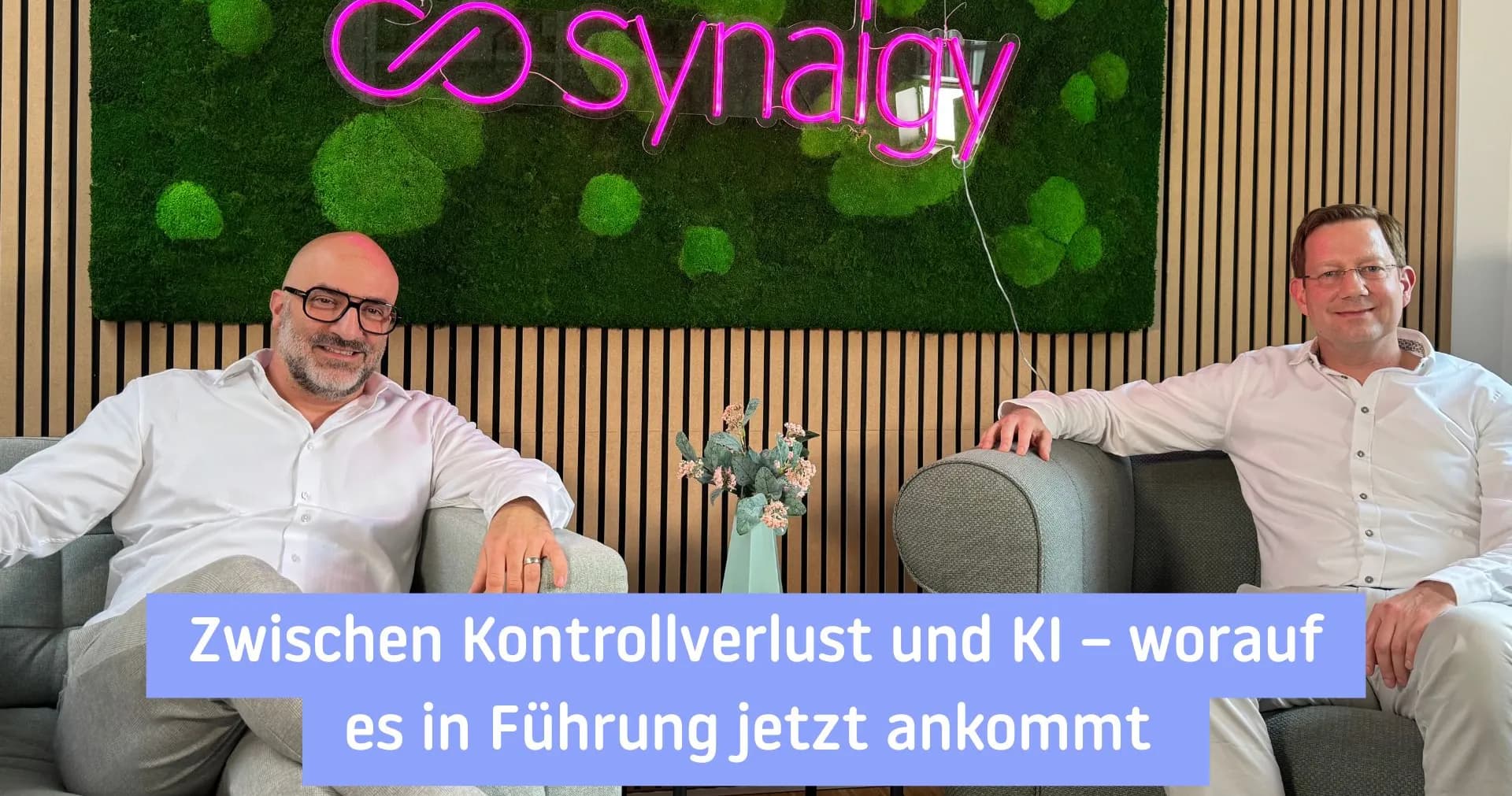
I don't think it's about doing everything at once right now. You really have to pick out the use cases where you say: okay, the technology is far enough along in this context. Something usable comes out of it – and then start with that. And I think that's actually the most important thing: to actually get moving.
The world has come off its hinges. At least that's how it feels. We used to talk about VUCA – volatile, uncertain, complex and ambiguous. Today BANI is the term – brittle, anxious, non-linear and incomprehensible. Welcome to the era where everything happens at once – and you still shouldn't lose your head. Because that's exactly what it's about: how do you keep an overview at a time when companies must simultaneously cut costs, integrate AI, restructure teams and open up new markets? And why a linear project plan is now more of a nostalgic relic than a valid solution. That's exactly the topic of the new episode with Markus Dränert from Intershop.
Leadership in an age of constant change
In classical models, change was mostly linear and predictable: innovation phase, growth phase, consolidation. Today, however, change processes run simultaneously – technologically, organisationally and culturally. For leaders, this means creating certainty no longer through planning, but through direction and trust. Markus Dränert describes this paradigm shift vividly: companies like Intershop must develop products further, drive AI initiatives, restructure teams and remain economically efficient all at the same time. To the question of whether this couldn't also be done step by step, he gives a clear answer: those who wait fall behind. „If we start splitting that up, others will be faster.“ he says. Leadership is thus transforming into a moderating role. It's about creating spaces in which teams can take on responsibility, and about the ability to move into action even without complete information.
AI as a tool – not as a promise of salvation
A central element of the transformation is the use of artificial intelligence. Intershop has set up its own AI team for this, which focuses both on integrating intelligent features into the platform and on optimising internal processes. In so-called discovery workshops, the team analyses across departments where recurring processes can be supported or accelerated by AI. The goal isn't to introduce as many technologies as possible, but to focus where concrete, measurable added value arises. This includes: - Automated customer advice and search functions - Support in customer service - Optimising internal workflows and decision-making processes The difference from classic automation lies above all in the degree of flexibility. AI systems such as GitHub Copilot go beyond mere routines by generating context-based suggestions and analysing complex error patterns. This makes software development increasingly a hybrid collaboration between human and machine.
New skills for new requirements
This development is also changing the requirements placed on skilled workers. While in the past deep specialist knowledge was mainly at the forefront, today willingness to learn, adaptability and systemic thinking are moving into focus. Markus Dränert advocates a new kind of CV: reflective and learning-oriented. Anyone willing to regularly engage with new technologies, methods and topics holds the better cards in a BANI world. He also emphasises the need for collaboration between generations. While younger employees usually take technological developments such as AI for granted, dialogue with experienced colleagues is needed to shape change holistically and sustainably.
Quality over quantity: why less code creates more future
An often underestimated aspect of digital transformation concerns the codebase itself. Intershop currently manages around twelve million lines of code – a considerable number that also brings challenges. Because every line of code has to be maintained, tested and further developed. Artificial intelligence can help here not only with writing code, but also with reducing it. The goal is to cut complexity and thereby respond more flexibly to new requirements, because "ideally, we halve the codebase while simultaneously creating room for new innovations." This approach underlines that technological progress doesn't always come from "more" – but often from simplification and a conscious renunciation of unnecessary structures.
Conclusion: shape change – don't just manage it
Today's challenges can't be tackled with yesterday's tools. Those who embrace permanent change don't just accept reality – they actively use it as an opportunity.
Leadership, technology use and skills development need to be rethought today – integrative, bold and focused on real added value. Because in a world where nothing is predictable any more, agility wins.
Would you like to listen to the full episode?
Find the podcast of the interview here:
Please accept the corresponding cookies to view this embedded content.
Prefer to watch the episode? No problem!
You'll find a recording of the interview here:
Please accept functional cookies to watch this video.
Prefer to read?
Joubin Rahimi
Great that you're back for a new episode of insights! My name is Joubin, Joubin Rahimi and joining us today: Markus Dränert. Hi Markus.
Markus Dränert
Hello Joubin. Great to be here.
Joubin Rahimi
Not just for the first time now.
Markus Dränert
For the second time.
Joubin Rahimi
Second time, exactly. And today we talk about world and uncertainty and everything currently moving us. Stay tuned, because we have some theses we... Didn't quite align on in pre-call. So this'll be exciting episode today. But before we dive in, would you like two, three sentences about yourself and your role?
Markus Dränert
Markus Dränert. I'm Chief Operating Officer at Intershop. That means everything to do with product, customer service and the new technologies, because of course we bring that to the platform to be future-proof, falls under me. And in that sense we're right in the middle of this transformation ourselves. I'd put it this way: the business model is the technology and everything we do in these times we're in and what's happening around us in the world. Exactly.
Joubin Rahimi
We came through punitive tariffs, through Trump, through a war, through all of that, also Covid and so on, which are genuinely changing the world, and AI. And you had simply said there's a new term, "new, after VUCA", which you can drop.
Markus Dränert
After VUCA comes BANI.
Joubin Rahimi
After VUCA comes BANI, exactly. And that's also a change we're really seeing here. You can sense this hesitancy and so on, and now it has a name, BANI. Shall I go ahead? Should I …
Markus Dränert
I think everyone can go and google BANI, what exactly the abbreviation stands for, but ultimately it's really about how we deal with these times of uncertainty. As you already said, there are so many things happening around us right now, at an incredible speed too, and you need answers to that. Not infrequently, though, this uncertainty also leads to anxiety, which then simply leads to: okay, I hold back for now and do relatively little, or I do it slowly, even though there's actually urgent need for action. Many of these changes aren't happening in a linear way at the moment, meaning they're no longer as predictable as perhaps before, when I could think in certain phases. So previously, I don't know, I'd have an innovation phase, then I'd have a growth phase, and then I'd have a shrinking-and-saving phase again. And the more you talk to colleagues, I think everything is simply happening in parallel right now. And I find that BANI makes that a bit more vivid, more tangible, in terms of: what actually is it, really? And from my point of view, it's exactly about the fact that all these things are happening at the same time, and these changes on various levels all need to be organised somehow at the same time too.
Joubin Rahimi
And that's mega hard. And it affects almost every industry. So our industry's affected by it, and our customers' industries too, from what I gather. They all have this "I need to be innovative, I need to become more efficient, but I have fewer resources available". So whether that's money or staff going into retirement and then I can't replace them at all, for whatever reason. So lorry drivers, other people, it's a widely spread topic. Is this a topic where you're also well represented internationally. A German topic, a European one or a worldwide one?
Markus Dränert
It's worldwide. It's worldwide. It spans all industries, and I think above all you first have to accept that this is simply happening right now and that it's normal. Yes, well, since we're also doing a lot in parallel right now, we're building the product, we need to bring artificial intelligence in. We're thinking about how we use artificial intelligence internally. We're not just thinking about it, we're already doing it. How do we restructure the product teams? How can we collaborate in new ways? These are all changes. And at the same time we still have to cut costs. And I think that's often a point where people quickly feel overwhelmed. Why are we doing everything at once? Can't we develop a plan and stagger it a bit? And the honest answer is simply: no, we can't. Because if we start staggering and splitting it up, others will be faster. Others will be faster there. There are also those who start on a greenfield site, they have no past, they're even faster. So all of that has to be organised. And I think the understanding of leadership, and how you can even shape such a transformation, is changing significantly, or massively, right now.
Joubin Rahimi
Then let's get into that, because I think that's much more exciting than, let's say, Trump tariffs and so on. That's unpredictable. But the topic of AI and how work is changing. We're actually running a hackathon right now, as we sit here, where we say, okay, next project simply less than 50% effort and completely with AI, whatever "completely" means now. What are you doing to enable your team on that? You said you're doing something there, or you're already doing quite a bit.
Markus Dränert
Well, first of all we set up our own AI team, which has two focus areas. On one hand, we design products and business models there to really build co-pilots and agents, so essentially AI tools, I'd call them that now, into our product, so that our partners, customers and our customers' customers can automate things, have better search, receive virtual advice, right through to automated customer service. And then we look internally towards Intershop: where can we deploy artificial intelligence? That means we really run so-called discovery workshops with every department. That means we really look at: what are the routine-heavy processes? What are topics we perhaps never had time for? What are topics we'd like to do but perhaps can't afford today? And then we look very precisely: what can AI genuinely solve of that today? I think it's always important to pick topics that work, because otherwise you just get one disappointment after another. And I don't think it's about doing everything immediately either. You really need to pick out the use cases where you say: okay, the technology is far enough along in that context. Something useful comes out of it, and then start with that. And I think that's actually the most important thing – simply getting into action at all.
Joubin Rahimi
That's how it is either way. We're called TIMETOACT as a group and so we simply have to make it easy either way and try it out. You just mentioned leadership. I find it very exciting, the discussion too: how do you handle AI then in company? And let me share my analogy: I say, back in factories we did a lot by hand or threw headcount at it, because we couldn't do it any other way. Then tools came along, then robotics, so that now in some factories no human works there any more at all, everything's done via robotics. IT itself is very manual though. I find that, I find it, kind of an irony: people sit there writing code without really having any aids, or if so only really light things, like a template, in sense of: I have a debugger that says: what's not working? And now with AI robotics suddenly comes in. So like in factories before, now suddenly I have things done by someone and I just have to plug them together, check, direct. Sure, on a different level, but that's okay too, because before, in car manufacturing, there were people who did a certain task and that was manual, physical. And now in IT you don't have manual, physical, but mental. So sure, you have to abstract that a bit. But now we're starting for first time to really have aids. And I think, two topics: A, I don't know whether you see it that way or not. Some say: AI is a new colleague. I say: no, that's simply a drill or a robot or whatever, so an aid. And B: you don't get all employees on board like that. So there are some who are totally open to it, others not. And C: I think we have to change our whole model because of it, because near and offshoring changes too. And now there was also, I think Google or Microsoft, who did live translation again. I'd mentioned that now and then. If that comes, near and offshoring with a different language suddenly becomes completely different, because you then have a meeting where everyone speaks in their native speak and then it gets translated. If we didn't have AI, that'd be really cool, because then you can offshore and speak in mother tongue. But now we also have AI and then question is: do you even need offshoring at all if you're actually doing AI or do you have to think about it completely differently? That implies leadership topic too then. Now I've talked a lot.
Markus Dränert
Yes, I was just about to say, we have many topics.
Joubin Rahimi
Not bad, but you're doing quite a bit more. How are you positioning yourselves? How do you see it in that regard?
Markus Dränert
Yes, well I think there's still a big difference when you look at AI, artificial intelligence and these agents and co-pilots compared with a factory, because in the factory it was always a kind of routine activity, which was often also physically demanding. Or you had to be a precise welder. The list goes on. And you were essentially automating recurring tasks. What we're now seeing, of course, with GitHub Copilot, which we're genuinely using in our development teams today, we call it co-coding. At the moment it's autocomplete. Let's call it suggestions from the AI: okay, it tries to read along live, work out what the developer seems to want to programme, and interprets that going forward and says, do you want this? And then you can basically press Enter, and it's in. So. That's the first stage now. And I think that's already a difference, because in principle I can now also give the AI an error pattern and say, hey, I've got a bug in the software here. Can you take a look yourself at where the fault might be and give me two or three suggestions on where I need to look. And I think that's already a new stage compared with a welding robot that always partially welds the same thing once it's been programmed. So we're already entering an era where I can give the AI individually different tasks each time and it comes back with at least good solutions, or simply saves me time, because the AI already tells me: look exactly there, that could be where the fault is, and by the way, I've already made you a suggestion.
Joubin Rahimi
Now here's my thesis on that. The way you describe it, thumbs up, I see it the same way. But I'd zoom out a bit further. De facto, a software developer always does the same thing, and dear colleagues, I mean that with full respect and warmth. An integration with an SAP system is basically always the same, but the fields are different, the description is different, how it's used is different. And sure, up to now people had to think it through: how do I put this together? But now I have a tool that takes that thinking off my hands. And when I zoom out the perspective, it's actually the same thing again. It's just an integration with SAP. Sorry, just an integration with SAP. For an AI, that's completely irrelevant, because it's been trained on that and can handle it.
Markus Dränert
But I think it's the same discussion we had with robot automation 30 years ago, when people said: oh god, now everyone in the factory will be unemployed, and that's not how it turned out. Well, the value creation-
Joubin Rahimi
It just shifts.
Markus Dränert
It's shifting. Value creation keeps moving forward, and honestly we're glad when we no longer have to deal with SAP data integration ourselves, because someone takes it off our hands. Because it doesn't add value either. The real question is: okay, what do I do with the data? And how do I actually extract the business value from it, and not spend x days on an SAP integration first in a migration project. But that's a really good example. I think automating things like that is good, and then genuinely capturing the business value and having the time for it again.
Joubin Rahimi
What kind of people do we actually need? We won't need the perfect coder anymore. What kind of people do we need in companies? What do we need and what do you need? What type of software developer will the customer need in future, or will it not be a software developer at all? That's also… exciting
Markus Dränert
Well, I think there are a few things that run through everything, regardless of whether you're a manager, colleague, employee, project manager, whatever you do. I think with everything that's happening at the moment, this is a term that, I think, has already been used a lot, but I believe it's becoming ever more important: lifelong learning. Anyone who isn't willing to genuinely engage with all these new topics, try them out, apply them, will fall behind. Yes. And in the past, I don't know, I might have hired candidates who'd built up knowledge in a specialist field over a long time and said: well, they've got ten years' experience, they're the best for us. Today I'd probably look more at: okay, who's done something new, content-wise, every year? They don't need to change jobs every year, that's not what I mean, but is there flexibility, is that reflected in the CV? Exactly, really engaging with new challenges, new technologies, dealing with them, and essentially being in a constant state of change yourself, because I think that's actually what it's about. We constantly need to question ourselves faster, whether we're building a product, whether our business model still works, or how I actually work. And that applies whether I'm a developer, project manager or a sales colleague. So in sales too, a lot will change.
Joubin Rahimi
Yes, a completely different topic on that note. But software development now for you as a provider … you're increasingly shifting towards a SaaS product and less professional service.
Markus Dränert
Yes, that fits. We call it PaaS. So we're not SaaS. That's more out of the box with everything the same. That's why we tend to call it platform service.
Joubin Rahimi
You're increasingly product-focused, or you're increasingly focused on that. What percentage of code do you already write? Do you have a figure? I know Microsoft says 20 at some point, three weeks later Google says they do 30, Microsoft says by the end of the month I do 40. So everyone always says twice as much as you.
Markus Dränert
The question is always: what is good? Lots of lines of code or simply good code? No, it's not about lines of code. I think the question really is: what business value do you create? That is, what you bring to the customer and to the partner. That has to have a direct benefit. So either I generate more revenue with my shop, or I save costs, or I can move into new markets faster, flexibility, or I can quickly try out new sales channels in a short time. Or I can solve skills shortages at partners or customers with agents and co-pilots that we provide in the platform. I think those are today's topics. And hopefully we don't write many lines of code for that. So ideally, coming back to BANI, I'd actually like to do both. I'd like to halve our codebase, actually get rid of the lines of code, and at the same time create all these new innovations.
Joubin Rahimi
Why do you want to get rid of them?
Markus Dränert
You have to maintain everything after all. So I think the fewer lines of code you have, the better.
Joubin Rahimi
But with AI? Does it matter or does it actually matter quite a lot? You're much closer to it than we are now.
Markus Dränert
Well, I say how we get there doesn't matter to me for now. I believe AI can definitely help us, because AI, firstly, with these roughly twelve million lines of code we've nearly got. We really built a monster over the years.
Joubin Rahimi
She doesn't say it like that, everyone has monsters.
Markus Dränert
Yes, and that's where AI can of course help, to have a look and say: okay, what can we perhaps shorten?
Joubin Rahimi
Great. What would you tell young people entering this field now? You've mentioned lifelong learning already. But you've probably got two or three more tips from your experience — you've been in roles like this for a very long time — on what's important.
Markus Dränert
I think you don't need to explain to young people, colleagues, how the world works today. But they always come, unless they're at a very young agency or a very young start-up where there are only young people, often into companies where there are also experienced, older employees. And I think that's quite exciting. So I don't think I need to tell any university graduate how to use ChatGPT or anything else, they're doing that already anyway.
Joubin Rahimi
In doubt, earlier than the older one.
Markus Dränert
Yes, but now it gets exciting. Meaning now young and old, to put it bluntly, meet each other. And this change has to be shaped together. And I think my tip would simply be to really listen in a bit to more experienced, older employees: okay, why do they seemingly not move right now? Why don't they adapt so quickly? Why do they insist on these old patterns? And I think everyone has to find their own way of dealing with it, because it's simply there. It's not gone and it won't go away. It will only succeed if you manage this transformation together.
Joubin Rahimi
Did you notice? My question was about younger employees and you turned it around. You don't need to do anything there. It's the supposedly older ones, set in their ways, who are inflexible. That's where you need to act.
Markus Dränert
No, what I meant was… You asked more what's the tip for the younger ones? I don't think I need to give technology tips, because young people can do that anyway, but they'll simply come across the older ones. And that has to work together, because they work together daily, they build the future, the product, together. And I think both together is what you have to achieve in this whole change process.
Joubin Rahimi
And that's a lovely closing word. I'd like to just leave it there. Dear Markus, thank you. Thank you all for listening, and feel free to leave questions, comments and remarks below. We're very happy to discuss them.
Markus Dränert
And we'll definitely go another round, right?
Joubin Rahimi
We'll do another round.
Markus Dränert
Alright. Until next time then.
Have questions or feedback?
Then feel free to contact us directly.
- Joubin Rahimi
Managing Partnersynaigy
Show phone numberShow mobile numberShow email address
Subscribe to the blog now and never miss any news
✔️free of charge ✔️weekly news ✔️expert knowledge
Please accept the corresponding cookies to view this embedded content.