



insights! #120: Re-platforming pitches in transition – why AI, flexibility & realism are the new pitch currencies
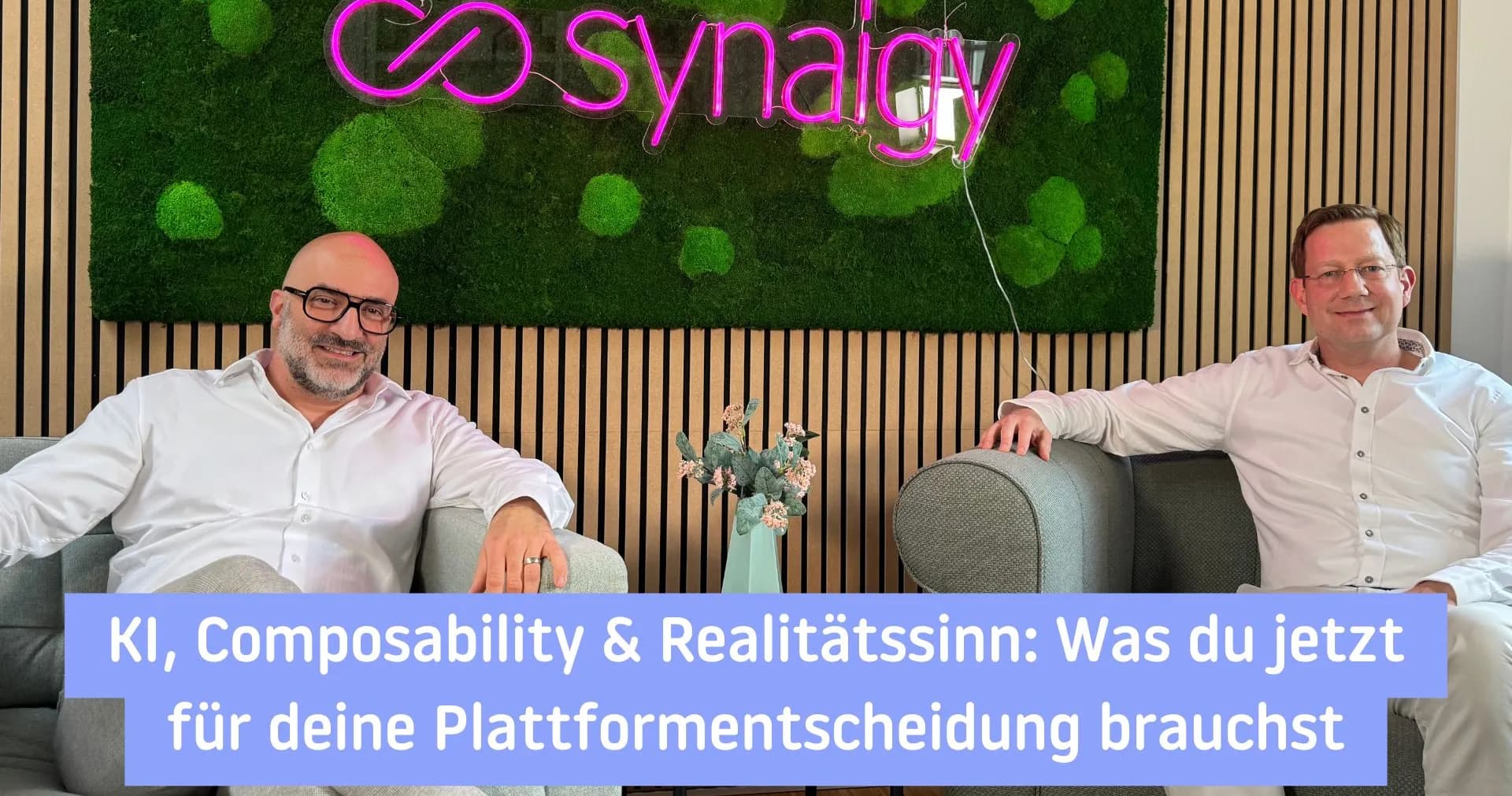
In our new episode of insights! Joubin spoke with Markus Dränert, COO of Intershop, about why re-platforming pitches are currently changing radically – and how you as a decision-maker (or provider) should respond. - You'll learn why AI is now mandatory. - You'll get insights into how real decision-making processes work today – hackathons instead of glossy slides. - You'll take away impulses on how platform choice can finally bring efficiency and innovation together again.
 Joubin RahimiManaging Partner · synaigy
4 min read
Artificial intelligence is no longer optional. Prospective buyers today want to know exactly how well positioned the platform is in terms of AI – and whether it will still be competitive in three to five years. Whoever can't answer that credibly no longer plays a role in the pitch.
Way companies select e-commerce platforms today has fundamentally changed. Classic pitch formats with feature lists and comparisons are increasingly taking a back seat. Instead, focus is on strategic foresight, innovative strength and concrete implementation capability. Conversation with Markus Dränert, COO at Intershop, makes this more than clear. What platform providers must deliver today isn't a theoretical chain of arguments – but solid proof that they actively think through and can concretely implement future technological challenges. Whoever only shows in pitch what platform can do today has already lost.
From feature list to innovation strategy
Few years back, enough to bring tidy feature list to pitch. "Can you do XY?" — "Yes, tick box." That approach belong to past. Companies today think in scenarios, adaptability, technological evolution over several years. What matter not whether platform fulfil every single feature, but whether it create conditions to react flexibly to new market conditions. Whoever fail to think ahead on AI, new sales channels, or regulatory requirements will hit limits fast. So pitch focus shift: not current capability count, but capacity for innovation.
Artificial intelligence as a gamechanger in the pitch
Hardly any B2B project still comes without the expectation that AI delivers measurable added value. But it's no longer about the whether, but the concrete how. Platform providers are now being asked to present real use cases in the pitch – from automated product recommendations to supporting sales processes through smart agents. What counts here isn't just the vision, but above all the practical implementation. Which agents can be used pre-integrated? How flexibly can data sources be connected? And above all: how quickly can you generate initial results that really make a difference in everyday use? This is exactly where the wheat is separated from the chaff in the pitch.
Hackathons instead of glossy slides: the new practical test
More and more organisations are relying on joint pilot phases or hackathons to genuinely experience providers and technology. A pitch today is often just the door-opener – real conviction comes from working together on prototypes, from tangible results and from the experience of whether the collaboration actually works. These phases also reveal how robust the promises made in the pitch really are. Can the team deliver? Is the platform configurable rather than just theoretically flexible? And how well can an innovative use case actually be implemented within just a few days? Anyone who wants to hold their own here needs to bring not just technology, but attitude too.
Standardisation with room to manoeuvre: the appeal of the composable approach
Platform strategy of recent years was often defined by modularity and maximum customisation. The price: high integration costs, rising maintenance effort and operational complexity. Today, organisations are once again looking for standards – but without wanting to give up adaptability. Providers like Intershop therefore rely on a composable approach with ready-made modules and open API architecture. Advantage: projects can start quickly, first results become tangible, yet room remains for individual extensions. This lowers not only time-to-market but also risk under tight budgets and limited resources.
Selection criteria rethought: what decision-makers really want today
Anyone choosing a platform today asks different questions than they did just a few years ago. It's about flexibility in the face of uncertain markets, efficiency in times of skills shortages, and scalability for future growth. Scaling is more than just technical throughput – it's about processes, internationalisation, new channels and automation.
Platforms that offer no answer to these requirements – whether through pre-integrated AI, flexible architecture or proven standard processes – will struggle to win the pitch. Decision-makers are looking for solutions that ease operations, are economically viable and open up new business opportunities at the same time. Anything else is no longer up to date.
Would you like to listen to the full episode?
Find the podcast of the interview here:
Please accept the corresponding cookies to view this embedded content.
Prefer to watch the episode? No problem!
You'll find a recording of the interview here:
Please accept functional cookies to watch this video.
Prefer to read?
Joubin Rahimi
Great that you're back for a new episode of insights! My name is Joubin, Joubin Rahimi and joining us today: Markus Dränert. Hello Markus.
Markus Dränert
Hello, Joubin. I'm glad to be here.
Joubin Rahimi
That's brilliant. And today you'll find out why pitches have changed so radically for re-platforming projects. Because Markus is CEO of Intershop and in our preliminary conversation, we both noticed a lot of things – how rapidly the world is changing in this environment too. Perhaps you'd like to say a couple of sentences about yourself first, dear Markus.
Markus Dränert
Yes, gladly. Yes, I'm Markus, I'm at Intershop, I'm the Chief Operating Officer. That means everything to do with product development, artificial intelligence, all the new topics right through to support, falls under me. Yes, and we're making the Intershop platform future-proof.
Joubin Rahimi
We'll need to talk about that in more detail in another podcast later. Now, on this pitch situation: at our end, we've noticed we're getting fewer and fewer pitches, or there are simply fewer in the market. We're hearing the same from agency friends too. That's why we're doing more marketing – what an irony. But sure, that's why we're more visible in the market, though we're also noticing that e-commerce pitches, re-platforming pitches, are different now. And one customer once said it's like a POS system – it's just become a commodity. Have e-commerce and platforms simply become a commodity, or how do you see it? You've been in the market for a while too, you're one of the oldest players.
Markus Dränert
Yes, well I think there are two topics currently massively influencing sales conversations, but also driving our customers' needs, let's say. One is world and changes we're currently having, which is very broad. Starts with tariffs, starts with technological changes like artificial intelligence. Yes, but also continues: what are tomorrow's trends? What should my platform actually have so I'm still future-proof tomorrow too? All the way to currency effects that pop round corner briefly. On one hand this leads to customers simply needing longer to reach purchase decision in these uncertain times. They wait.
Joubin Rahimi
Or simply postponing it, we do that quite often too.
Markus Dränert
Postpone, yes. Postpone, precisely because something crashes in from the side, you first have to deal with that: Well, and the current platform is still running after all. So we do see that, let's say, the cycles or the time period from I first talk to a customer to I really get to signature, simply drags out a bit. And these uncertainties really don't help right now. That's one thing we see, and the other is of course actually artificial intelligence. That means, first of all a term, a buzzword, it's a megatrend, everyone wants to do something. Above all though, prospective buyers want to be sure that the platform they choose is well positioned when it comes to artificial intelligence and can still keep up in three to five years. And I think those are the topics that have changed massively. That means, while previously we used to go through our whole feature lists in B2B e-commerce, very long list: Can you do this? Can you do that? Can you do this? That's really shifted to, okay, that's still important, but if we simply look at how much time in the sales conversation goes to which topic, then two-thirds of the time we're now talking about agents, about co-pilots and how we shape the future.
Joubin Rahimi
That's become a bit of a hygiene factor. You simply have to have certain things. Exactly. We've now received another tender. 40 pages. It's more about budget and so on. The platform itself is set. But what was exciting was that they said: I don't actually want you to pitch everything in the hour afterwards, but you have a pitch task. And the pitch task is then: how do you approach a certain topic area with AI? I found that really exciting too, because they said: sure, you have a company presentation and so on, but everyone can be asked about the business you need. But we want someone who's there for the next five years, as you also say. And that's why they give an innovative task, probably to see: where are the companies heading? What knowledge do they bring in? With what standpoint?
Markus Dränert
What we're now seeing a lot is that customers or prospective customers really get deeper into the technology. We're now often seeing that we first go through all the criteria. Maybe you get a task here and there, specifically in the pitch, to focus on something, but often there are, let's say, two or three providers left at the end, where either the customer's partner or the customers themselves get involved and say: we're now really going to look at the technology for two or three weeks. What does it feel like to work with provider A, B or C? What can I actually customise, tailor there to my needs? How easy is that? And what feeling do I get, especially with these innovative topics, in terms of how flexibly and quickly I can implement things there? And we simply see that this is changing.
Joubin Rahimi
Hackathon-style, so to speak. We've had this a few times now, where we said, we can imagine doing this with you, but let's run a joint hackathon for a week. Can the people who'll later be on the project work together? Do you know the technology? You'll find out along the way whether that…
Markus Dränert
We notice that too. Even our existing customers really like doing this, because often our customers' networks … We also have many cooperatives or cooperative-like associations that run this for their members on Intershop. And of course, especially at these hackathons, it's about how do I actually get started working with new technologies? And hackathons are perfect for that. I can present all the AI tools there, I can start working with them directly, and produce very concrete results. And that helps everyone engage with the technology, see what I can actually achieve, and in what time. And when you manage to present real prototypes at the end of one day, that creates a real sense of new beginnings, and then maybe one or another scepticism gets set aside. You see it's not that complicated after all. You can actually get things done relatively quickly there, without having to dive too deep into the whole technology, and bring them to success, get them running.
Joubin Rahimi
Exactly, you're not part of the Mach Alliance either.
Markus Dränert
No, we're not.
Joubin Rahimi
But the advantage is, let me put it the way we position you: you can simply pull it out of the socket or out of the drawer. You have a ready-to-run system first, which is then adapted. Of course you can always rewrite everything again, but you actually come with such a set and say, you don't have to decide on best of breed for everything, but your ambition is a different one, namely that you bring a lot with you. That's how we position you.
Markus Dränert
We say that we're composable too. We are. They're on the latest technology stack.
Joubin Rahimi
Exactly, I don't want to deny that at all.
Markus Dränert
We have all of that. Still, I'd say you get a good B2B e-commerce standard from us out of the box, which is nonetheless customisable enough that, depending on your special cases, you can still implement all of that too. We think about the AI topics in the same way. That means, ultimately, we want to pre-integrate things well enough that everyone can actually get started, because a lot of what we're seeing now, what partners might be starting too, is often very bespoke, and we believe you simply have to start first and make it as easy as possible for customers and our partners too. That's why we're currently working on really pre-integrating things, to be able to say: okay, I can really switch my first agents on and off, depending on what need I have, what I need, so I can simply get going. To do it really well, I think you still need to connect another data source or adjust one rule or another, which you can do. But if you want to get started first and simply get a feel for how this could work in my business, then I think you need a good pre-integrated standard that lets you simply get going and dare to start.
Joubin Rahimi
You have 2022, right.
Markus Dränert
Yes, 2022.
Joubin Rahimi
You bought a SPARQUE, didn't you? I don't know if everyone picked up on that in this setup, because I think if you don't follow you, you don't pick up on it directly, but you made a decision early on to offer more than just I only do the transaction engine. Maybe you can say two or three sentences about SPARQUE.
Markus Dränert
Yes, SPARQUE is an AI-based search. But it's more than that. It's not just a search, it's actually a personalisation engine. That means, for one thing, I can replace the search in the shop with it. I can also integrate various live data. So if I want, I can integrate the weather forecast. I can look at the order history. I can really connect it however I need it for the customer. In the end, it's about the customer finding exactly what they're looking for more quickly, or us using the technology to anticipate what they might need. I think that's the big difference.
Joubin Rahimi
And for you I find that mega exciting, because what's happening in market now is, I'd say, e-commerce systems, transaction engine and so on, checkout, PDP, that's commodity, tick box done. There's some who encapsulate that quite strongly and say: that's what we stand for, we just do API-first or MACH architecture, and you've chosen path of positioning your entire ecosystem much broader. And I see that with some vendors and others do it very narrowly. And there's personalisation engines too, loads, an Odoscope, a Turbo, so really, really many more that I haven't named. And insofar customer, our customer, always has question: where do I do something special? And where do I also, for example if I've decided on Intershop, where do I take that out of standard? Do you notice that such fundamental decisions get made, just so you even get into pitch? Or is that more world I'm painting for myself right now?
Markus Dränert
No, well, maybe one more addition: with us, a lot comes out of the box, a kind of standard, but we also already have a great deal built on APIs behind it. That means we've built our own shop front end internally on top of APIs. And that's really the beauty of it. So if you start with Intershop, you can get going quickly. But if you say you have very specific requirements, you can also call our APIs and build whatever you like around them. That's why I always really compare us to being composable, we have APIs just like the MACH Alliance does too. Even so, you can start out of the box and simply get going.
Joubin Rahimi
I don't want to take that away from you at all. We do exactly the same. Sometimes we use your storefront, sometimes we don't. Quite varied, really. What I mean is more that the market increasingly moves towards, well, put the other way round, I'm just thinking it through. With Covid, the e-commerce market, above all in B2C and only secondarily then in B2B, generated a huge amount of digital revenue, and a lot got invested because everyone said: it's going up, it's going up, it's going up, and it keeps growing year on year. And then suddenly I build this huge architecture, MACH or not, doesn't matter, I build this huge architecture and then realise: actually that's not so cheap after a while. And now the market has come back down again, calmed a bit, so companies are looking again: what can I simply standardise? Where do I really need something new? Or where can I go with a standard that comes from you? And I don't need a specialist provider who might be a bit better but doesn't give me the added value of maintaining it, paying extra for it, dealing with it, hiring, keeping staff on standby for it.
Markus Dränert
My Corona had two effects. One, everyone not yet fully digitalised and aligned to online business, had to do it. So think, lot money on table there. Had to act fast, maybe didn't negotiate optimally anymore. Just needed something, quick. Mustn't forget that. Bit while ago now, but of course led to lot invested, lot built up. And question now of course: what do you build? Go modular build, must of course a) choose each module myself. Must bring modules together, even with platform that can do it. Always more complex. And must of course maintain all these modules in operation too.
Joubin Rahimi
And professionally too: where do I maintain what, when?
Markus Dränert
Exactly. Yes, that's not to be underestimated. That means I have X modules moving to new versions. There are also API breaks there, even if I have a standard. That's unavoidable. And the more detail I want to solve for my own specific case, the higher the costs go at some point. And that's something we're seeing in the market now too, especially with, let's say, potential new customers we're currently talking to. Some of them are coming from such a complex, I'll call it, integrated construct. And they're naturally noticing that total cost of ownership is a bit of the term there. The overall costs are already high, the complexity too. Yes, and I also need the know-how for the modules, that's not just the costs, I need all of that too. And then the question is: okay, how is my business developing right now? We already talked earlier about the uncertainties in the market. And if I then come under cost pressure myself, because I'm perhaps facing more competition myself with my core business, then at some point I naturally also ask the question: okay, how much money really needs to flow into the platform? And don't I have optimisation potential there too? Yes.
Joubin Rahimi
If you switched roles now, effectively here in our conversation, and became CIO or CEO at a B2B wholesaler, how would you make a pitch? Or how would you support a selection process? What would be your three key things where you'd say: this is how I'd shape it to get the best possible outcome?
Markus Dränert
I think every customer today has to adjust to these different influencing factors, which feel like they're changing on a monthly basis. I think today you need a platform that's flexible. Whether that's tariffs, new technologies, you have to respond to it. If I'm an international customer, it's also very much about sales channels changing. No one knows how much longer the Google channel will work the way it does today, just to name one example. Chatbots are spreading, and at some point they'll replace that, at least to a large extent. These will all be challenges you have to respond to, and respond to in a way that's actually possible with the platform you choose. I think that flexibility will be extremely important. On the other hand, there's simply cost pressure. I think that's generally increasing. There's a high expectation of efficiency in the market, meaning everyone else will eventually turn to artificial intelligence. I think if AI isn't part of the platform, there's no point looking any further. So I think that's definitely one point. We're generally running into the skills shortage issue. I think that concerns all of us.
Markus Dränert
That means I'd always look for a platform that in some form answers this question. So are there agents that can take routine tasks off my hands on certain topics in future, so that I can really put my staff on the important topics, instead of doing repetitive routine tasks. And yes, I think, last but not least: you still want to grow. So I think, with everything currently occupying us, another phase of strong growth will come again too. And the platform of course needs to be ready for that too: can I move into other countries fast with it? Can I ramp up different sales channels? Can I customise it to my business enough that I can scale and grow well with it? And is it still profitable then, or do my costs explode?
Joubin Rahimi
I'll try to sum this up in three, four, five points, because there's lot in there: a) flexible, is it flexible, but also efficient. Is it efficient and therefore also effective for what you want to achieve, and can it grow with you. Scaling doesn't just mean more traffic, but languages, currency, other countries and so on.
Markus Dränert
Yes, it's above all about processes too. I think many people, when it comes to scaling, only ever think about cost.
Joubin Rahimi
More traffic or something like that.
Markus Dränert
Exactly, more traffic, more costs or more orders. But that's not it at all. I think when we talk about scaling today, or also efficiency gains, and especially now in connection with artificial intelligence, a huge amount will change in terms of operational processes. At some point I'll have agents that take over part of employees' tasks today, but really they change my whole workflows and processes differently. And that's what it's about. Which means I need a platform that can also handle genuinely scaling these processes – that's how I'd put it – and mapping them completely differently. And if I then have to start again, if it's always a customising project, then it gets complicated and expensive again.
Joubin Rahimi
Great. And I'll take that as a closing word, and I have a question: for the last point, on how to do AI properly too, could we just do another separate podcast on that?
Markus Dränert
Let's do it.
Joubin Rahimi
Great. Because I think we covered a lot there. We're already at 18, 20 minutes and that's really worth its own podcast episode.
Markus Dränert
Let's do it.
Joubin Rahimi
Hopefully you recognise yourselves in parts of this, or it helps you think it through again, especially for replatforming projects ahead of you. Feel free to post comments, links, remarks on it too. We're very happy to discuss it. Thanks Markus for the insights.
Markus Dränert
Thanks for the invitation.
Joubin Rahimi
Great, very happy to.
Markus Dränert
And yes, we're just carrying on filming.
Joubin Rahimi
We'll carry straight on, exactly. Stay tuned.
Have questions or feedback?
Then feel free to contact us directly.
- Joubin Rahimi
Managing Partnersynaigy
Show phone numberShow mobile numberShow email address
Subscribe to the blog now and never miss any news
✔️free of charge ✔️weekly news ✔️expert knowledge
Please accept the corresponding cookies to view this embedded content.