



insights! #90: what Germany must do to ignite the tech turbo
 Joubin RahimiManaging Partner · synaigy
3 min read
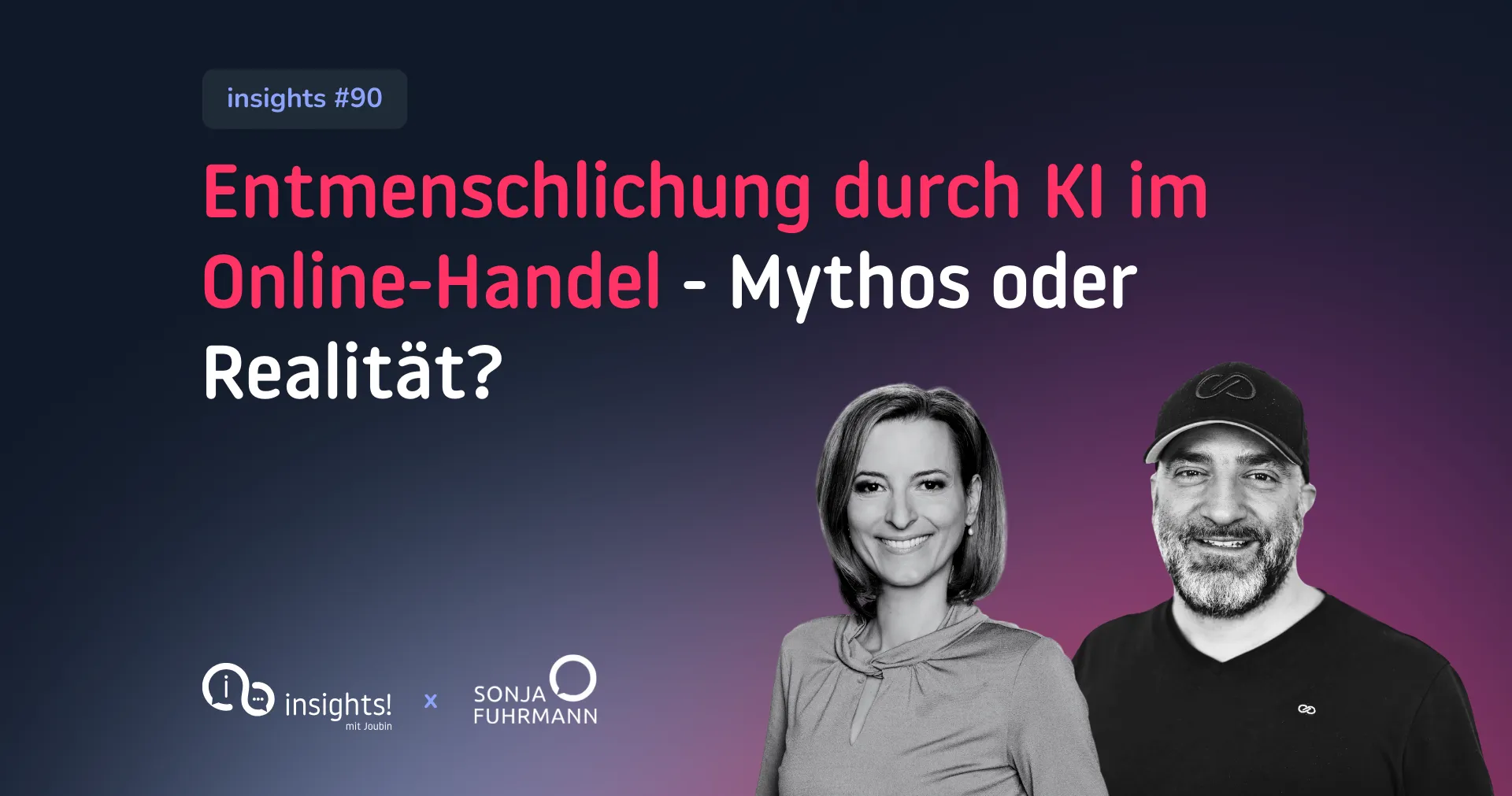
In this insights! episode, we dive deep into the topic of artificial intelligence. Together with tech investor Philipp Klöckner, we discuss current challenges and opportunities of AI in Europe. From regulation to the impact on developing countries – no question goes unanswered. You'll also learn why Germany still needs to catch up in the AI race and what role energy supply plays in this.
Jobs will be lost, but new ones will also emerge. And that's the change we're facing.
AI – hardly any topic is currently discussed more heatedly. But is this technology really the revolutionary breakthrough it's often celebrated as? Or is it more of a clever marketing move to sell simple algorithms as expensive high-tech solutions? These questions were at the centre of an insightful conversation with Joubin Rahimi, CEO of synaigy, moderated by Sonja Fuhrmann.
The Comparison: Is AI the Modern Equivalent of the Printing Press?
I see AI as a transformative force whose significance is on par with Gutenberg’s printing press. Just as the printing press once democratized knowledge and made it accessible to the general public, AI today enables everyone to automate complex tasks and process vast amounts of information. Whether it’s creating content or analyzing data—AI has the potential to change our lives just as fundamentally as the internet and the smartphone have done in recent decades.
Opportunities and Risks in E-Commerce
In e-commerce, AI offers enormous opportunities but also poses significant risks. On the one hand, it enables personalized shopping experiences that are precisely tailored to customers’ needs. On the other hand, there is a danger that this personalization could go so far that it turns into manipulation. The technology itself is not manipulative—it all depends on how we use it.
Another risk is hyper-concentration in the market. Through the use of AI, a few large companies could gain market dominance and distort competition. But I remain optimistic: AI also offers opportunities for smaller companies by allowing them to position themselves skillfully in niche markets and thereby remain relevant.
Dehumanization Through AI? A Double-Edged Sword
A frequently expressed concern is that AI could lead to dehumanization. Will AI eventually influence us to such an extent that we can no longer make our own decisions? I don’t think so. While AI automates certain processes, it also creates new opportunities for us to use our time more meaningfully. Here’s an interesting comparison: Just as personal assistants in executive offices filter tasks and free up time, AI could help us focus on more important tasks.
Job Loss Due to AI: Threat or Opportunity?
The issue of job loss due to AI is also often viewed critically. It is undeniable that automation will eliminate some jobs. However, I do not see this as a threat, but rather as an opportunity to develop new skills and pursue new careers. This development is similar to industrialization, during which many traditional jobs disappeared, but new ones emerged at the same time. Above all, I see automation as an opportunity to improve the quality of work and free people from repetitive tasks.
Looking Ahead: AI and the Future of E-Commerce
A brief glimpse into the future: I am convinced that digital assistants will soon be ubiquitous and will revolutionize the way we shop and interact online. This development could bring enormous benefits not only to large companies but also to smaller players—provided they take advantage of the opportunities that AI offers them.
Entrepreneurs should actively explore the possibilities of AI and take advantage of the opportunities this technology offers. In doing so, however, they should always keep the risks in mind and ensure that the use of AI remains ethically sound. The future of e-commerce will be exciting—and AI will play a central role in it.
Would you like to listen to the full episode?
Find the podcast of the interview here:
Please accept the corresponding cookies to view this embedded content.
Prefer to watch the episode? No problem!
You'll find a recording of the interview here:
Please accept functional cookies to watch this video.
Prefer to read?
Sonja Fuhrmann:
Yes, the term AI is on everyone's lips. Joubin, isn't that just a marketing gimmick to sell simple technological algorithms at a high price?
Joubin Rahimi:
Oh, that hurts. That really hurts a lot. So it's not a marketing gimmick, but from my point of view something like the printing press in the course of societal innovations. So this fundamentally changes our world.
Sonja Fuhrmann:
Give an example.
Joubin Rahimi:
I'll go back even further. With Gutenberg's printing press, a great deal changed. Before that, knowledge was reserved for whom exactly? Think about it: for the nobility and the church. And then with the printing press, suddenly knowledge became accessible to many, many people. And that was the foundation of democracy, also through the democratisation of schooling, of industrialisation. Everything we now have, we owe, de facto, to the printing press. I'm really going back a long way. The second point is: I won't go into industrialisation. I'll jump straight to the year 2007. With the internet, specifically the combination of the internet with the smartphone and social media, our purchasing behaviour changed again, because suddenly we could distribute information worldwide. So anyone can, with one post, reach the world, just as we hope to as well, reach this world. But also, for example, product reviews suddenly gained a completely different level of traction, and markets changed, and topics too. And with AI exactly the same thing is happening, because we can suddenly make the creation of concepts, of topics, much, much easier. And it's no longer reserved for people who have a lot of money or have a company, who say, okay, I'll hire someone to do this, but suddenly I have an AI that does it.
Sonja Fuhrmann:
Of course, AI also brings a lot of fears, one has to say. Is AI really intelligent in this context, or is it manipulating me into impulse purchases?
Joubin Rahimi:
Well, those are trick questions to start with. From my point of view, they're two questions at once: AI isn't intelligent. Intelligence in the sense of generating something and so on, that's not what it is – rather we teach the AI topics, and it then repeats them, simply at immensely high speed. The advantage is that because I pack a huge amount of knowledge into a system, which then, as it's trained, provides answers, you can very quickly support people, even with new knowledge, to get things done, but it's not intelligent in the sense of generating something new. Is it manipulative? As always with technology, it depends how you use it.
Sonja Fuhrmann:
But doesn't that lead to a dehumanisation of e-commerce, ultimately?
Joubin Rahimi:
So you mean, ultimately, that we humans will then be worth nothing, right? That we no longer even make our own decisions, but are truly manipulated and controlled?
Sonja Fuhrmann:
Yes.
Joubin Rahimi:
Certainly the AIs, once in use, will dictate things. We see it with Google already. If you're not in Google's top three results, you're very likely not in the relevant set for very many people. So AI will naturally also drive hyperconcentration. Will it dehumanise? I don't think so, because questions can be so diverse and manifold that smaller firms, through clever positioning in a niche, suddenly become relevant for that question. So new opportunities emerge too. And another angle entirely: many chief executives, chairs – I don't even know the correct gendered term, I must say – executives of all kinds. These often have personal assistants. And these people also produce something, generate something, filter things out. They free up time, and AI will also free up time for us humans in certain areas. So it's a dehumanisation perhaps, but on the other hand I have someone helping me use my time differently. And I believe that's a huge win in turn.
Sonja Fuhrmann:
You just equated AI with the invention of the printing press. Fact is, AI will drastically change our world.
Jobs will be lost due to AI. Is that ethically justifiable?
Joubin Rahimi:
First, purely factually: yes, jobs will be lost, but there will also be new ones. And that's the change we're seeing. Especially with all the technological progress we're seeing, certain jobs won't exist in that form any more and new ones will emerge. Simple example: in accounting, we have 1,300 employees, we certainly employ 14, 15 people in accounting at head office. One of their tasks is sorting receipts, scanning them and so on. We've now introduced tools where employees can photograph receipts and at the same time these are read and already pre-categorised. Huge time saving. Yes. Yes, as a result we'll need fewer accountants to do all that in future. But it's also a job where I'd say the accountants can do much higher-value work, booking things correctly, introducing controls, and that will emerge anew. And I'd say, with that profile, let's take the accountant as an example, I can also do completely different work that has nothing to do with the finance sector in that form and create added value there instead of following tax law.
Sonja Fuhrmann:
So you also see the opportunities. But many also see the risks, namely that AI becomes too intelligent and at some point takes control in e-commerce. How do you see that?
Joubin Rahimi:
That's a question where, if you look at the statistics, Germans are always in first place when it comes to fear. And of course, where there's light, there's always shadow. No question. But my mission is to show the light. Let me put it bluntly. AI, and I'm firmly convinced of this, will not take over us humans like in a science fiction film. And we won't become the slaves of AI. That won't happen. We had these thoughts with the steam engine too, where people said if you go too fast, you'd become ill, I believe. Or the printing press, to bring that up again, which led to fears that novels would change people so much that we wouldn't know where we were heading, that we'd all become stupid. I believe these fears aren't really real and are being stoked by those who have other goals, namely to get ahead through innovation and technology.
Sonja Fuhrmann:
So you have the entrepreneurial mindset, you see the opportunities. What do you advise other entrepreneurs on AI?
Joubin Rahimi:
Guess, see the opportunities.
Sonja Fuhrmann:
Why?
Joubin Rahimi:
I think we need to move away from the German bubble. We now also have the corresponding AI Act in Europe, which is slowly gaining traction. We're positioned globally. We humans can make use of anything from around the world. And here in Europe, we're still doing pretty well. But if I look further towards Asia or Africa, all these countries are experiencing real change in their ways of life through learning and innovation. That makes them far, far hungrier to create and try out new things. We're in the fortunate situation of having had it extremely good for centuries now, with our roughly 350 million inhabitants in Europe. But if I consider that Germany is actually about the size of the four largest cities in India, that perhaps shows a little how many people we actually are. And if you then consider that Africa's population is heading towards around one and a half billion in future — and I'll get to why I'm telling you all this in a moment — a huge amount is happening in this context with AI. And within Europe we should be open to embracing these topics. I'd say, in the fortunate position we're in, to make them available to users on a safe and sensible basis, and on a sustainable basis. That could be the real added value for the world. But it naturally requires a certain mindset from all of you. I'm taking the risk at a time when things are genuinely going well.
Sonja Fuhrmann:
Is it even feasible for smaller companies to keep up with this?
Joubin Rahimi:
The question is what they do. If they simply say: I want to build loads of big things into my web shop now – we're coming from the e-commerce topic here – they very likely won't do it, unless they can scale mega. Now let's look ahead again. So if I think about how e-commerce will change. And there was a really great talk I had with Sören Stammer, co-founder or founder of CoreMedia and managing director there. In the discussion we arrived at the point that at some stage each of us will have a digital assistant. And I think that's where it's heading, so that each of us has a digital assistant, and there are digital assistants on the site that guide you through what you want.
Sonja Fuhrmann:
Thank you for your vision, for the conversation, Joubin, and thank you all for your attention.
Joubin Rahimi:
Thanks. And if you have questions, comments, see it completely differently, or simply have more examples, very welcome, because I think we need to exchange views, so we're keen on your impressions, impulses and ideas. Just drop them in comments below, or gladly, if you don't want whole world to see it, as direct message.
Have questions or feedback?
Then feel free to contact us directly.
- Joubin Rahimi
Managing Partnersynaigy
Show phone numberShow mobile numberShow email address

Subscribe to the blog now and never miss any news
✔️free of charge ✔️weekly news ✔️expert knowledge
Please accept the corresponding cookies to view this embedded content.