



#130 - Factory-Ready with AI: Repeatable, Measurable, Profitable
The new insights! episode with Adrian focuses on what matters: results. We discuss how AI gives you speed, transparency and traction – with standardised processes, auditable decisions and a scalable approach: 50% now, gather data, then scale up strategically. In short: less gut feeling, more resilient options. More on this in this blog post.
 Joubin RahimiManaging Partner · synaigy
5 min read
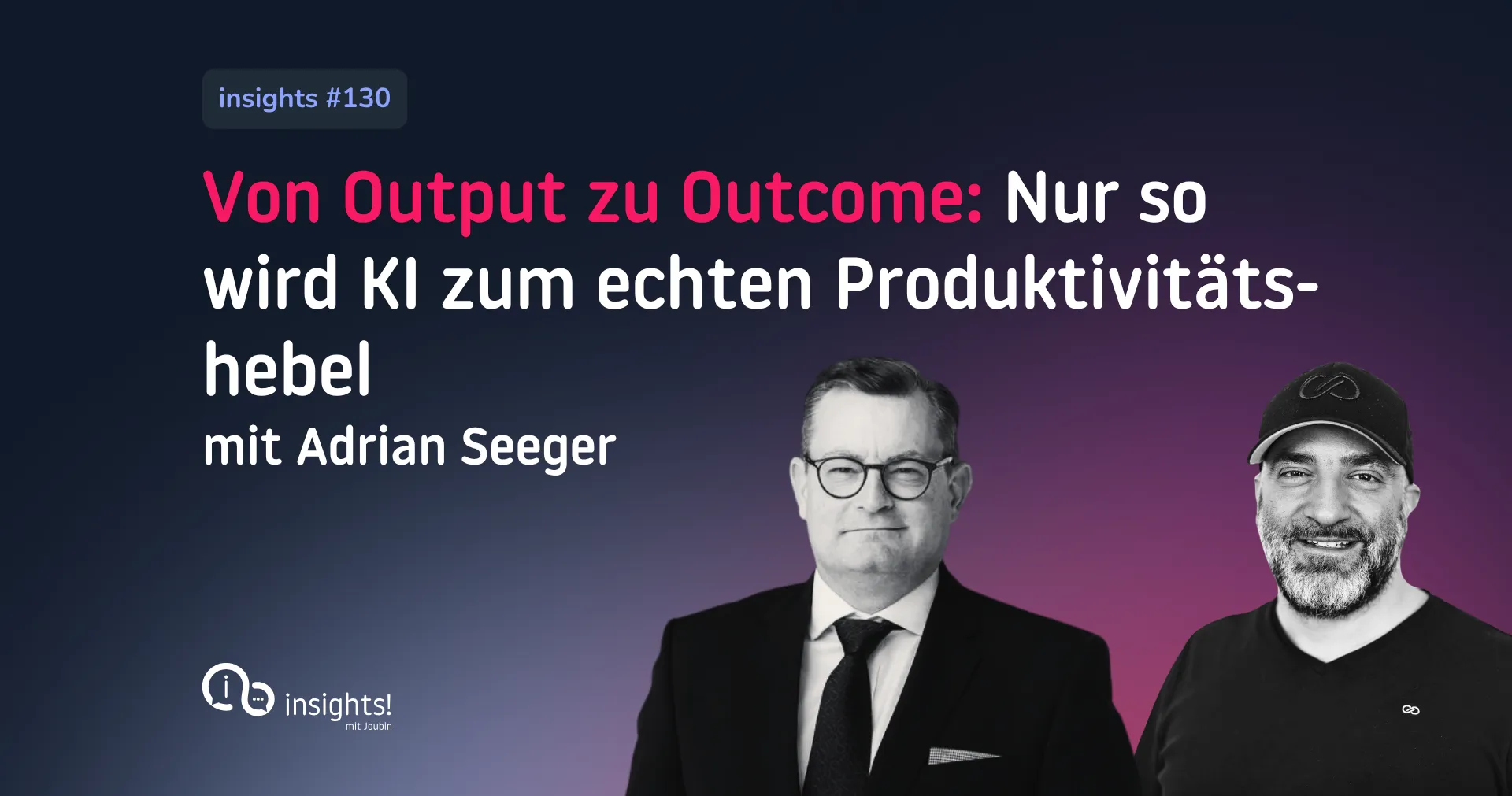
AI replaces no one: it clears away routines, makes quality measurable and brings decisions in minutes rather than days. If you think in terms of the factory approach – with clear quality gates, reusable prompts and clean logging – you get predictability instead of gut feeling.
The episode outlines the structural shift driven by AI as a productive lever: routine tasks are reduced, decision-making processes are accelerated and quality is made transparently measurable. At the centre is an AI factory approach that steers projects more predictably and efficiently and enables step-by-step scaling. You'll learn how a viable 50% solution today paves the way to a fully built-out target architecture tomorrow, and which core competencies are decisive for this – precise problem definition, measurable quality criteria and the well-founded combination of results. The goal is less manual grind and more demonstrable impact, supported by clear goals and controlled iteration.
From the printing press to the bot – why AI is the next great democratisation
The history of technology is a history of opening up: first the printing press, which no longer left knowledge to the elites. Then the internet, which made information accessible to everyone. Now we're on the threshold of the next stage: AI democratises creation (of texts, code, concepts, right through to decisions based on large volumes of data). This is a massive structural shift. You get tools in hand that let you do in hours what used to take weeks. And yes: that shakes up routines. But that's exactly where the opportunity lies.
Fear of replacement or appetite for leverage? The right analogy helps
If you want to understand what's happening right now, it's worth looking at the industrial revolution. The steam engine didn't "take away" work. It changed work. Muscle power was scaled, and people could focus on more valuable tasks.
Same pattern today: AI doesn't replace jobs wholesale, but relieves people of repetitive tasks, connects previously separate information silos and makes leaps possible instead of just step sequences. Whoever reads this as a threat loses time. Whoever reads it as leverage gains an edge.
Change naturally triggers reflexes – especially when familiar linear processes suddenly become multidimensional. What matters: the logic doesn't disappear, it just changes shape. "A → B → C" becomes "A ↺ (B, C, D) → new option". And you can actively shape that option.
What's behind the “magic” – and why trust is part of it
At its core, AI runs on statistical models that combine probabilities in neural networks. That sounds dry, but it delivers answers in seconds that would take you days to produce manually. Trust, though, comes from sober practice: checking results, doing spot checks, cross-reading alternative models. Just like with colleagues – only faster. With every iteration your hit rate grows, and your team learns where AI is strong and where human judgement remains essential. A striking example from medicine shows how unfamiliar patterns bring new quality: when algorithms find clues in tens of thousands of chest X-rays that humans overlook, diagnostics shift – and with them entire workflows. The same principle applies to all data-rich fields: AI detects signals beyond the obvious and thereby speeds up decision-making.
Practical example: from projects to a “factory” – speed as a product
Many talk about AI, but impact only comes once you change structures. A factory approach bundles methods, models and people into a repeatable delivery process. Result: projects get faster and more consistent thanks to automation and clear quality rails.
Particularly interesting: the effect isn't just in coding (which often only makes up a third of the effort). AI creates speed in scope management and steering. “Is this a change request?” instead of endless email loops – a model delivers a robust initial assessment and an effort split you can negotiate on the spot in the client meeting
This creates a new quality of conversation: instead of "we'll get back to you next week", there are live options, trade-offs and price brackets. That changes sales, project management and expectation management — for the better.
How you know you're factory-ready:
You can translate user stories into standardised patterns.
Quality gates are measurable (not just “gut feeling”).
You have a reusable prompt and snippet inventory.
Decisions are logged traceably (audit prompts, versioning).
Customer focus rethought: 50% today, 150% tomorrow
Not every budget allows for the perfect solution – but almost every one allows for an effective one. With AI you can deliver a 50% version today that provides real value, and set up the roadmap so the next step pays off disproportionately. That's not a downgrade, it's design for traction: a small, robust increment that gathers data, tests hypotheses and makes the 150% expansion stage more solid. In parallel, your pool of experience in the factory grows. Every project improves the next. The real trick: this way of working reduces uncertainty on the customer side. You don't just present a vision, but variants that can be simulated live with impact and cost frameworks. That turns budget discussions into product strategy in real time.
Want to listen to the full episode?
Here's the podcast of the interview:
Please accept the corresponding cookies to view this embedded content.
Would you rather watch the episode? No problem!
Here's a recording of the interview:
Please accept functional cookies to watch this video.
Prefer to read instead?
Joubin Rahimi
Great that you're joining us again for a new episode of insights! My name is Joubin Rahimi and today with me is Adrian. Adrian Seeger. Hello Adrian.
Dr. Adrian Seeger
Hello Joubin. Thanks for having me.
Joubin Rahimi
Absolutely happy to. You reached out to me the other day asking whether I could answer a few questions on AI for your LinkedIn newsletter. Exactly. And on top of that, we actually met each other through AI. Right. So today's topic is AI – what can we do with it? And also demystifying it a little. Let's kick off with a question. If we're allowed to say it, AI is a big deal, but to see what it can change, let's look at the past and go back to the 15th century, to the invention of the printing press. The printing press really democratised knowledge. There were more schools, more children could learn, and adults too – it was no longer reserved for the elite. Then, almost 500 years later, with the internet, social media, Google, smartphones, we democratised the distribution of knowledge – or rather information, since it doesn't always have to be knowledge – something that had previously been reserved for large companies. And the latest thing, or the most current one – something new will come along – is AI. With AI, we're currently democratising the generation of pretty much anything. And these are always entry points. But you mentioned in our pre-conversation the industrialisation and then AI. You actually come more from the physical economy than I do. What did you mean by industrialisation?
Dr. Adrian Seeger
I think that historical comparison is really good. The printing press is a lovely example of the democratisation of knowledge. The industrial revolution in the 19th century, the invention of the steam engine, to take another example that's just as well known as the printing press, meant that we could make work easier. Suddenly we were able to do other things, because human muscle power was replaced, and we were able to do entirely different things. That moved us forward as human beings. But of course, it also meant that things changed. Work that used to be done by a great many people was then done by a steam engine. That's how it was back then. And there were fears at the time too, because jobs changed.
Joubin Rahimi
You're going so fast, that'll give you brain damage, I reckon. Exactly.
Dr. Adrian Seeger
Today we're in exactly the same situation. The analogy is exactly the same. We're moving from a more or less analogue world, one that's already technologised, into a world that's able to pool all information, bring it together synaptically, and, as you just said, turn it into something. Everyone has to define the requirement for themselves. And I think, in terms of education about this, we're not far enough along yet. That always leads to fear that AI can eliminate jobs. That's also something of a German phenomenon, to some extent. The reflex always comes up. Thinking back to my working life, how often did we have conversations, when we introduced e-commerce, about how many people we could then cut from sales? That's not even the question. The question is: how can we retain the customer, and how can we create an experience with the customer that makes them want to stay our customer and do more with us. That's what it's about. It's not about whether I can cut staff. That may possibly be a consequence that follows from it, but I think that analogy is wrong. Today, AI actually gives us the opportunity to go a step further, namely to bring together things that used to be separate, to see what new things we can create from them. That unsettles some people, because the logic they used to see, in its simple form of A leads to B leads to C, they no longer have today, because it simply skips whole steps and something new comes out of it, because now one, two, three more things are added on top. So we're no longer in one-dimensional space, but in multidimensional space. But the logic stays exactly the same. I'm arriving with a new option, one that's technologically dynamic too, because AI keeps developing, it keeps getting better. And I think it's a huge opportunity, because it simply gives us the chance that today we're not only able to improve processes, or have things done that we might previously have said, my goodness, that's tedious, but it also gives us the opportunity to create entirely new offerings. It will turn whole areas, whole industries, upside down, simply because it's new. I like to think of the knowledge industry here. Let's look at the whole topic of school, and later university. In the past, when I went to university, I still went to the library and borrowed a book.
Dr. Adrian Seeger
If I told my children today, go to the library and borrow a book, they'd look at me and ask, why? We've got all that already. And then you write an essay from it: why? My system does that for me. So that means the possibilities are becoming different, and in my view, this opportunity clearly offers the advantage that we can then think beyond. It's no longer about creating something now, because I can just ask the AI, and there are certain areas where AI is now very, very good. But of course, I can also use the capacity that's been freed up to think further about how I can use that directly. Absolutely. And that's why I believe that today, with AI, we have a huge opportunity to develop business models not just a little further, but by a real leap. And I don't think we need to be afraid of that – I think we simply need to have the courage to use it and try it out. We now have some great applications where we're using AI that are genuinely convincing.
Joubin Rahimi
That's the exciting thing, when I think about it – electricity. I trust that electricity will always come out of the socket. We also roughly understand how electricity works. I'm not a physicist, but we roughly understand how it works. With AI, fewer and fewer people understand how it actually works. And I think what matters is how it's produced, which is actually something quite mundane. It's simply statistics. So, to put it bluntly: statistics and probabilities combined within certain neural networks. But a lot of people switch off at that point, and that's completely fine too. But then to say: I trust that these can also be sensible answers, the way I would with an employee... I like to compare it to an employee or a colleague you divide tasks with. Things come out of that too, and I can absolutely question them. That's not wrong to do either, but if I want to be fast, or if I question certain things, then not right down to the last comma – I just take the results. And I think that's exactly the tipping point we're at right now: do I trust that AI will bring something positive to it?
Dr. Adrian Seeger
I think that question is entirely justified, but the answer is already there. I'll grant you, we're talking about statistical models. So, to demystify it a bit: behind it there's a mathematical model, and it's built in three dimensions. That's always a bit hard for us to picture, but if I imagine a three-dimensional cube containing lots of grid networks within it, that's roughly comparable. If I then span that across the whole space and say there's a piece of information in every one of them, I can compare it roughly like that. And then there's a little robot – this is how I always explain it to others – that jumps very quickly between these points and gathers it all together, puts it in little baskets and writes it down. They can only do that at speeds we perhaps can't quite imagine yet. Our brain is just as fast as what the computers can do there. We're just not trained to do it. And a lovely example I saw: Professor Spitzer, a doctor at the University of Ulm, who focuses above all on the lungs, began years ago statistically analysing medical data. At some point he said, we now need to take all the chest X-rays, in other words of the lungs, and scan them all in, in order to find anomalies that also point to diseases or symptoms of disease, so we can start treatments. What came of it? They scanned in 80,000 images and ran them through an AI. It didn't take long before the AI gave an answer. It said the probability of someone developing metastases in the lung is high if a certain image is present. And the insight was that this image isn't in the lung – which, incidentally, is what everyone had always looked at, for centuries – but outside the lung. That led to all the work in this field worldwide being brought to a halt within three months and set up in a completely different way. And I think if you keep these topics in mind, and know that this can bring enormous progress, because it simply helps us as human beings – we're not conditioned to consciously process large volumes of data. We can do it, because we can do it three-dimensionally. We can feel, smell, taste. We can do all of that. We can also see, and we can do all of that together too. But we're not aware that we can process large volumes of data.
Dr. Adrian Seeger
We do that every day, all the time, but we're not conditioned to process individual, singular data points in this volume. But actually, it's nothing other than what our brain does permanently every day, subconsciously. And that's why I believe this topic of AI will be an enormous leap forward for us, one that we also have to embrace positively. Because we don't even need to have the discussion about whether it changes work processes. They have to change anyway, because someone will start doing it and that person gets the competitive advantage, so we don't need to kid ourselves. Better that we're the ones out front and leading, rather than running after others. So I believe that's something we have to do. And there are already brilliant applications today that already offer enormous value. Even the simple language models, a ChatGPT that came out a few years ago, which every pupil now has on their phone to do their homework or research with, has simply changed the world of work.
Joubin Rahimi
And it'll get so much more. Absolutely. And that's what you say in the other episode, we have to be bold. And you ask why do we have to be bold? And in a nutshell, we love it when things are steady. Most people love being in a certain environment and don't want it to change too much. Now, of course, it's changing hugely. And what did Darwin say? It's not the strongest or the fastest that survives, but the one who adapts most flexibly to new requirements. So we actually have to do something that doesn't come naturally to us at all. That's why I find “be bold” really fitting. And it affects us as synaigy and Timetoact and all digital agencies, IT service companies too. Quick aside: five years ago we had a really difficult situation and had to look at how to become properly profitable again in that sense. And we weren't, for example. There were difficult years too. And back then we already said AI will change the work. We just didn't know how. And since the start of this year we've built up a factory.
Joubin Rahimi
Built up a factory to run projects. And there was resistance too. Others said: no, I'll just keep developing the way I always have. Luckily we also have people who say: I'll try it out and develop it further. And that's how this factory came about. Two sentences on that: what do we do? We deliver projects in far less time and at higher quality. So clients get their project faster and at higher quality. And what's changing? Coding is changing, but coding only makes up a third of a project. That gets forgotten really fast. Project management too, also the question: you have a work package and a change request. Well, how much does that cost now, or first of all: is it a CR or not? You know that one too, a very popular discussion. And then also to say: okay, the AI tells you whether it's a CR or not. And the assessment behind it. And then you have a fairly neutral instance that first gives you information based on the facts. And then we get an estimate straight away. Because as a client you also say: yes, okay, that costs 50 days now. That's too much. I've only got 20. Then you can say: okay, what can you do so that for 20 I get something that hits the target group? You get an answer. That's game-changing, and not “we'll go away and get back to you in a week,” but in the conversation, bam, bam, bam. But of course that changes everything.
Dr. Adrian Seeger
And that's customer orientation, and at the end of the day that's what it comes down to again. As a company you have to …
Joubin Rahimi
The business model simply changes. Exactly.
Dr. Adrian Seeger
As a company you have to be able to, and this is now a sales topic. When you're standing in front of a client and they say: I'd like this and that, but I've got a limited budget. Then today you can offer them a solution that maybe pays into that, and you can already show them it'll bring a benefit that's maybe at 50% of their ideal solution, but they can have it now. And when they have a new budget at some point later, we might have moved the technology further on, or we'll have other experience values by then. Then we build on the 50 and can go straight to 150. But of course that changes the way you work, the way you sell, and of course, as you've just described, in your production too, how you code. Yes, totally. And this factory you've got in the background there, it won't just … It's a dynamic construct. It'll keep developing further, because the experience values that come in, and also the possibilities, AI learns. And the more we connect within AI, the better the output gets, and the more precise it becomes too. And at some point we'll be at the point, and I give you that, you're totally right. You have the neutral instance, you ask it, you ask your Siri and it gives you an answer. And that answer is reliable, and that's new. And that's where people are still at the point right now of: how far can I trust that, or is it fake? And I firmly believe, today we already have various AI models and they're all language models built on different logics. But you can certainly put the question into one, then the other, then a third, and then look at the results. And there's nothing wrong with that at all. You'll roughly find you have 70, 80% overlap, and then you see, okay, this one concludes in this direction and the other in that one. But what's interesting is bringing the things together and, so to speak, making the best solution out of it.
Joubin Rahimi
Or also to learn why the conclusion is different. Absolutely. That's a brilliant insight too.
Dr. Adrian Seeger
What I find cool is, you have to look at it this way, that our children, they're growing up with this today. They don't just have a phone. People always say the children are stuck on their phone the whole time, but it's far from true that they're only doing TikTok — they're actually using these things today to inform themselves. My son said to me at some point: hey, I don't even use Google anymore. I only use ChatGPT. It's much cooler as a search engine, because it gives you the full answer straight away, just the way I'd like it. And I don't have to go and check Wikipedia and so on anymore. I've got it all in one place. And then I also talked with him: do you believe that's actually true?, and so on. He said: Dad, most of it's true. But we can just check that quickly otherwise. One uses ChatGPT, the other uses Copilot. So then you come together on it. But if they're already using something like this today at such a young age, then we really don't need to worry anymore that it's some kind of danger to us. On the contrary, we just have to accept that it's here and we have to use it.
Joubin Rahimi
Us old fogeys? Is that how it is? That's how it is. We have to engage with it, because the young generation takes it along with them. Right?
Dr. Adrian Seeger
For them it's basically an everyday thing. And the nice part is they're not afraid to use it. Whereas all us old fogeys, so to speak, maybe still tend to have that worry: what am I even allowed to put in there? And my data and so on. All nonsense. It takes courage now to just try these things out, and brilliant solutions come out of it. I think certain topics are going to change completely. When I think about it, this whole topic of book publishing — we talked about this in the pre-call — a topic where anthologies used to get made. Authors would get approached, then it all gets collected together, very labour-intensive. The big publishers have outsourced it to India and so on today. None of that's necessary anymore. All of that will soon happen within a model like this, and at insane speed. So this topic you mentioned at the start, democratisation of knowledge, we'll experience it in a completely different form, and available on demand at any time. Full stop.
Joubin Rahimi
And what you already said, bold, and the thought that came up too, just giving young adults our task at hand sometime. Absolutely. How would you solve that? Absolutely, exactly.
Dr. Adrian Seeger
And brilliant results come out of that.
Joubin Rahimi
And with that, I'd say give it a try and comment on what it brought you.
Dr. Adrian Seeger
Exactly.
Joubin Rahimi
Thank you. My pleasure. I've enjoyed this episode. It's coming to an end now. Thanks, Adrian.
Dr. Adrian Seeger
Thank you very much.
Joubin Rahimi
Thanks for listening and watching.
Got questions or feedback?
Then feel free to contact us directly.
- Joubin Rahimi
Managing Partnersynaigy
Show phone numberShow mobile numberShow email address

Subscribe to our blog now and never miss any news
✔️free ✔️weekly news ✔️expert knowledge
Please accept the corresponding cookies to view this embedded content.