



insights! #89: what Germany must do to ignite the tech turbo
In this insights! episode, we dive deep into the topic of artificial intelligence. Together with tech investor Philipp Klöckner, we discuss current challenges and opportunities of AI in Europe. From regulation to the impact on developing countries – no question goes unanswered. You'll also learn why Germany still needs to catch up in the AI race and what role energy supply plays in this.
 Joubin RahimiManaging Partner · synaigy
4 min read
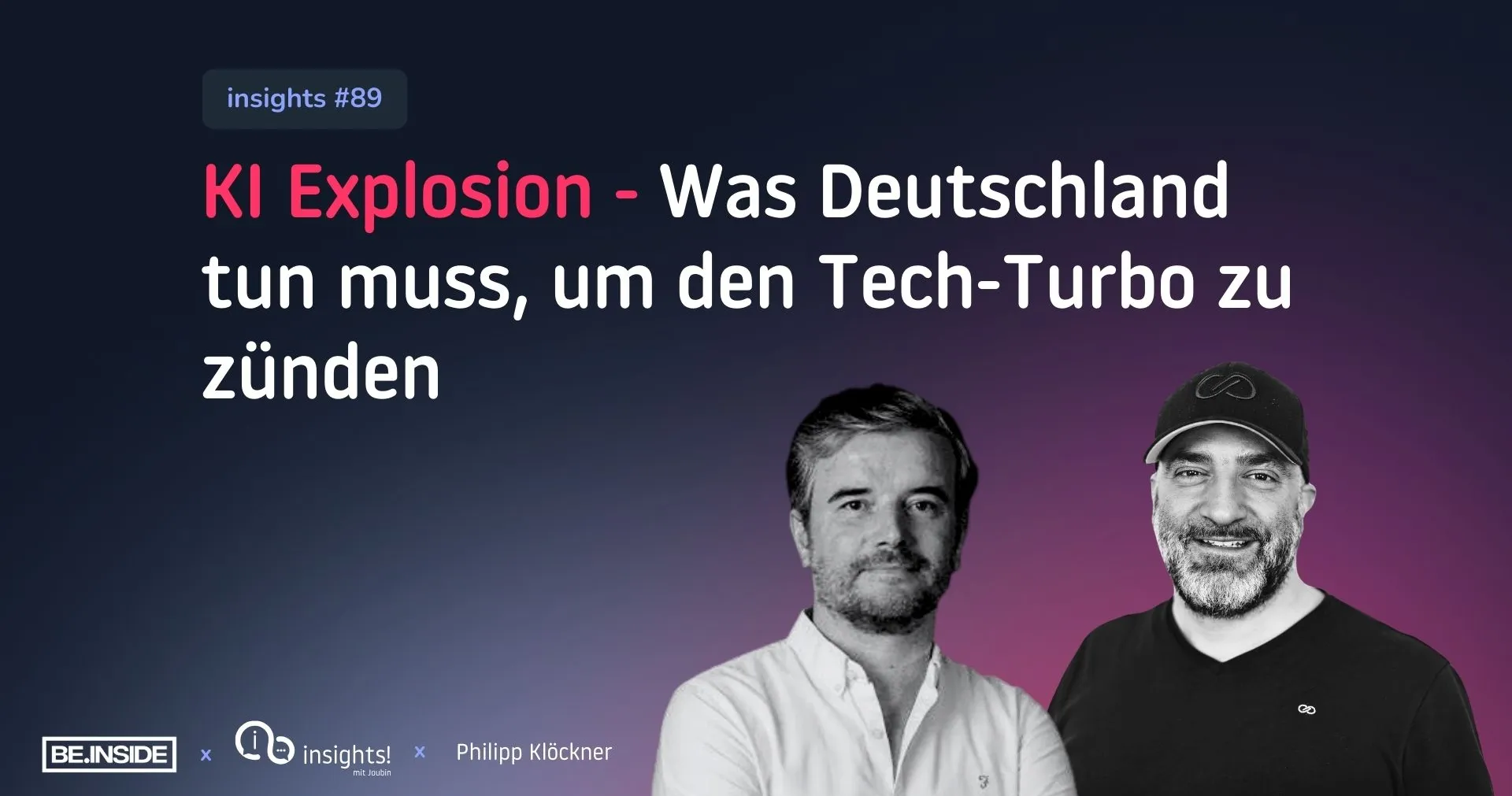
One thing is that the most recent AI regulation probably puts obstacles in the way of people who want to research AI and bring AI to market.
Europe lagging behind? Unfortunately, yes!
We're all talking about artificial intelligence. While the US and China are already going full throttle, Europe is still wondering where the ignition key is. Philipp puts it plainly: in Germany we're not only behind, but also disorganised. There are clever minds from Germany involved with major international AI players, but here on the ground? Nowhere to be seen! Philipp does highlight France as a positive example, though: Mistral, a company that really plays at top level when it comes to AI.
But what's going on with Germany? Why can't we get into the big AI projects? Philipp thinks we don't necessarily need our own AI model. It's far more important that we support the bright minds we have and provide them with resources.
Chips and cloud – nothing runs without power!
This might sound a bit abstract at first, but Philipp explained it to me like this: AI is like a very hungry teenager – it needs vast amounts of energy and resources. Large chip clusters that provide plenty of computing power are indispensable. Yet Europe seems to be setting different priorities. While ETH Zurich provides a huge research cloud, we lack exactly that in Germany. Why? Good question!
Another problem: we lack bold investors willing to invest in AI infrastructure. Philipp sees family businesses and mid-sized companies in particular as having responsibility here. They should invest in AI and drive forward the innovations of start-ups.
AI as an opportunity for the world – or just for the big players?
Okay, now it gets exciting! Philipp sees huge potential in AI being able to solve global problems – particularly in remote regions. Imagine an AI could bring medical help to a village that otherwise has no access to healthcare at all. Or give children in Africa first-class education in their own language. Sounds fantastic, doesn't it? But – and here comes the big but – AI could also lead to more inequality. Philipp fears that the big tech companies will become even more powerful and the rich even richer. So: Is AI an opportunity for the world, or just a tool to make the already big even bigger?
Energy, baby! How much power does AI really need?
If you think AI is just a clever algorithm floating around somewhere in the cloud, you're wrong. AI consumes an enormous amount of energy. Philipp throws a figure at me that makes me swallow hard: Microsoft's data centres alone consume as much energy as the last three decommissioned nuclear power plants in Germany produced. Just Microsoft! That's when it becomes clear that AI isn't just a question of technology, but also one of energy supply. Philipp has a clever idea: why not relocate data centres to where electricity is cheap and green? Schleswig-Holstein, for example, where the wind blows strongly and the sun shines. A bit of AI power made in Germany – sounds good, doesn't it?
What now?
So, what do we need to do to not miss the AI train? Philipp says we need more investment, more courage and above all more resources. Europe has the bright minds, the potential and the opportunities – we just need to start using them. Sounds easier than it is, but hey, nothing ventured, nothing gained!
Would you like to listen to the full episode?
Find the podcast of the interview here:
Please accept the corresponding cookies to view this embedded content.
Prefer to watch the episode? No problem!
You'll find a recording of the interview here:
Please accept functional cookies to watch this video.
Prefer to read?
Transcript of the episode:
Joubin Rahimi:
Fantastic that you're back for a new episode of insights. My name is Joubin, Joubin Rahimi, and today with Philipp Klöckner. Hi Philipp.
Philipp Klöckner:
Hello, nice to see you there.
Joubin Rahimi:
It's brilliant that you're here. It's a long day for all of us today. You've just come back from holiday. So thank you, thank you, thank you for making it work after all.
Philipp Klöckner:
Very happy to.
Joubin Rahimi:
And we started brilliantly and we're going to finish brilliantly. What are we finishing brilliantly with? With a great talk on AI. But before we get into that, perhaps you can say two or three sentences about yourself for those who might not know you. I can't quite imagine that, but perhaps you can say two or three sentences about yourself.
Philipp Klöckner:
My name is Philipp Klöckner. I'm tech analyst, invest in start-ups, advise start-up and growth companies, worked long time in marketing, responsible at Idealo for largest price comparison in Germany, later company with Rocket Internet worldwide, did marketing consulting, product consulting for digital products, today advise large private equity funds like KKR, sit on supervisory board at listed companies and do podcast on side and keep trying to learn and pass on my knowledge.
Joubin Rahimi:
What's the podcast called?
Philipp Klöckner:
Doppelgänger Podcast, that's its name.
Joubin Rahimi:
Doppelganger.
Philipp Klöckner:
Comes out twice a week, on Wednesday and Saturday.
Joubin Rahimi:
Great. Also subscribe to ours alongside. That's been mentioned to me two or three times today already, that they know you from there. Or from the OMR podcast.
Philipp Klöckner:
Exactly, we had you often there too.
Joubin Rahimi:
AI is a big topic, and you don't look at it from the angle of which tools exist, but from a completely different altitude. And I want to dive straight into depth: looking at Germany or Europe, what do you say we should be doing and changing right now, partly because of AI?
Philipp Klöckner:
Yes, many things. One is that the most recent AI regulation probably puts obstacles in the way of people who want to research AI and bring AI to market. That means they probably overstretched things a bit there. Maybe the new internal market commissioner, there's a change happening right now, maybe they'll see it differently, or whoever it turns out to be. I think we need to make resources available for AI. AI is a very capital-intensive foundational technology. That means you need these huge chip clusters, which require billions and tens of billions in investment. Maybe we should provide some kind of public cloud or research cloud at universities. ETH Zurich does that, for example, with a large research cluster. That could help build up start-ups and research. We need the big family businesses and SMEs to invest their money in AI and become customers of start-ups. That would lift us up too, and above all we need immigration of qualified staff. Those are the three, four things that matter most to me. And that's essentially also what matters most to founders in the AI industry.
Joubin Rahimi:
And which countries or regions in the world do you see adapting this fastest and moving forward?
Philipp Klöckner:
USA and China, as you often hear. Exactly, and after that there's not much for a long while, I have to say. France has a very prominent, successful player with Mistral, who build very successful state-of-the-art open-source models. In Germany we currently unfortunately, there are many Germans who work successfully at the big players, at OpenAI, at Magic, at Mistral, but we ourselves unfortunately don't currently have a competitive foundation model company, one that builds its own model. Maybe we don't necessarily need our own model yet, but as I said, we have more successful founders of German origin. Magic in Vienna, for example, was just founded, building a developer that's meant to build software itself with AI. That means we have the human capital. We need more people who move from research into entrepreneurship. That would help. But otherwise there isn't that much to look at in Germany on that front. Clearly number one is the USA. Then China, very ambitious, fortunately not quite as far along in chip technology as the USA. And then the next most important is already the UK, because that's where DeepMind, Google's research centre, was based, and France, where Mistral really built an outstanding model first.
Joubin Rahimi:
These are all countries that are already fairly mature. I'd say the internet and the technologies and possibilities allow everyone to look into it. And if I look at the map or the world map, Africa is the region that has so far benefited the least from all of this. Couldn't they also say: I'm now betting exactly on that and simply overtaking everyone on the right, or I won't say everyone, but move forward a few metres?
Philipp Klöckner:
I think overtaking will be hard. But I believe AI, if used correctly and distributed correctly, can help close gaps faster, just as mobile internet, for example, led to billions of people who previously couldn't afford a computer or laptop going online via smartphone and gaining access to knowledge, information and technology. AI can enable the same thing. So you can bring access to better education to remote regions of the world, whether in Africa or South-West Asia or South America, through AI. You can create individual education in various languages with it. You can bring medical education to small villages, where someone can then at least carry out basic medical care themselves, which they previously had no access to. Hence AI will probably, on one hand, I fear, lead to more inequality, with rich tech corporations, big tech corporations, becoming even bigger and their owners even richer. But it should also, as technology generally always does, empower many people to get out of poverty, so to speak, and tend to live a better life. So it's ambivalent, you simply don't know yet, or don't have a feel for where it's heading.
Joubin Rahimi:
Right. Super hard to do that on-site already today. You need a lot of resources.
Philipp Klöckner:
But it has the potential, that much can be said.
Joubin Rahimi:
You mentioned resource hunger, and resource hunger, sure, monetary, but energy is also a big topic there. And if I now look at the energy topic in Europe and Germany, especially in Germany.
Philipp Klöckner:
Yes, energy prices are becoming a competitive factor and location factor for AI applications too. That means calculating or training these large models requires a dataset, so first you need chips, and these chips consume huge amounts of energy. Microsoft alone has built as much data centre capacity as our last three nuclear power plants used to consume, the ones we shut down, or as much as they generate.
Joubin Rahimi:
Just again, right? Only Microsoft, right?
Philipp Klöckner:
Yes, just Microsoft, five gigawatts, and you have to imagine, something like Emsland or Neckarwestheim produces about 1.4 gigawatts. That means these three power plants, Isar, Neckarwestheim and Emsland, would have produced as much electricity as Microsoft alone needs. And the other tech corporations need roughly as much again. That means the good thing is, this AI can move to wherever electricity is cheapest, meaning wherever the model gets trained. That's irrelevant at first. Now, disregarding regulation, if we also regulate it in the EU, that obviously doesn't make it any easier. The good thing is, we don't necessarily need the energy back in the Ruhr area or in Bavaria, but if we say, in Schleswig-Holstein we have a lot of wind and sun, or just in Vorpommern. Then you could theoretically build a data centre there, because there are many days with negative energy prices or very cheap energy prices there, and that can help too. So if you have good storage technology and a lot of renewables in the long run, then Germany could become exciting again too. And it could even end up relieving the energy grids, because the data centres can move to wherever electricity happens to be cheap. And there are regions in Germany where electricity tends to even be cheap. Where it can be produced well.
Joubin Rahimi:
Exactly. And with that positive note, I'd also like to close this short insights episode. Thanks for the insights, for the other impulses. And you're not at the event there. There you'll be presenting for 30 minutes plus more detail. Thanks for your insights, your time. Thanks for being here, and subscribe to the Doppelgänger podcast.
Philipp Klöckner:
Very happy to. Thank you.
Joubin Rahimi:
Thanks.
Have questions or feedback?
Then feel free to contact us directly.
- Joubin Rahimi
Managing Partnersynaigy
Show phone numberShow mobile numberShow email address
Subscribe to the blog now and never miss any news
✔️free of charge ✔️weekly news ✔️expert knowledge
Please accept the corresponding cookies to view this embedded content.