



#134 - What modern AI in the shop really delivers and what opportunities B2B retailers can seize now
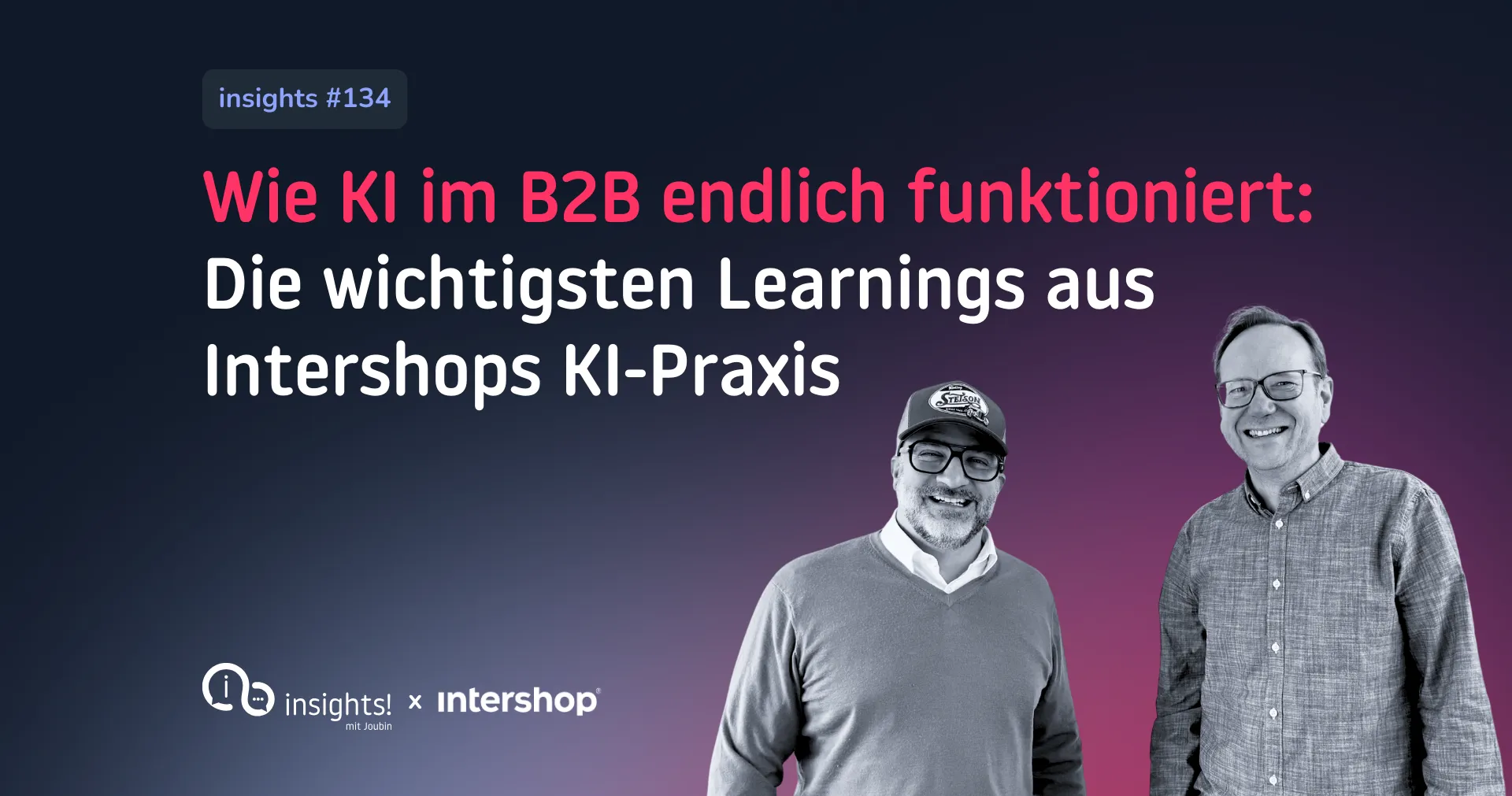
In this insights! episode, I talk with Nils Breitmann, Senior Director AI at Intershop, about how AI is redefining B2B e-commerce. We dive into why customers increasingly "talk" rather than "search", how AI agents take over operational tasks, and what that means for teams and processes.
 Joubin RahimiManaging Partner · synaigy
5 min read
The classic online shop won't disappear, but customers have long since stopped using it. They don't want to click, they want to talk. And AI listens.
AI in B2B is a solid competitive advantage. But that's nothing new to you. That's also shown by the conversation between Joubin Rahimi and Nils Breitmann, Senior Director AI at Intershop. And that's exactly where this blog post comes in: you get a clear view of how search behaviour, workflows and e-commerce expectations are currently changing, and what role AI plays in that context. Because one thing becomes clear right from the start: anyone who tries to simply "handle AI on the side in daily business" will fail. That's why Intershop has created a dedicated role that deals with it exclusively. A step that shows how seriously companies should now be taking this topic! How does it look for you?
The new standard: customers want to talk, not search
The way people find information has changed radically. In the past, you had to "operate" search engines almost literally. Today you expect to simply phrase your question exactly as you would ask a person.
In B2B this is particularly exciting. Because it's often about:
Complex products
Multi-stage decision-making processes
Fixed framework agreements
Long-standing customers
This also means: the classic online shop as a click-through path is losing importance. Buyers don't want to "navigate", they want to solve problems. And often this already happens via WhatsApp or a phone photo, as with the electrical wholesaler example: a fitter sends a picture of the fuse box and expects someone to identify the right item.
This is exactly where AI comes in, as a new form of interaction. It's about putting natural language back at the centre — the way people have always done business.
Co-pilot in shop: why chatbots suddenly work now
Chatbots existed years ago (but were very expensive and not nearly as mass-market-ready and efficient as today's chatbots). What didn't exist back then: models that truly understand complex questions. Today that's different. Intershop's "co-pilot for buyers" is a genuine product expert.
It recognises use cases, understands requirements and finds matching products, even when the user only describes their goal. Examples range from home office equipment to products with specific safety standards. The clever part: the co-pilot uses extended knowledge such as data sheets or standard descriptions to deliver not just generic answers but precise recommendations.
So he can:
Understand product attributes
Interpreting standards correctly
Extracting details from unstructured text
Co-pilot in the back office: when AI suddenly joins marketing
While buyer co-pilot recommends products, seller co-pilot helps on platform operator side. And that's at least equally exciting. Because e-commerce managers know problem: creating promotions, maintaining product texts, documenting standards – all that costs time. Lots of time. That's exactly where Intershop's approach of deploying various specialised agents comes in. For example: • Content Agent: enriches product information automatically • Localization Agent: translates cleanly and context-sensitively • Pricing Agent (in development): analyses price positioning and market movements Particularly powerful is approach of simply being able to create actions in natural language. Instead of clicking through menu structures, sentence like: "Create promotion with 10 percent discount for all monitors, code XYZ" suffices. Agent implements it including rules, exceptions and complex conditions. Result is that new employees become productive immediately without lengthy onboarding, because knowledge no longer sits "in heads", but in system.
Why agents are changing teams, not just processes
An exciting thought from Nils concerns the future team structure. AI won't replace, but complement. However, the form of collaboration will change. Teams consisting of, say, two humans and ten agents are conceivable. The humans steer, prioritise, think strategically. The agents then handle the operational detail work. So AI doesn't take on the role of an employee, but that of ten specialised working students who need no breaks, are never ill and want no holiday or pay rise. At the same time, another advantage arises: knowledge is no longer lost when employees leave the company. Expertise can simply be recorded, documented and made usable by the AI.
Technically separate, but strategically united: why there are two co-pilots in the system
Although both co-pilots are based on same LLM foundation, they're technically separate systems. Reason lies in tool architecture: buyers and sellers need completely different tools, API access and knowledge domains. A buyer needs access to products, standards, orders. A seller needs access to backend functions, pricing logic, content rules. AI independently recognises when which tool must be used. This is a concept further strengthened by MCP (Multi-Component Protocol), as it creates standardised interfaces. This separation makes systems scalable, secure and independently extensible.
Conclusion: AI in B2B becomes the operating system
What Intershop shows is a glimpse into the future of B2B e-commerce. AI takes over neither the platform nor the person, but it becomes the operating system for better decisions, faster processes and closer customer relationships. The key learnings: • AI needs focus and clear responsibilities – it doesn't work as a side project. • Agents aren't just chatbots – they act, they carry out tasks. • Knowledge gets digitalised instead of lost – a huge advantage for ageing workforces. • Natural language becomes the new user experience – whether via chat, voice or photo. And the best part: the ideas often only emerge once companies genuinely experience the possibilities. That's exactly when technology turns into real innovation.
Would you like to listen to the full episode?
Find the podcast of the interview here:
Please accept the corresponding cookies to view this embedded content.
Prefer to watch the episode? No problem!
You'll find a recording of the interview here:
Please accept functional cookies to watch this video.
Prefer to read?
Joubin Rahimi
Great to have you back for a new episode of insights! My name is Joubin, Joubin Rahimi, and today joined by Nils Breitmann, Senior Director AI at Intershop. Nils, lovely that you made the long journey here to Dortmund for you and for us.
Nils Breitmann
Exactly, I came from Jena. That's where Intershop's headquarters are.
Joubin Rahimi
There you're making your sentences about yourself, and can that be a role, you say? That means, to start with, a Director AI sounds amazing. I'd like that role too.
Nils Breitmann
Exactly, at Intershop I specifically look after AI topics. Firstly, how we use it in our products, but also how we ourselves use AI internally at Intershop to automate processes.
Joubin Rahimi
Those are of course two really exciting fields you can really dig into.
Nils Breitmann
Over a year ago now we created this role specifically as new, because it did not exist, simply to give due weight to the importance of this topic. We learned that if you take the normal teams, the backlog is always full, the teams are always busy, also with problem tickets, feature development, this and that. And if you do not dedicate yourself properly to this topic, you only move forward very slowly.
Joubin Rahimi
And that's an immediate lesson for anyone out there putting teams together. Very few employees can simply do that alongside their day-to-day business. And saying: I have someone who focuses on this entirely, is probably hugely sensible.
Nils Breitmann
And of course that needs support from the board. It doesn't work any other way.
Joubin Rahimi
But last time Markus was also Director AI?
Nils Breitmann
He was COO, Markus Dränert, and my role was already under him too, back then. Okay.
Joubin Rahimi
I already made a joke about that.
Nils Breitmann
He had championed that. He saw it.
Joubin Rahimi
I've already joked about it. The last person who was here became CEO. No, no, no. We can already congratulate you then. It's also great that we get to welcome you here again, second person from Intershop. There are two, three aspects, well, many more aspects really, but two, three that we're looking at today. And one of this year's trends in 2026 is that we're asking: how can things be found? How is that changing? I'd like to play through this chain a bit. That means, in terms of GEO, so Generative Search Engine Optimization or Generative AI Optimization, how do you view that? Is that a big topic for you, or less so?
Nils Breitmann
We at Intershop have a specific focus on B2B, on B2B e-commerce. We have a platform there that we provide mainly for wholesalers and manufacturers. We also do B2C. So ultimately we've always done B2B and B2C, and now, of course, there are also many cases of B2B2C, or B2B retailers who also do B2C on the side. We can do B2C too, but our main focus is clearly B2B. And we've also thought very hard about how this whole geo topic hits particularly in B2B. My view is you have to look at this in a very differentiated way, because B2B is also a broad field, depending on what the products actually are. There really are products that range from office supplies through to insulation wool, or we have seed. We have customers who do that. Very varied. And the difference in B2B is that sometimes you have complex products, sometimes also complex processes, so with approval workflows, or we see things where framework contracts already exist, and then buyers are only allowed to see things that are also covered by that framework contract. So these are complex matters. And of course the main difference in B2B is that you have many existing customers. It's not so much this new-customer business, where perhaps the case arises that someone starts searching in ChatGPT instead of Google — you naturally already have these relationships.
Nils Breitmann
That means you've definitely got the point that, through these large language models, GenAI, people have rediscovered that they can simply formulate their problem in natural language too. That's actually the main difference now. Maybe, we were trained for years. We knew how to use Google. We maybe even knew how to use plus and minus in front of words to target things specifically. But that's not actually the natural way people do business, rather for millennia, I'd say, a seller has simply talked to a buyer somehow, maybe explained the problem they had, and then found them the right products. And that's what I now see as the main trend, because through ChatGPT that expectation is coming back in and people think: surely this must be possible.
Joubin Rahimi
Then I have two questions on that. Following on from the point that the seller talks to the buyer or purchaser and they have a conversation. A: Do we even still need websites, if that's the topic? I'm exaggerating a bit. I was actually asked that question recently too. And B: Wouldn't the content then need to be presented completely differently, if it's that important? I understood you're saying B2B, that's not the top priority, but if you say it does have a priority, how would you need to change the website, if there still is one? I did split it into two, that was the question.
Nils Breitmann
Exactly, my view is you can do it on both sides. You can now somehow optimise your content so it now appears in ChatGPT here. Or you can do what we also do, build a co-pilot, an assistant into the shop, and it then answers the question there and recommends the right products or explains how to use the product. Right, what was the question again?
Joubin Rahimi
Put bluntly, are there still websites at all?
Nils Breitmann
Exactly, yes. We spoke recently with an electrical wholesaler and he says his electricians often just send his service team a WhatsApp with a photo and say, I need another fuse box like the one in the picture. And that already shows you don't necessarily need the classic shop. But you do need someone who solves the problem, and that could possibly just be a voice interface, like ChatGPT+ here, where the tradesman on the building site or on the way to the site says: I still need this and that, and just speaks it in.
Joubin Rahimi
I think I'd like to underline that. Last year there was also a new standard, or a proposal for a new standard, from Anthropic, OpenAI and so on, that the MCP interface isn't just content-based any more, but also brings in the UI function. Why is that so exciting? Because then you don't just have the bots talking to each other, you can also use it, for example via WhatsApp, and surely more will come in there too, to say, okay, then you suddenly also have something visual. Took a photo of a switch cabinet, sent it in, and then back comes, you meant this, here's the price, and then you've fed part of one of your applications, for example.
Nils Breitmann
I find that really interesting too, though I also see that right now, especially in companies, you often have this Microsoft world. Then Microsoft Copilot is perhaps already set as the assistant employees use in the company context. And then the question is rather: how can you integrate into that?
Joubin Rahimi
And that brings us to the second question: once traffic is on the website, how does it change? And at the partner day, not just this year, last year and also the year before, you've actually always highlighted the topic of AI again together with Copilot. Roughly where do you stand on that, and what's your understanding of how Copilot can be used together with Intershop?
Nils Breitmann
We first have two co-pilots, one for buyer side, one for seller side. Copilot for buyer side is now like small chatbot sitting in shop. You know that already And you too, many years ago, I think, around 2018 or '17, there was chatbot wave, but never really worked. Only thing is, now it works. Was also really expensive.
Joubin Rahimi
We once did that for Esprit. Automated answering of e-mails. We invested over 400 days purely to be able to handle six cases automatically.
Nils Breitmann
And here's what's really great, that this is no longer like some keyword search you might type into the chat, but I can explain my problem. I can say what I'm planning to do. I always use the example, we have a new employee who needs home office equipment, and then Copilot recommends exactly the monitor, keyboard, mouse, everything you need. Or we have a health and safety example. There I can say I need a yellow hard hat approved for German construction sites, and then Copilot can look up in the extended knowledge what the correct standard is that you need, and then use that standard as a filter to find the right products too.
Joubin Rahimi
What is the extended knowledge?
Nils Breitmann
In principle, totally flexible. It could be things like product data sheets, for instance. In this case, it was simply the description of these standards, or just the standards themselves, that get fed in. Technically, this vector search is used, along with RAG, Retrieval Augmented Generation, to simply give the agent, the large language model, further knowledge at hand that it can then use to answer the question.
Joubin Rahimi
Without prompting it yourself, but with it now adding it smartly.
Nils Breitmann
Exactly. And also not that it now had to be extensively trained beforehand. That's also a thing. In AI the connection often comes up, because previously, with classic machine learning models, they always had to be trained. But now it's like this, you have this generic model, GPT, 4.0-mini, let's take that as an example, that's fully trained. Open AI did that for us in an elaborate and expensive process. No one can do that themselves, but nevertheless, it contains all this world knowledge. But of course the specialist stuff isn't necessarily in there, perhaps that B2B wholesaler or manufacturer thing.
Joubin Rahimi
That's the buyer side. What do you do on the seller side with Copilot, then?
Nils Breitmann
There we support the e-commerce manager or partner content editor with the Copilot too. So there's a case, for example, where I say Intershop has very sophisticated promotion functionality for marketing promotions, but it's also a lot of screens you have to click through to set it up. Now retailers who don't use it that often have said: we'd like this simpler, and we say: just go ahead and use the Copilot, and then I simply say in words: create a promotion with 10% off all monitors and promotion code X. And then the Copilot uses a tool in the background, that's what they're called, these APIs, and can create the promotion.
Joubin Rahimi
That's great.
Nils Breitmann
That's one case. And then in this copilot for retailers we've also built in various specialist agents. For example there's Content Agent, which can enrich product information. Or there's Localization Agent, which can then translate it. We're currently working on a Pricing Agent, which now also analyses price information and can then give recommendations: Here with this product you might be above market price or too far below. You're wasting margin here. These things which would really be very time-consuming for a human. Of course anyone can go, take product data, find product data sheet, pull out information, write it in. That would keep you busy a long time, and this Content Agent then maybe does one product in 30 seconds. Researches, downloads manufacturer's data sheet, reads it, creates descriptions, attributes cleanly.
Joubin Rahimi
That's incredibly powerful, because then you're not just saying, okay, this is how you could set something up, but the system, the agent, actually does it. And why is that so powerful? I want to underline that again. In cases we often run into the same theme: then you summarise it and I have information on how something is done. No, the agent does it, and that's so powerful because new employees, staff too, don't have to learn it directly first. They can act instantly. They can also play out their own idea. Take this coupon discount idea, saying: I'd like to apply this to all monitors within that period, except customers who've bought more than 5 million, they get it handled differently. And if the price is contractually set differently, then we pick that instead. That's highly complex, and we can formulate it quite well and then it's in there quickly too. So two things: firstly, for anyone who doesn't know Intershop, you're really strong there in what you can do, and you don't have to develop your way around it. That's cool. And now you can also call it up much faster. We also have a fair number of Intershop customers where quite a few staff are a bit older, close to retirement too.
Nils Breitmann
That's really a thing too – that this knowledge doesn't get lost, that you feed it in beforehand, into this copilot-salesperson as well, all this sales expertise. It has to be stored somewhere, and it's really not that dramatic. It can sit unstructured somewhere. Large language models can handle that. You can still index it.
Joubin Rahimi
Or you can just speak it in.
Nils Breitmann
True, also great. An interesting thought is also how the world of work will change at all. There are theories that in future there will be more teams made up of humans and agents, so you'd say you have two people and maybe ten agents doing the task. Still two people, so that one can go on holiday or be sick. And then team structures will change too, and perhaps also what software development will look like.
Joubin Rahimi
Exactly, that's actually the second part you're also responsible for, and I'd love to make a separate episode out of that. Gladly. But perhaps we can round this off. So we're now buyer-seller. You have two different co-pilots there. Are those technically two as well, or is it one? And if so, why is that?
Nils Breitmann
Technically these are two things too, cause behind it sits this agent-and-tool architecture. Meaning you always have LLM, you have system prompt describing what it does first, and then give large language model tools in hand, so it can, for example, call API, interface, or query extended knowledge. And once you've understood that, it's kind of mind-blowing, I'd almost say, cause you just give agent tools and describe what tools do. Now there's also this standard MCP, then it's all nicely solved already. And agent then decides itself what, based on customer's request, is right tool it needs to call. Example: he just wants to see his invoice. Then you've given it tool that can load invoices from ERP, and agent knows, okay, he wants invoices, then this tool's right one, and I'll use it now to query invoice. And without me having programmed single bit in there.
Joubin Rahimi
And what's mind-blowing is that you don't even have to think it through yourself, the AI works it out on its own. Yes, yes.
Nils Breitmann
Of course, you can never predict 100% what will happen either. That's naturally... That's just how it is in this whole way large language models function, there's always this temperature in there. It's always a bit of chance. That means it's not exactly the same every time, and of course small changes in the input values can then also lead to bigger changes in the output. That's the art of configuring it so that it works. And that's why we at Intershop always say: an implementation partner like synaigy always needs to be involved. The experts who then adapt it to the specific customer case.
Joubin Rahimi
Yes, it varies from customer to customer too. Depends on the data volumes and topics.
Nils Breitmann
Exactly, and what we also see is that once customers see this, they come up with really good ideas that we wouldn't have thought of ourselves, and these can then be implemented very easily in the project.
Joubin Rahimi
And so you can still develop good ideas, let me wrap this up here. What you threw out right at the start is that you simply can't do AI and the topic on the side, but that you took the step of having your own team, which you get to lead, and then developing things for yourselves and for the customer. I think that's a great learning. Second, what came at the end, is this: there isn't the one agent, but several, and the agents themselves already know what they can do and who they need for it. I think that's important too. And the third thing is the topic that the agents can also do this, that you've directly implemented it that way, and that it's so incredibly valuable. I'd like to go with you, because we won't manage it time-wise, into the topic of processes, because with the Co-Pilot we actually only touched on that: he does something. But you say, is that a follow-up, could we go deeper into that another time?
Nils Breitmann
Sure, happy to.
Joubin Rahimi
That's great. Then I'd say you wait for the next episode and we'll film it right away, because that's bound to be mind-blowing too, in this respect. Nils, thanks for your insights today and for the glimpses behind the scenes. Thank you.
Have questions or feedback?
Then feel free to contact us directly.
- Joubin Rahimi
Managing Partnersynaigy
Show phone numberShow mobile numberShow email address

Subscribe to the blog now and never miss any news
✔️free of charge ✔️weekly news ✔️expert knowledge
Please accept the corresponding cookies to view this embedded content.