



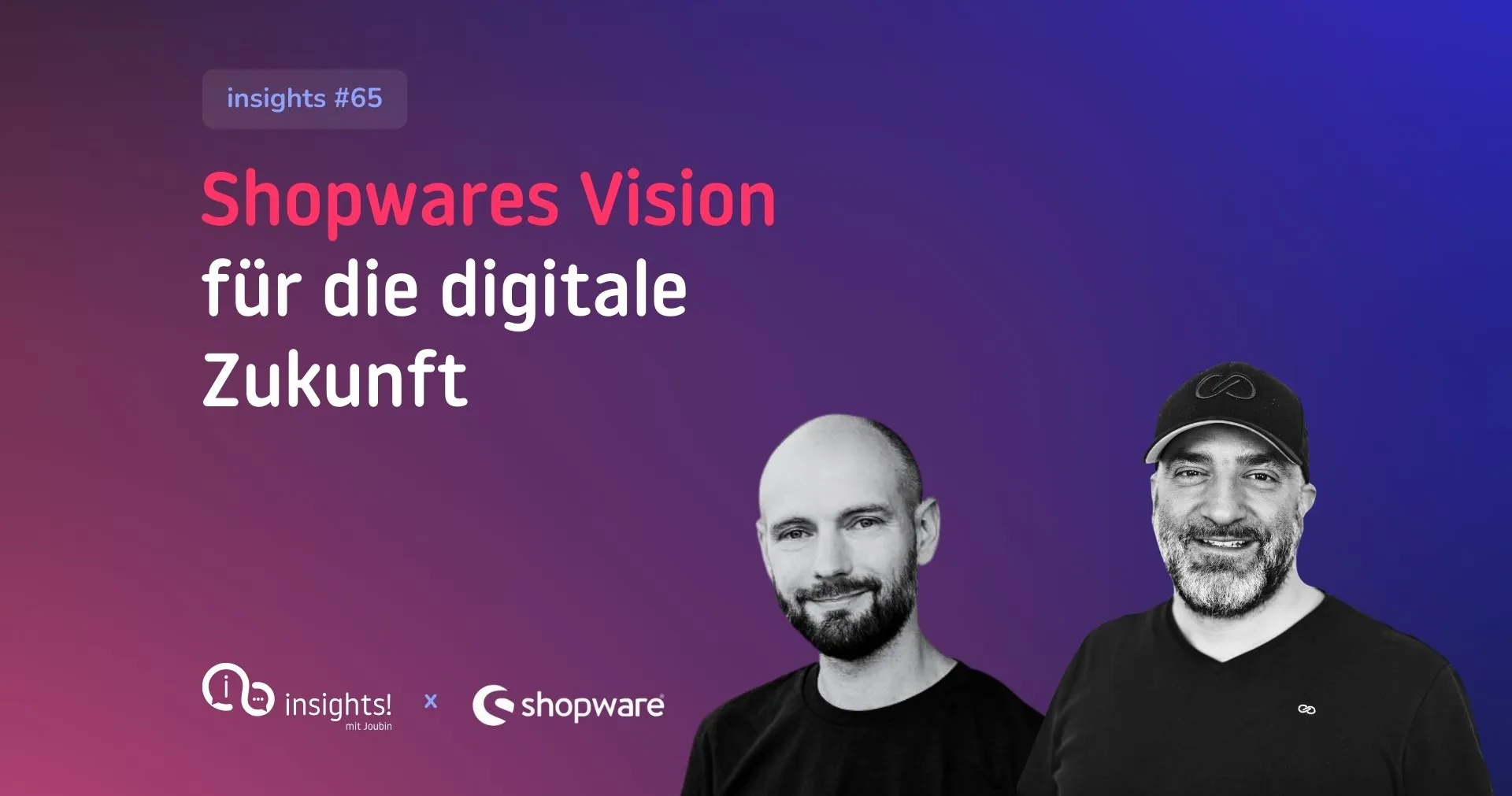
insights! #65: Shopware's vision for the digital future of e-commerce
 Joubin RahimiManaging Partner · synaigy
4 min. read
In my view, artificial intelligence always has to be a leadership topic
E-commerce is evolving rapidly, and that takes more than just good products – it takes bold visions and tailor-made solutions. Sebastian Hamann, co-founder and CEO of Shopware, explains how his company supports the mid-market and why it is especially important right now to drive innovation forward. Shopware has made it its mission not only to respond to the needs of the largest corporations, but above all to equip the often overlooked mid-market with the right tools for success.
Shopware and the mid-market: a tailor-made solution
Over the past 23 years, Shopware has grown from a small company into a market leader for e-commerce software in the mid-market. Sebastian Hamann emphasizes that the mid-market is often overlooked, even though it faces complex requirements that call for specifically tailored solutions. With features such as the Flow Builder and the Rule Builder, Shopware enables companies to automate their e-commerce processes and thus work more efficiently, without the need for expensive and elaborate development work.
These tools are one example of how Shopware helps companies increase their efficiency and focus on what matters: improving the customer experience and increasing margins. Hamann sees the combination of flexibility and ease of use as the key to success for the mid-market, which often does not have the resources to compete with the big players.
American e-commerce and the opportunities for Europe
With its move into the American market, Shopware has not only expanded its own reach but also gained valuable insights. The American market is not only the largest e-commerce market in the world, but also an engine of innovation. Sebastian Hamann notes that the positive, bold attitude of American companies toward new technologies and business models can serve as a role model. That attitude could also help the German mid-market act faster and more decisively.
Hamann sees the expansion into America as a win-win situation: the innovations and trends emerging in the USA feed directly into the further development of Shopware and thus also benefit European companies. He sees enormous potential in AI in particular, potential that is far from exhausted.
Direct-to-consumer: a disruptive model with a future
Another exciting topic that comes up in the conversation is the direct-to-consumer (D2C) model. Hamann sees D2C as one of the biggest changes in retail in recent years. Through direct access to their customers, brands can not only develop better products, but also improve their margins and reduce their dependence on traditional retail.
He emphasizes, however, that this does not mean that traditional retail models have had their day. Rather, he sees a future in which brands and retailers can both be successful if they offer their customers real added value. This could happen, for example, through personalized advice, digital services or a unique brand experience. Building a strong brand is becoming ever more important in order to hold your own in an increasingly competitive market.
The courage to face the future: daring to innovate and seizing opportunities
Sebastian Hamann is convinced that the key to success in the future lies in making bold decisions and actively using new technologies such as AI. He sees enormous potential for innovative business models in the e-commerce industry and calls on companies not to let themselves be paralyzed by fears or uncertainties. Instead, they should experiment, learn and, above all, act. In closing, Hamann emphasizes the importance of community and networks. He believes that building strong communities can be of great benefit both to companies and to their customers. Through collaboration and the exchange of ideas, companies can not only improve their own products, but also strengthen customer loyalty.
In a nutshell: a positive future for e-commerce
Sebastian Hamann and Shopware show how important it is to be bold and innovative in a rapidly changing world. With a clear focus on the mid-market and a strong orientation toward future technologies such as AI, Shopware has set the course for a successful future. Companies that adopt this attitude and actively seize the opportunities of digital transformation will be able to strengthen their position in the market and be sustainably successful.
Would you like to listen to the full episode?
Here you will find the podcast of the interview:
Please accept the corresponding cookies to view this embedded content.
Would you rather watch the episode? No problem!
Here you will find a recording of the interview:
Please accept functional cookies to watch this video.
Would you rather read?
Joubin Rahimi:
Great to have you back for a new episode of insights. My name is Joubin Rahimi and today I get to welcome Sebastian Hamann from Shopware. Hello Sebastian.
Sebastian Hamann:
Hello Joubin.
Joubin Rahimi:
Great. Thanks for taking the time. As the CEO of what is by now a really large software company in e-commerce, and as a founder, you probably have plenty of other topics on your desk as well. So thank you for that up front. Thanks for that. We have known each other for a while now. But maybe you would like to say two or three sentences about yourself and about Shopware for those who do not know you yet.
Sebastian Hamann:
Yes, many thanks for the invitation. My pleasure, Joubin. I am Sebastian. Sebastian Hamann founded the company 23 years ago now, together with my brother Stefan. I come from the product side, just like my brother. So we are product founders, if you will. Yes, I stand for the whole customer experience area; back in the day I even designed the frontend myself, the user interface of Shopware and so on. So I am still very passionate about the product and about customer value. My brother was responsible for all of the technology and developed and drove the whole thing forward. Right, Shopware, some of you may have heard of it.
We are the market leader in Germany, we focus on the mid-market and we are known above all for having very flexible and adaptable software.
Joubin Rahimi:
Thanks, let me pick that ball up right away, because we always have the discussion, when we get to advise customers, about which software makes sense when and where. And for one thing it should of course be the customer who decides, not us. We are there in an advisory role. But you said mid-market. How do you define the mid-market in that setup?
Sebastian Hamann:
Yes, first of all I think the mid-market is badly neglected by many vendors. Many vendors want to cover the entire spectrum, or many go for the enterprise segment, meaning the really large corporate companies. The small business segment is very competitive as well. So there are many vendors operating there, and the mid-market gets neglected, even though it also has very high requirements for commerce solutions. It deals with a lot of complexity. Especially when I have several languages, several currencies, want to serve several countries, possibly have different warehouses that I connect, maybe different ERP systems on top, customer groups, B2C, B2B or D2C business models that I want to run at the same time. Then I have high complexity and high requirements, but not necessarily the budget to afford those big, heavyweight enterprise systems. And maybe they would even overwhelm me, because they simply cannot deliver the speed I need in the mid-market. At Shopware we define the mid-market by that complexity and by those requirements, but also by the size of the companies, especially by the online trading volume, the GMV that is generated. And as a rule we say that the moment I cross that 1 million, 2 million GMV threshold, I move into the lower mid-market, and from there I go up to the upper mid-market, which in Germany or Europe sits somewhere around 100 million GMV. If we now take a look at America, where we are also active with Shopware, things look a little different. In America the mid-market is by definition somewhat larger. In America it is not only the shampoo bottle that is a bit bigger, but online retail revenue is simply bigger too. There we see that range being more like 250 to 300 million. That is exactly the sweet spot where Shopware operates and where we can generate the greatest value for our customers.
Joubin Rahimi:
Great, thank you. I actually have two paths I would like to follow with you, or not right this second. One part is the German mid-market again, which is also the engine of the entire industry we have here. So I am extremely pleased that we also have German software companies that now operate internationally, so not just SAP, and you have a similar color, it just occurs to me. But that we have you as well, writing the software out of Germany. You are also partly responsible for the product and for UX, as you mentioned, or the customer journey. What I often criticize about German companies is that we do cool things and do not really talk about them. I do not think you fall into that category entirely, but I do think you could add another notch. Maybe you can name two or three things you have done recently that not everyone picked up on right away.
Sebastian Hamann:
Yes, I think I know what you are getting at. It is perhaps partly a cultural difference too. I do think that we Germans tend to be very perfectionist. High engineering, let us say, and then only going out with it once it is really super, super perfect, and waiting a long time, while in America perhaps things are carried out much faster and much louder and with more confidence. In recent years in particular we have developed a great many innovative features and released things such as the Flow Builder, which is available in Shopware, and the Rule Builder, which lets me automate my e-commerce processes without needing any developers or custom programming work. I can do that straight out of the software.
Joubin Rahimi:
I am a real fan of that. I really celebrate that tool of yours, because it takes a lot of load off software development. But I think most customers still use it far too little.
Sebastian Hamann:
There is certainly more potential there, especially for leveraging efficiencies. And right now, especially when we look at the industry, that is extremely important, becoming more efficient, having more time available, focusing on what matters, namely my core business, increasing margins, reducing costs. And that is where the Flow Builder and the Rule Builder can play an absolutely essential role. We have released further innovations, such as Digital Sales Room, which also showed up in the latest Gartner Magic Quadrant report, where I can start a video conference and then provide advice directly via co-browsing. I can take over control, guide my customer through the online shop, show products, configure them together and so on. It is in use at the company Wortmann, among others, known for Tamaris in the B2B space. We have just released Subscriptions, subscription payment integrated natively into Shopware. We have launched the AI Copilot, where 9 to 10 AI features are already available out of the box in Shopware. I can use them today. There are some really good things in there, which we also developed together with the merchants, features that make it possible, for example, to crawl the product data, and out of that the AI then makes suggestions for you: “Hey, have you ever thought about distilling these and these attributes out of the product data I have just read?” That would make sense, because it would make the faceted navigation and the filter properties much more intuitive for the customer to find the products. And much more. So, big picture: we invest a great deal in the product and in the future and we know that a lot more is coming our way in the years ahead. Driven in particular by artificial intelligence, but also by spatial, meaning the whole 3D world and the topics that are coming toward us. That is going to be incredibly exciting. I look ahead to it very, very positively, because I believe it will influence the customer experience toward a really very positive effect.
Joubin Rahimi:
I think it is awesome what you are all putting out, and I also think your move to scale up now and go to the USA is mega smart. I do not know your motives, but I think it is mega smart for one reason. There are many, many reasons. And when you work with American customers, then from my point of view you also get requirements that have not even arrived here in Germany yet for most companies. So from my point of view the American market is two or three years ahead. But first I would be interested in your assessment of whether you see it that way too. Feel free to say no, I do not see it that way, the Germans have caught up. I would be delighted. And whether that is also a factor, whether you say that out of these conversations with the companies that are at the front, as people simply do not say anymore, which I also think is wrong, but at the
Spearhead of innovation, and that try out the newest things with the customer and gather the experience, so that you can then build it in as well. Was that a factor in expanding toward the USA, or? That is three questions at once. Just fire away however you like with the answers.
Sebastian Hamann:
Yes, let me try to sort that out. So America is the largest e-commerce market. And that is of course incredibly exciting for us, to gain a foothold there with Shopware and also to benefit from that growth, when we think in terms of growth. Then there is a point you made that is true. It is also the case that the European market and Germany as well will benefit if we are successful in America, because there, as you said, e-commerce is very, very fast and very innovative. And that innovation and those features and benefits flow straight back into the product, which Germany, or rather all of Europe, can then benefit from as well. Then there is the fact that the mid-market is neglected in America too. And a bit of context on that. Some of you may have heard of it: there is the software company, or software solution, Magento. Magento used to be the market leader in America, especially in the mid-market. And as just mentioned, in the mid-market there is that complexity I have to get a grip on. But now this Magento software solution has increasingly withdrawn from that mid-market segment and positioned itself more toward large enterprise companies with Adobe. And that leaves a big gap in the market and also strong demand for a solution like Shopware, which is built perfectly for exactly that, to offer the flexibility that is needed there to get that complexity under control. And when you pull these aspects together, it is a very consistent and logical step for us to gain a foothold in America as well and build a business there.
Joubin Rahimi:
A super smart move then, for many different reasons. We see it here as well, that we keep having Magento cases that no longer fit, funnily enough, where the vendor simply no longer fits the customer. But I do not want to dwell on Magento, rather on what you may also be seeing in America, the change over there in America. Can you give two or three points where you would say we could simply copy that in Europe, they are already doing that really well?
Sebastian Hamann:
I actually have one very significant point that I was able to experience myself and personally. I was in America at various e-commerce events, and I also had conversations with customers, partners and so on. And when I compare that a little with some German events, the mood is simply different. Let us say the mood in America is more like: hey, we are moving forward in good spirits. Maybe not everything is easy, but it is not hopeless either. And we pitch in and are totally interested in making it happen, in driving this development forward. Whereas in Germany in particular I have the feeling that quite often things are colored rather negatively, especially when I look at the Handelsblatt topics and so on. The news and reports come across as rather oppressive, and I know the situation is not easy. But I do think there is a big difference to America, where you notice that people are more willing to make bolder decisions, to move forward and to look at the future far more positively. And I believe it would do us all good to move a bit more, perhaps not quite as pronounced as it is in America, but a bit, toward that positive thinking and courageous attitude here too. Because I do not think it will happen by itself. And in this spiral of self-despair we will not be able to drive Germany's economic strength forward either.
Joubin Rahimi:
A really, really great call to action. Let me put it this way. Even though we have now, I believe, just become the third strongest economy in the world, but mainly because Japan has fallen back, not because we have risen, that is only a veil, from my point of view, over what we are really seeing here. Especially on the topic of AI, which you are actively working on, I tend to get rather reserved feedback from many customers. Sure, everyone wants to do something with AI, but really investing in it, we are still very hesitant there, that is my impression. What is your impression?
Sebastian Hamann:
Well, we also do a lot with partners, we have a large ecosystem at Shopware.
So we have many developers, partners like you. We have many merchants, customers, brands, manufacturers, a very broad field of companies we deal with. And there we do see the will and also the courage to experiment with AI and to move forward, which I think is very good. I believe we are already very modern in the e-commerce industry. You also should not forget, with everything you read, that we are still operating in a growth market. And I think that, even looking at the forecasts, maybe the growth rate will no longer be in the double-digit percentage range over the next few years. I am speaking for Germany now. But it is still very decent and we are still growing. AI is a topic. Yes, it stokes fear. There are many companies that are reserved, they cannot quite picture it yet. In my view, artificial intelligence always has to be a leadership topic and also a topic for the boss. It is about experimenting, trying things out yourself, developing a feel for how it can affect my business model, how it can develop it further, how it can help me, how it may also change the industry in the future in which I am currently positioning myself with my business model. That has to come out of an entrepreneurial spirit, to get an assessment of it. And then I also start, once I have developed a clear picture of it and have experimented. It is very, very much about experimenting and trying things out and learning from it. And I believe that is absolutely essential and at the end of the day it will also make the difference for the companies that engaged with it early and recognized where artificial intelligence really adds value, where it makes sense to allocate further resources and invest, and where perhaps it does not. “Hey folks, go use ChatGPT or whatever and get into it and then come to me with a dozen suggestions and then I will take a look,” and then, well, that is difficult. And that is why, speaking from my perspective, that is the path you have to take. And then we will also find that there are many fields, many employees, many profiles that can develop further there. That has to happen now, to be honest. I cannot wait five years and say, well, I will see how other companies do it, where it is working now, then maybe I can adapt it and copy it. No, I think this is moving at such a rapid pace over the next few years that everyone is well advised to engage with it early and, as I said, from the leadership team as well, with the impact it will have.
Joubin Rahimi:
You said a whole lot of great things. I think leadership, AI is leadership, that should simply be underlined once more, and that so much is changing. And I would like to take that ball and run with it, because with AI I think it is another catalyst, it will be much stronger again. But let me frame the whole thing. We have retail customers, so omnichannel retailers. We used to have Reno as a customer. We have brand manufacturers, or brands and manufacturers, and industrial companies and wholesale. That is roughly our portfolio. In some B2C, so in some retail companies, we see that it is really tough. Fashion, fashion and shoes especially. And there we do see that a few iterations have happened, because Reno no longer exists in that form. They filed for insolvency and I believe there is no positive going-concern forecast. The stores are closed, the shop is closed, they are gone. On the other hand there is, well, Görtz has exactly the same kind of challenges. On the other hand we suddenly see Deichmann managing quite well, as far as I can tell from the press, holding their ground, with Snipes as well, so with a very target-group-specific approach. And then when I look at Adidas, that is a completely different story. The manufacturer is moving ahead. What I am getting at is that these classic multi-tier sales channels are changing. And we see that in the fashion sector. We believe it will be the same in the other sectors. But I would like to reflect that with you. So do you see D2C as a genuinely lasting topic, or is it just a fad being chased through the village, or essentially important?
Sebastian Hamann:
Yes, D2C is certainly one of the disruptive formats we have seen over the past years and decades. In Germany, everyone certainly remembers MyMüsli. Then Betteins, also a customer of ours, the ones who together with us, or let us say, where, and I think you should not forget this either: retail is dealing with several factors that are putting it under pressure. We have seen the rise of the direct brands that popped up and that, to be fair, brought out really good products with branding, that were much more efficient on the cost side and grabbed market share there and put traditional retailers under pressure. Then we saw that acquisitions came about faster than ever. So companies consolidate, buy each other up, merge. A great deal has happened. And what is absolutely essential, and that, I think, is the topic you are getting at, is creating a brand, building added value. And that has become much more important over all these past years. I have to get out of this product comparability. I have to get out of this price and availability spiral, you have to get into desirability and brand. And this verticalization, this direct access to the customer, is a very important step toward that, I believe. I gain far more experience, I can develop my products together with the customer, so I have the data, the usage data, and can also build further business models on top of that. Now please do not get me wrong. That does not mean that the horizontal retail models do not work. Quite the opposite, I see a lot of potential there. But that potential again comes back to this: I have to become a brand. I have to offer a customer experience that provides added value. What do I mean by that? If I now, you just mentioned shoe retailers. If I am a shoe retailer, I think in the future I have to think much harder. And that is a bit of the retail expertise that the mid-market has as well, which is why it also has its raison d'être, because it has that expertise. It has that advice. It understands, for example with sports shoes, with running shoes, why those shoes are good. And I think that has to be played out much more. I can couple this service mindset to products. Maybe I cannot only ship physical products, but perhaps even sell digital services on top. I do not know. If, for example, you want to buy a new stereo sound system, maybe in the future I will turn that around and say: hey, if you buy it, or when we come together on it, you also get a setup call from me on top, where you can then, when you unpack it, unboxing in your living room, basically call me on your smartphone. Then, via a digital sales room, I can co-browse with you on how to set it up, how to arrange the setup in your living room. Maybe if I am somehow in the children's goods space, I could also say: hey, an added value is that if you buy the baby carrier, you can basically contact me and then I will show you again how to tie it. And thinking your way into these examples, I see a whole lot of potential there for retail, for how it can position itself for the customer in the future and also sustainably create a strong brand. Because exactly these customer experiences, this experience, feed right back into your image and your brand and stick in customers' minds. And that is something nobody can take away from you. It is like a kind of moat that you build for yourself. And in retail right now it is all the more about achieving exactly that, because that in turn also means that customer acquisition costs are lower in the long run, logically, that I can become significantly more efficient and also increase margins.
Joubin Rahimi:
Those are a whole lot of great things, especially in the last, well, 15 minutes anyway, but now also in that last passage. Manufacturers and retailers are both still there, but everyone has to earn and demonstrate their added value for the customer, and the brand has to be there. I would really underline that too. The complexity is there, and you have to tackle it actively with the American spirit that you, or with the part of the American spirit that you mentioned earlier. To close: I always like to ask, what are three topics you would wish for if you could wish for them? That is an unrehearsed question, for the market, for you, for the customers? It is completely open.
Sebastian Hamann:
That is an exciting question. Three things I am allowed to wish for. Yes, I wish that we would move forward more boldly. Yes, that we would adopt innovation more. And I believe that is the only way we can manage to break out and really create great new companies out of Germany that are genuinely forward-looking. And that is where we have to get to. We have to make bolder decisions, be bolder, accept risks in order to step on the gas. And I think the e-commerce space is a really super exciting environment where I can establish new business models and so on.
Joubin Rahimi:
Be brave. So to everyone listening: be courageous, be brave and curious, and do it rather than discussing it theoretically.
Sebastian Hamann:
Yes, wishes. I think we should invest even more in the community mindset. So not only in the form of speaking about Shopware now and saying, hey, that is the community. Yes, that makes total sense. So thinking in ecosystems, in networks, but perhaps also from a merchant's and retailer's perspective, that I start building these communities and networks myself, because I believe that in turn lets me achieve enormous added value and also a win-win situation. Here too the topic of courage comes into play again. But why not? Why not also bring topics into your own customer community and activate them with questions and say: hey, why don't you help develop a product. Maybe I run exciting campaigns and promotions there, maybe I even let my developers and product teams develop something together with the community, with the customers, and then bring it to market as, so to speak, an individualized product of my own. I believe these topics will be very, very beneficial in the future, in order to build a strong brand and an improved customer experience here as well. The third thing I would wish for: yes, honestly, right now simply better weather. We are talking about topics like these right now and we are in that season where the weather is not quite so good anymore. And then I notice that a lot of people are again a bit more negatively disposed. So yes, let a bit more sunshine come through from the weather again. I think then everyone will be in a slightly better mood again and then we will have a good basis for moving into the future even more boldly.
Joubin Rahimi:
That is a great closing word. Weather, we are working on it getting warmer here, unfortunately with other consequences too. And thank you, dear Sebastian, for your time, for all the insights, for much more beyond your software, and also for presenting yourselves as a partner. Not just: we have a piece of software there, but: we have ideas to move forward with you, and we can discuss them too. And I find that valuable. You are simply a partner at eye level, and coming from Europe, from Germany, that is mega valuable. Certainly for the German-speaking and DACH listeners, who are the majority, since all of this is in German here. So thank you for that, and I look forward to more exciting decades with you. We have been on the same side that long already, and I am curious and also courageous about what follows, and certainly in better weather. Thank you, Sebastian.
Sebastian Hamann:
Many thanks for the invitation. It was fun and I look to the future positively. Thank you. Great.
Would you rather read? Here is the content:
Joubin Rahimi:
Great to have you back for a new episode of insights. My name is Joubin Rahimi and today I get to welcome Sebastian Hamann from Shopware. Hello Sebastian.
Sebastian Hamann:
Hello Joubin.
Joubin Rahimi:
Great. Thanks for taking the time. As the CEO of what is by now a really large software company in e-commerce, and as a founder, you probably have plenty of other topics on your desk as well. So thank you for that up front. Thanks for that. We have known each other for a while now. But maybe you would like to say two or three sentences about yourself and about Shopware for those who do not know you yet.
Sebastian Hamann:
Yes, many thanks for the invitation. My pleasure, Joubin. I am Sebastian. Sebastian Hamann founded the company 23 years ago now, together with my brother Stefan. I come from the product side, just like my brother. So we are product founders, if you will. Yes, I stand for the whole customer experience area; back in the day I even designed the frontend myself, the user interface of Shopware and so on. So I am still very passionate about the product and about customer value. My brother was responsible for all of the technology and developed and drove the whole thing forward. Right, Shopware, some of you may have heard of it.
We are the market leader in Germany, we focus on the mid-market and we are known above all for having very flexible and adaptable software.
Joubin Rahimi:
Thanks, let me pick that ball up right away, because we always have the discussion, when we get to advise customers, about which software makes sense when and where. And for one thing it should of course be the customer who decides, not us. We are there in an advisory role. But you said mid-market. How do you define the mid-market in that setup?
Sebastian Hamann:
Yes, first of all I think the mid-market is badly neglected by many vendors. Many vendors want to cover the entire spectrum, or many go for the enterprise segment, meaning the really large corporate companies. The small business segment is very competitive as well. So there are many vendors operating there, and the mid-market gets neglected, even though it also has very high requirements for commerce solutions. It deals with a lot of complexity. Especially when I have several languages, several currencies, want to serve several countries, possibly have different warehouses that I connect, maybe different ERP systems on top, customer groups, B2C, B2B or D2C business models that I want to run at the same time. Then I have high complexity and high requirements, but not necessarily the budget to afford those big, heavyweight enterprise systems. And maybe they would even overwhelm me, because they simply cannot deliver the speed I need in the mid-market. At Shopware we define the mid-market by that complexity and by those requirements, but also by the size of the companies, especially by the online trading volume, the GMV that is generated. And as a rule we say that the moment I cross that 1 million, 2 million GMV threshold, I move into the lower mid-market, and from there I go up to the upper mid-market, which in Germany or Europe sits somewhere around 100 million GMV. If we now take a look at America, where we are also active with Shopware, things look a little different. In America the mid-market is by definition somewhat larger. In America it is not only the shampoo bottle that is a bit bigger, but online retail revenue is simply bigger too. There we see that range being more like 250 to 300 million. That is exactly the sweet spot where Shopware operates and where we can generate the greatest value for our customers.
Joubin Rahimi:
Great, thank you. I actually have two paths I would like to follow with you, or not right this second. One part is the German mid-market again, which is also the engine of the entire industry we have here. So I am extremely pleased that we also have German software companies that now operate internationally, so not just SAP, and you have a similar color, it just occurs to me. But that we have you as well, writing the software out of Germany. You are also partly responsible for the product and for UX, as you mentioned, or the customer journey. What I often criticize about German companies is that we do cool things and do not really talk about them. I do not think you fall into that category entirely, but I do think you could add another notch. Maybe you can name two or three things you have done recently that not everyone picked up on right away.
Sebastian Hamann:
Yes, I think I know what you are getting at. It is perhaps partly a cultural difference too. I do think that we Germans tend to be very perfectionist. High engineering, let us say, and then only going out with it once it is really super, super perfect, and waiting a long time, while in America perhaps things are carried out much faster and much louder and with more confidence. In recent years in particular we have developed a great many innovative features and released things such as the Flow Builder, which is available in Shopware, and the Rule Builder, which lets me automate my e-commerce processes without needing any developers or custom programming work. I can do that straight out of the software.
Joubin Rahimi:
I am a real fan of that. I really celebrate that tool of yours, because it takes a lot of load off software development. But I think most customers still use it far too little.
Sebastian Hamann:
There is certainly more potential there, especially for leveraging efficiencies. And right now, especially when we look at the industry, that is extremely important, becoming more efficient, having more time available, focusing on what matters, namely my core business, increasing margins, reducing costs. And that is where the Flow Builder and the Rule Builder can play an absolutely essential role. We have released further innovations, such as Digital Sales Room, which also showed up in the latest Gartner Magic Quadrant report, where I can start a video conference and then provide advice directly via co-browsing. I can take over control, guide my customer through the online shop, show products, configure them together and so on. It is in use at the company Wortmann, among others, known for Tamaris in the B2B space. We have just released Subscriptions, subscription payment integrated natively into Shopware. We have launched the AI Copilot, where 9 to 10 AI features are already available out of the box in Shopware. I can use them today. There are some really good things in there, which we also developed together with the merchants, features that make it possible, for example, to crawl the product data, and out of that the AI then makes suggestions for you: “Hey, have you ever thought about distilling these and these attributes out of the product data I have just read?” That would make sense, because it would make the faceted navigation and the filter properties much more intuitive for the customer to find the products. And much more. So, big picture: we invest a great deal in the product and in the future and we know that a lot more is coming our way in the years ahead. Driven in particular by artificial intelligence, but also by spatial, meaning the whole 3D world and the topics that are coming toward us. That is going to be incredibly exciting. I look ahead to it very, very positively, because I believe it will influence the customer experience toward a really very positive effect.
Joubin Rahimi:
I think it is awesome what you are all putting out, and I also think your move to scale up now and go to the USA is mega smart. I do not know your motives, but I think it is mega smart for one reason. There are many, many reasons. And when you work with American customers, then from my point of view you also get requirements that have not even arrived here in Germany yet for most companies. So from my point of view the American market is two or three years ahead. But first I would be interested in your assessment of whether you see it that way too. Feel free to say no, I do not see it that way, the Germans have caught up. I would be delighted. And whether that is also a factor, whether you say that out of these conversations with the companies that are at the front, as people simply do not say anymore, which I also think is wrong, but at the
Spearhead of innovation, and that try out the newest things with the customer and gather the experience, so that you can then build it in as well. Was that a factor in expanding toward the USA, or? That is three questions at once. Just fire away however you like with the answers.
Sebastian Hamann:
Yes, let me try to sort that out. So America is the largest e-commerce market. And that is of course incredibly exciting for us, to gain a foothold there with Shopware and also to benefit from that growth, when we think in terms of growth. Then there is a point you made that is true. It is also the case that the European market and Germany as well will benefit if we are successful in America, because there, as you said, e-commerce is very, very fast and very innovative. And that innovation and those features and benefits flow straight back into the product, which Germany, or rather all of Europe, can then benefit from as well. Then there is the fact that the mid-market is neglected in America too. And a bit of context on that. Some of you may have heard of it: there is the software company, or software solution, Magento. Magento used to be the market leader in America, especially in the mid-market. And as just mentioned, in the mid-market there is that complexity I have to get a grip on. But now this Magento software solution has increasingly withdrawn from that mid-market segment and positioned itself more toward large enterprise companies with Adobe. And that leaves a big gap in the market and also strong demand for a solution like Shopware, which is built perfectly for exactly that, to offer the flexibility that is needed there to get that complexity under control. And when you pull these aspects together, it is a very consistent and logical step for us to gain a foothold in America as well and build a business there.
Joubin Rahimi:
A super smart move then, for many different reasons. We see it here as well, that we keep having Magento cases that no longer fit, funnily enough, where the vendor simply no longer fits the customer. But I do not want to dwell on Magento, rather on what you may also be seeing in America, the change over there in America. Can you give two or three points where you would say we could simply copy that in Europe, they are already doing that really well?
Sebastian Hamann:
I actually have one very significant point that I was able to experience myself and personally. I was in America at various e-commerce events, and I also had conversations with customers, partners and so on. And when I compare that a little with some German events, the mood is simply different. Let us say the mood in America is more like: hey, we are moving forward in good spirits. Maybe not everything is easy, but it is not hopeless either. And we pitch in and are totally interested in making it happen, in driving this development forward. Whereas in Germany in particular I have the feeling that quite often things are colored rather negatively, especially when I look at the Handelsblatt topics and so on. The news and reports come across as rather oppressive, and I know the situation is not easy. But I do think there is a big difference to America, where you notice that people are more willing to make bolder decisions, to move forward and to look at the future far more positively. And I believe it would do us all good to move a bit more, perhaps not quite as pronounced as it is in America, but a bit, toward that positive thinking and courageous attitude here too. Because I do not think it will happen by itself. And in this spiral of self-despair we will not be able to drive Germany's economic strength forward either.
Joubin Rahimi:
A really, really great call to action. Let me put it this way. Even though we have now, I believe, just become the third strongest economy in the world, but mainly because Japan has fallen back, not because we have risen, that is only a veil, from my point of view, over what we are really seeing here. Especially on the topic of AI, which you are actively working on, I tend to get rather reserved feedback from many customers. Sure, everyone wants to do something with AI, but really investing in it, we are still very hesitant there, that is my impression. What is your impression?
Sebastian Hamann:
Well, we also do a lot with partners, we have a large ecosystem at Shopware.
So we have many developers, partners like you. We have many merchants, customers, brands, manufacturers, a very broad field of companies we deal with. And there we do see the will and also the courage to experiment with AI and to move forward, which I think is very good. I believe we are already very modern in the e-commerce industry. You also should not forget, with everything you read, that we are still operating in a growth market. And I think that, even looking at the forecasts, maybe the growth rate will no longer be in the double-digit percentage range over the next few years. I am speaking for Germany now. But it is still very decent and we are still growing. AI is a topic. Yes, it stokes fear. There are many companies that are reserved, they cannot quite picture it yet. In my view, artificial intelligence always has to be a leadership topic and also a topic for the boss. It is about experimenting, trying things out yourself, developing a feel for how it can affect my business model, how it can develop it further, how it can help me, how it may also change the industry in the future in which I am currently positioning myself with my business model. That has to come out of an entrepreneurial spirit, to get an assessment of it. And then I also start, once I have developed a clear picture of it and have experimented. It is very, very much about experimenting and trying things out and learning from it. And I believe that is absolutely essential and at the end of the day it will also make the difference for the companies that engaged with it early and recognized where artificial intelligence really adds value, where it makes sense to allocate further resources and invest, and where perhaps it does not. “Hey folks, go use ChatGPT or whatever and get into it and then come to me with a dozen suggestions and then I will take a look,” and then, well, that is difficult. And that is why, speaking from my perspective, that is the path you have to take. And then we will also find that there are many fields, many employees, many profiles that can develop further there. That has to happen now, to be honest. I cannot wait five years and say, well, I will see how other companies do it, where it is working now, then maybe I can adapt it and copy it. No, I think this is moving at such a rapid pace over the next few years that everyone is well advised to engage with it early and, as I said, from the leadership team as well, with the impact it will have.
Joubin Rahimi:
You said a whole lot of great things. I think leadership, AI is leadership, that should simply be underlined once more, and that so much is changing. And I would like to take that ball and run with it, because with AI I think it is another catalyst, it will be much stronger again. But let me frame the whole thing. We have retail customers, so omnichannel retailers. We used to have Reno as a customer. We have brand manufacturers, or brands and manufacturers, and industrial companies and wholesale. That is roughly our portfolio. In some B2C, so in some retail companies, we see that it is really tough. Fashion, fashion and shoes especially. And there we do see that a few iterations have happened, because Reno no longer exists in that form. They filed for insolvency and I believe there is no positive going-concern forecast. The stores are closed, the shop is closed, they are gone. On the other hand there is, well, Görtz has exactly the same kind of challenges. On the other hand we suddenly see Deichmann managing quite well, as far as I can tell from the press, holding their ground, with Snipes as well, so with a very target-group-specific approach. And then when I look at Adidas, that is a completely different story. The manufacturer is moving ahead. What I am getting at is that these classic multi-tier sales channels are changing. And we see that in the fashion sector. We believe it will be the same in the other sectors. But I would like to reflect that with you. So do you see D2C as a genuinely lasting topic, or is it just a fad being chased through the village, or essentially important?
Sebastian Hamann:
Yes, D2C is certainly one of the disruptive formats we have seen over the past years and decades. In Germany, everyone certainly remembers MyMüsli. Then Betteins, also a customer of ours, the ones who together with us, or let us say, where, and I think you should not forget this either: retail is dealing with several factors that are putting it under pressure. We have seen the rise of the direct brands that popped up and that, to be fair, brought out really good products with branding, that were much more efficient on the cost side and grabbed market share there and put traditional retailers under pressure. Then we saw that acquisitions came about faster than ever. So companies consolidate, buy each other up, merge. A great deal has happened. And what is absolutely essential, and that, I think, is the topic you are getting at, is creating a brand, building added value. And that has become much more important over all these past years. I have to get out of this product comparability. I have to get out of this price and availability spiral, you have to get into desirability and brand. And this verticalization, this direct access to the customer, is a very important step toward that, I believe. I gain far more experience, I can develop my products together with the customer, so I have the data, the usage data, and can also build further business models on top of that. Now please do not get me wrong. That does not mean that the horizontal retail models do not work. Quite the opposite, I see a lot of potential there. But that potential again comes back to this: I have to become a brand. I have to offer a customer experience that provides added value. What do I mean by that? If I now, you just mentioned shoe retailers. If I am a shoe retailer, I think in the future I have to think much harder. And that is a bit of the retail expertise that the mid-market has as well, which is why it also has its raison d'être, because it has that expertise. It has that advice. It understands, for example with sports shoes, with running shoes, why those shoes are good. And I think that has to be played out much more. I can couple this service mindset to products. Maybe I cannot only ship physical products, but perhaps even sell digital services on top. I do not know. If, for example, you want to buy a new stereo sound system, maybe in the future I will turn that around and say: hey, if you buy it, or when we come together on it, you also get a setup call from me on top, where you can then, when you unpack it, unboxing in your living room, basically call me on your smartphone. Then, via a digital sales room, I can co-browse with you on how to set it up, how to arrange the setup in your living room. Maybe if I am somehow in the children's goods space, I could also say: hey, an added value is that if you buy the baby carrier, you can basically contact me and then I will show you again how to tie it. And thinking your way into these examples, I see a whole lot of potential there for retail, for how it can position itself for the customer in the future and also sustainably create a strong brand. Because exactly these customer experiences, this experience, feed right back into your image and your brand and stick in customers' minds. And that is something nobody can take away from you. It is like a kind of moat that you build for yourself. And in retail right now it is all the more about achieving exactly that, because that in turn also means that customer acquisition costs are lower in the long run, logically, that I can become significantly more efficient and also increase margins.
Joubin Rahimi:
Those are a whole lot of great things, especially in the last, well, 15 minutes anyway, but now also in that last passage. Manufacturers and retailers are both still there, but everyone has to earn and demonstrate their added value for the customer, and the brand has to be there. I would really underline that too. The complexity is there, and you have to tackle it actively with the American spirit that you, or with the part of the American spirit that you mentioned earlier. To close: I always like to ask, what are three topics you would wish for if you could wish for them? That is an unrehearsed question, for the market, for you, for the customers? It is completely open.
Sebastian Hamann:
That is an exciting question. Three things I am allowed to wish for. Yes, I wish that we would move forward more boldly. Yes, that we would adopt innovation more. And I believe that is the only way we can manage to break out and really create great new companies out of Germany that are genuinely forward-looking. And that is where we have to get to. We have to make bolder decisions, be bolder, accept risks in order to step on the gas. And I think the e-commerce space is a really super exciting environment where I can establish new business models and so on.
Joubin Rahimi:
Be brave. So to everyone listening: be courageous, be brave and curious, and do it rather than discussing it theoretically.
Sebastian Hamann:
Yes, wishes. I think we should invest even more in the community mindset. So not only in the form of speaking about Shopware now and saying, hey, that is the community. Yes, that makes total sense. So thinking in ecosystems, in networks, but perhaps also from a merchant's and retailer's perspective, that I start building these communities and networks myself, because I believe that in turn lets me achieve enormous added value and also a win-win situation. Here too the topic of courage comes into play again. But why not? Why not also bring topics into your own customer community and activate them with questions and say: hey, why don't you help develop a product. Maybe I run exciting campaigns and promotions there, maybe I even let my developers and product teams develop something together with the community, with the customers, and then bring it to market as, so to speak, an individualized product of my own. I believe these topics will be very, very beneficial in the future, in order to build a strong brand and an improved customer experience here as well. The third thing I would wish for: yes, honestly, right now simply better weather. We are talking about topics like these right now and we are in that season where the weather is not quite so good anymore. And then I notice that a lot of people are again a bit more negatively disposed. So yes, let a bit more sunshine come through from the weather again. I think then everyone will be in a slightly better mood again and then we will have a good basis for moving into the future even more boldly.
Joubin Rahimi:
That is a great closing word. Weather, we are working on it getting warmer here, unfortunately with other consequences too. And thank you, dear Sebastian, for your time, for all the insights, for much more beyond your software, and also for presenting yourselves as a partner. Not just: we have a piece of software there, but: we have ideas to move forward with you, and we can discuss them too. And I find that valuable. You are simply a partner at eye level, and coming from Europe, from Germany, that is mega valuable. Certainly for the German-speaking and DACH listeners, who are the majority, since all of this is in German here. So thank you for that, and I look forward to more exciting decades with you. We have been on the same side that long already, and I am curious and also courageous about what follows, and certainly in better weather. Thank you, Sebastian.
Sebastian Hamann:
Many thanks for the invitation. It was fun and I look to the future positively. Thank you. Great.
Do you have questions or feedback?
Then feel free to contact us directly.
- Joubin Rahimi
Managing Partnersynaigy
Show phone numberShow mobile numberShow email address

Subscribe to the blog now and never miss any news
✔️free ✔️news every week ✔️expert knowledge
Please accept the corresponding cookies to view this embedded content.