



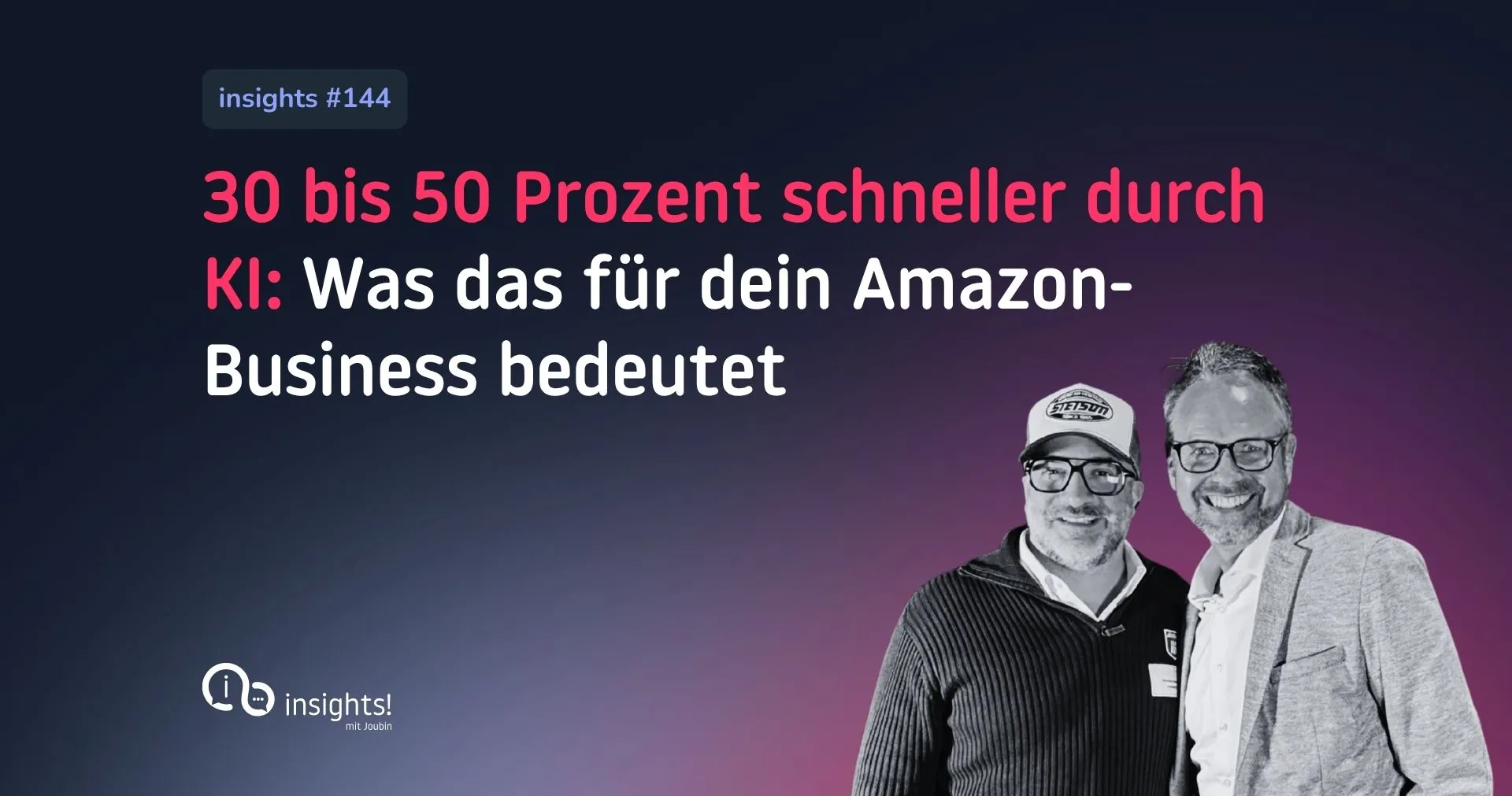
#144 - 30 to 50 percent faster with AI? What that means for your Amazon business
In this conversation, Joubin Rahimi and Amazon marketplace expert Michael Hartmann show why no retailer can avoid Amazon, how you achieve operational excellence on the platform, and what role agentic commerce and AI play for the future of e-commerce. You'll learn why the question is no longer WHETHER you sell on Amazon, but HOW, what FBA and FBM mean for your logistics, and why Amazon is already piloting AI-based content optimisation. The two also discuss how AI agents are revolutionising shopping behaviour, and why Amazon is simultaneously suing AI startups while crawling other webshops itself.
 Joubin RahimiManaging Partner · synaigy
7 min read
From my perspective, you can certainly try, but you have to be where the customer is. If you want to be where the customer is, Amazon is simply a major touchpoint in that customer journey. And therefore it's probably important for every retailer, every B2B provider, to be there too, at the end of the day, depending on which product you offer or which brand you represent. In most cases, your brand or your product is already on Amazon anyway. That means it's no longer a question of whether or not, it's a question of: how do you do it?
Amazon Marketplace 2026: Why "We already have a webshop" is the most expensive sentence in e-commerce
The figures are clear: over 60 percent of Amazon's revenue now runs through the marketplace. More than 100 million people visit the platform every month. And yet, companies still say: "We already have a webshop, that's enough." Spoiler: it isn't.
In the latest episode of the insights! videocast, Joubin Rahimi talks to Michael Hartmann, one of the most experienced Amazon marketplace experts in the German-speaking region. Hartmann brings over 20 years of sales experience, 14 of them deep inside the Amazon ecosystem. He built the European Amazon business from the ground up for brands such as Gardena, and currently oversees nine-figure revenues in the entertainment sector at CenterSoft. If anyone can get straight to the point on Amazon, it's him.
It's no longer about WHETHER, but HOW: the Amazon reality for retailers
One of the episode's most provocative statements comes right at the start: in most cases, your product is already on Amazon. Whether you listed it there or not. Resellers, third-party sellers, or even Amazon itself ensure your brand has a presence. So the real question isn't whether you sell on Amazon, but who controls your listing. Hartmann puts it plainly: you have to be where the customer is. And Amazon is simply a massive touchpoint in the customer journey. That's no longer true for B2C alone. In B2B too, the platform is becoming increasingly relevant, especially for C-parts and standard products.
Operational excellence: no business on Amazon without the basics
Before you think about AI and agentic commerce, you need to master the basics. Hartmann defines three essential building blocks for success on Amazon:
Availability: your product must be permanently in stock. Outages cost you not only revenue but also ranking.
Content quality: what packaging is in physical retail, content is online. Images, videos, comparison tables. Explain to the customer why exactly this product fits their need.
Pricing: you earn, Amazon earns, and the customer gets a fair deal. The three-way relationship has to work.
What sounds simple is a real challenge in practice. Amazon isn't just another sales channel you run on the side. It's its own world with its own rules, its own requirements and its own pitfalls.
FBA, FBM, or both? The logistics decision that changes everything
A central theme of the episode is the question: who ships? With Fulfilment by Merchant (FBM), you handle shipping yourself. That means maximum control, but also full responsibility for speed, Prime eligibility and returns. With Fulfilment by Amazon (FBA), Amazon stores your products and takes over the entire logistics process. Hartmann stresses: both models have their place, and you can even combine them. But the decision has far-reaching consequences. FBA brings different billing models, different labelling requirements and a completely different supply chain. Accounting with Amazon is a pain point in itself, says Hartmann, because Amazon deducts funds from invoices quickly, even when the matter isn't yet clear.
Amazon as a visibility platform: present even without selling
A surprising aspect of the conversation: Amazon isn't only relevant for sellers. Even brands that don't sell a single product there use the platform for advertising and brand presence. Robinson Club advertises holidays, and Mercedes has at times showcased the E-Class. The reason is simple: nowhere else do you reach so many purchase-ready people in one place. For retailers and brands, that means: even if you don't use Amazon as a sales channel, you should think of Amazon as a marketing channel. The reach is enormous, the traffic organic, and users' purchase intent higher than anywhere else.
Agentic commerce: when AI agents shop for you
The most exciting part of the conversation revolves around a development that could transform e-commerce as a whole: agentic commerce. This refers to AI agents that independently search for, compare and buy products.
Hartmann describes the current dynamic: Amazon sued Perplexity because its shopping agent made unauthorised purchases on the platform. At the same time, Amazon does something comparable itself: the platform crawls products from webshops such as Adidas, pulls the content into its own site and enables the purchase. The user hits the buy button, Amazon buys from Adidas and has it delivered straight to their door. The double standard is obvious: what it sues others for, it practises itself.
The race is in full swing: Google has created a standard for communication between AI agents with the MCP protocol. ChatGPT temporarily integrated a shopping feature and then withdrew it again. Amazon is investing heavily in ChatGPT. And in 2026, Gemini is coming to all iPhones. The big players are currently positioning themselves for the battle over the shopping interface of the future.
AI in day-to-day Amazon operations: opportunity and risk at once
Beyond the big future visions, AI is already changing day-to-day business on Amazon today. Hartmann names concrete use cases:
Automatically generating SEO-optimised product copy
AI-generated product images: a soft toy on the sofa, then on the bed, without an expensive photo shoot
Automatic translations for international markets
Particularly sensitive: Amazon has started piloting AI-based product content optimisation, making suggestions to retailers. Anyone who doesn't object within two weeks automatically gets the optimised content. For smaller retailers, that might be helpful. For brands with a clear corporate design and defined quality standards, it's a real problem.
At the same time, Hartmann warns against blind euphoria: the limits show up especially with translations. A Spaniard who has lived in Germany for 20 years translates differently from someone in Madrid. And exactly that can happen to AI too. Grammatically correct, but stylistically off.
Getting started with Amazon business: pragmatic, not oversized
For companies wanting to get into the Amazon business now, Hartmann has clear advice: get external know-how at the start. There are excellent agencies that help with the first steps, from contract drafting through content optimisation to logistics integration. The mistake many make: they immediately hire three to five people before understanding the basics. Hartmann's recommendation is to start on a small flame, take the first tentative steps with support, and then gradually build up internal expertise. The budget can quickly reach six figures when you factor in personnel, agency costs and marketing.
30 to 50 Percent Efficiency Gains Through AI: What's Coming Our Way?
To close the conversation, Hartmann gives an assessment of AI's potential: in the coming years, he expects between 30 and 50 percent efficiency gains through AI in the Amazon environment. He sees rapid progress particularly in the finance area, where clear figures are involved. For creative and subjective tasks such as content creation and translation, human quality control remains indispensable.
The core message of the episode is that Amazon is no longer an optional channel. It's a standalone business area that requires dedicated resources, expertise and strategy. And with agentic commerce and the rapid pace of AI development, the playing field will change dramatically again in the coming years. Whoever sets the course now has a decisive advantage.
Want to listen to the full episode?
Find the podcast of the interview here:
Please accept the corresponding cookies to view this embedded content.
Would you rather watch the episode? No problem!
Find a recording of the interview here:
Please accept functional cookies to watch this video.
Prefer to read?
Joubin Rahimi
Wonderful that you're joining us again for a new episode of insights! My name is Joubin Rahimi, and today, with Michael Hartmann, we have one of the experts when it comes to marketplaces. Michael, great to have you here.
Michael Hartmann
Hello, thank you very much for the invitation to sit on the couch.
Joubin Rahimi
Absolutely, but tell us two or three sentences about yourself, why you're the marketplace expert.
Michael Hartmann
My name is Michael Hartmann, 51 years old. I've been in sales for more than 20 years, the last 14 of which in e-commerce and the Amazon space. I've supported a great many different companies and categories. Gardena, Sony, and most recently CenterSoft in the entertainment sector, with revenue responsibility of over 100 million – I believe that's actually already one of the larger ones in Europe. And it's always been great fun for me.
Joubin Rahimi
And we actually met at an event format like this. We got to know each other in the ECC environment, and then we spoke to each other very often, and it was always brilliant. So I first want to make the case for meeting other people and having regular in-depth conversations. That's why I'm glad you have the time so we can talk here. Marketplace – well, Amazon is over 50 percent of B2C revenue, probably 55, 56 – now you know better than I do.
Michael Hartmann
Actually it's 50, roundabout over 60 percent, that now already go through the marketplace, i.e. through the seller business, and it's simply also an important revenue pillar for Amazon, because of course through the fees they get a large share of profits and
Joubin Rahimi
And actually, as a retailer, you can't really get around it, even in B2B business – particularly in the C-parts area, Amazon is a serious player, or is it not like that in B2B? Just to give us an idea.
Michael Hartmann
From my perspective, you can indeed try, but you have to be where the customer is. If you want to be where the customer is, Amazon is simply a major touchpoint in this customer journey, as they say. And so it's probably important for every retailer, every B2B provider, to be there too, at the end of the day, depending on which product you offer or which brand you represent. In most cases, your brand or your product is already on Amazon. That means it's no longer a question of whether or not, but a question of how you do it.
Joubin Rahimi
And this how is exciting. Here at the ECC Forum we have some retailers who really run the full range and can play every key. Many in the B2B space are still at a completely different point. What would you say a B2B retailer should do to be able to benefit from the marketplace? It's not just a case of listing something and that's it.
Michael Hartmann
You can try that, but at the end of the day it really comes down to fixed basics. That means, how can you achieve operational excellence? That means you have to make sure your product is constantly available, you have to have your logistics processes under control, you have to ensure that all the customers who want to buy your products can always access them. Next, you have to make sure your product is well presented – what packaging is in bricks-and-mortar retail, content is in online retail, meaning imagery, video material, comparison tables. Simply explain to the customer as best as possible why this product best fits their need, and you've already won a lot. And the last point is, of course, the price has to fit too. That means you have to make sure that you actually earn your money, Amazon earns its money, but the customer also really thinks: great, good product, fits my need, and it also fits my wallet – then I'll buy.
Joubin Rahimi
We've all – B2B people already have a webshop, don't they, so surely it's just another feed. But that's not the case, is it?
Michael Hartmann
Well, at the end of the day, selling on Amazon is already a challenging task in itself.
Joubin Rahimi
Is different.
Michael Hartmann
It's also not just simply another channel, but really a task you have to take on, one you also have to dedicate resources and budget to. And of course many have their own webshop, but that costs money too, because you have to somehow get customers onto that webshop from outside. And Amazon simply has such huge traffic, such organic traffic within itself – you have to consider, well over 100 million people a month go on Amazon, so an incredibly large visibility platform, which even leads to companies that don't sell a single product on Amazon still having a presence there. Robinson Club advertises its holidays, Mercedes once advertised its E-Class there, even though they don't sell a single car, and they all make use of the maximum reach that Amazon can really generate today.
Joubin Rahimi
Logistics, you said earlier, you need to have your logistics processes under control. Everyone will say that, I have my act together, I'm already shipping. But Amazon has some special requirements on top. I know from my past that there was a special arrangement for toys around Christmas, for example. But generally, if you want to offer Amazon Prime, you also have to,
Michael Hartmann
You have to be able to deliver quite a lot there. Above all, you have to be very fast, order comes in, has to be shipped the same day, so that you can actually get this Prime badge, there are indeed a few hurdles you have to clear. But that of course also means the customer trusts you and your platform. On the other hand, you can also go the other way and say, I don't want to be the one shipping it, then you just send it to the Amazon warehouse and Amazon takes over the entire logistics process for you. That can also be a solution. So this typical FBM, Fulfilment by Merchant, meaning you ship it yourself, or FBA, Fulfilment by Amazon, are also the two options.
Joubin Rahimi
That's already a topic you can't just answer off the cuff. And once you've decided on one or the other, or on both together, that probably also depends on,
Michael Hartmann
You can run any of them, you can even actually be available on Amazon as a Vendor, depending on what market size or revenue volume is behind it, and as a Seller in a hybrid form. And even then you can say, okay, I'll do FBM or FBA. That's possible too.
Joubin Rahimi
Now we're actually at the basics for everyone doing Amazon, that's nothing exciting. And now Agentic AI comes round the corner, Agentic Commerce. How does that change, from your point of view, the balance between platforms? Is Amazon dying, or is it growing right now?
Michael Hartmann
Well, at the end of the day I don't think Amazon will die that quickly. You can see in America, Amazon is currently leading the legal dispute against Perplexity. They wouldn't do that if they were totally relaxed about it. Perplexity was one of the first to integrate the shopping option into their AI. That was a bit of the trigger, and they're now trying, for the most part, to shield off their data a little so these agents can't just crawl this information indiscriminately. At the end of the day, though, they do it themselves too. Amazon also buys products for you in the US on platforms that wouldn't otherwise be available. There's an example with Adidas, meaning I want a particular Adidas shoe. Amazon goes and takes the content of that shoe from Adidas's webshop and puts it up on its own platform. I can press the buy button. Amazon buys it from Adidas and has it shipped straight to your home. So what we accuse them of on one hand, they're happy to do themselves on the other.
Joubin Rahimi
But Shopify has just backed off for now. They said, we're building this shopping feature. No, no, ChatGPT. ChatGPT said, we're shutting the shopping feature down again.
Michael Hartmann
Right, they've taken a small step back for now. But I still think there's a contest or a race among the big players, and ChatGPT will certainly be part of that, but also Google, especially with the new protocol that's made sure these agents can communicate excellently with each other and with platforms, and with that has started an attempt to create a standard. And I think the big players include Google, include ChatGPT. But it also includes Amazon, who have now, for example, invested a whole lot of money in ChatGPT.
Joubin Rahimi
Quite funny
Michael Hartmann
I only heard this at the weekend, hadn't really registered it before, but Gemini is actually launching on all iPhones in 2026. So your Apple phone gets software from a competitor of Apple's. I find that quite exciting.
Joubin Rahimi
Siri, finally a proper Siri,
Michael Hartmann
Finally a proper Siri answer. Exactly, that's actually something I'm still waiting for from Amazon too. We had a discussion earlier about Rufus, when I ask my Alexa at home things, a lot of not-great answers come out, and with ChatGPT I feel like I can ask anything and it answers with epic breadth and depth. That's quite impressive, but Alexa lags behind a bit there, and Siri
Joubin Rahimi
Yes, even more so. You can't really do a web search with a phone, I don't want that.
Michael Hartmann
At the end of the day, AI is currently moving at a speed that impresses everyone a great deal and at the same time sometimes intimidates them a bit too, because of course it overtakes things in split seconds. We're seeing LLMs now develop not on a yearly or monthly cycle any more, but it feels like a weekly cycle already, generating images is easier than ever, or videos can be shot today, seemingly all over the world, without actors having to fly all over the world. So it's really quite something.
Joubin Rahimi
Actually, if I say I want to build an Amazon business, it should now be a lot easier, because I can also use AI, write up concepts, how should my team look? How should one build an organisational structure? Then you just need, only need is completely the wrong way to put it, the right people who then continue to oversee all of that, coordinate it and bring the drive.
Michael Hartmann
So AI does of course already help you in part within the company. You can have SEO-optimised texts, you can have content optimised, you can have images created, for example of a stuffed toy that's sitting here on the sofa, and then afterwards it's sitting on a bed, so that you
Joubin Rahimi
Have such a unique image. That's what it's about, isn't it?
Michael Hartmann
Well, there are ways to take a lot of work off your hands there, do it very quickly and, above all, very cost-effectively. Many couldn't afford expensive photoshoots for certain products at all, and even Amazon offers this. Amazon is currently trying, on a pilot basis, to optimise product content. That is, on a pilot basis they're already going a step further, optimising product content via AI, and they then suggest that to the manufacturer as such. Do you agree with this text or not, and even if you don't respond within, I think it was a two-week deadline, if you don't say there, no, I don't like that, then they just go ahead and implement it without asking further. That might even be a help for small businesses sometimes, but for a great many, even larger, businesses that's definitely not a good development, because of course they say: I have a very strong interest in it matching my CI and the quality with which I want to present my product.
Joubin Rahimi
The change to that. But how would you build it up? So if I were managing director now and I wanted to do something with Amazon, I sell electrical goods and we're not doing anything with it yet, but we have a webshop. What would you say one should invest in terms of money and people to set a starting point there, and what expectations can one have?
Michael Hartmann
Expectations are of course difficult, it depends a lot on the category, on the product segments and also on the development of the respective channel. But I think it can be helpful to get help from outside at the beginning. So not immediately try to provide all the resources within your own company, but there are quite a number of very, very good agencies on the market that can help you very well with these first steps, and then also with the first hurdles, contract drafting, everything that needs doing. The second way would of course be to really bring in a dedicated resource or more, to say, okay, I'm building up the know-how and the resources internally within the company. As I said, at the beginning I think, depending on company size and monetary possibilities, I would probably tend to first buy in knowledge from outside, then build up the knowledge within the company, in order to later say, now I can do it alone, because I've overcome the first hurdles that were perhaps unfamiliar to me.
Joubin Rahimi
So it's quickly six figures
Michael Hartmann
It can become
Joubin Rahimi
When I think about employees and so on, that is.
Michael Hartmann
Ah yes, of course, as I said, depending on how many employees you need, you definitely need, well, to really play gladiators with Amazon in every respect, you usually need at least one person. Once it gets going and you say, okay, I need someone else who knows about logistics, or a dedicated back-office person who coordinates orders and the flow of goods and forecasts and coordinates the supply chain, then there's the topic of marketing. That means if I now start really driving up traffic there, because my products should be more visible, that also needs its own know-how. But again, I think before you hire 3, 4, 5 people, I'd first look at how I can build something small, cook on a low flame, take my first tentative steps, which country subsidiaries are interesting for me, for example. Today I can actually start on Amazon relatively quickly in other countries too, not just in Germany, and there I think I'd also like to get support and knowledge from outside again at the beginning
Joubin Rahimi
But that's exciting too. You say marketing comes in again, logistics comes in. So if I take care of this channel, it runs through a large part of the company. If you do FBA, then you also have a completely different type of billing. I think this pick and pack also costs extra, that's then five bookings for one shipment. Accounting mustn't enter that by hand.
Michael Hartmann
Yes, there are agencies that thankfully help with that too. But actually, finance together with Amazon accounting is always a pain point, you just have to say that clearly. Amazon also deducts money from invoices relatively quickly, even if the matter perhaps isn't yet very simple or very clear. That's definitely one selection point, and logistics for sure too, because all these requirements, how a box has to be labelled, SSCC label, what an advice note has to look like, how that goes into the system, EDI connection and all that, especially at the beginning these are really a few things you have to engage with very intensively.
Joubin Rahimi
Thanks for the insight into the Amazon part. But I'd like to go back to AI briefly. How much do you think you can get done with AI in that environment? So how much faster is it compared to ten years ago, when you think about the processes and so on? Just as a best guess to close out?
Michael Hartmann
That's a good question. I think there are areas where AI can lead to efficiency gains very quickly. I could imagine that across the whole finance area, where it's constantly about very clear figures, that's simply straightforward. Then there are other areas that have a lot to do with subjective taste and similar things. So do I like an image or not? Does the text sound fluent to me or not? Especially when we think about translations. Companies have for a relatively long time tried translating into other countries with native speakers. If you take a Spaniard who, for example, has already lived in Germany for 20 years, it's possible that he understands and speaks Spanish differently by now than someone who still lives in Madrid today. That means he would say in Spain, yes, that's grammatically and content-wise correct, but we wouldn't say it like that here. That can happen. That can happen with AI too. We see that, for example, when Amazon independently translates text into other languages. They can do that by now too. That means you just click the language up top and suddenly you have it in Swedish and Finnish and who knows what. There are also lots of funny examples where people say that wasn't good. But as I said, AI can definitely provide a significant boost in speed. I can't tell you exactly how many percent, but especially over the next few years I'd say something probably between 30 and 50 percent significantly.
Joubin Rahimi
Great, thanks for the assessment. Thanks for the time. And yes, then we'll still have a lovely evening here.
Michael Hartmann
Thanks again for the time, for chatting here on the sofa with us. The two of us are now going to go and have a quick drink.
Joubin Rahimi
We'll do that. And if you have any more questions, pin them below for us or ping Michael Hartmann directly. We look forward to a lively discussion, and also to the question, will AI destroy commerce marketplaces?
Michael Hartmann
You're saying, no, not that fast
Joubin Rahimi
I'm curious to see. Stay tuned. Thanks for listening and watching.
Do you have questions or feedback?
Then feel free to contact us directly.
- Joubin Rahimi
Managing Partnersynaigy
Show phone numberShow mobile numberShow email address

Subscribe to the blog now and never miss any news
✔️free ✔️weekly news ✔️expert knowledge
Please accept the corresponding cookies to view this embedded content.