



insights! Episode #42: What we can all learn from the startup Aparkado…
 Joubin RahimiManaging Partner · synaigy
1 min read
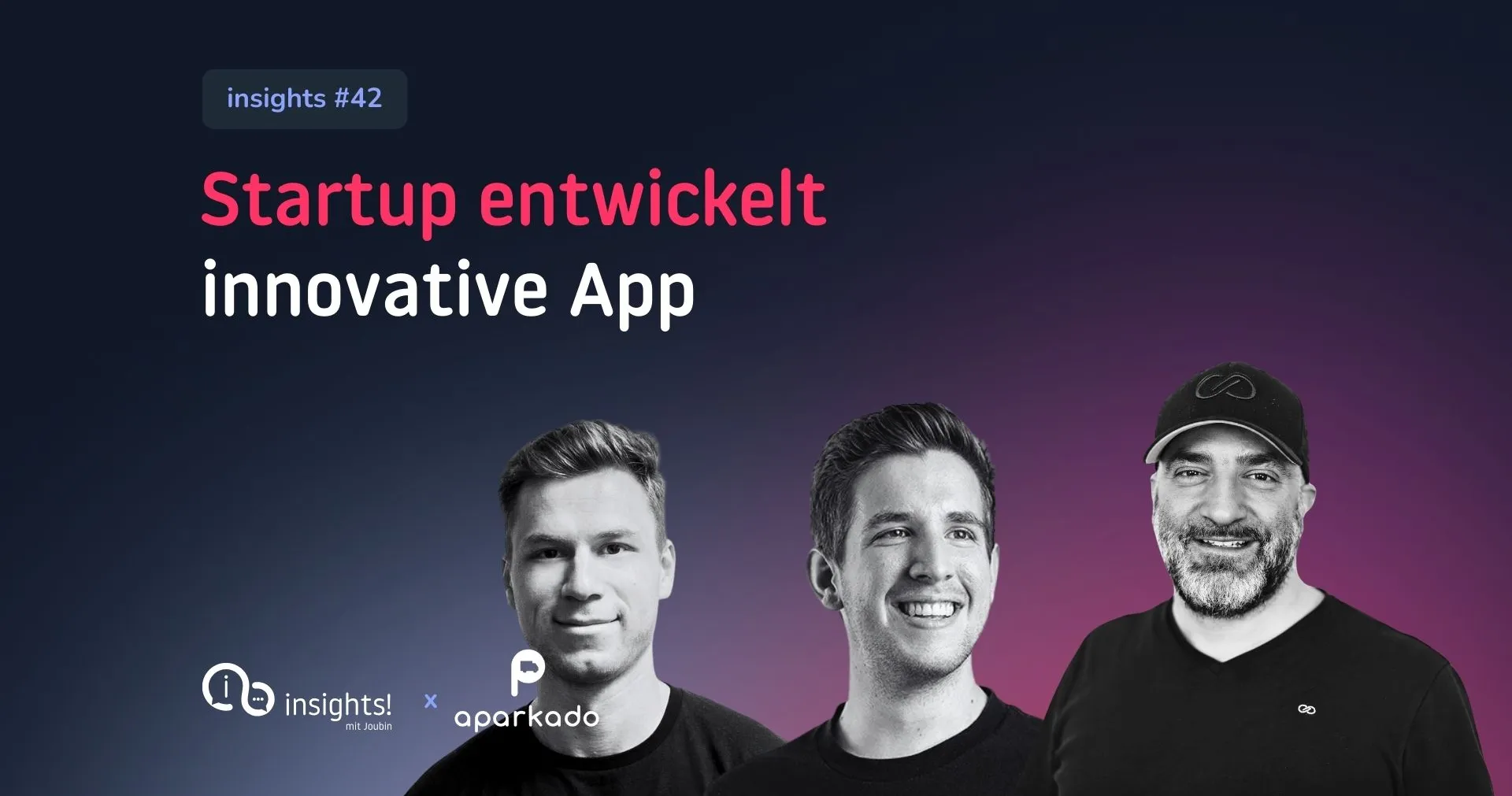
Aparkado, the startup that rocked the startup stage last year and emerged as the winner, faced a barrage of questions in an interview. In the new insights! episode, we talk to Philipp Henn and Roland Moussavi from Aparkado about how the business idea came about, their marketing strategy, learnings from recent years, and app development and features.
Finding free parking spaces has never been easier.
Aparkado campaigns for a better working life for truck drivers. Together with drivers and transport companies, they're building an intelligent parking guidance system, making it easier than ever to find free parking spaces.
With Aparkado, truck drivers can easily see nearby parking spaces via the app, avoiding a lengthy search. This makes planning less stressful, which in turn leads to a more relaxed journey along the route. At the same time, the community gets involved. Through ratings of parking areas and loading ramps, users can share their knowledge with truck drivers in real time.
Would you like to listen to the full episode?
Tune in now and find out more:
Please accept the corresponding cookies to view this embedded content.
Would you rather watch the episode? No problem!
Here you'll find a recording of the interview:
Please accept functional cookies to watch this video.
Would you rather read it?
Joubin Rahimi:
But we've got something prepared for you here, namely an interview with last year's winner. That's exciting, of course. You pitched here. The question is, what do you take away from pitches? What do you take away from the startup as well? What were the fuck-ups? What insights were really great? And in the pre-chat I can already say, it's a mistake to leave now. Because some of the insights are mega exciting. Also how Philipp and the team managed to gain insights, super instructive to work with, and what worked and what didn't. And in the end, I believe you have to have done all that yourself in order to properly set the whole thing up going forward. I'd like to welcome Philipp Henn and Roland Moussavi to the stage now, from Aparkado, who built something for a target group they actually didn't know at all and are based somewhere completely different. So a huge round of applause for Philipp and Roland. I'm looking forward to the next 20 minutes. 20 minutes where we can dive into the topics in peace. Maybe you could say a sentence or two about yourselves, who you are, where you're from. And then I'd like to ask what Aparkado was originally supposed to do.
Philipp Henn:
Yes, gladly. Hi everyone. My name's Philipp. I'm 29 years old and co-founder of Aparkado. I'm responsible for marketing and sales at our company.
Joubin Rahimi:
And you're mega polite, because you never corrected me even though I've always pronounced your name wrong.
Philipp Henn:
Yes, we've already heard the wildest versions of our name. So we let it slide a bit.
Roland Moussavi:
Quickly about me. I'm Ronald Mousavi, 26 years old, studied business administration as my background, and I'm now mainly responsible for product, finance and strategy at the company.
Joubin Rahimi:
How many mobility apps do you have on your phone?
Roland Moussavi:
Good question. What counts as mobility, then?
Joubin Rahimi:
You'll have to ask the colleague over there, who's 24 years old. He's got more than ten.
Roland Moussavi:
I think around five to ten at least too.
Joubin Rahimi:
Tell us two or three sentences about Aparkado, how you originally came up with the idea and what you offered.
Philipp Henn:
Originally, the idea came about over a beer. Roland and I met during our studies, and here in Cologne there's a pub on Zülpicher Straße, and that's where we simply talked about what we actually wanted to achieve later on. And yes, we tried out a lot of ideas, or rather went through them. And our idea ultimately arose from an observation in traffic. So we're not truck drivers ourselves, which is our main topic in the app. But we're just as much fellow travellers of all the vehicles on the motorways. We saw the full rest stops out there and simply asked ourselves: okay, how can it be that in such a digital world as we see it here, the rest stops are completely full of parked vehicles and truck drivers are forced to stop there without knowing how full the next rest stop actually is. And that was actually the initial spark to say: we want to develop something for that.
Joubin Rahimi:
And for that you first had to develop something too, right?
Philipp Henn:
Right, there's still that.
Joubin Rahimi:
And what did you develop? A little flag so you know a parking spot is full?
Roland Moussavi:
Spot on. I think our product lead can say something about that. In the very first step, we developed an app called Aparkado, which we then tested with around 80 testers from about seven countries, so directly multi-language. It was mainly about us showing parking spaces along a route. That meant a truck driver could simply enter their start and end point and find parking along the route accordingly. What we were missing there was the occupancy, the occupancy of the parking area. That means there are no digitised, or very few digitised, truck parking areas in Germany. And accordingly, the biggest challenge for us was finding out this occupancy on site, i.e. the actual utilisation of the parking area. Fortunately, we then found our investor, we can maybe say more about that later, and built up a team as a result. Together we started to recognise, analyse and predict this whole topic of on-site occupancy, and we're now at the point where the occupancy of parking areas is actually shown live in the app, or rather predicted. And there's the option for every user of our app to improve the live occupancy. That means if we predict that the parking area is empty, but the parking area isn't empty at all but extremely full, then the truck driver can improve this directly in the app, and all other truck drivers are notified. So the community also helps ensure that the parking problem is tackled and hopefully solved.
Joubin Rahimi:
Before we get into that. You've solved a problem, or you're offering a solution to a problem you're not actually affected by yourselves. You're not lorry drivers, you told me, you only observed it. How did you find out this was really a pain point? It could be a pain point for car drivers who say, I can't get onto the services, but not for lorry drivers, because they say: great, I'll just drive on to the next four stops, even if I run over time. How did you discover the problem? I think this angle is really fascinating.
Philipp Henn:
Exactly, once we'd decided that's what we wanted to develop a solution for, we obviously did some research and found a study. And the most important thing, since we're not drivers ourselves, is to talk to the drivers out there and get a closer understanding of the problem. So we went out and simply ran a survey, and we pushed that survey through influencer marketing. There's the programme "Trucker Babes". We just asked the influencer, spoke to her on the phone, whether she'd like to support our mission. And she did. Prime time, Sundays at 7pm. And within about two days we had 600 completed questionnaires back. A dream come true for any student who's ever written a bachelor's thesis. But that was really the step where we got a huge amount of input.
Joubin Rahimi:
And that's really important. And the point is, it sounds so easy. Now we've got loads of feedback. We asked an influencer. All "easy peasy". That's exactly why start-ups are so important. You did it. You asked the user. How often do you ask users in your company? How often do you actually get honest feedback back? And that's obviously something you were able to work with. And a figure of 600 responses is of course gigantic in that context. And that's certainly a huge learning to take away from it. Now, you asked them once, did you meet them again? Are there feedback loops, or how does that work? Or was it a shoot and run?
Philipp Henn:
Yes, so continuous feedback is of course important for us, so that we don't head in the wrong direction. After we'd asked and got the answers, we also went to a truck stop and had conversations there, along the lines of: not how many mobility apps do you have on your phone, but do you actually use apps in this area at all? And what can we learn from the others? And that's how we went about it, and beyond that we also set up an advisory board. That means, of course, we've built up advisors in the start-up and entrepreneurship space. But we also have a group of lorry drivers, currently eleven of them I believe, whom we ask on a daily basis, and they tell us, of course, what isn't working. That's the valuable feedback for us that lets us improve the app, and then ultimately look at exactly that and see what we can't do with the app but can do beyond it. Also in our communication out there. Everyone knows the parking space problem. But when you actually talk to people, notice the lorry next to you, it has completely different problems than you as a car driver — raising a bit of awareness for that.
Joubin Rahimi:
And now feedback loops. You build something in. Roland said you deployed on Sunday, so put something live. Do you always do it on Sundays?
Roland Moussavi:
No, actually I don't even know why we chose Sunday this time. I think so that we can fix the bugs again straight away on Monday. Every deployment always has bugs too. Every developer knows that. This was simply the 1.7 version. Sounds a bit random at first, but actually our goal is to make a bigger release again with the second version, bringing in new features again and so on. And for us this was a big step, because it was the first time we really actively put the topic of occupancy and occupancy forecasting front and centre. And for us it was a learning we had, especially last year, that we need to focus on certain topics. And that was our focus topic now, and accordingly our release day being on a Sunday was actually random.
Joubin Rahimi:
I'd actually guessed you'd say because less driving happens on Sundays. There's a driving ban then, at least in Germany. But you're also in six other countries.
Roland Moussavi:
Yes, it really was random. Especially on Sundays a lot of lorry drivers, particularly from the east, are parked up and still check the app anyway, and that's exactly why it wasn't a special day.
Joubin Rahimi:
So how do you manage the occupancy planning or the occupancy display? Or do you just roll the dice on expected feedback?
Roland Moussavi:
We've actually developed a method where, using big data and machine learning techniques, we analyse historical data, adapt it forward, and can forecast accordingly. At the moment it's mainly historical occupancy that we analyse and display accordingly in the app. And that, combined with the learnings we get from driver feedback, is a very, I'd say, powerful tool for giving an accurate picture of how full the car park currently is. And we're sometimes even surprised ourselves at how accurate the data is, and that's definitely cool to see.
Joubin Rahimi:
A bit like Google Maps, when I say I'm driving from here to Düsseldorf the day after tomorrow and it shows there'll be a traffic jam in the morning. And where?
Roland Moussavi:
Exactly. So a prediction. At what time will the car park be too full? At what time is the car park still empty? Currently we've only designed it for the current point in time. That means, if you go into the app now, you see different coloured markers in the app and can tell from the colour codes accordingly how full or empty the car park is. Or how optimal it is. And we're now expanding that step by step, so that you also get forecasts: if I arrive at the Frechen-Mundorf car park at 6pm tonight, how full will that truck stop be?
Joubin Rahimi:
Without going into the secrets now. That's certainly a core part of your IP, intellectual property, that you've generated there. And you're not just doing it in Germany, this display ultimately spans many countries at once.
Roland Moussavi:
Exactly, that was also our ambition, what we felt was missing from other solutions out there on the market, that we don't just show it once for a single optimal car park, but that we actually design the whole thing to be scalable. And accordingly there were many challenges along the way. That's also an insight we've only gained now after a very long time. For example, there's the topic of car park booking, that a lorry driver already books in the morning where he'll park in the evening — that's simply not feasible at all. And we realised that over time. We also spoke with many providers of parking booking systems, but came to the conclusion that isn't the ambition we have; instead we want to create a solution for the broad mass of lorry drivers. And with our current system we've definitely achieved that.
Joubin Rahimi:
One learning was exactly that, that the lorry driver said he doesn't even know where he'll ultimately end up, and so won't book accordingly. What else did you learn along the way?
Philipp Henn:
It's important to bring your team along too. Two of our team members are here and communicating with them matters. We started with the business model and simply noticed along the way: hey, that's not working. Then of course you start questioning your whole startup a bit, because if no money comes in going forward, how are you supposed to build it up? And the key learning is: transparency and communication, talking to your people and saying: hey, we found out something, it's not great, but how can we solve it? How can we solve it together? We involve everyone in that, regardless of department. Well, we don't really have departments, but we're split by topic. We don't have corporate structures within us. We don't need that at our size. I'd try to talk to people, gather ideas, stay open about it and bring them along.
Joubin Rahimi:
How big are you, then?
Philipp Henn:
So 15.
Joubin Rahimi:
Fair enough, though you have to reach that first. But if there are 15 of you, how many people were there for the deployment on Sunday?
Roland Moussavi:
Two.
Joubin Rahimi:
Sometimes you just have to. Often you're not alone in it, and the nearest thing is coming into the office Monday morning and straight away saying: oh, stressful, you'll need to work on team spirit.
Roland Moussavi:
Yes, we've definitely had other experiences too, where we worked right through the weekend together with Mariam. So there have been other experiences, but this deployment was well prepared and accordingly we gave ourselves plenty of time beforehand. We had no time pressure at that point any more, so we said: okay, let's just do it now, and it went smoothly.
Joubin Rahimi:
You won here last year. What would you recommend to those who pitched today as well? Some have already been running their startup for a few years, others are just in the founding phase, the first phase. But what would you say, what did you take away from the fair as well? And what did you take away from last year as a learning, something you'd like to pass on, or something you shouldn't do?
Philipp Henn:
I think Roland came off best, he unfortunately had to fight the final in Hamburg on his own. I was sitting at home and could only watch via livestream because I was ill. But generally, what we took away last year, or what we'd like to pass on to anyone in the founding phase or further along, is simply to focus on one topic. So many new impulses come in, daily, weekly, whatever you see on LinkedIn, new emails, new contacts here at the fair. But really focus on one thing, that one thing, and do it really well. And that was a learning for us too, that we said: hey, on the topic of parking, there's also the topic of refuelling, all the points of interest for a driver are interesting too, but that costs you a lot of time and you don't do anything properly. Or only half-heartedly. And we saw that costs a lot of time, builds up a lot of stress and pressure, because everything's supposed to be finished at once. We definitely noticed then, that's one topic, one thing. For us it's utilisation, that's where we see the biggest opportunity to achieve something, and that's what we went with.
Joubin Rahimi:
Now you said Roland should give feedback.
Roland Moussavi:
Yes, on the topic of the pitch. I think what really helped us was the topic itself. It's a topic everyone can grasp. Everyone knows or recognises the image of a lorry standing at the entrance or exit of a service station. And we made that a bit, I'd say, emotionally charged and communicated it in understandable language. And I think that worked pretty well, which is why the jury said at the end of the day that our topic was, I believe from an ESG perspective, the most important topic, or the topic closest to what they were looking for at the time, and accordingly they voted for us. But the other companies were definitely very, very strong too. From my point of view, any of the others could have won as well. At that point it was simply the right place and the right time for us to be there.
Joubin Rahimi:
Good that you bring it up. I think we saw some great pitches again today, and I believe you know each other too. One or two of you, I think.
Roland Moussavi:
Exactly, yes. J.H. H. I actually met him in Hamburg, on the train journey.
Joubin Rahimi:
Okay. Who do you think has a good chance today?
Philipp Henn:
Tricky. Well, of course. It's a mixed bag, but really tricky. There were so many diverse solutions for very different problems, all a bit around mobility and energy generation. I found sustainable energy generation really interesting, we deal so much with lorry drivers in logistics, so it was nice to broaden the horizon a little. And I think I'll be diplomatic about it. We wish everyone the best, that they make it, move forward and win.
Joubin Rahimi:
That was very diplomatic. Now Jonatan has basically sprinted to the front. Maybe we still have a microphone. Would you mind handing him the microphone? You have a question, Jonatan. Maybe someone else has another question too. Shall we bring that in?
Audience member:
Yes, thanks first of all for the exciting information. I think you've already half answered it, because my first thought was straight away: what about ratings for infrastructure, so how clean are the toilets? Are there good showers? But surely 1,000 people have already given you that feedback and that's probably not the focus.
Roland Moussavi:
Actually, we do have that in there too. From our point of view it was so self-evident that we didn't mention it separately. That's naturally the first step, actually maintaining and bringing in the metrics or the master data or, let's say, the standard data. And that of course also needs to be fed back regularly, you know how roadworks on the motorway keep appearing regularly and also get removed again quite quickly, well, not that quickly, but eventually, in some cases. And accordingly we have that in there too. That's the foundation. And utilisation is just the extra, the dynamic data that's now coming in, that's what we've newly brought in now.
Audience member:
So that's also an incentive for the car park providers to keep their car park in good condition, so that they attract lots of people who then book there, right?
Roland Moussavi:
Ideally, yes. On the other hand, there simply aren't any alternatives. And unfortunately, the people concerned know that too. Everyone knows the prices on the motorway, at the service stations. And that shows you they're in a pretty comfortable position and accordingly don't do much to change it.
Audience member:
Cool, thanks very much to you both.
Joubin Rahimi:
Does anyone else have a question, while we're in the Q&A round?
Audience member:
I'd be interested to know how you approach this from a marketing perspective, i.e. how you actually reach potential users, meaning the lorry drivers. So where are the touchpoints? Do you go directly to the service stations? Do you advertise there, or how does it work?
Philipp Henn:
Primarily online, actually. If we were to drive to every single service station, I think that would cost too much time, and then we'd have no time left for app development. But we did find social media channels work for us. The other solutions that also reach lorry drivers, for example other apps already used on the road in the truck, all go through the haulier, and nobody speaks directly to the drivers. So we said: okay, bingo, from a marketing perspective that's brilliant as a communication channel. That's why we speak directly to the drivers via social media and TikTok. We simply tried it out to see if it works for us, and did everything ourselves in true start-up fashion, and are slowly managing to get a bit of a hearing there too, as well as with the panel of advisors, having a direct channel via our WhatsApp group. And there, I'd say, we find open ears. Which is of course lovely for us, a sign of appreciation towards the drivers too, simply listening to them. And, as we've already said, none of us on our team is a lorry driver. But the fact that we, as outsiders, simply listen to them and develop something with their feedback, they find that very appreciative, which they often don't get in everyday life. And it's great communication, and it's fun to communicate in that direction too.
Joubin Rahimi:
Is there another question? Yes, then would you like to pass it on?
Audience member:
Thanks. Yes, definitely an exciting solution to a problem everyone knows. The question I'm asking myself is, how do you earn money, or where's the source of what comes in? You said you have an investor, but do you have to generate some kind of revenue? So where does it come from?
Joubin Rahimi:
Where does the money come from?
Roland Moussavi:
That's a very good question. Our investor is actually pretty relaxed about it. That means we're currently under relatively little pressure on that front. I think that's also a bit of what sets us apart a little from other companies at the same stage. To answer your question overall, there are endless ways to market or commercialise the whole thing long-term, or to generate revenue from it. As soon as you've got a group of people together on a platform, there are always countless possibilities. At the moment, though, we're actually focusing on, with the purpose we're creating with our app, bringing the, let's say, the added value, or the revenue stream, relatively close to the value we provide, and accordingly earning money with what we do, with the value we offer, and correspondingly asking the transport company to pay for it in the long run, because we're not just saving their driver stress, but also saving the transport company unnecessary detours, and accordingly we want a slice of the pie there too.
Joubin Rahimi:
Great. Does anyone else have a question on that? Who's the investor, whose name you haven't mentioned yet? Is that a secret?
Philipp Henn:
No, I think you can read it in the commercial register. But yes, it's Jens Tiermann, the founder of the company TimoCOMM. For us it was important to have someone on board who understands the problem we want to solve. And our investor still drives a lorry himself. As founder of TimoCOMM, which is the leading freight exchange in Europe, he's also very close to the subject. We have someone there who not only provides us with financial backing, but also with other resources, with a network, with know-how. Because of course we first had to learn a lot about what's important in logistics and what's less important, and what we should approach differently and what not.
Joubin Rahimi:
Great. So, thank you very much indeed. Let me have another look round to see if there's another question. You'll certainly still be around during the award ceremony and the Q&A rush too. If there are still questions, feel free to direct them to you both, to Philipp and Roland. I'd like to thank you sincerely for sharing these insights with us here. Really exciting. Amazing what you've built there, and for sharing the insights. That deserves a huge round of applause first of all.
Philipp Henn, Roland Moussavi:
Thanks. Thank you very much.
Got questions or feedback?
Then feel free to contact us directly.
- Joubin Rahimi
Managing Partnersynaigy
Show phone numberShow mobile numberShow email address
Subscribe to the blog now and never miss any news
✔️free ✔️weekly news ✔️expert knowledge
Please accept the corresponding cookies to view this embedded content.