

AI tools
How artificial intelligence sets new standards and revolutionises the digital world.
7 min read

Artificial intelligence – what it means for our industry and our customers
Experts agree: artificial intelligence (AI) is revolutionising the way we work, communicate and collaborate. By now, these technologies have become the engine of digital transformation. Whether industrial companies, banks and insurers or media houses – many deploy various AI-based language models that all share one thing: they can generate human-like text at incredible speed and interact with us in natural language. This lets companies respond even better to the needs of their users and customers – and in doing so strengthen their market position.

What is artificial intelligence?
If you ask the language model ChatGPT (default GPT-3.5) on 15 April 2024 at 13:32 what artificial intelligence is, you get this answer:
Artificial intelligence (AI) refers to technologies that enable computers to learn, recognise patterns in data and make human-like decisions. In marketing for mid-sized companies, AI can boost efficiency by recognising customer preferences, creating personalised campaigns and optimising the marketing strategy in a data-driven way.
And if you don't like the answer or don't understand an aspect, within seconds you get numerous further answer variants with different explanatory approaches, in this example with this prompt: What is artificial intelligence – explain it in 50 words to a marketing manager of a mid-sized company? This is exactly where the blessing and the curse lie at the same time: because on the one hand, AI-based language models deliver answers to anyone, without any particular prior or specialist knowledge, at breathtaking speed, they solve tasks and can create texts, images, logos, code and much more. On the other hand: the results are random every time and are generated from certain probabilities of word or pixel frequencies – meaning that entering the same question can produce different results, or be answered partly differently or even identically.
How AI influences collaboration with our customers
Artificial intelligence brings host of new ideas, near-endless sources of inspiration and research databases for alternative approaches or concepts – and it pushes us toward even better and sometimes faster results.
How we support our customers in dealing with AI
However, as long as language models don't reliably deliver true results, or produce partially contradictory statements with multiple prompting, it is and remains necessary for our experts to evaluate the results according to clear criteria, improve them and place them in the right context. Particularly in the field of products requiring explanation, both specialist knowledge and empathy with the target groups are needed, which an AI - at least at this point in time - cannot deliver.
Alongside opportunities described, use of AI also brings risks: data protection breaches, bias and discrimination, or misinterpretation of information. To minimise these risks, important to develop clear guidelines for AI use, use high-quality training data and monitor models carefully.
As a full-service digital agency, we've relied on the support of AI-based tools for years. The galloping trend of recent times reinforces our conviction to use these tools as a source of inspiration in strategy, an idea generator in creation and a sparring partner in technology.
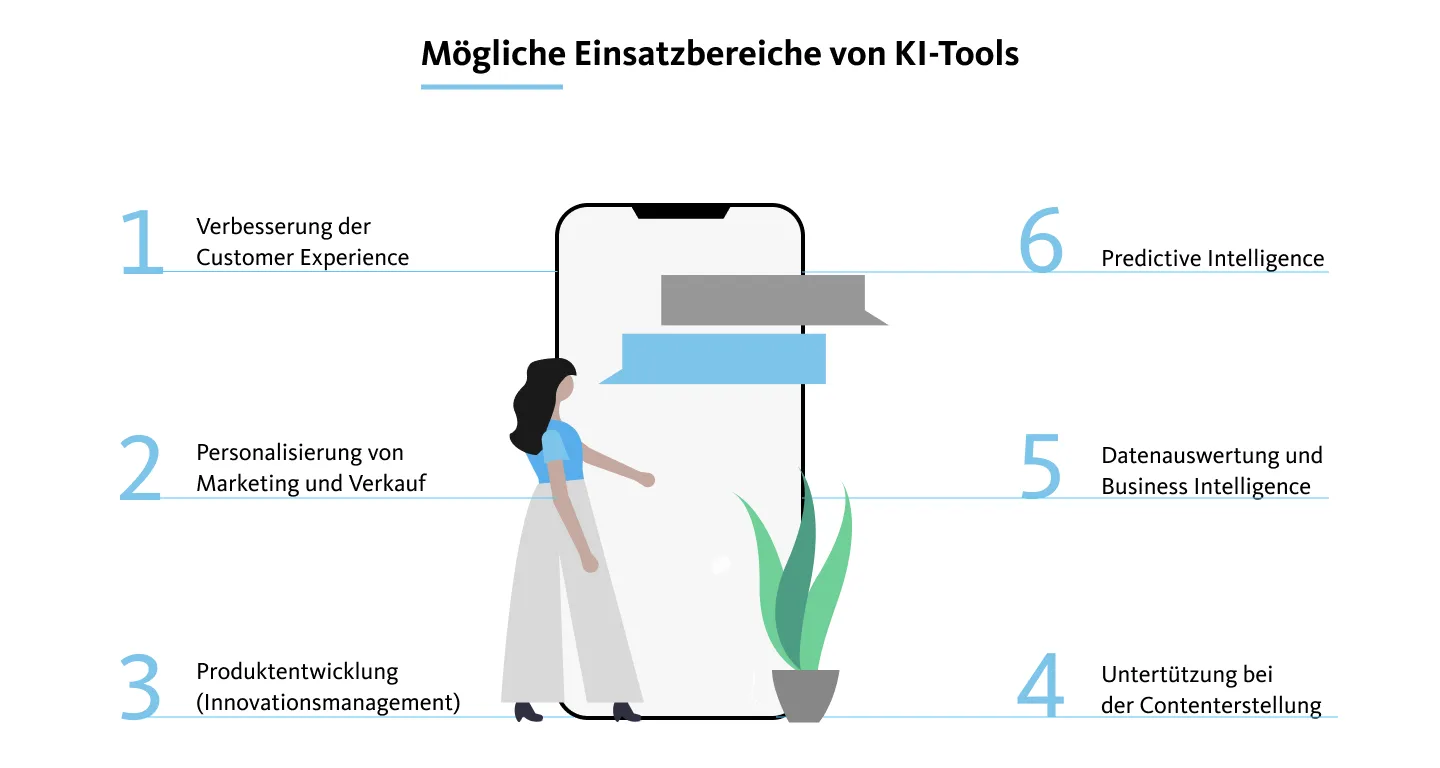
Possible use cases for AI tools
For our customers and for us, the use of artificial intelligence offers a wide range of opportunities – whether in customer experience or in optimising internal business processes of all kinds.
Improving the customer experience:
For example, chatbots and virtual assistants can handle customer enquiries round the clock, answer frequently asked questions and resolve simple issues. This relieves the customer service team and can improve the customer experience.
Personalisation and automation of marketing and sales:
AI can be used to analyse customer behaviour and provide personalised recommendations. This increases the relevance of marketing messages and improves the chances of successful sales. In addition, already established marketing automation processes can be optimised.
More about marketing automationProduct development (innovation management):
AI can support the design and development of new products or services by drawing on data analysis and user feedback to understand requirements and drive innovation.
Support with content creation
AI can help with research and the automated generation of content such as product descriptions, marketing copy, blog posts, etc. This can speed up the production process – but at the same time increases the quality assurance and editorial workload.
Data analysis and business intelligence:
AI can analyse large volumes of company data, recognise patterns and deliver insights that support strategic decisions. This ranges from market analysis to the optimisation of business processes.
Predictive Analytics:
Companies can use AI to make predictions about future trends, customer behaviour and business developments. This supports better planning and resource allocation.
But regardless of which area AI is used in, careful planning, training and monitoring are important. Because choosing the right AI technology or application depends on a company's specific goals and needs.


Jointly seizing the opportunities of artificial intelligence
Development in the AI market is disruptive. New tools, features and plugins based on or drawing from artificial intelligence emerge daily. That means: we must not only keep an eye on developments, but constantly test, try out and stay open to new developments. Because the strategically sound application of AI can make the difference between market leadership and mediocrity. To stay in tune with these changes, we regularly engage in open dialogue with AI experts, to exchange views on the latest developments, understand them and integrate them purposefully into our work.
For insights into our conversations with experts such as Samuel Tschepe (HPI) or Florian Dohmann (Birds on Mars) about the future of AI and its impact on our industry, read the following articles:
On the synergy of AI and design thinking with Samuel Tschepe & Marcus Völkel
With Florian Dohmann on the "Generation AI"
Our five tips for using AI:
Build expertise: encourage a fear-free approach to AI and the relevant tools, and enable playful access to them. Form dedicated AI expert groups across all departments and trades who exchange knowledge and leverage synergies. The challenge remains distributing this knowledge throughout the company.
Set clear goals: Clearly define which goals you want to achieve by using AI. Whether it's about automating processes, understanding customers better or optimising decision-making – clear goals help you stay focused and choose the right tool and setting.
High-quality data: AI models learn from data. Make sure your data is clean, relevant and extensive. A solid data foundation is crucial for the quality of the results.
Consider transparency: Consider ethical aspects early on. Monitor your AI systems for behaviour that could promote bias or discrimination. Strive for transparency, especially when AI systems make decisions that affect people.
Continuous learning: AI is a constantly evolving technology. Stay up to date on trends and progress. Be ready to adapt your strategies and update your models to keep pace with changing requirements.
Would you like to explore the possibilities and limits of AI technologies together with us?
Our AI experts help you redesign your processes, products and services – we support you on both strategic aspects and individual requirements of your business. Our offer: start with an AI workshop and discover with us the full potential of artificial intelligence for your corporate website or digital experience platform (DXP).
Request an AI workshop
Your contact person
- Marcus Völkel
Consultingsynaigy
Show phone numberShow email address