



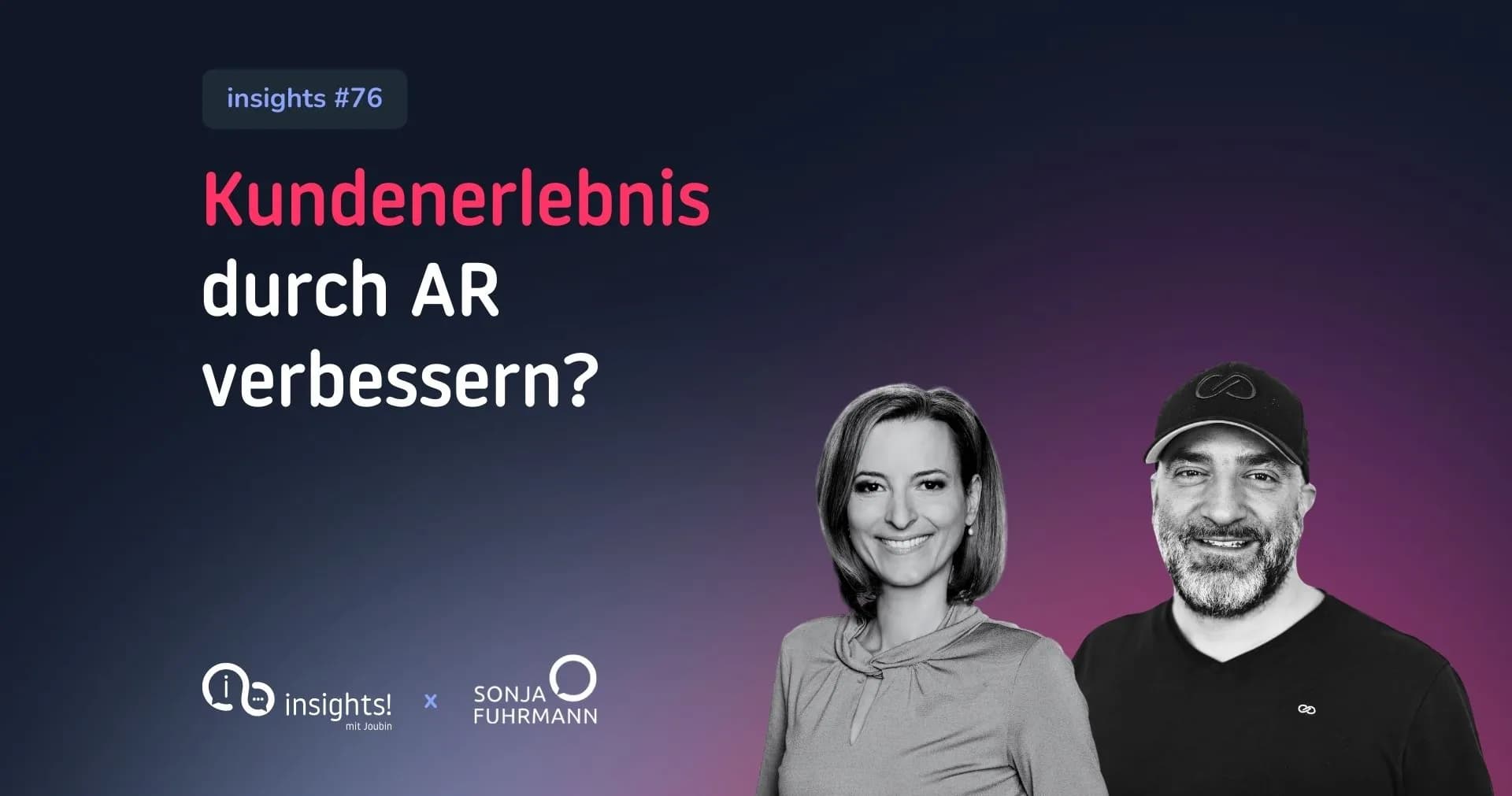
insights! #76: Using AR in E-Commerce to Improve the Customer Experience
Placing furniture virtually in your living room? Trying on outfits without leaving the house? With Augmented Reality, online shopping becomes an experience! This technology makes shopping increasingly interactive and exciting, resulting in less uncertainty and more fun while shopping!
 Joubin RahimiManaging Partner · synaigy
3 min. reading time
But if I say I simply want to become market leader, I want to increase my market share, I want to truly create what is actually opportune in this day and age, customer experiences, then you should look into AR.
In the new insights! episode with Sonja Fuhrmann, freelance journalist, that's exactly the topic! We shed light on the benefits and risks of this technology and explain why integrating AR into your online shop isn't a trend but the ultimate form of customer loyalty.
Augmented Reality is no longer just a buzzword from science-fiction films, but a reality that is improving our everyday lives and e-commerce in particular. It blurs the line between the tangible and the virtual, giving us a unique shopping experience.
Imagine being able to try on clothes and accessories virtually without leaving your comfortable sofa. Or better still, redesigning your home by placing virtual furniture in your living room to see how it looks in your space. That's exactly what AR makes possible - a seamless fusion of reality and digital worlds.
Not only that, companies are using AR to offer their customers an entirely new kind of service. Instead of tedious instruction manuals, there are now interactive tutorials showing you how to use a product. Virtual showrooms let us view products from every angle, as if we were actually holding them in our hands.
But of course there are also challenges. Physical interaction with products is something AR cannot yet fully replace. And then there are the costs and technical hurdles that need to be overcome in order to integrate AR into e-commerce. Legal aspects must also be taken into account.
Yet despite these challenges, AR is already fundamentally changing customer behaviour. Virtual try-ons make us feel more familiar with products, leading to faster purchasing decisions. This personalisation strengthens customer loyalty and encourages repeat purchases.
So what lies ahead for us in the future? An exciting mix of innovations and new possibilities. Virtual try-ons are becoming increasingly popular in the fashion and beauty industry, while virtual showrooms allow customers to experience products in their own environment. Advances in AR hardware, such as depth sensors and smart glasses, promise an even more immersive experience.
Integrating AR with virtual assistants such as Siri or Alexa makes the purchasing process even more seamless, while AR filters on social media platforms such as Snapchat and Instagram offer a creative way to promote products and engage customers. AR development is progressing rapidly. In future, we'll experience even more ways to use AR in e-commerce.
Augmented Reality, then, is not just a nice gimmick, but a transformative force in e-commerce that opens up new ways of shopping and experiencing. Who knows, perhaps your next purchase is already a virtual adventure just waiting to be discovered!
Would you like to listen to the full episode?
Here's the podcast of the interview:
Please accept the corresponding cookies to view this embedded content.
Would you rather watch the episode? No problem!
Here's a recording of the interview:
Please accept functional cookies to watch this video.
Would you rather read it?
Sonja Fuhrmann:
How does Augmented Reality influence the online purchasing process? Joubin, is the hype around Augmented Reality in e-commerce justified?
Joubin Rahimi:
Absolutely. And from my point of view, it's really only just getting started now. Perhaps to clarify the terminology: AR, VR. These are often mixed up in our conversations with prospects and customers.
Sonja Fuhrmann:
What's the difference?
Joubin Rahimi:
Well, with Augmented, I essentially have the physical world as I see it, and I overlay something onto it. I overlay something digital, whereas VR is above all an entire virtual reality. People often mean AR when they say that, but it's actually virtual reality. Today we're talking about AR. So I have the real image plus a digital one that I overlay onto it, and that's going to find its way into certain industries far, far more.
Sonja Fuhrmann:
How can AI create added value for the customer in the shopping experience?
Joubin Rahimi:
Really, whenever I have a product, or whenever I'm picturing something, and I then have to picture it in a room or in the digital world. So whenever you're wondering what the whole thing would look like. That could be clothing, one topic, but it's very commonly found in B2C when it comes to furniture, pictures and decorative elements. So what would a moss picture look like here? What would a particular type of moss picture look like here? Or should we use neon lettering instead? Those are the kinds of thoughts we're having right now. And of course AR helps you immediately there, if you say, I have the moss picture at this size, and how big does it need to be? And we don't calculate that ourselves. We're not the professionals there, but we have a feel for what's good. And that's where we're at right now, at the beginning. Amazon already does this for some products these days. If you go over it with your smartphone via the app, or IKEA too, for certain items they have, so that you can furnish your space pretty well.
Sonja Fuhrmann:
That was the customer perspective, absolutely understandable. How can companies benefit from using AR in the longer term?
Joubin Rahimi:
First of all, it's a cost factor.
Sonja Fuhrmann:
I can imagine that.
Joubin Rahimi:
And I want to nip that in the bud straight away: 'oh right, six months, a year'. Nope. And if you do it properly, it's a much longer case that you need to factor in. Let me draw a comparison: if you build a branch instead of renting one, and you depreciate it, the case is simply longer too. And here it's similar — I can't rent this, I have to build most of it myself. I need the data. So I need the raw material for the products, the data, so I can visualise it. That's the first case. And the second: even where software already exists, I have to combine it. Once I've combined it, the next question is: how do I interact with it again? But why should companies do this at all? I think it helps customers decide on something. And where would you rather buy? Where you get exactly that support, or where you don't? And yes, we're in Germany, so people will say: 'well, he'll get advice here and buy elsewhere'. Maybe. But the good ones manage to get the customer buying from them.
Sonja Fuhrmann:
Sounds like a big investment. Who is it worthwhile for?
Joubin Rahimi:
It's worthwhile for those in a niche, in really tough competition, for those genuinely being first movers, and of course for those who can scale. That's why the examples are Ikea and Amazon. It's no coincidence that these are exactly the companies investing in that market.
Sonja Fuhrmann:
Right, back to the consumer perspective: aren't we losing ourselves in a world of digital deception here?
Joubin Rahimi:
Quite so. It is, first of all, a visual deception we have there. But I think it helps you and saves time, because how often do you say to yourself beforehand: 'do I want to buy it or not?' And you didn't know, so you drove to a shop just to get an impression, only to realise: 'I still have no idea how this sofa would actually look at home.' And you spent a lot of time on that. So it's another reason not to drive to a branch — but that's not really the point; the point is making the customer experience and the customer's buying process as great as possible.
Sonja Fuhrmann:
How important do you think it is for companies to follow this trend? And what does that mean for companies that are hesitant right now?
Joubin Rahimi:
I think I'll give a general answer to that. We're very cautious in Germany. If I'm a business owner or a decision-maker and I only operate in the German market, with no strategy to grow beyond it, then I probably don't need this so urgently. But if I say I simply want to become market leader, I want to increase my market share, I really want to do what's opportune in this day and age — create customer experiences — then it's something you should get to grips with.
Sonja Fuhrmann:
Good closing words. Thank you very much, Joubin.
Joubin Rahimi:
Thank you, Sonja. Thank you very much for your interest. And we're really keen to hear your opinion and your input. Do drop it in the comments below — and that's a genuine, strong invitation, because the discussion around this and your experience can really enrich this piece.
Do you have questions or feedback?
Then feel free to contact us directly.
- Joubin Rahimi
Managing Partnersynaigy
Show phone numberShow mobile numberShow email address

Subscribe to the blog now and never miss any news
✔️free ✔️weekly news ✔️expert knowledge
Please accept the corresponding cookies to view this embedded content.