



Bare Metal meets Public Cloud: What is Bare Metal, Public Cloud or Metal Instances all about?
 Marc AchsnichTeam Lead · synaigy
7 min. reading time
With Bare Metal and Public Cloud, OVHcloud offers two distinct approaches to provisioning IT infrastructure, each with its own trade-offs. With Bare Metal, a customer rents a physical server and gets full control over the hardware, operating system, network configuration and applications running on it, so the IT infrastructure can be tailored entirely to individual requirements. These servers are reserved exclusively for one customer, with no one else sharing the resources in parallel.
Public Cloud, on the other hand, refers to a virtual infrastructure provided by OVHcloud. When using Public Cloud, you only pay for the resources actually consumed. OVHcloud manages and maintains the physical hardware, while the customer is responsible for configuring and managing the virtual machines, the operating system and the applications.
Advantages and disadvantages of Bare Metal:

Performance: Bare Metal generally offers higher performance than Public Cloud, as the hardware is dedicated and you get full control over the resources. It is possible to optimise the hardware configuration to meet the requirements of individual applications and to make full use of the hardware resources.
Flexibility: Bare Metal allows greater flexibility when configuring hardware, operating system and network configuration. Hardware configurations can be flexibly adapted to specific requirements, for example by using specialised processors or network devices. Bare Metal thus also gives you the freedom to use any operating system and adapt the network configuration.
Security: Bare Metal offers greater security, as you have full control over the physical hardware and therefore direct control over the security measures. It is possible to control the network and ensure that all security policies are adhered to.

Scalability: Bare Metal is less scalable than Public Cloud, as physical servers have limited resources and it is more difficult to add additional resources. If additional resources are needed, they must first be provided by OVHcloud. This process generally requires more time and money than with Public Cloud.
Range of services: OVH-specific cloud services such as Managed Kubernetes or AI Services cannot be run on Bare Metal instances. If, for example, Kubernetes is to be used, it must be installed and operated manually, for instance with Proxmox and Openstack.
Administrative effort: Bare Metal requires more administrative effort than Public Cloud, as additional effort is needed for configuring and managing the hardware and operating system. Security updates and patches must also be carried out independently.
Advantages and disadvantages of Public Cloud
Scalability: Public Cloud offers high scalability, as resources can be added or removed quickly and easily as needed. This happens in real time. This allows a quick response to changing requirements and flexible adaptation of the infrastructure.
Fast provisioning: Public Cloud enables rapid deployment of infrastructure. A new virtual machine or a new service can be provided within minutes, without having to wait for physical hardware. This allows a quick response to changing business requirements.
Range of services: Public Cloud offers a wide range of individual services that can simply be rented as needed. Examples include Managed Kubernetes, Block Storage or OVHcloud's AI Services.
Control: Public Cloud offers less control over the infrastructure, as it cannot be managed directly. Configuration takes place via OVHcloud's interfaces and tools.
Performance: Public Cloud performance can depend on various factors, including network latency, storage access and virtualised resources. This can make it difficult to achieve consistent performance and to measure and optimise performance precisely.
Limitations: Public Cloud may have limitations regarding the operating systems, programming languages and databases used. It must be ensured that the technologies used are supported. In some cases, the application and data must be adapted in order to run them in the cloud.
Best of Breed - the symbiosis of two worlds with Metal Instances
We were recently shown a new feature at OVHcloud Engage that really has something to it. OVHcloud has managed to connect two worlds with one feature, creating a new USP.
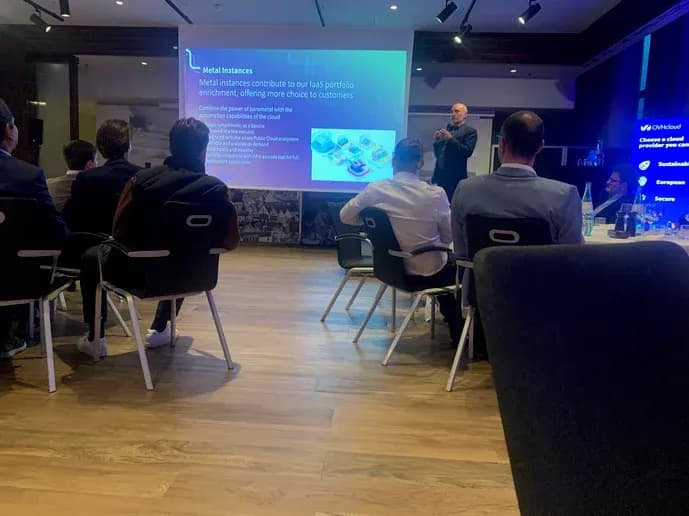
This is called "Metal Instances" and is particularly suited to workloads that require direct and exclusive access to compute, storage and network resources. It can be configured according to performance, licensing or individual settings of the lower software layers as needed. Resources are billed on an hourly or monthly basis and are provided together with the Bare Metal instances. Compatibility with the entire Public Cloud ecosystem is guaranteed, so commissioning can be automated using Infrastructure-as-Code tools.
This means that dedicated hardware for the customer can be operated within the Public Cloud, which can be scaled up and down quickly and easily.
Dedicated Server
A dedicated server offers numerous advantages, as Metal Instances access all of the server's available resources directly and can therefore offer strong performance and reliability. These dedicated resources are particularly suited to workloads that do not require a virtualised environment and require special computing or storage performance that may need to be allocated via its own hypervisor.
Automation and cloud combined
Thanks to compatibility with the Public Cloud ecosystem, Metal Instances can be provided on demand and are ready for use within just 3 minutes. Provisioning takes place via APIs and Infrastructure-as-Code tools, so that powerful instances can be operated on an industrial scale, including virtualised instances. In addition, the entire Public Cloud catalogue is available for advanced deployments. This means it represents a perfect addition to a powerful Kubernetes setup.
Cost transparency
Metal Instances offer an excellent price-performance ratio and can be used for an hour, a few days or a whole month as needed. OVHcloud offers a traffic flat rate, so no additional costs are incurred. Compared to pure Bare Metal, this enables a cost-efficient setup.
Comprehensive certification
OVHcloud also offers various certifications such as ISO/IEC 27001 and 27701. The Information Security Management System (ISMS) identifies risks and vulnerabilities and secures the ongoing operation of the cloud infrastructure and services. The Privacy Information Management System (PIMS) also ensures the security of personal data.
Price Comparison
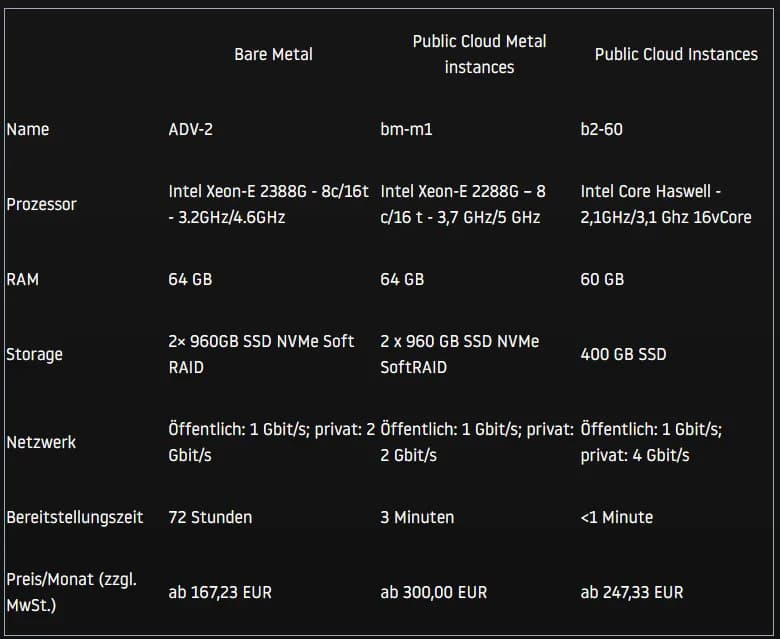
The MetalInstances are offered by OVHcloud in the following three size classes. These are compared below with equivalent systems from Bare Metal and Public Cloud instances:
Small
Medium
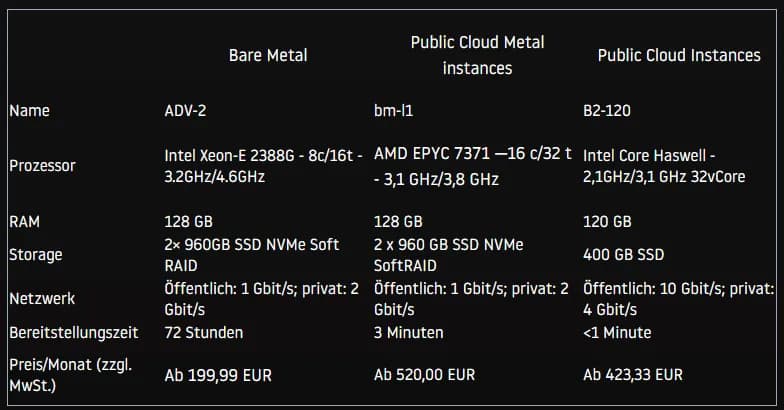
Large
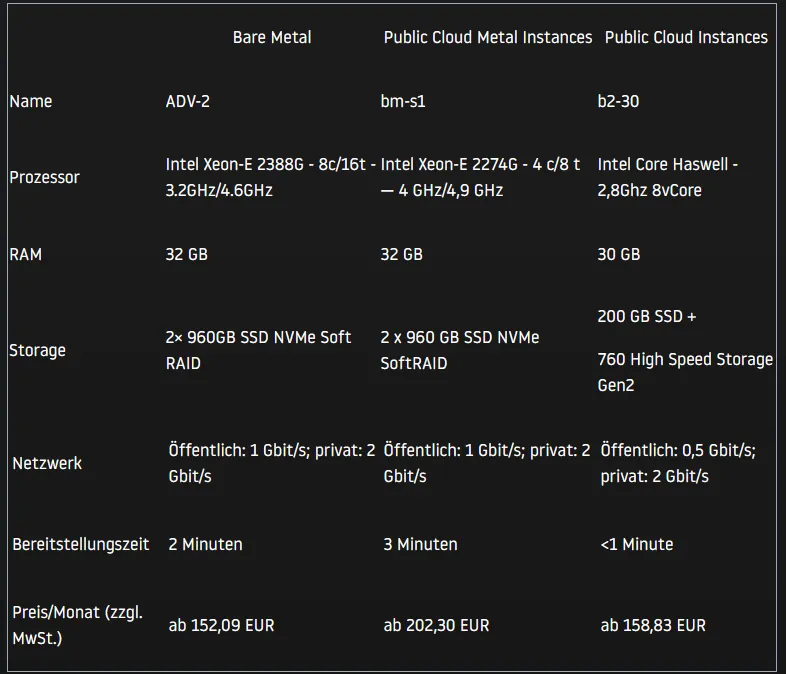
Advantages and Disadvantages of Metal Instances
Scalability: The Metal Instance offers high scalability. Resources can be flexibly added or removed. This allows a quick response to changing requirements and flexible adaptation of the infrastructure.
Performance: Metal Instances offer higher performance than Public Cloud instances, as the hardware is dedicated and you get full control over the resources. This means no other customer runs in parallel and full performance is available.
Provisioning: Metal Instances can be provisioned within 3 minutes. This enables near real-time provisioning.
Range of services: Metal Instances are compatible with Public Cloud services and thus offer a wide range of individual services. For example, they can be run as nodes in Managed Kubernetes or as database servers.
Direct access: There is no virtualisation of the servers, so you get direct access to the operating system.
When should you opt for Metal Instances?
With Metal Instances, best-of-breed of both worlds can be used for a small surcharge over conventional instances. This is particularly interesting for customers who do not want to share their hardware or who have particular performance requirements.
These include the following use cases:
Licence-compliant operation:
Some applications do not permit a virtualisation layer under their licence terms. Because Metal Instances are delivered without virtualisation, the application can be run on the server in the Public Cloud.
Automated operation:
A high-performance automated environment is required. Through the connection to OpenStack and API, hardware can be provisioned on demand via Terraform and Ansible.
Scalability of workloads:
Metal Instances can be provisioned within a few minutes. This means additional hardware can be made available at the right time when needed. This is particularly relevant for high-traffic websites with high user peaks, where time-limited high workloads arise that require corresponding computing power.
Conclusion
With Metal Instances, OVHcloud offers a new way to run applications with particular power and security in the Public Cloud. Before migrating to the Public Cloud, it should definitely be assessed whether it is worthwhile for a company to use Metal Instances. If you want to learn more about Metal Instances and further use cases, or need advice on cloud computing, we're happy to help you individually.
Have questions or feedback?
Then feel free to contact us directly.
- Marc Achsnich
Team Leadsynaigy
Show email address

Subscribe to our blog now and never miss any news
✔️free ✔️weekly news ✔️expert knowledge
Please accept the corresponding cookies to view this embedded content.