



#145 - Better be bold: what D2C brands can teach mid-sized companies about community building
How do you build a brand that turns customers into fans? Dennis Baltzer, founder of BETTER BE BOLD, the world's first bald-head care brand, talks with Joubin Rahimi about how community building, clever social media marketing and a genuine stance turn a niche into a million-euro business. From TikTok strategies to influencer challenges through to concrete tips for mid-sized companies: this article delivers hands-on insights for everyone who wants to take their digital marketing to the next level.
 Joubin RahimiManaging Partner · synaigy
7 min. read
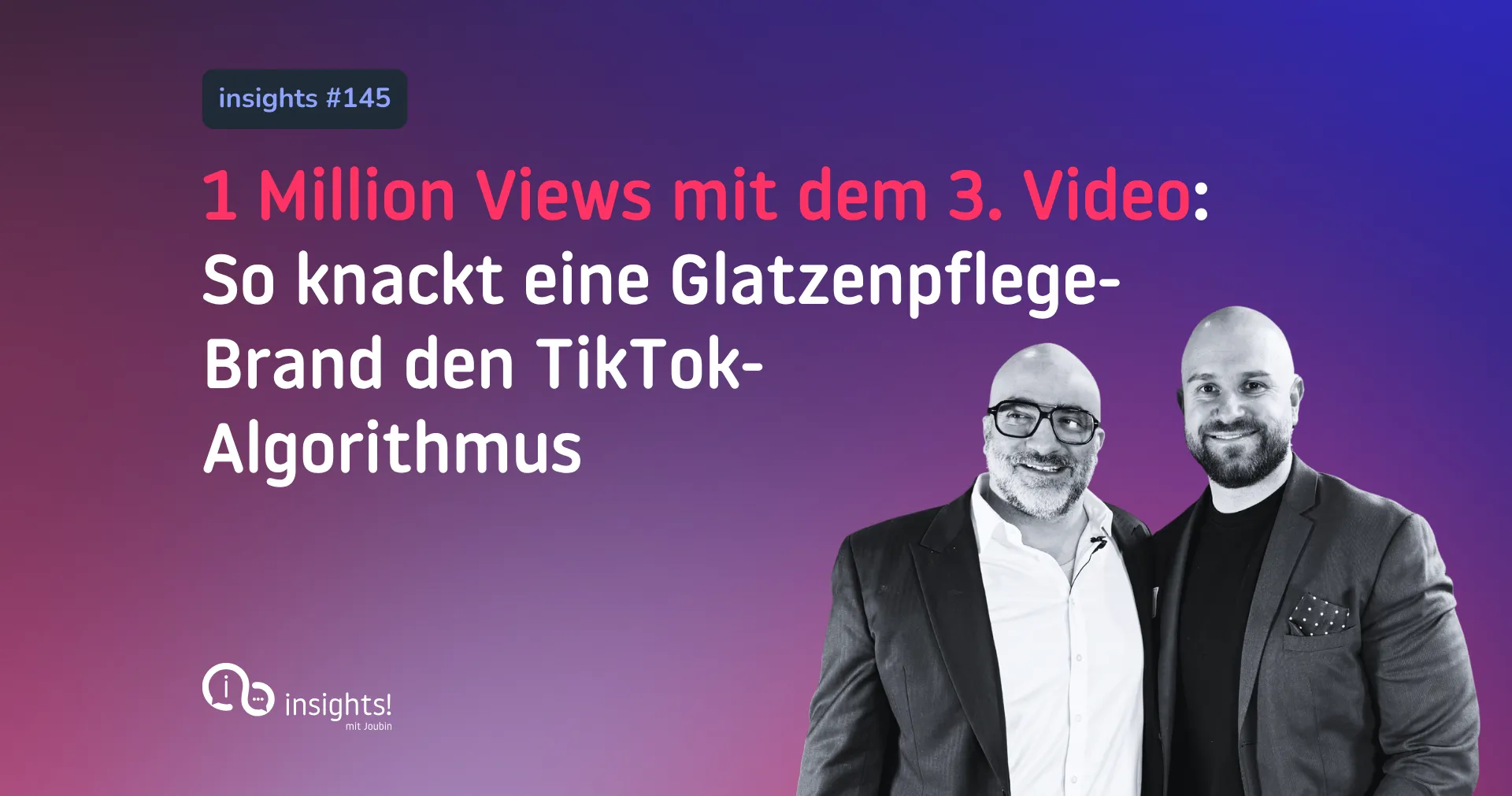
If you want to build a community for the long term, what doesn't work is talking about your products the whole time. You have to mix that in, because in the end you want to sell something, but you can't spend all day just explaining creams, that's simply boring. So we do street surveys, we go out and talk about the topic of baldness, about the emotional aspects too, about asking women, so every perspective you can take on the topic, simply to keep the entertainment value high.
From bald head to million-euro business: what companies can learn from BETTER BE BOLD about community, content and taking a stance
Eight out of ten men are affected by hereditary hair loss. And yet, until a few years ago, there wasn't a single care product aimed specifically at people with a bald head. Dennis Baltzer changed that. With BETTER BE BOLD he founded the world's first premium care brand for bald people, building a brand that not only D2C startups but also established B2B companies can learn a lot from.
In the insights! videocast, Joubin Rahimi talks with Dennis about his path from MyMüsli managing director to founder, about the power of an active community, and about why social media is still underestimated among mid-sized companies. What comes out of it is not a classic founder story, but a blueprint for modern marketing.
Hair loss, courage and a gap in the market: how BETTER BE BOLD came about
Before Dennis Baltzer became a bald-head care pioneer, he had hair himself. Quite a lot of it, in fact, as he points out with a wink during the conversation. After his studies he joined MyMüsli, worked his way up from sales rep to managing director and left the company in 2019 with a new idea in his head. Because in his mid-twenties, hereditary hair loss set in, and after four years of futile rescue attempts with various shampoos, he shaved it off. What came next is familiar to many bald people: dry scalp, irritation from regular shaving, heavy greasiness, sunburn on the head. Dennis looked for solutions and found none. So he developed them himself. Today the BETTER BE BOLD range includes mattifying bald-head creams, special sun protection and after-shave balm. And yes, the company was also a guest on Höhle der Löwen.
Your community isn't a target group, it's your product team
What sets BETTER BE BOLD apart from many other brands is how it deals with its own community. Dennis relies on radical involvement: 20 to 30 core members vote on product designs and formulations. Content ideas come directly from the community. The flop rate for new products? Extremely low.
The result speaks for itself: 25 percent of new customers come purely through recommendations, without incentives, without advertising pressure. Dennis calls them „bald missionaries“ – customers who actively recommend the brand because they identify with it. But that only works if a brand offers more than good products. People have to feel that the brand stands for something.
What you can take away from this:
Actively involve your customers in product development – it reduces risk and creates loyalty
Referral marketing only works if your brand connects emotionally
Community isn't a nice-to-have, it's a strategic competitive advantage
TikTok isn't a youth channel: why the 40+ target group has long been there
TikTok and a target group in their mid-forties? At first that sounds like a contradiction. Dennis and his team thought so too and started on the platform late. The strategy was simple: upload existing Instagram videos to TikTok and see what happens. The third video reached one million views. What's decisive is not the platform demographic, but the algorithm and your content. BETTER BE BOLD monitors the age distribution of its viewers weekly. 80 percent are over 25 years old – exactly the target group. Shaving videos with the electric shaver work particularly well, considerably better than pure skincare content. The key: entertainment instead of product explanation.
Influencer marketing in a niche: why the bald-head creator is missing
Influencer marketing sounds simple: find someone with reach who shows your product. In practice, though, it's more complicated for niche brands like BETTER BE BOLD. Because while there certainly are influencers with a bald head, they generally don't create bald-head content – they report on cars, sports or lifestyle. So their followers don't follow because of the hairstyle, but because of the topic. Dennis drew a smart conclusion from this: he became the face of the brand himself. As the founder, he delivers the more serious content, while the social media manager takes on the wilder, more entertaining part, including waxing videos and street surveys. This division of roles gives the brand depth and authenticity. For other companies that means: before you go looking for the perfect influencer, consider whether the faces aren't already sitting in your own team.
Social media in mid-sized companies: between intern and perfectionism
During the conversation, Dennis shared an observation that many entrepreneurs are likely to find uncomfortable: too many mid-sized companies treat social media as a checklist item that ranks somewhere between trainee project and obligatory chore. The consequence: half-hearted content, no strategy, no results.
On the other hand, though, Dennis also warns against overdoing it: if every video has to be approved by 36 committees all the way up to the management board, you lose all agility. Agencies go crazy, editors lose motivation, and in the end you post two videos a week instead of daily. Social media needs cadence, clear no-gos and the freedom to try things out.
The most important principles at a glance:
Invest in competent people, not in cheap labour
Define no-gos (no swearing, no political statements) and give freedom within that framework
Accept that not every post has to be perfect
Be open to suggestions from your team and your agency
Rethinking the customer journey: when the buyer isn't the user
A fascinating detail from the conversation: 40 percent of buyers at BETTER BE BOLD are women who buy the products for their partners. That raises exciting questions for marketing as a whole: Joubin Rahimi himself was given the products as a gift by his wife, used them, liked them, but didn't reorder. A classic gap between buyer and user.
Dennis takes this feedback seriously and wants to examine whether female email addresses should be addressed differently in marketing than male ones. Because the woman is buying for someone else, and that calls for a different tone and different triggers for repeat purchases. For every e-commerce company this is a relevant line of thought: who really buys your product? And who uses it? Are your marketing measures geared to both?
Taking a stance: why a bald head doesn't mean far-right
One of the most honest moments in the conversation: both Dennis and Joubin speak openly about how bald people are perceived in everyday life. The fear of being classified as far-right or as a hooligan played a role for both of them in the decision to go bald. In 2025, a man still has to worry about whether his hairstyle will be politically misinterpreted. BETTER BE BOLD tackles this head-on: with a campaign in Berlin in which 50 bald-head tattoos were given away, the brand takes a stand against prejudice. That's not just clever marketing, it's a genuine stance. And that is exactly what separates brands that last from brands that are interchangeable. If, as a company, you stand for something beyond your product, you win your customers' hearts.
D2C learnings for B2B companies
During the conversation, Joubin makes an exciting transfer: community building doesn't just work for hip D2C brands, it works in B2B too. Hilti has long had its own community, even if it looks different. On TikTok, construction site videos go viral, and when a tradesperson says 'awesome stuff, that drill', that's the strongest advertising you can get.
Dennis agrees and emphasises: content and community aren't exclusive to consumer goods brands. In B2B the route may go via a couple of detours and measurability is harder, but the principle stays the same: if you manage to get people to identify emotionally with your brand, you have a competitive advantage that no price war can copy.
Would you like to listen to the full episode?
Here you'll find the podcast of the interview:
Please accept the corresponding cookies to view this embedded content.
Would you rather watch the episode? No problem!
Here you'll find a recording of the interview:
Please accept functional cookies to watch this video.
Would you rather read?
Joubin Rahimi
Fantastic that you're joining us again for a new episode of insights! My name is Joubin, Joubin Rahimi, and today I'm here with Dennis Baltzer. Hi, Dennis.
Dennis Baltzer
Hi, great to be here. Thank you.
Joubin Rahimi
Absolutely my pleasure. So tell us two or three sentences about yourself and then I'll have to jump in right away.
Dennis Baltzer
Gladly, gladly, gladly. I'm Dennis Baltzer, 38 years young, married with two kids, from beautiful Iserlohn. And five years ago – and I was really pleased about your hairstyle just now when I got to see it under the cap – I founded Better be Bold, the world's first bald-head care brand, and we're now in our fifth year and I enjoy it every day.
Joubin Rahimi
How did you come up with it? What did you do before? How did you come up with it?
Dennis Baltzer
Before that, I had hair, unimaginable. And I sold muesli, so MyMüsli is probably familiar to a lot of people. I was one of the earlier employees there and started in sales after my studies and then developed a bit along with the company. I was managing director there for the last two years, then left in 2019 because I got an idea – and specifically, before I got the idea, I got hair loss. Eight out of ten men are affected, hereditary. My dad didn't have all that much either.
Joubin Rahimi
How old were you when it started?
Dennis Baltzer
That was around the time with my former best friend, I was in my mid-twenties, when I noticed it was getting a bit thinner and sparser. And then it took about four years where I tried to save what could be saved with shampoos. And we all know those ads – in vain, as you can see today. Then I shaved it off and saw a bit that the scalp, when the hair is missing and the protection is missing, does need special care, or at first brings a few little problems. And then I thought: if I have this problem, then maybe a few others do too. And that's how the idea for Better be bold came about – developing special products that help keep your bald head in shape, protect it and keep it healthy.
Joubin Rahimi
We have a similar story, because I don't have any hair either. You can see up here, here I had a real bush, empty behind it. Oh, you have – then I've got a ring of hair at most, looks awful, but I held on to it for a long time too. Now here's an anecdote, and the funny thing was: I was about 27, 28, a consultant, at a big retail group, at Metro I was a consultant. I was employed at IBM, wore one of those double-breasted suits, weighed a bit more too. I was in my late twenties and that was the time when I was also trying to find the right woman for life. Only much older women ever approached me,
Dennis Baltzer
When you had a bald head or with hair loss.
Joubin Rahimi
With hair loss, funnily enough, because I simply had this thinning hair and then had daddy vibes. Incredible. And the project manager – on the last day I offered to switch to first-name terms. She said finally, finally, finally. Why finally? To me she was in her mid to late thirties. She said: you're much older than me.
Dennis Baltzer
Oh I see, she was waiting for you to offer first names, because I
Joubin Rahimi
Am the older one – and then moved from Düsseldorf to Cologne, shaved it off, met my wife a bit later, and I would never have approached her, or rather we're still arguing about who approached whom. You'd never have dated me if you'd had such thinning hair,
Dennis Baltzer
But was it easy for you to shave it off or did you struggle a bit?
Joubin Rahimi
Well, I struggled for a long time, but actually it wasn't that difficult. I did make a real mistake, though. I went to the hairdresser, who had no idea what to do. I want a bald head now.
Dennis Baltzer
And above all, at the till there's the question: this hairstyle isn't even on my price list. So what do I charge you for it?
Joubin Rahimi
And then it was like you said, you had it everywhere – psoriasis, or the skin was completely greasy. Exactly, and that took a while.
Dennis Baltzer
Yes, but it's great that you feel comfortable. I mean, that's the main thing, and I always think it's a great message when you go out there and look at examples like you and me, who somehow made that journey as well, and which also shows a bit that it's a topic that occupies men at that age in particular, and what a liberating step it can be to say: I'm shaving it off and, in the best case, I'll even feel good about it, or it half-way suits me. I always think that. Give courage to the men out there who might be walking around with the hairstyle you had at 27.
Joubin Rahimi
The exciting thing now is – we can also touch on the product briefly. When you launched, my wife gave it to me for my birthday.
Joubin Rahimi
Brilliant. I tried it too.
Dennis Baltzer
Yes, brilliant.
Joubin Rahimi
But I stopped, and we can come back to reactivating users in a moment.
Dennis Baltzer
Let's do that.
Joubin Rahimi
But you can see it too. With you it's much – it doesn't shine, with me it shines a lot more.
Dennis Baltzer
Yes, although I do think there are many roads that lead to Rome, that may well be, but it all looks great on you.
Joubin Rahimi
But it was quite funny, because for a while I always had make-up on before recordings.
Dennis Baltzer
Oh.
Joubin Rahimi
No way.
Dennis Baltzer
It does work, but you just don't want to walk around with it all day or go to that effort early in the morning
Joubin Rahimi
Then the caps. I'm not a pro at it, but you learn it.
Dennis Baltzer
Our biggest learning is always – our typical customer is male, often mid-thirties, so the average customer is in his mid-forties, and you notice again and again that men want it to be easy. When they have to spend hours in the morning with a brush and powder and so on, for many that's simply a bit too feminine and too much effort, and that's why – we notice it again and again with products – the products that work are the ones that have an immediate effect and are simple. I always like that
Joubin Rahimi
I have to say, what did work – I used it right to the end, but I didn't buy it and then I didn't reorder it directly either, because my wife thought – well, I don't look at myself in the mirror all the time, she sees me more than I see myself. But she didn't reorder it for me directly either. So how do you deal with that? Because that's surely – we're surely not an isolated case, right?
Dennis Baltzer
Well, that's a classic customer journey issue. That means the buyer – very often the buyer is the wife or the mate, so not the user himself. You're the user, the buyer was someone else, and presumably what we have to do now, after this feedback – I'd take this topic away and discuss it with our email agency and say, please have another look at it. We can separate female target groups from male ones in email marketing, and I'd now simply go and check: do the female email addresses get the same emails as the male ones? So maybe we need to find a different approach in the wording, because we have to be aware that they don't use it themselves – instead they should perhaps buy it for their husband again, or forward the email to the husband so that he buys it himself. So that would be another learning I'd take away from this: do the women get the right kind of message from us too? For that alone it was already worth being here today.
Joubin Rahimi
There's also some underwear online retailer, mainly for men actually, who then started bringing out women's pants as well, and you could say I'll give my wife or girlfriend the pants too, but you have to provide the email address and the delivery address. Did that and then targeted
Dennis Baltzer
We do have your wife's email address, otherwise she couldn't have bought it – not yours. Exactly, and now the question is really whether we need yours, or whether we have to engage your wife better.
Joubin Rahimi
Exactly, or some kind of incentive. Okay, we're already in solution space.
Dennis Baltzer
We'll find a solution.
Joubin Rahimi
You're here at the ECC Forum and you also talk about social media, or you mainly do. Now TikTok is being scaled back more and more in America. How do you see it here in the German market? So is it a youth thing and not a problem, or what's your initial assessment of using TikTok?
Dennis Baltzer
Well, we also started with TikTok late, or later. Let's say Facebook, Insta, we did all of it. YouTube and TikTok came relatively late, because there was always a bit of the view that – as we just discussed – our average target customer is male, mid-forties, and we didn't really believe he'd be on TikTok. And then we said, come on, the barrier is relatively low, let's just take the best videos from Insta, upload them and see what happens. And then somehow the third video had a million views, and we saw, okay, the algorithm is really something – a million views on Insta is a bit harder. And then we got into it. These days, when we run TikTok, we have a kind of weekly KPI overview, and in the TikTok insights you can see – well, we simply said, what's the share of viewers between 18 and 24, and that share always has to be very low for us, because they shouldn't be watching our videos, because, I don't know, in the end they don't buy it – and our share is somewhere around 80 per cent. That means we see, A, we seem to be making the right content, which the algorithm recognises as such and also serves to the 25+ target group, and we see from the tracking and from the ads that it converts. So it's a topic where we always say we look at it, but always with a clear goal – asking, is the content right, do we have to adapt the content for the platform, are we reaching the right people, and in the end the ROAS, the return on investment, simply works out for what we invest, whether in time or money.
Joubin Rahimi
You said you were surprised that the older gentlemen are on TikTok after all. Can you say which social strata or context that is, or is it mixed?
Dennis Baltzer
Social context, I don't really know. But at the end of the day TikTok is also simply an enormous amount of entertainment and you find all sorts of things there. So, funnily enough, we've noticed that since we've been using the electric shaver and showing shaving videos, those work better than, let's say, skincare stories. That's what we've taken from it. To be honest, that's where I have to go. So we simply noticed that this type of video works, so we do a lot of it, and in the end we didn't question it any more deeply, but
Joubin Rahimi
It probably doesn't matter either, does it? Almost anyone can afford the product.
Dennis Baltzer
Yes, exactly. So we're not in a – we're in a premium segment where you'd say this isn't a Temu price or anything, but somewhere in the range – our products are between 25 and 100 euros, depending on the product and set, where you'd say that no matter how you're set up, if you really want it, it's affordable.
Joubin Rahimi
Do you work with influencers as well?
Dennis Baltzer
It's not our core topic right now, but we do it too. The challenge for us is always a bit of an issue. It's easy to find influencers who have a bald head, but the optimal case is always that the person has a bald head and makes bald-head content. And usually our issue is that the creator himself has a bald head but makes car content, where you'd say – that means the followers don't follow him because he has such a nice bald head, but because he presents cars in a cool way. And that's always a bit of a challenge for us, where in the end you ask: why do they follow the creator, and the fact that he has that hairstyle alone isn't enough. But cars, for example – we've since found out that we do have an influencer in the e-mobility space, where we also look at the insights: how old are their customers? And the only thing we can do is check whether the topic is somehow male, whether the age group fits. And then we can at least narrow down the wastage a bit, but the bald-head influencer as such – I had to become that myself, because we didn't find one.
Joubin Rahimi
It probably has to be more beauty-oriented, right?
Dennis Baltzer
Yes, or simply bald-head-related. Because we also do a huge amount of content about the topic of baldness in general. What is it like to have a bald head, what is it like to date with a bald head? We've even run experiments with profiles, saying: with thinning hair, with a bald head, two Tinder profiles, and we look at what happens with the matches. Thinning hair is rubbish, is rubbish – full or not at all, full or not at all, or a hair transplant, but thinning hair is empirically proven to be rubbish,
Joubin Rahimi
I found that out too.
Dennis Baltzer
And there we simply test a huge amount and do – and I think it's the same with content of that kind: if you want to build a community for the long term, what doesn't work is talking about your products the whole time; you have to mix that in, because in the end you want to sell something, but you can't spend all day just explaining creams, that's simply boring. So we do street surveys, we go out and talk about the topic of baldness, about the emotional aspects too, about asking women, so every perspective you can take on the topic, simply to keep the entertainment value high.
Joubin Rahimi
That's similar to MyMüsli, isn't it? You went out with MyMüsli too, but it was also about the topic of healthy eating. Exactly, high-quality products.
Dennis Baltzer
Exactly, so breakfast and nutrition in general as well. How important, let's say, a good meal is for starting the day and so on. So content there – at least today the topic is different, I think. But if you rewind, MyMüsli was founded in 2007, and back then it was still – if we think back. Back then McDonald's was still at its all-time high and „Geiz ist geil“ was everywhere. So it was a different time and you really still had to educate people in the area of healthy eating. Today it's all a bit – I think the knowledge is different, people inform themselves differently. There's something like Nutri-Score and so on, none of that existed in 2007. That means people wolfed down white bread and wondered why they were getting fat. That was the time back then.
Joubin Rahimi
The community you mentioned. How important is community building, and what is your community, or how would you describe the community?
Dennis Baltzer
Well, it's always a bit difficult, because sometimes it isn't measurable either. I think at the end of the day, if the topic of brand matters to you – community is simply, well, of course we use the community a great deal for: we develop products with them. That means I do think we now manage to keep the flop rate for products, or for new products, relatively low, because we say we don't do it behind closed doors – instead we have a hard core of 20 to 30 people, and we really give product designs to our community and let them vote, and in the end they make the product with us. And there are an enormous number of ways to involve people in the process, ask them what they want and get a lot of input. We develop content ideas with the people themselves too, because in the end I'm not doing it just for me – I don't know – but for the people, and, as I said, also very much for product development, for the website, for whatever. So we're always very, very open there and say we do it together with the people, and we also see it in the repeat purchase rates, for example. We run customer surveys very regularly and we have a referral rate. So new customers who come purely through recommendations: for us that's 25 per cent. That only works if you connect emotionally somehow and people say – you have these little bald missionaries out there who say, my neighbour has a bald head too, I have to tell him he needs Better be Bold. In my opinion you only manage that if people don't just say it's a good product, but if people say: what they're doing is really great, that's a great brand, and the way they play the topic and stand up for us bald people, and this topic of the image of bald heads. So this weekend we rented a tattoo studio in Berlin with four tattoo artists and gave away 50 bald-head tattoos and took a stand against the far right and showed that a bald head isn't far-right and can be taken out of that grubby corner a bit. And whenever we do things like that, we always notice that people are really very grateful, because in the end a great many of them have the personal experience of saying: sometimes I do get funny looks.
Joubin Rahimi
That's true, isn't it?
Dennis Baltzer
Yes, it is.
Joubin Rahimi
So if I go out the door in a hoodie – not in a suit, but in a hoodie, black ideally – and there's someone there with a considerably darker skin colour than mine, he looks at me twice, funnily enough.
Dennis Baltzer
That's how it is. And to be quite honest, that was – I don't know how it was for you, but it played a role in my decision to go bald. I really was worried. It's actually sad that in the year 2000 – when was it, 2020 – that in 2020 you still have to worry about whether, hopefully, I won't be perceived as far-right, or how could that, or could I – I do a bit of sport too, could I somehow come across like a hooligan or something. Those were things that worried me, because I didn't want to come across that way, because that's not what I am.
Joubin Rahimi
I hadn't thought about that at all. But it was funny – friends and family were there at a birthday party and I was the only one. I don't feel like a foreigner.
Dennis Baltzer
What roots do you have?
Joubin Rahimi
My father comes from Iran, my mother is German, my father was even trained by the German navy. So it was before the revolution, all quite funny, but pretty German. But I am one. I just don't look one hundred per cent German, but I was once at a party and then there was a remark – I already had a bald head by then – „so where's the sleeper agent?“, that sort of thing. But I'm there, and very much in the style of Hans Sarpei, I always take it all with humour. It's me, I'm well disguised too and you've got a rubbish haircut, and it broke the ice. But it is pretty striking, too. So you're put in a drawer immediately, less
Dennis Baltzer
I think it's still always a bit a question of how you come across, and whether you have a friendly face, and how you dress and so on.
Joubin Rahimi
But I still think – you made a joke. I can do that too.
Dennis Baltzer
Exactly, but it's still in a great many people's heads. We notice that again and again when we talk to the community. We also make videos about it where we address the topic of prejudice, and it's still an issue that occupies many people and that they're afraid of.
Joubin Rahimi
Okay, so you give something back to the community as well. That's exciting too. Not just: we have the community in order to sell something, but really a community to shed light on the topic.
Dennis Baltzer
Absolutely, completely.
Joubin Rahimi
And by the way, I'm drawing this out because I think we have a lot of B2B customers, because B2B customers have this community topic too. Take Hilti, Hilti as an example. And the funny thing is, there are all these Insta and TikTok Hilti videos where the Hilti driver pushes the new 911 out of the way on the autobahn and so on. Because they're always heading off to the building site or to a customer, always in the left-hand lane.
Dennis Baltzer
Yes, yes, totally.
Joubin Rahimi
There's a whole narrative around it too.
Dennis Baltzer
Yes, I think so too. So I also think content isn't necessarily – it isn't reserved for D2C brands somehow, at the end of the day it's for everyone. I'd describe us more as a D2C brand, because somehow 95 percent of our revenue is direct to customer. But for us, building a community makes it easier, because we can measure more easily what it delivers. For a B2B brand it goes via a couple of detours. But nevertheless, I think if you manage that as Hilti – that every tradesperson who uses the Hilti drill somehow says, wow, this is great – it's brilliant if you manage to get that into people's heads, so that people look at the tools and say, awesome stuff.
Joubin Rahimi
I think that plays a huge role. That's why I find it completely portable to the B2B model too, or Caterpillar for example. They do have certain brands.
Dennis Baltzer
Construction site videos go viral on TikTok anyway. I'm a big fan of these – there are these Polish construction workers, filmed really well with drone shots and things like that. Very, very humorous too, playing with prejudices. I sometimes really laugh my head off and it's very, very, very good.
Joubin Rahimi
You're always in your own bubble there. I mostly see old cars,
Dennis Baltzer
I'm hopeless with my hands and I get construction site videos. I don't know what that's supposed to tell me. Maybe I should learn it, the universe.
Joubin Rahimi
What would you recommend to a B2B brand, a wholesaler or a brand that says okay, I want to build up this community topic too? Two or three tips you'd give a fellow managing director?
Dennis Baltzer
I think with a lot of things it's simply – I think sometimes it's about not overthinking things to death. Because that's sometimes an issue, especially among mid-sized companies, that you then – well, I think tip number A is: don't put the next best intern on it. It really has to be a good intern, because that's what I often see at B2B mid-sized companies. Social media or community is somehow a point on the checklist where it says we have to serve that somehow. That means you look around for which trainee you can find who has two hours a week to spare and put them on the topic, and then they don't do it either. They can't learn – what do you expect – and maybe they don't do it brilliantly either, but not because they can't do better; it's about taking the topic seriously. And you can make a trainee project out of it, but then perhaps look for a good agency after all, or someone in-house who really understands it. So I think if you do it, then do it properly and right. That's the thing, I think. And sometimes also not overthinking things to death. So on the one hand it's maybe about not being too casual and simply letting the trainee do it with no concept, but on the other hand not going too far to the other extreme and overthinking everything to death. And every video – in the end you also have to say quite clearly that if you do social, you need a certain cadence. There's no point posting two videos a week, you really have to put something out every day ideally. And that just doesn't work if every video first has to be approved by 36 committees up to the management board. Every agency goes crazy, every editor loses it and doesn't feel like working with you any more and in the end only does it because you maybe pay well. So a bit of agility and being open sometimes and trying things out. And I think this tension between taking the topic seriously but not too seriously, finding the middle ground somewhere: come on, let's just do something.
Joubin Rahimi
That's surely very difficult for one or two managing directors who still read through the press release, and then there's a video
Dennis Baltzer
Or weigh every word on the gold scales and so on. We have that with our agencies and editors too, where we say we have certain no-gos. So we say no swearing, we simply don't want that, no political things and so on, because it only causes problems. So we do have rules, but within that – if these no-gos are respected in that area, there are also things where I say I'd have done it differently, I don't think it's optimal either, but then you simply have to say: okay, if I'm getting help, then I also have to be open enough to say, come on, let's test it, and maybe you're right – and I don't have to find everything one hundred percent great all the time.
Joubin Rahimi
You have the community and you also ask them – now I have an agency, I have someone who steers the agency, they make the videos. But how do you then tie that in with sales, product development, or how essential is that? Do you say I have a community, or is it really a mindset shift too, because other people say I can use this community, or am I thinking about it far too elaborately?
Dennis Baltzer
So you mean how we ultimately organise this, from community wishes about what they want to see through to how we implement it in the end?
Joubin Rahimi
Exactly, because it plays a central role for you.
Dennis Baltzer
Yes, Asana board. An Asana board. Structuring the Asana board in such a way that – so we have ideas, rough ideas, final ideas, next shooting day, and then we move the ideas along. That means we have a weekly meeting with the agency where we say everything that comes in as ideas from the community goes onto this Asana board. We use this weekly status to discuss these ideas and say: look, this is a wish from the community. And it wasn't just one person who wanted it, it was 20, I think we should make a video on this topic. What do you think of that feedback – to put it bluntly, can we make something great out of it? Do you have a concrete idea how it could be implemented? The idea is there, all right, a wild idea becomes a concrete idea, then the script follows, then it's scheduled into the next shooting day and then it's live five days later.
Joubin Rahimi
How much do you do with AI on the shoots?
Dennis Baltzer
Almost nothing.
Joubin Rahimi
Nothing. Do you think it's coming? Or do I have to ask the agency?
Dennis Baltzer
Yes, we've done it in ads – I think we've had ads where we, well, image ads for example, so in the paid area we already use a lot of AI imagery, that works extremely well. In video I find it's – if you have individual scenes in between, it doesn't stand out. But if you have a complete creator sitting there talking for three minutes, you can still tell. And that isn't what we want either; as the founder I'm very, very present and a brand ambassador. Then we also have a social media manager. We're both the faces. I'm the founder, I make different content than our social media manager. So he's the crazy one, he goes out on the street, he – I don't know – gets himself waxed and is in pain and makes the crazy content. And I'm the one trying to be the halfway serious one. And that's how we divide it. And I do believe that in the end you don't build community via virtual – well, in the end it's difficult.
Joubin Rahimi
We tried out a digital twin of me too. The voice isn't right yet, visually it's already well advanced,
Dennis Baltzer
But now he can just quickly do a story from here, from the couch.
Joubin Rahimi
We'd have to do that with you too, that's harder then.
Dennis Baltzer
But I don't know either. So at the moment we're not doing it yet, because we believe – well, of course we do a huge amount of story content all the time, in between, on the road, from the office. It's unedited and raw, and it's simply: phone out and we tell people what's happening right now, and the selfie. People want to know what trousers I'm wearing in the morning and that sort of thing. And that's why we deliberately still rely on a real person there, but try to keep this content process very effective and very lean.
Joubin Rahimi
Great, thanks for the insights. You've got a talk on it coming up in a moment.
Dennis Baltzer
Yes, exactly.
Joubin Rahimi
That goes deeper into it. And if you have questions, then talk to Dennis – LinkedIn, Insta, TikTok, no doubt
Dennis Baltzer
Feel free to write.
Joubin Rahimi
Exactly. If not you, then who?
Dennis Baltzer
Well, there are certainly plenty of others too, but I think I bring a bit of understanding to it.
Joubin Rahimi
Great, thanks for your time.
Dennis Baltzer
Thank you. Thanks.
Do you have questions or feedback?
Then feel free to contact us directly.
- Joubin Rahimi
Managing Partnersynaigy
Show phone numberShow mobile numberShow email address
Subscribe to the blog now and never miss any news
✔️free of charge ✔️news every week ✔️expert knowledge
Please accept the corresponding cookies to view this embedded content.