



insights! #112: Brain Machine Interaction is here and Katrin-Cécile Ziegler shows where the journey is heading
In this episode, Joubin Rahimi talks to digital economist Katrin-Cécile about the potential of brain-computer interfaces (BCIs). How thought control is changing our interaction with technology – and why ethics and responsibility need to be considered right now. An exciting look into the future between innovation, self-optimisation and social relevance. 3 key learnings from the episode: - Brain data is becoming the new interface – and the new currency. - This shift affects not just one industry, but every industry. - Anyone thinking about technology must think about ethics too.
 Joubin RahimiManaging Partner · synaigy
4 min reading time
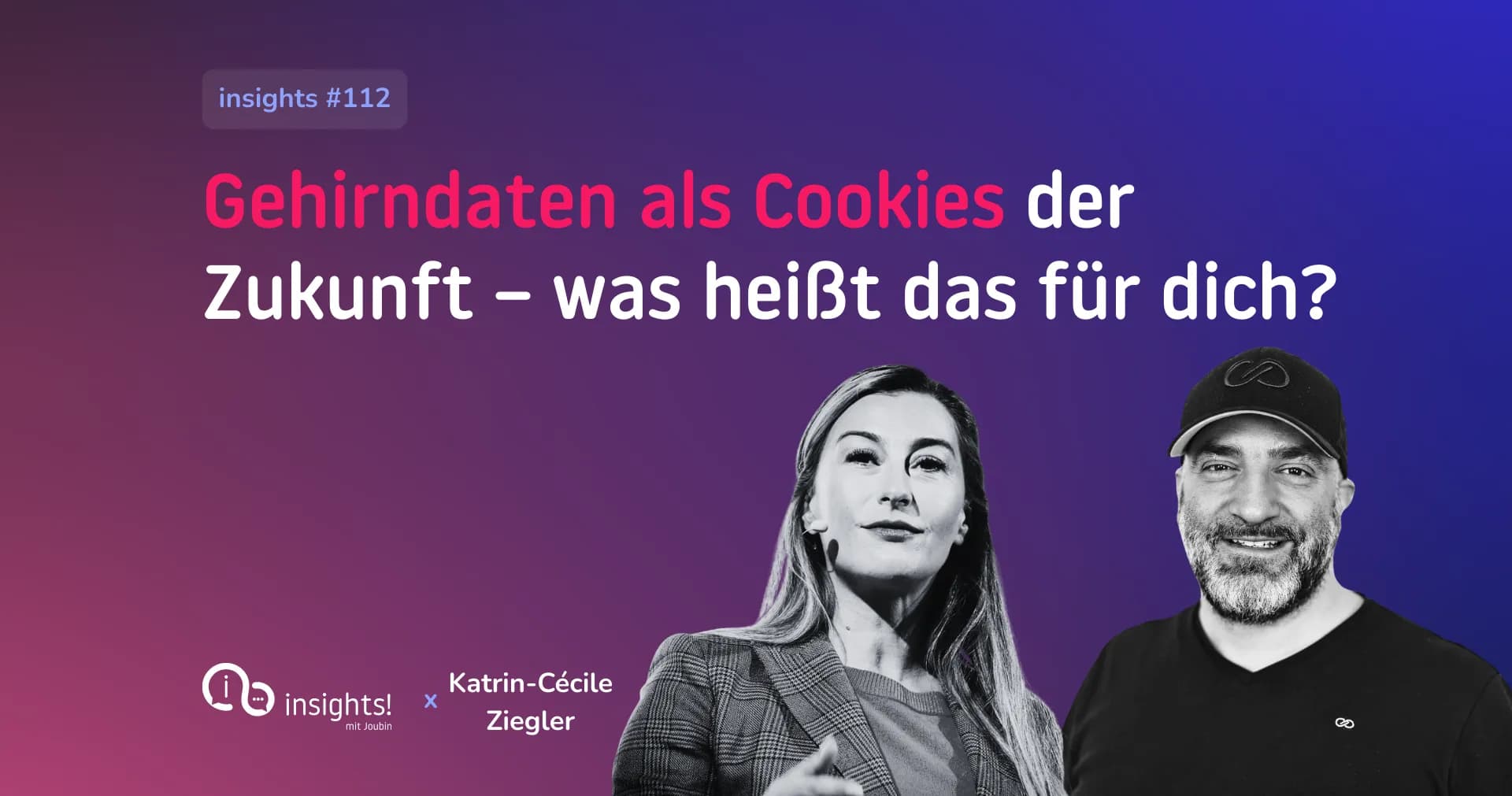
„Brain data is the cookies of the future. It delivers information that goes deeper than any voice input – unconscious, unfiltered, highly precise. Anyone who understands what that means recognises: the next stage of human-machine interaction doesn't begin with a new device, but with a new awareness.“
Brain-computer interfaces: the next interface of digital transformation
You put on a cap and use it to steer your car. Sounds like science fiction? Not quite. In the latest insights! episode, Joubin Rahimi talks to digital economist and keynote speaker Katrin-Cécile about a technology that has the potential not only to fundamentally change our interfaces – but also to redefine the boundary between human and machine: brain-computer interfaces, also known as BCIs. „The strongest firewall we have is our brain – and that's exactly what's now being breached,“ says Katrin-Cécile. And this isn't happening through invasive implants, but via wearable technology – glasses, headphones or caps that capture brainwaves and interpret them using AI. What until recently sounded like music of the future is moving into everyday life at high speed.
What BCIs can really do – and what businesses gain from them
But what exactly can this technology do? In short: it delivers valuable insights into mental states. BCIs capture electrical signals from the brain, which allow conclusions to be drawn about the following aspects: • Emotional states such as joy, fear, stress or arousal • Mental parameters such as focus, tiredness or exhaustion • Early indicators of neurological abnormalities Particularly in a business context, highly relevant fields of application are opening up here. For example, in safety-critical activities such as driving a vehicle, it can be detected early on whether concentration is waning – long before it becomes subjectively noticeable. New possibilities for human-machine interaction beyond touch, keyboard or voice are also opening up in the world of work. „Brain data is the cookies of the future,“ Katrin-Cécile sums it up. The implication is clear: emotional reactions to websites, advertising materials or pricing could in future not only be observed, but measured objectively – in real time.
Where the first application scenarios are becoming reality
BCIs are not an isolated tool, but are developing into a new infrastructure for digital interaction. The potential is particularly tangible in the automotive sector: conceivable scenarios include early detection of tiredness, adaptive cockpit control or – in the case of autonomous vehicles – faster intervention through cognitive impulses when the machine needs support. The gaming industry is also seen as a likely driver of this development. Here, reaction speed counts, and anyone who steers by thought has a clear advantage. In North America, the first market-ready products already exist, such as headphones that simultaneously read brain data and thereby function as a game controller. Beyond that, manufacturers of household appliances are also discovering BCIs as the next stage of evolution. Voice control is now showing its limitations – thought control, on the other hand, could mean a genuine leap in innovation.
What does ethics say?
The debate is no longer just about regulation, but about fundamental human rights. What is a „private thought“ in a world where even unconscious processes become technically visible?
Conclusion: those who think today shape tomorrow
BCIs mark not just a technological milestone, but open up a completely new level of interaction between human and machine. They don't replace existing interfaces – they revolutionise them. For businesses, this means: the time to act is now. Because while the technology is maturing rapidly, the decisive step isn't acquiring a new device – it's strategically engaging with your own fields of application. Anyone who wants to understand where and how brain-computer interfaces can be usefully deployed is well advised to seek dialogue with experts like Katrin-Cécile. Because one question is becoming increasingly urgent: do you want to wait until others know your customer data better than you do – or do you want to become the one setting the pace of this new reality yourself?
Would you like to listen to the full episode?
Here you'll find the podcast of the interview:
Please accept the corresponding cookies to view this embedded content.
Would you rather watch the episode? No problem!
Here you'll find a recording of the interview:
Please accept functional cookies to watch this video.
Prefer to read?
Joubin Rahimi
Wonderful that you're joining us again for a new episode of insights! My name is Joubin, Joubin Rahimi, and with me today, Katrin Ziegler. Hello Katrin.
Katrin-Cécile Ziegler
Hello Joubin.
Joubin Rahimi
Could you say a couple of sentences about yourself, because you're not a customer of ours, not a partner of ours, and so you're a special person in our podcast episode.
Katrin-Cécile Ziegler
Yes, today I have the honour and pleasure of being keynote speaker at your event, and that is of course also part of my job. But I also do a lot of expert moderation, and my background is as a digital economist, and among other things I'm also a university lecturer for tech trends and for neuroethics, and indeed also brain-computer interfaces.
Joubin Rahimi
And exactly, neuroethics is the keyword, brain-computer interfaces, because that's coming up right in the keynote. Have we already covered this, or first of all, what's behind it? Let's start there.
Katrin-Cécile Ziegler
Yes, so the classic line in these media articles, newspaper articles, is always: it's not science fiction, it's reality. That's always the opening sentence, and it's actually been written for five years now, and it's true. This technology is already fairly well developed and has made a massive leap in the last couple of years, partly thanks to generative AI. And often people only talk about Elon Musk and Neuralink, and indeed Black Mirror.
Joubin Rahimi
That would have been a starting point right there too.
Katrin-Cécile Ziegler
Exactly, something gets implanted into our brain, and of course that happens too, and has for many years. There are already hundreds of people with brain implants, but what's really interesting now is the development with these non-invasive brain-computer interfaces. That means this is the technology that's being integrated into completely everyday wearables. Like your cap, for example, your beanie, bam.
Joubin Rahimi
Maybe I already had one.
Katrin-Cécile Ziegler
Yes, maybe you already have one, but also in your glasses or headphones and so on. And with that we're breaking through the boundary or the strongest firewall we have – that's our brain so far – and we're also dissolving the boundary between human and machine.
Joubin Rahimi
And it's not that the machine can read data or my thoughts. That's not it. So what exactly is it? What does it read?
Katrin-Cécile Ziegler
Well, to start with, you can read thoughts to some extent, but only to a limited degree. Fundamentally, it's about measuring the electrical signals. These are then of course decoded with AI, and what I can measure is, for example, emotions, really well. So joy, fear, arousal, but also neurological changes, depression. What's interesting in a business context is concentration, focus, tiredness, exhaustion, and those are of course already interesting data points you can do a lot with.
Joubin Rahimi
Those are more meta-information then, if I'm a lorry driver and the system notices you're getting tired, it flashes now, but then you could probably say much more precisely that you're getting tired.
Katrin-Cécile Ziegler
Yes, exactly.
Joubin Rahimi
Throttle the car, right?
Katrin-Cécile Ziegler
Yes, for example. You could get feedback. In fact, the automotive market will also be one of the first markets where a major breakthrough happens. Maybe even earlier in the gaming market, we can talk about that afterwards too if you like, but it's not just this measuring. Fundamentally, it's bidirectional. I can read out data. It will certainly also come that we can manipulate as well. That means, for example, boosting concentration. But what's really interesting, and why I actually believe it will become a genuine infrastructure of the future, is that we use it for control. So I can issue commands with it. It essentially replaces keyboard, touch, voice.
Joubin Rahimi
You mentioned the automotive industry earlier. I think, many, many years ago, I read something about BMW already researching this. Is it then like, I say turn left, or I think turn left and then the car turns left at some point? Or what do you need that for in this context?
Katrin-Cécile Ziegler
Well, I think it'll be more the car itself that knows, since I've entered it into the sat nav. But in the automotive context it's of course primarily about comfort. I can operate things with it. So I'm no longer distracted by various commands. But also once we're at autonomous level three, I think that's where the car already drives largely on its own, but we're still legally obliged to intervene in emergencies. A BCI can of course help there, because if the car is driving itself, I'm distracted. Maybe I'm browsing, dozing off or something else, and then a situation arises where I need to intervene. Via a BCI I can of course do that much faster, because the muscular pathway takes longer.
Joubin Rahimi
Exactly. I'm forming a thought here. We believe robotics is also playing an ever bigger role. It's also becoming much, much more haptic through AI, and robots are getting better. Let me speculate a bit. Do you also think it could be that we then have robots at home, and I'm at work and I've forgotten, maybe we should still do the laundry or something. And I wouldn't even need to call any more. I could then talk to the robot, or I could tell Marc behind the camera by thought: please pan the camera again or something, without us speaking. Is something like that coming, or is that too fancy already?
Katrin-Cécile Ziegler
I'd say that's still very far off. So really what we understand as telepathy, and that kind of communication with machines too. There we're looking into the crystal ball. It's possible that it comes, but I don't think those are the first points that are interesting right now. We're not there yet. No.
Joubin Rahimi
So where are we exactly?
Katrin-Cécile Ziegler
So we can read out emotions really well. I also think that's what's interesting for businesses to begin with, because we already communicate a lot via language, even when we, I don't know, type something into ChatGPT or into Google. That means a lot is already known from our thoughts there. But this emotional response, we don't have that quite so directly yet, and that's also measurable in the subconscious. So language is often reflected on, but emotions are unconscious, and that's of course far more interesting, getting hold of that information and perhaps then linking that data with the data we already have from social media, from all the other technologies we use. And then we have a completely different level of profiling
Katrin-Cécile Ziegler
That makes me think of a sales tool for that, a marketing tool. If I then see what the price is and I see whether they're pleased.
Katrin-Cécile Ziegler
No, that's true too. No, really. It is like that. I mean, I do believe that in future, for example at work or when we're browsing, we'll be wearing headphones. I think headphones will become the device that neurotechnology gets integrated into first and foremost. And if you're browsing with them and so on and you have this monitoring, sure. So that's also why I say, brain data is the cookies of the future.
Joubin Rahimi
And how far does that go? Does the hat need to sit on your head, or do I have glasses, where we could even establish that between ourselves right now?
Katrin-Cécile Ziegler
How do you mean, that what you're thinking gets transmitted to me exactly, without …?
Joubin Rahimi
Yes, that I could read it without you wanting me to. I'm leading straight into neuroethics with that.
Katrin-Cécile Ziegler
Yes, so fundamentally yes. I can of course hardly control that. That's why I also say the strongest firewall is broken, and it's harder for me to control whether I release the thought or release the emotion, without meaning to. If I'm thinking about it, right? Yes, exactly. And I myself might not even be aware of what I'm thinking right now, for example. So we're already in an area that has a lot of ethical dynamite.
Joubin Rahimi
Is there an ethics commission for that too? We're in Europe after all, so we quickly get something along those lines. Does one already exist?
Katrin-Cécile Ziegler
Yes, and not just in Europe, actually already globally and very much so from countries or regions like Canada and also the USA. I'd even say we're further along in the ethical development and reflection than with any other technology before it reaches the consumer market, and that's a good thing.
Joubin Rahimi
Why do you think that's the case? Aren't the tech guys as fast this time? So the tech guys and ladies aren't as fast this time, or?
Katrin-Cécile Ziegler
To develop the ethics? Well, I mean, the corporations don't really have that much interest in developing the ethics themselves, probably. Of course, this is something that arose in neurotechnology, above all in the field of medicine, medical technology, because it's initially about treating neurological conditions, and in the military sector too, also very important in neurotechnology. And if we're now in the medical field, then ethics has always been part of that. And scientists and researchers formed these committees very early on to discuss, okay, what consequences will this have for society and people, and how do we need to, well, how do we need to prepare for that? And there's actually a lot of talk about human rights there. And if you now say Europe, the funny thing is, we also always think we'll have the very first regulation or the first law regarding neuroethics and neurotechnology, but that's not the case at all. That's not how it is.
Joubin Rahimi
No, it's Chile. It's Chile, okay.
Katrin-Cécile Ziegler
Chile has already enshrined human rights in its constitution regarding neuroethics.
Joubin Rahimi
Yes, then they're ahead of the game. We've seen it before, we're not quite at the front in digitalisation in the Cisco Digitalisation Index, unfortunately.
Katrin-Cécile Ziegler
We probably won't be there in neurotechnology either, if you just look at where the start-ups are distributed globally. Yes, USA is around 45%, Canada is also very strong, Europe 25%, China 10 and Germany under one%.
Joubin Rahimi
Which sectors will it affect then? You already mentioned health care or medicine and also the military sector. What others? You also mentioned automotive. Will it go into everything? Yes.
Katrin-Cécile Ziegler
Well, I'd say it'll become a device the way, say, a smartphone or a keyboard is relevant for someone. You can no longer say: No, that's only one sector, rather it's a tool. And I think that's why it'll become an everyday thing too. But if you look at what the entry markets are, then I'd say automotive, and next is above all the gaming market. Why? It's naturally a device I can control with, that I can also control faster with, simply directly. Thought, impulse. And that translates into action, and also because competitive pressure is very high. That means if one person has a BCI that's faster, then of course I want one too. Totally.
Joubin Rahimi
Of course. That'll be the game-changer.
Joubin Rahimi
Yes, totally. And then there are also young, tech-savvy users who are open to it too. There's a will towards self-optimisation. So we have network effects, peer pressure, and it's also already. So there's a gamer on Twitch who's already using a BCI from Emotiv and is also a lot faster with it. So it's not really on the market in Europe yet, but in Canada, for example, the first headphones have now come out. They look like the Apple ones and can do everything the Apple ones can, but also measure brain data.
Joubin Rahimi
So if I wanted to get into the topic, would I simply buy the device, play a game, so that I get a feel for what's happening there, or are there other ways to explore it in a business context?
Katrin-Cécile Ziegler
Yes, to contact me.
Joubin Rahimi
Yes, okay. Always a clever thought.
Katrin-Cécile Ziegler
I advise companies, give talks on it, exactly.
Joubin Rahimi
That's a real easy one now, too.
Katrin-Cécile Ziegler
But also, first of all, to think: Okay, where are the use cases for me? So I also find it interesting, when I give my talks, which industry companies then approach me afterwards. And I recently gave one for the association for the electrical goods industry, and I thought, okay, now all the ones that make, I don't know, audio devices and consumer electronics will come. No, it was actually several companies that make household appliances. Why? Because those are also products that I don't keep buying new, that need new innovations, and where it's now also being said, we've noticed that voice control is totally maxed out, far too strenuous in that context too. That means they've already understood, no, actually this is the new tool for smart home.
Joubin Rahimi
I'd like to wrap up with that, because that would also be the point of getting in touch with you or the two of you. But I think I'd definitely want to try the headphones out.
Katrin-Cécile Ziegler
Yes, on the market in Europe next year.
Joubin Rahimi
You could always fly over to Canada. Someone's bound to know someone. Thanks for being on the podcast today, and thanks also for giving the keynote on this topic at INSIGHTS. We're already really looking forward to that.
Katrin-Cécile Ziegler
Thank you.
Got questions or feedback?
Then feel free to contact us directly.
- Joubin Rahimi
Managing Partnersynaigy
Show phone numberShow mobile numberShow email address
Subscribe to the blog now and never miss any news
✔️free ✔️weekly news ✔️expert knowledge
Please accept the corresponding cookies to view this embedded content.