



#158 - Why wholesale is underestimated and still keeps the system running
Fabian Haustein, responsible for e-commerce and marketing at SHK Deutschland, moved from B2C retail to B2B wholesale half a year ago. In the new insights! episode, he explains why wholesale is more than a warehouse with a delivery note, what B2B and B2C can really learn from each other, and why not every trend should be followed when it comes to AI.
 Joubin RahimiManaging Partner · synaigy
6 min. reading time
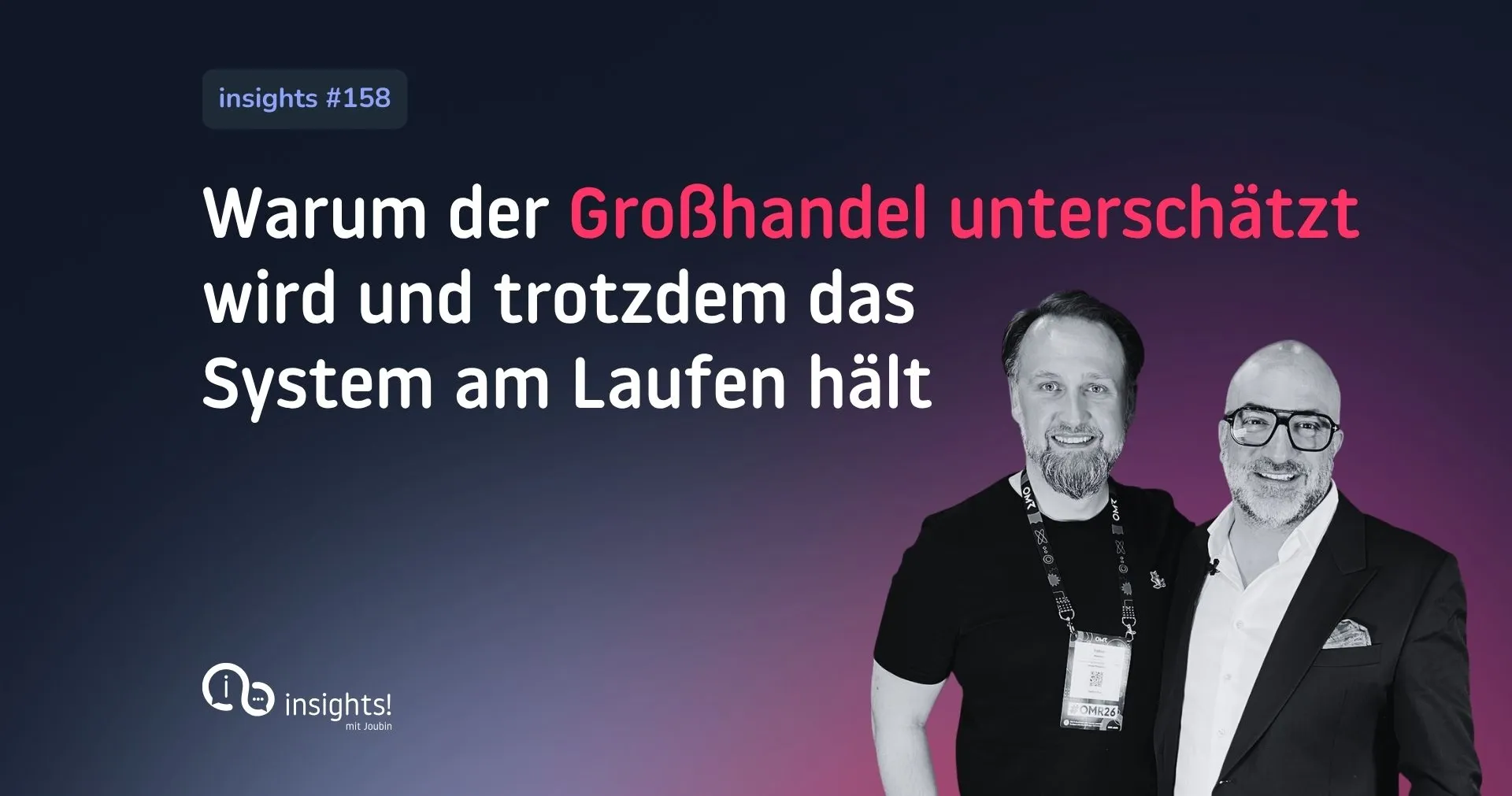
Both worlds, B2B and B2C, also think of themselves as very unique compared to one another. And I think the click comes a bit, or has to come, from realising that neither is actually that unique, because we trade with people and with people, ultimately with individuals. Even when companies trade with each other, they're still people who then also use the digital channels.
Wholesale as an operating system: why the warehouse metaphor no longer holds up
When you hear wholesale, you think of warehouses, delivery notes and perhaps a weary field sales rep. Fabian Haustein brought a much more precise metaphor to our conversation: wholesale is the operating system between manufacturer and end customer. It doesn't just deliver products, it connects industry partners with trade customers, organises advice, procurement and service, and creates an infrastructure without which the three-tier distribution principle in the SHK world simply wouldn't function.
This platform logic is a solid reality. SHK Deutschland operates large-scale bathroom showrooms where tradespeople can configure complete bathrooms together with their end customers. On top of that, there are energy-saving worlds where heating concepts can be experienced hands-on, and regional specialists for topics such as ventilation systems. Anyone who sees this as mere distribution is missing the real value. It's about an orchestrated interplay of range, advice, floor space and knowledge that, in this depth, simply doesn't exist in many other countries.
B2B vs. B2C: whoever talks about being 'unique' here hasn't understood the market
One of the most honest statements from the conversation concerns how both trading worlds see themselves. B2B and B2C both consider themselves unique and look at each other with a mix of distance and mutual underestimation. Fabian Haustein sees it differently: at the end of the day, people trade with people in both worlds. Even when companies do business with each other, individuals sit on both sides, using digital channels and making decisions with gut feeling, experience and sometimes even emotion.
This creates a clear transfer of learning in both directions. What B2B can learn from B2C:
Speed and willingness to experiment: run small tests faster, learn on a small scale, then scale up.
Community building and linking channels: bringing end customers and tradespeople together digitally as well as in person.
Owning the customer journey: not just delivering individual touchpoints, but thinking through the whole journey.
Conversely, B2B delivers equally valuable lessons: deeper process discipline, a higher tolerance for complexity and a healthy scepticism towards every new hype. Anyone who simply overturns processes in B2B risks real damage, which is why things get checked more carefully. This mindset would save some B2C players from expensive knee-jerk decisions.
AI in wholesale: custom GPTs instead of a trend carousel
SHK Deutschland is at the starting point on AI and is approaching the topic in a deliberately structured way. A committed IT team is driving it forward, in-house AI in the form of custom GPTs is used across the group, and expertise is passed from team to team via internal multipliers. This isn't a revolution with fireworks, but a structured empowerment of employees. This very carefulness is the underestimated success formula in both SMEs and large corporations, because it creates acceptance instead of resistance.
Fabian's stance on AI trends is also striking. While half of LinkedIn chases every new model, wholesale deliberately watches developments more closely. Not out of inertia, but because process complexity in B2B is higher and a quick wrong decision comes at a higher cost. From a digital decision-maker's perspective, this is a discipline that could be copied more often in one's own strategy.
Data protection, IP and the asset called company knowledge
A topic often underestimated in the AI discussion is the data and knowledge held within specialist areas. In SHK wholesale, for example, this includes the calculation of ventilation systems, a highly complex field of knowledge with real business value. Such knowledge must not be naively fed into public models. It's an asset and needs to be treated as such.
This stance should be standard for every company with specialised expertise. That applies just as much to mechanical engineering data as to customer communication, pricing models or regulatory content. AI is not the enemy, quite the opposite. But it needs clear governance that decides which knowledge may be processed where, and where it may not. Anyone who doesn't draw a line here will, over time, lose what actually differentiates their business.
The uncomfortable energy question: why AI isn't free
One of the most original statements in the episode concerns the energy behind the AI boom. We talk about CO2 from driving, regulate combustion engines, and at the same time consume AI as if it were a free good. In reality, every query needs computing power, every bit of computing power needs electricity, and electricity isn't available indefinitely. Fabian Haustein turns this into a very useful rule of thumb: use your own head first, then add AI in a targeted way, rather than reflexively putting it first.
This is neither hostility towards technology nor a sermon on efficiency, but strategic maturity. Anyone banking on scale has to think about resources too. Cloud costs, compute time, energy consumption, all of this will become more of a competitive factor in the coming years, especially in a market environment with rising energy prices. Anyone prioritising cleanly now is already building resilience against exactly these developments.
Five skills for the next decade: what Fabian Haustein recommends to his children
Perhaps the most personal moment of the conversation comes with the question of career choice. What do you advise your children in a world where AI supposedly does everything? Fabian's answer is refreshingly unfashionable, and viable precisely because of that:
Build media literacy, so you don't believe every bit of nonsense online.
Understand that free digital services are paid for with your own data.
Combine craftsmanship with digital competence, rather than playing one off against the other.
Stay curious, keep learning throughout life, don't settle in at one career stage.
Have a solid grasp of reading, writing, arithmetic and a foreign language, because that's the foundation for everything else.
At first glance, these five points seem unspectacular. On closer inspection, they describe a robust foundation that carries any career, no matter how fast the surrounding technology changes. Anyone who develops their employees, their team or their own children towards these skills is building future readiness that doesn't depend on the next model change.
Conclusion: wholesale has a future, if it retells its own story
The episode with Fabian Haustein is a rare mix of industry insight, honest self-reflection and concrete recommendations. It shows that wholesale in the HVAC world is far more than mere distribution and that it doesn't need to hide behind B2B clichés. On the contrary: those who consistently think in platform logic, take community building seriously and use AI with judgement build a business model that will still hold up in the next decade.
For digital decision-makers, e-commerce leads and marketing managers, the episode offers several points of connection: a clearer picture of your own value chain, a pragmatic approach to AI trends and an honest reflection on resource consumption and skill-building. It's exactly this mix that makes the difference between strategy theatre and viable transformation.
Would you like to listen to the full episode?
Here you'll find the podcast of the interview:
Please accept the corresponding cookies to view this embedded content.
Would you rather watch the episode? No problem!
Here you'll find a recording of the interview:
Please accept functional cookies to watch this video.
Would you rather read?
Joubin Rahimi
Great that you're back for a new episode of insights!. My name is Joubin, Joubin Rahimi, and joining me today is Fabian Haustein. Well, actually, we'd already recorded once before that we never sent out. Hi Fabian!
Fabian Haustein
Hi Joubin! True, thanks for having me here.
Joubin Rahimi
Very happy to. The second time. And we've also done a panel talk here before.
Fabian Haustein
Exactly, did both last year. And somewhere along the way the recording got stuck in the archive.
Joubin Rahimi
That's actually a good link, because I think that's the exciting part. Fabian, your background is, I think, you're not a classic business informatics graduate or IT manager, you found your way here via other paths, other directions.
Fabian Haustein
Yes.
Joubin Rahimi
And that alone would be worth an episode. But back then it was still at your previous employer.
Fabian Haustein
And also in retail.
Joubin Rahimi
And also in retail. So you were in B2C retail, now you're in B2B.
Fabian Haustein
Yes.
Joubin Rahimi
So today I'd like to dive into what you took away from B2C retail that B2B can definitely learn from, take on board, because we're also mostly B2B, and people sometimes say B2C ticks so differently. Yes, but they also just do things in a cooler way, because they've simply had to for centuries. That's putting it bluntly, isn't it? But now a little introduction to you as well, maybe you'd like to add 2, 3, 4 sentences on that.
Fabian Haustein
Yes, exactly, so the switch from B2C to B2B is of course a bit of a leap at first, you ask yourself why, then at some point I started that bold journey. That's roughly the short version. And yes, there are a lot of parallels, but both worlds also tend to think of themselves as very unique compared to the other. Right, so. And I think the click comes a bit, or has to come, when you realise neither is actually that unique, because we trade with people, and with people, ultimately with individuals. Even when companies trade with each other, they're still people, who then also use the digital channels, just like the Arabs. Somehow it's the person who makes the business happen, and even more so, entirely so, in trade. So both can learn from each other, check. We'll probably get into that a bit more in a moment, I think. But I also think both need to accept each other more. I think now it's getting exciting. You could put it that way too.
Joubin Rahimi
Yes, yes, what I'm getting at is that it's increasingly blending together, when I look again at the Lidl Schwarz Group, the Schwarz Group with Lidl, and then suddenly you have the DIY store line, right, and they have good products, some of them affordably priced, and on top of that, brilliant marketing. That's suddenly a retailer rolling in like a manufacturer, right. And now let's say the HVAC sector, or you as SHK Deutschland, are somewhat the disc between manufacturer and customer. Just putting that out there.
Fabian Haustein
Yes, I think it's an important function, but yes, that really hits it too, because I think this whole wholesale topic, what we do as SHK Deutschland or also our market competitors, is totally important. And this three-tier principle, which has been established for such a long time, we work with our industry partners, but we also work a lot more with our trade customers and have a really important function there. I never really see it as retail, but as wholesale. I find, somehow it's a bit like, an analogy I really like, is the operating system idea.
Joubin Rahimi
Okay.
Fabian Haustein
It really is somehow the operating system. You don't just have this product, like I have it in stock, I deliver it there. You somehow do more and make a lot possible, and you're in the background, but you're somehow always there too. I think that's a point that, in my view, never goes out of fashion. Only the retailer with an industrial park, I find that hard to imagine. Everything has its pros and cons, and I really like this idea of the operating system, that we're a bit more than just a wholesaler, I think that's really good, and to be fair, you see it more and more too.
Joubin Rahimi
You have so many important functions, and I think some people know this, those who've built a house at some point or are of course in the industry, but when you suddenly go with the tradesperson into a showroom that's fairly large, which isn't actually the tradesperson's showroom, but the wholesaler's. That's one of the services you offer.
Fabian Haustein
And no small service either, right. It's not just that the products are there, the brochures, where you put together your really cool bathroom. From this to that, yes, even entirely privately, from, well, I'll probably get flamed for this, but you actually start at 20,000, you can go up from there, there's no ceiling above. Sky's the limit really. And being able to give every tradesperson, and then also the customer, that service to present all of that. That's really great, right? Genuinely enjoyable. We don't just complement this bathroom showroom topic, which is really prominent for us and very broad, a large number of bathroom showrooms. We also simply have the energy world, the energy-saving world, and there it's the same. There the tradesperson can come with their customer and learn more about heat circulation.
Joubin Rahimi
So heating or also photovoltaics or
Fabian Haustein
The topic of heating is covered there, and very nicely for the tradesperson, but for the industrial park.
Joubin Rahimi
So you're basically Enpal's competitor.
Fabian Haustein
Yes, yes, sort of
Joubin Rahimi
Seen regionally, right.
Fabian Haustein
We of course have a bit more, they of course approach the topic differently, we come from the trade, from a service orientation, but you can certainly see it. I think we just did it earlier and need to get louder about it.
Joubin Rahimi
What can B2B learn from B2C? So what do you take away, where you'd say, I'm going to implement that, or I've seen that work?
Fabian Haustein
If I look a bit at my areas, marketing and specifically marketing and also e-commerce, I think as B2B we can simply move into trying things out faster, so thinking more in terms of experiments. It's always framed negatively now, but I don't see it that way at all — rather that you approach things faster and see where you can test on a small scale first and then scale it up. I do think that's faster in retail or in B2C. Both worlds are hugely bold in their own way, but you get started faster there. Conversely, in B2B you have a wider range of functionality and process that you have to factor in, so you can't always do that, you have to think more from a process perspective, which in turn would hurt retail. But if you manage to combine the two, I think that's definitely something you can learn from each other and look to one another for. And the third point, I think, is this topic of connecting channels — you mentioned product placement — that's being linked much more with digital topics, which is far more common in B2C, where you position yourself more broadly and own much more of the journey. You can learn from each other there too. It's not to say one does it better or worse, but simply to draw inspiration from it, those impulses.
Joubin Rahimi
Always very diplomatically put. Yes, but I do think, if I spin that further, feel free to correct me, you have the wholesaler, who then has their home, you have the energy-saving concepts, but how do you get the tradesperson to the customer there? So you also support the tradespeople in the process.
Fabian Haustein
But that's where we learn massively from B2C, namely on this topic of community building. Community management, of course very buzzwordy, but what's behind it? We already bring the tradesperson together with the end customer now, and have done in the past. We run events around the topic and use similar formats to B2C to bring the two together on-site in our showrooms. But thinking about that a bit more digitally and in a more modern way, that's what we can definitely take from B2C, and we do take from it, simply to be even more excellent there. And the challenge, though, is not forgetting that traditional side. And then we have some genuinely cool approaches, honestly. We've just done one or two things that also came out of the showrooms, which my e-commerce and marketing people then supported wonderfully. Those are already some lovely things, experiments that emerged.
Joubin Rahimi
Okay, then I'd say, back here again in a year, and then we'll see what you can share on that. The second topic, AI, is of course on everyone's lips. How are you approaching it? You said you're just starting out with the whole thing.
Fabian Haustein
Yes, I'd call it a starting point. From my perspective — I haven't even been in the industry that long myself, about six months now — we have a great IT team driving the topic, who really take care of it properly, and it's increasingly being carried into the company through multipliers. So one person shows another, and we're able, within the corporate group, as we're already able to, to use our own AI. So, custom GPT, I believe it's called. That's already pretty cool. And then the first step is really about enabling people. At least my team. My team gives us a good foundation and support there, to then move in that direction. But of course we want to do trend topics too, one AI trend chases the next, and I think that's actually where the bridge lies back to what was asked. I think you can learn from us, from B2C, in that we don't chase every trend immediately, but rather take another look at it first, go into it a bit more, I won't say more honestly, but more precisely. That's just something for us, that the speed is right.
Joubin Rahimi
That's of course also because you're turning bigger wheels when you change the process.
Fabian Haustein
Yes, the process complexity is much higher. But you have to learn that first too.
Joubin Rahimi
How do you handle data protection and compliance in relation to AI?
Fabian Haustein
That's hugely important. By nature, coming from patient-record procurement, compliance and data protection are a very high priority for us, something we take very seriously, because we know it's hugely important within our company, but ultimately also for our main customers. It really does matter. They look closely at that, so it has a high standing in that regard.
Joubin Rahimi
What do you protect in particular, or what's especially worth protecting?
Fabian Haustein
The company data and knowledge, the corporate knowledge, because the industry is also very knowledge-driven. Calculation models for ventilation, for example, aren't at all trivial, you really have to protect those, it's an asset.
Joubin Rahimi
Ventilation, so ventilation systems.
Fabian Haustein
Yes, exactly, like here on the, on the, if we look at the ceiling, you have to, well, you have to calculate that. And yes, you could of course use AI there, just not currently. We have excellent people who do that. That's probably a good use case. But that's just knowledge you have to protect, really corporate
Joubin Rahimi
IP on top of that. Yes, that also shows where wholesale still makes sense after all, right? Because wholesale isn't everywhere. In some countries there's no wholesale at all.
Fabian Haustein
We just set up this service and work with specialists for specific topics in every region. Here in the north it's fans, fans, so, and that's a really, really cool topic.
Joubin Rahimi
The digital services, which are also becoming more and more common now, why, because it's also a service. What have you launched where you'd say, that's really cool? Because I know the HVAC industry never talks about the future. Something you might have seen before one way or another, but that's fine for others in the industry, yet a smart idea for others.
Fabian Haustein
Well, we have services that I find really cool, that aren't just leftovers from the 90s, that have been running for a very long time. One is that we offered a relatively early digital bathroom consultation. So I want to fit out a bathroom myself, and there we gathered relatively high digital know-how, and then you also need human know-how, which puts us in a position to build something like that very quickly, and puts you in a position to get a first overview relatively quickly of what something like that costs.
Joubin Rahimi
Yes, that's what customers want, isn't it? A quick idea, a quick indication.
Fabian Haustein
And then get to an appointment quickly too, and then experience that appointment in our bathroom showroom.
Joubin Rahimi
Is speed a selling point for you? So price fast, idea fast, implementation timing fast.
Joubin Rahimi
I'd say yes straight away, for us internally at least, if I look a bit at e-commerce, marketing, definitely. Of course the market's shifting too, we're not just looking at wholesale. In Germany we also have a big D2C field in this area, and there we naturally also want to stay a bit with the times. For the customer themselves, if we just look at the end customer who's in the queue, speed is a value too. Finding a tradesperson who fits your bathroom quickly, yes sure, that's an issue.
Joubin Rahimi
A bit rhetorically pushed in there. I have gathered a bit of experience, after all.
Fabian Haustein
But there too, second cool service, there are tradesperson networks, like SHK has, regionally, and where regional companies do a cool job matching these tradespeople up with our end customers. And we already have a first digital platform for that too. They have a different name, so it's quite fine to make it even cooler, but these are already services that exist and are used, and they're really cool.
Joubin Rahimi
What would you— let me ask you a completely different question. Your kids are still a bit younger.
Fabian Haustein
Yes, middle-aged, let's put it that way.
Joubin Rahimi
But at some point the career choice comes up. What would you pass on to them? I should actually have asked that question every day today, but you're the first to get it.
Fabian Haustein
Have good media literacy.
Joubin Rahimi
Yes.
Fabian Haustein
So don't let anyone pull the wool over your eyes online. Understand what your thing is. The second would be, if you get something in the digital world for free, you pay with your data. Few people have this core competence. Combine trade skills with digital competence, that would be the third. And just stay curious. Yes, so those 5 points, I think, are totally important. Alongside a 5th point, which for me is more general — for me it's still about learning to read, write, do maths and a foreign language, then you also get a good view of the world around you. If you bring these 5 things together, I think, in this volatile world where you don't know what's happening with AI at all, well sorry, it's a pretty intense topic right now.
Joubin Rahimi
Totally. But my kids just ask, why should I learn that, AI does it anyway.
Fabian Haustein
Exactly, that's the point. If AI really does do it, that's exactly what leads to demand. Because right now we see a crisis where we don't all have to drive cars any more. Why? Because our cars use an enormous amount of fuel in the mass. Volkswagen would say, 3 litres. True, but we only consume AI, but AI needs energy too, a lot in fact.
Joubin Rahimi
A lot indeed.
Fabian Haustein
So, where does this energy come from eventually, and how will it get limited at some point? And is AI always the first step, or should we perhaps first use our own mind, then bring in AI, because it uses energy? We're actually relatively smart people, I'd like to think, and I believe that's a point you have to look at. I think you have to understand the trend, when it comes to learning, that's also why this combination of AI and trade skills, but in the end also to think, okay, I have to look behind it, what does that actually mean.
Joubin Rahimi
Yes, cool. So I'd say, this is another call to action: what do you think you'll teach your kids for tomorrow, so they study, learn, train in the right thing? And then we can just keep discussing.
Fabian Haustein
I find that totally cool. I think I'd add combined.
Joubin Rahimi
We've both had a rather unconventional career path too, and in that sense I think it's the right way.
Fabian Haustein
It doesn't always have to be a straight line.
Joubin Rahimi
With that, I'd say we're looking forward to an after-beer. You're very welcome to stay, we've still got another session, and feel free to write comments. Thanks, Fabian, for really making it happen with us here today. See you soon then.
Fabian Haustein
Definitely, thanks so much for having me. Have a great time.
Do you have questions or feedback?
Then feel free to contact us directly.
- Joubin Rahimi
Managing Partnersynaigy
Show phone numberShow mobile numberShow email address
Subscribe to our blog now and never miss any news
✔️free ✔️weekly news ✔️expert knowledge
Please accept the corresponding cookies to view this embedded content.