



#142 - Between margin pressure and innovation: how to build successful digital services
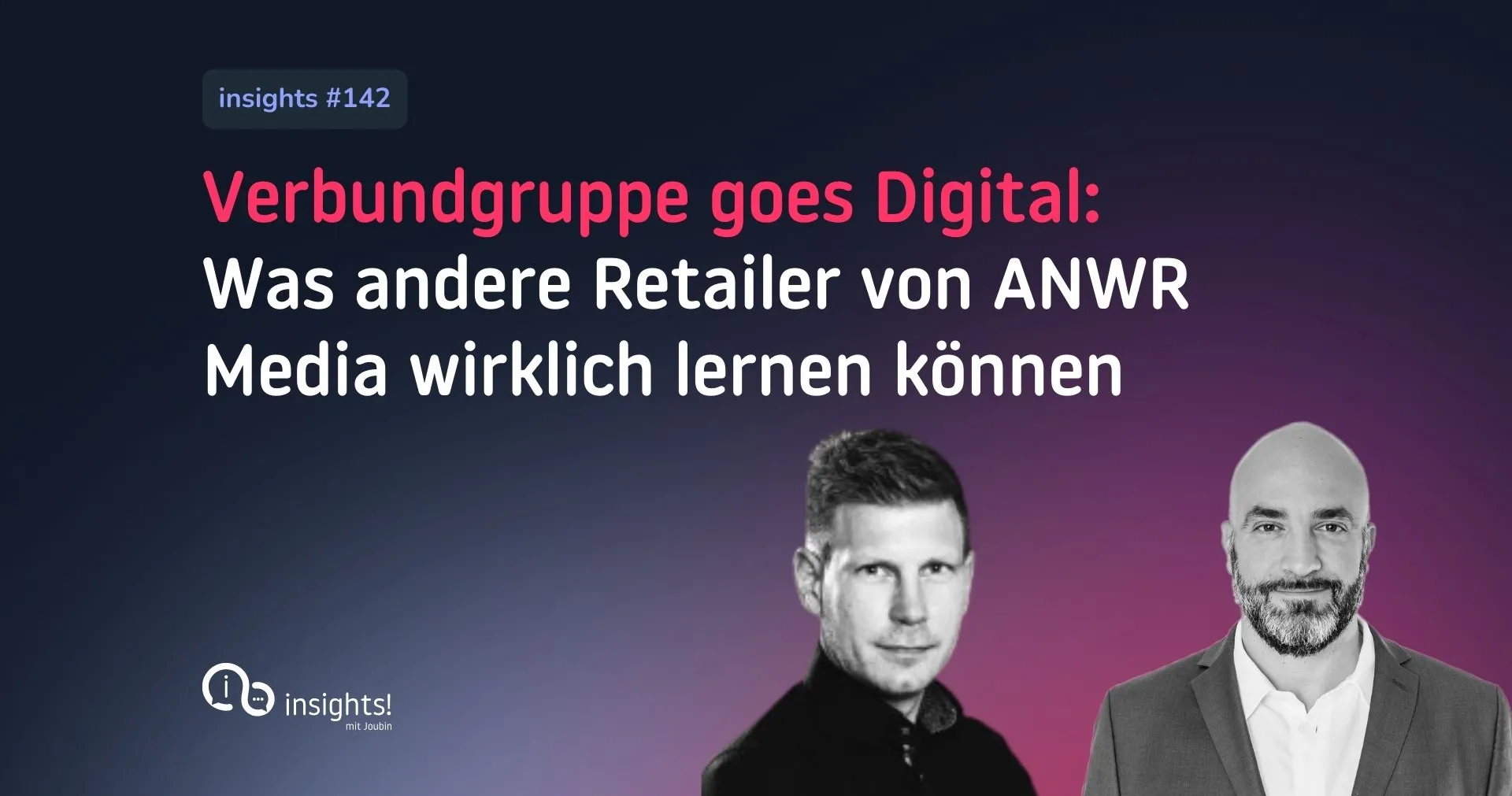
In this episode of insights! Joubin Rahimi meets Tim Wiese, co-managing director of ANWR Media, the digital service provider of the ANWR Group for the shoe and sports trade. Together we talk about building digital platforms for thousands of brick-and-mortar retailers, real AI use cases in the retail context, make-or-buy logic in the Mittelstand, and why mindset and team spirit deliver more than the biggest AI budget.
 Joubin RahimiManaging Partner · synaigy
6 min read
You can have the best players, but if they don't function together as a team, it's usually doomed to fail. You notice that in a team like this too. Of course sparks can fly sometimes, or you might disagree, but then you have to communicate openly and talk it out. These differing opinions create exactly this friction, and this friction usually leads to things getting better.
AI in the shoe trade? How ANWR Media proves digitalisation isn't a budget question
Retail is no longer facing digital transformation. It's right in the middle of it. Anyone who hasn't noticed that yet probably isn't with ANWR Media. In the current episode of insights!, Joubin Rahimi meets Tim Wiese, who together with fellow managing director Michael Stolt leads the digital unit of the ANWR Verbundgruppe. A cooperative over 100 years old for the shoe and sports trade with thousands of affiliated retailers in Germany. What sounds at first glance like a traditional industry turns out in conversation to be one of the most honest and concrete insights into real digitalisation practice you can currently get.
Building a platform instead of shop-window dressing: Schuhe.de & co.
Anyone who knows Schuhe.de, Sport2000.de or the newest addition Absolutteamsport.com knows the result of a strategic decision ANWR Media made years ago. What started as a digital business card for bricks-and-mortar retail is today a full-fledged platform operation with its own marketplace access to Zalando and Amazon, plus its own development team. Behind this development lies a logic many companies are too hesitant to embrace: building up capabilities in-house where it makes sense, and buying in where standards are better and cheaper available on the market.
Tim calls this make-or-buy thinking. And he makes no secret of the fact that this decision in a cooperative under margin pressure is not a strategic game, but sheer necessity. What many see as a disadvantage, ANWR Media counts as an advantage. Whoever knows exactly what they can and can't afford makes more precise decisions. And precise decisions lead to results faster than strategy projects with a three-year horizon.
30 per cent automated: the digital doorman that never sleeps
Now comes the heart of this episode. ANWR Media introduced a so-called digital bouncer late last year. The name sounds unassuming, the effect isn't. It's an AI trained on thousands of incoming messages that fully automatically categorises, prioritises and routes enquiries to the right contact person. The result speaks for itself:
30 percent of all end-customer enquiries are answered directly by AI
Responses come immediately, regardless of time of day or day of week
Spam is filtered out and no longer burdens the external service provider team
The internal customer service team can focus on more complex cases
This isn't a pilot project for the investor presentation. It's running in production. And it shows what many discuss in theory but rarely implement in practice: AI works when you simply start. ANWR Media is also actively optimising product data with AI support, an area that is always one of the biggest cost drivers for platforms with huge assortments.
Data sovereignty: not optional, but not the only factor either
A brief but important exchange in this episode centres on hyperscalers and data sovereignty. Joubin's question of whether the origin of the cloud infrastructure matters is answered honestly by Tim: performance and price decide primarily. But data protection isn't up for negotiation. Customer data from B2C and B2B areas must be protected, overseen by a dedicated data protection officer. That's no compliance phrase. It's a clear signal for anyone who believes data sovereignty is only a topic for large corporations. Mid-sized platform companies must hold their ground here too, and they can, if the structures are right.
Digital sovereignty: the overlooked survival issue
One topic runs through the conversation like a common thread: digital sovereignty. And here Kai Hudetz becomes particularly clear. His core statement hits home: digital infrastructure has now become just as important for survival as energy infrastructure. What does that mean in concrete terms? The vast majority of European companies use exclusively American providers for cloud, AI and data, and that without a plan B. Joubin doesn't pass judgement on that, but has a clear expectation: use what's useful to you, but have a fallback plan. The moment the price screw gets turned or political decisions threaten your ability to deliver, you want to be able to stand up and switch. Exactly this sovereignty – i.e. flexibility and the ability to switch quickly – is itself made easier by AI. Joubin gives a concrete example from practice. A customer switched from an e-commerce platform that was becoming more expensive to a new solution – thanks to AI support, at a fraction of the cost previously needed. What used to be a multi-year migration project suddenly became feasible.
Mindset decides: what AI strategy has to do with team sport
One of the most defining moments of this episode isn't actually an AI topic at all. Tim Wiese comes from team sport and makes no secret of the fact that his understanding of leadership is strongly shaped by it. His thesis is as simple as it is uncomfortable: the best individual players are worth nothing if the team doesn't function. Friction between people with different opinions leads to better results when there's open communication and everyone works towards a shared goal.
What he says about AI and digitalisation is no less direct: there are people who hold back because they don't know how to deal with it. And there are those who simply get going. Tim is convinced that companies must take an active stance here. The mindset needs to be fostered. Waiting is not a strategy. That's not management poetry. That's an attitude that distinguishes real digitalisation projects from endless rounds of strategy.
Give and take: why ownership is the decisive leadership principle
Another point that keeps coming through in this conversation: how do you hand over responsibility without giving up your standards? Tim describes an approach that many leaders talk about but rarely live consistently. Give freedom, enable development, let employees discover things themselves. At the same time, clearly demand that everyone carries their part. Not pushing it away. Not delegating just to offload yourself. But creating genuine ownership.
That sounds like common sense. And yet in many digital organisations it's the real bottleneck. Not the budget, not the technology, but the question of whether someone truly stands behind something. Whoever solves that has the decisive advantage in digital competition. Tim Wiese shows what that looks like when it's lived out.
Would you like to listen to the full episode?
Find the podcast of the interview here:
Prefer to watch the episode? No problem!
You'll find a recording of the interview here:
Please accept functional cookies to watch this video.
Prefer to read?
Joubin Rahimi
Great to have you back for a new episode of insights! My name is Joubin Rahimi, and joining me today, already laughing, is Tim Wiese. We've known each other for a few years from ANWR. Tim, would you like to introduce yourself?
Tim Wiese
Very glad to. Hi, hello to audience. My name is Tim Wiese, work at ANWR Media together with my fellow managing director Michael Stolt. We lead digital affairs of the Group and offer Digital Services for our affiliated retailers within this buying group. Yes, exactly. That's largely what we do and how we've worked with synaigy in past.
Joubin Rahimi
Quite funny, I can still remember the pitch at yours, I think that was four or five years ago. It was about managed service for part of the platform and we have an employee with very dry humour and I know he cracked a joke. I don't know what the colleague's name was, but she fell off her chair laughing. There was such warm chemistry already in that room. It was brilliant.
Tim Wiese
I believe, and this is really important to us. In everything we do, we want to identify with what we do and we want to enjoy it. And that includes being able to laugh at yourself sometimes when running a business, or doing so together. So, yes. Exactly.
Joubin Rahimi
And what's also really nice for everyone watching is that we started a journey together, but it ended differently, because the market environment and objectives changed. And I think that's interesting for everyone watching too, because you, you said you are the Media, and maybe you can say a bit more about ANWR, because most people already know ANWR, just not under that name. And this path you took, I think, is quite right and good.
Tim Wiese
Yes, well I could go into detail now, then we'd probably be here for half an hour. I'll try to keep it short. ANWR is a buying group, a group, a cooperative for the shoe and sports trade. Explicitly the shoe trade grew out of that, has continuously developed further over the years, now more than 100 years old. We also have our own banks, with which we carry out central settlement for our affiliated retailers. Exactly. And alongside the various companies we offer a great many services that form the value or added value for the affiliated retailers. That's exactly what we do. And within ANWR Media we're simply the digital service provider. That means we create opportunities for our retailers who come to us to open up additional sales channels. That includes our own channels, which we push ourselves with Schuhe.de and Sport2000.de or the new addition Absolutteamsport.com, but also the sale of our retailers' goods through external channels, marketplaces of this world like Zalando and Amazon.
Joubin Rahimi
In that sense, each of us has at least indirectly had dealings with you. If you buy shoes somewhere, there's a good chance they were distributed by you.
Tim Wiese
Yes, definitely.
Joubin Rahimi
I think it's always important to see this when you don't know the company names. You said, ANWR Media, you set up a digital unit to give digital services to your members. Why didn't you sell shoes, why are you now entering the digital business?
Tim Wiese
Well OK, it's of course about the fact that retail hasn't only been changing since yesterday. Schuhe.de has existed, I believe, since 2014 when it was originally launched as a business card, a digital business card for bricks-and-mortar retail, so it would have visibility. From that a platform developed which offers retailers the opportunity to jointly convey to the end customer the visibility they couldn't achieve alone. And from that, starting in 2020/2021, the Sport 2000 platform emerged, scaling on the same basis, and now also, at the end of 2024, absoluteamsport.com. We're there, as I said, very clearly focused. We want to focus on or strengthen this visibility of bricks-and-mortar retail, bearing in mind that buyer behaviour out there is of course changing, and the transformation of the business naturally doesn't pass our retailers by either.
Joubin Rahimi
What I find remarkable, and for everyone watching who's also facing a topic like this – I might have hardware products, do I need digital services or not? You're a great example. Vorwerk is also a great example, because Vorwerk actually sold vacuum cleaners, carpets, kitchens, and now with the kitchen machine ultimately also has something where you get a digital product. And you've built your own unit. You're also building capabilities there, so in-house development, in-house architects and so on.
Tim Wiese
Exactly, I think that goes hand in hand. The question, of course, is always: what do you do yourself versus what do you buy in? We now operate in a platform business, and naturally, just like wholesale and just like retail, we're dealing with relatively low margins, so we need to look all the more closely at our cost structure and our margin. That's why we decide very precisely whether to make a make decision or a buy decision. That affects our staffing structure. Yes, we have our own IT department, but we also buy in certain services. But it also affects technical implementations, where we say we can develop this ourselves in our department, and other things not, because that's a market standard.
Joubin Rahimi
And I think that's quite a good pattern, that you say, I have the competencies myself to assess things and act faster for your members. Since you now have that, I can ask a few more questions. The topic of AI, how much does it affect you in developing services for retailers? I mean, they're all – you have many independent retailers, is that right? You already have many town-centre retailers too.
Tim Wiese
Absolutely. So those are, in inverted commas, members or the members of our buying group, the shoe retailers out there in Germany, keeping their individuality, the skill of highlighting their speciality, also with sports retailers with the development of the additional specialist concepts within sport 2000, which is working very successfully. And of course it's about setting up services around that, to give these retailers the best possible service and access to digital channels, to new target groups in digital business.
Joubin Rahimi
And do you already see certain cases where you say, he looks closer there?
Tim Wiese
Yes, well of course, I mean, I don't think that's anything new. Many companies operate in customer service. So on the one hand we have the B2B area, where we look after our retailers who are connected to our platform, who send their feeds every day and whose orders we process. On the other hand, of course, there's also the end-customer business with the operation of Schuhe.de, with the operation of Sport2000.de, and of course also very, very many end-customer enquiries. And one of these cases was that, at very short notice at the end of last year, we integrated what we call a digital doorman and chatbot. For us, the digital doorman is nothing other than an AI that's been trained on huge numbers of incoming messages and carries out a categorisation for our customer service and partner management team. So this AI already clusters things precisely. What kind of enquiry is this? Where does this need to go back to? To whom, to which employee? Which department does this enquiry need to be sent to? Does it come from a retailer? Does it come from an end customer, or is it perhaps spam? It helps us, for example, with this spam topic, which of course is no small matter, to keep a lot of capacity away from our external service provider, for instance. Right from the start we managed to answer around 30 percent of customer enquiries, of the end-customer enquiries that come in, directly via this AI. That of course creates an incredible service level, because the customer sends an enquiry and gets a reply within a very short time, regardless of whether they do that at 2am or 8am. Those are of course smaller cases we're currently implementing. We're also active in the product data area, because of course we maintain very, very large volumes of product data, in order to bring about optimisation there and to operate more efficiently, faster, more efficiently and at lower cost.
Joubin Rahimi
You say, does it matter at all where hyperscaler is? Don't know if you have discussion on that, or say service just need be good and performant.
Tim Wiese
I believe that. That's what it's about, I think. It's about discovering the right service for us, which naturally fits within our framework. Of course, you can always buy very, very high-end services, which are probably in a different range than perhaps where we need it. Accordingly, a very, very clear selection is necessary for us due to our margin situation and the development of ANWR Media itself.
Joubin Rahimi
So product price becomes the most important thing, and not sovereignty at all, that is, data sovereignty. It must not be open. It must not be open.
Tim Wiese
It mustn't be open, naturally. We of course have data protection officers who are on top of it and who look exactly at where our data flows to. We have a lot of sensitive data, be it from the B2C area, but also from the B2B area. Naturally we need sovereignty there. Absolutely.
Joubin Rahimi
Then a completely different point, if you could give your colleagues, managing directors in retail three tips, or at least one to three, who aren't as far along as you are with regard to retail tech, let's call it that. What are some learnings where you'd say, I wish I'd known that at the start, or that was a really cool decision early on. I already know one.
Tim Wiese
Yes, I'm looking forward to it. I'm just wondering if I'll meet the right person,
Joubin Rahimi
I think many right choices made, but one choice. You also hired a brilliant, really good architect.
Tim Wiese
Yes, that's one of the things. Of course an entire project stands or falls with how your team is set up. We know ourselves that especially in recent years around Covid, everything shifted into the digital space where purchasing was concerned. We connected an incredible number of new retailers, and what simply wasn't available in terms of resources were the right people behind it all to run everything, and the whole AI topic back and forth. There are still certain areas — and you say it — a relevant software architect on our team, for example, or a Head of IT, can't be replaced by that. So that's naturally decisive and has helped us enormously. So the manpower itself, finding the right team. But I don't just mean the right team, but also the right mindset behind it, because finding that hundred-percent match is down to luck. Do you always manage to find exactly the person you're really looking for? I think that's also very much down to mindset. How do people approach a topic like this? How do they develop? What openness do they bring? And I think you see that especially with AI too. There are people who are more reserved because they're not quite sure how to deal with it, and there are others who just dive straight in. I think everyone has to decide that for themselves. But I also think we actually need to give our company a bit of that advice and foster this mindset of trying these things out.
Joubin Rahimi
You've got a sports background. How comparable is that, and can you take things from it? There are parallels there.
Tim Wiese
Yes, so sport, I draw things from that every day. I come from team sports. Of course, in team sports you're also, in a certain way, an individualist, but in team sports you achieve things. You can have the best players, but if they don't function together as a team, then it's usually doomed to fail, or you don't end up right at the top of the podium. You notice that in a team like that too. So you build a team, and it's crystal clear that the team has to be in harmony with each other. Of course, there can be friction sometimes, or you can disagree, but then you have to communicate openly and talk it through. And it's through these different opinions that exist in sport, or developments that you also have in a company or in your squad, that exactly this friction arises, and this friction usually leads to things getting better. So this team spirit, working on things together, pushing each other, motivating each other and ultimately working towards a common goal, or fighting for it in that sense. I think that's where we simply have the parallels between sport and business.
Joubin Rahimi
And the question didn't come out of nowhere, because we felt it. Both on the pitch and after the match, we did a lot together, including drinking it away. Not everyone felt so good afterwards.
Tim Wiese
I was always the driver. I think that's part of it. Also this collaborative, open communication
Joubin Rahimi
You do that consistently with many partners too. I know, Shopmacher does quite a bit together with you too, and it's similar. And that's why, I find that something, when questions arise, how you build a mindset. Go to Guy for me is also Tim, thank you. Yes, well I know in teaming. I can just reflect that from other situations, you notice it already. I think this athlete theme just comes through there too. We're a team, together we manage this and not.
Tim Wiese
Well, I think it's a very simple interplay of give and take. So thanks for the compliment. I hadn't really noticed that much in myself, but it's simply a give and take between colleagues. We try to give freedom, enable development potential, let colleagues discover a lot for themselves. But of course, on the other hand, we also demand things, that has to stay in reasonable balance. It has to lead to a sense of responsibility being placed on the colleague, regardless of their level in the hierarchy. And that colleagues then have this self-understanding: I'm responsible for something, I want to drive something forward, and I'm not pushing it onto my neighbour or colleague, but this is my project, this is my sub-project. I'm the owner of that and I make sure we achieve the best possible result.
Joubin Rahimi
I'm fighting for it. It's this mindset question. So, thanks for listening. Thanks for your time here at the conference. There are lots of exciting talks here too. If someone takes the time to apply this sports mindset and something strategic themselves, that's something you can really learn from you all.
Tim Wiese
Yes, we're certainly not at the end yet and need to.
Joubin Rahimi
That's the sports mindset again, we're not done yet. There's still a bit more in the tank.
Tim Wiese
Yes, absolutely no question. Thank you very much.
Joubin Rahimi
Thanks. Thanks for watching, and if you have questions or are listening in, feel free to drop them in the show notes, write comments, and we'll make sure to get in touch off the back of that. And I'll say it for you too. Tim, you're a great conversation partner for, I think, peers at your level, in terms of what he's done. That's really great.
Tim Wiese
Thank you so much, Joubin, thanks for the invitation. Thanks.
Have questions or feedback?
Then feel free to contact us directly.
- Joubin Rahimi
Managing Partnersynaigy
Show phone numberShow mobile numberShow email address
Subscribe to the blog now and never miss any news
✔️free of charge ✔️weekly news ✔️expert knowledge
Please accept the corresponding cookies to view this embedded content.