



insights! #100: agile, smart, customer-centric – how BYK is shaping the industry's future
While parts of the industry are still stuck in old structures, BYK is moving full steam into the digital future. From the PIM system to AI-driven service, the company proves that smart solutions can make a huge difference in the chemical industry too. Real-time information, fast sample orders, data-based decisions – that’s the standard! In the new insights! episode, Maik Dudda, Head of Digital Channels & Strategy, shows you how BYK is making processes in the chemical industry more efficient through digital solutions such as customer portals, real-time product information and AI.
 Joubin RahimiManaging Partner · synaigy
5 min read
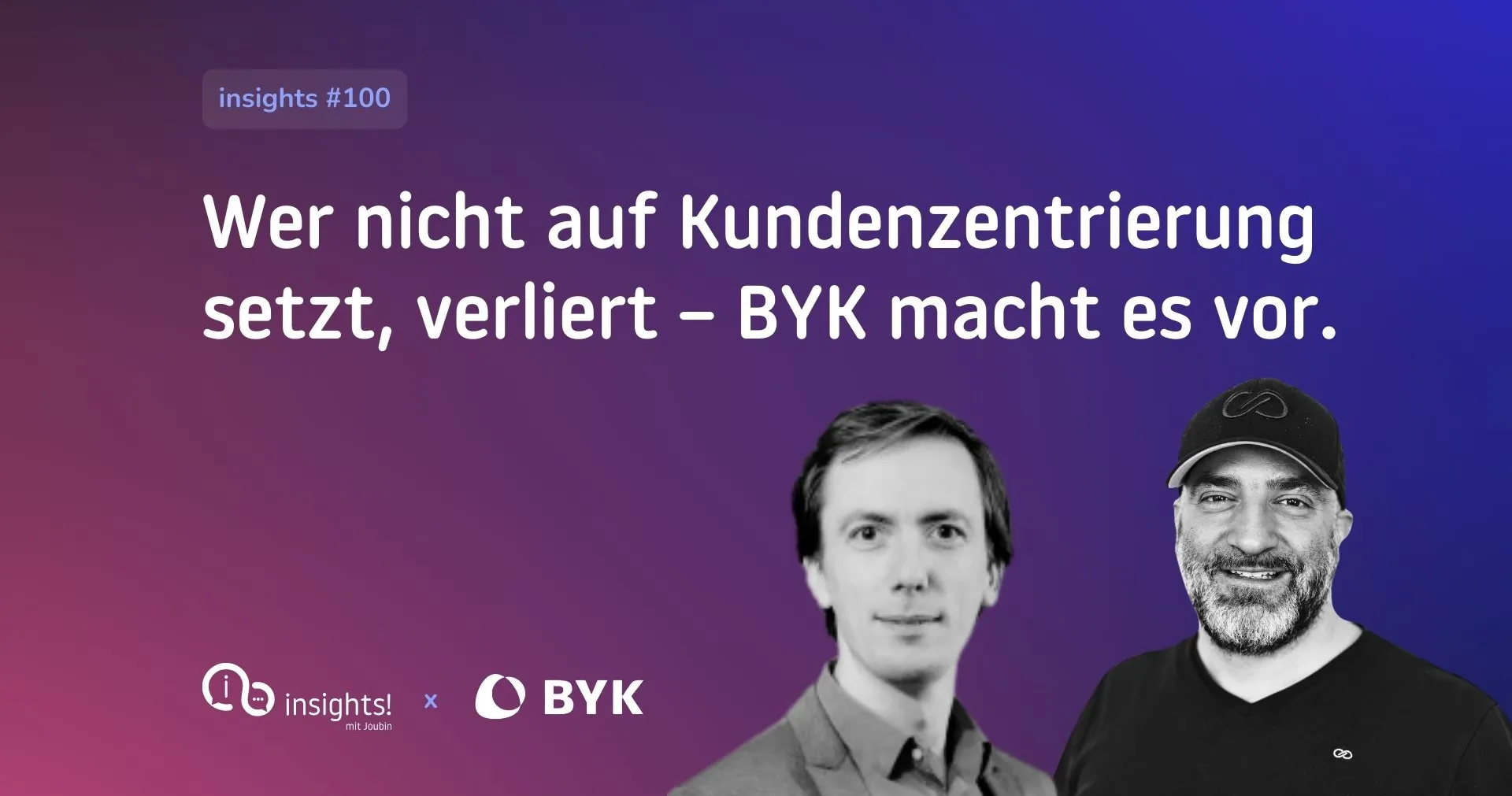
Our success is based on putting the customer at the centre and understanding what they really need, not just what we want to offer them.
With the introduction of agility and the role of Product Owner, BYK ensures that customer requirements are implemented effectively and on a data-driven basis. For the future, the company plans to use artificial intelligence to further personalise customer interaction and optimise processes.
The chemical industry is facing a revolution – and BYK, a globally active speciality chemicals company, is leading the change with innovative solutions and a consistent focus on the customer. The company has redesigned its digital processes so that they not only create efficiency internally but also take customer interaction to a new level. A look at the key steps BYK has taken in digital transformation shows how companies in traditional industries too can succeed through innovation.
BYK's digital journey: how it all began and what has changed since then
Digital transformation at BYK began over ten years ago, when the company recognised that a digital future was no longer just an option, but a necessity. With a clear focus on customer centricity and efficiency gains, the first digital projects were launched. A decisive milestone in this development was the introduction of the product information management system (PIM) around seven years ago. At the time, the idea was still visionary, but today the PIM system enables central management of all product information, which is relayed in real time to various channels such as the company website and WeChat. This means customers can access consistent, up-to-date information at any time, wherever they are – worldwide.
The success of this digital initiative shows not only in better-informed customers, but also in the efficiency of internal processes. By digitising its processes and integrating systems such as PIM, the company has laid the foundation for the next stage of digital transformation.
From CRM to customer portal: how BYK advanced its customer interaction
Another major step in BYK’s digital development was building its own customer portal. At first glance, this might look like a simple tool for ordering samples or viewing invoices. But the customer portal is much more. It’s a central tool for knowledge transfer and gives customers direct access to important product information and safety data. In an industry like the chemical industry, where technical and safety-relevant information is of decisive importance, this portal represents genuine added value.
The sample ordering process in particular has proven to be a great success. This process, which strongly resembles the ordering procedure in classic online shops, enables straightforward ordering of product samples and thus facilitates lead generation. This simple yet efficient process has achieved an impressive NPS (Net Promoter Score) of over 70 among customers – clear proof that customer focus and user-friendliness are the right priorities.
Agility and the product owner: how BYK drives digital development with new roles and methods
Introducing agility into everyday business operations was another key factor on the path to digital transformation. At BYK, agility doesn't just mean implementing changes, but also a fundamental rethink of collaboration between departments. A central element of this shift was the introduction of the Product Owner – a role originally from agile software development that acts as the link between business departments and IT.
The Product Owner at BYK ensures that every requirement – whether for the website, the PIM system or other digital projects – is not only technically implemented, but also always takes the needs and wishes of customers into account. This role has proven highly successful, as it helps keep the focus on the customer while also ensuring that all departments work in harmony. The Product Owner ensures that all decisions are made on a data basis and that the customer perspective is always taken into account.
A look into the future: artificial intelligence and personalised customer interactions
BYK's digital journey is far from over. In future, the company will focus increasingly on personalised customer interactions and gather feedback even more specifically along the entire customer journey. In doing so, they want not only to further optimise digital touchpoints such as the website and customer portal, but also to more strongly integrate offline interactions such as trade fairs and personal conversations into the process.
Another exciting area that BYK wants to develop further in future is the use of Artificial Intelligence (AI). AI is already being used to optimise the handling of customer enquiries. AI helps to automatically categorise requests and forward them to the right employee. In the long term, AI is also to be used more in customer contact, to automate processes and further improve customer service.
Take responsibility, stay curious and always keep the customer in view
The most important learnings from the digital transformation at BYK are clear ownership, constantly questioning existing processes, and a consistent focus on customer needs. The company has shown how important it is, in a more traditional sector such as the chemical industry, to implement innovative digital solutions in order to both increase efficiency and strengthen customer loyalty.
BYK has successfully taken the path of digital transformation and stays on course to continue acting as a pioneer in the industry in future. The combination of agility, data-driven working and clear customer orientation sets standards that reach far beyond the chemical industry.
Would you like to listen to the full episode?
Find the podcast of the interview here:
Please accept the corresponding cookies to view this embedded content.
Prefer to watch the episode? No problem!
You'll find a recording of the interview here:
Please accept functional cookies to watch this video.
Prefer to read?
Joubin Rahimi:
Great to have you back for a new episode of insights. Today with a few firsts and an anniversary. It's the hundredth episode, and that's something special, of course. And for the hundredth episode, we also have a special guest. Secondly, we've spruced up our setup. You can see the moss wall and the LED wall. Today the LED wall is showing TIMETOACT, TIMETOACT GROUP, synaigy is part of the whole, and we'll be swapping that out from time to time. But that's not what today is about. Today it's about Maik Dudda, Head of Digital Channels and Strategy at BYK. Welcome, Maik. Great to have you here.
Maik Dudda:
Thanks, Joubin, for the invitation. I'm delighted.
Joubin Rahimi:
Absolutely. We do have a few points of contact, but viewers and listeners aren't necessarily familiar with Bück yet. What does BYK do and where might we know BYK from?
Maik Dudda:
So we at BYK are a globally active speciality chemicals company and belong, among others, to Altana Holding. Altana as parent group, perhaps a bit better known sometimes, but is now privately owned and actually produces products you can experience everywhere in your daily environment, see where you can feel it, and among other things ensure improvements in paints and coatings. We're contained in many surfaces and ensure, for example, that table is scratch-resistant with our products. So in daily life you're really always in contact with our products, but you normally don't know us.
Joubin Rahimi:
And I find that exciting, because you're saying, really, who's beavering away the whole time? And often you don't quite know the companies behind the small improvements to the products, but you're a globally large-scale operating group. And your role, Head of Digital Channels and Strategy, describe that. What are you responsible for?
Maik Dudda:
In my role I basically get to change and improve BYK's digital customer interaction day to day. I now do that with my team of a good six people, and we're a bit of a, I always say, home base for the product owners. With us sit the product owners for, among other things, the PIM system, so the product information management, which we built up a good six to seven years ago from scratch, because it simply didn't exist before. With us sits the product owner for the website. That's also the point of contact where we do a lot of work with synaigy together, where we try to be data-driven and think and shape our development much more from the customer's perspective, from customer centricity. But we also get to develop the CRM further, which is based on Salesforce, and have a few colleagues who look after that and are in exchange day to day with sales, for example, and try to shape our processes as best as possible so that our colleagues, I'd like to say, at the front line can be successful.
Joubin Rahimi:
Mega exciting, because you also get a shift when you say, think data-driven. I know it from my history. Sales had little to do with data – I was in sales for 20 years too – but very much gut feeling. And that's not the case today anymore. Do you also have this change in the company, you said, you now have to …? Ticks differently there. So putting the customer at the centre is already something new. It's not like it's common practice.
Maik Dudda:
Yes, basically, the journey started for us too, a good ten years ago, in that direction. Back then it was recognised that, especially in the customer-centric area, you could be operating in a much more digital way, and first projects were set up. That was, among other things, also the reason for my job, which came about back then, a good eight years ago. And since then I've been able to help shape this journey. And among other things, we notice that in our processes we still come from a mid-sized-company background to some extent. So we were a company that grew fairly fast too, even though Bück itself has been around for 150 years, but especially over the last 15 years we've had enormous growth, globally too, and we simply need to grow into that in our processes, in our customer interactions. And there are plenty of examples where we're already doing that right now. And the website in particular is of course one of the channels that tries, day in day out, to best satisfy the customer's need for service, for information.
Joubin Rahimi:
And where would you say, in recent years you've done things you're really proud of?
Maik Dudda:
There's plenty. Yes, brilliant. No, well, we had the great opportunity that we got to design a lot from scratch. And that gave us tremendous freedom. So there are many really great things, like the introduction of the PIM system, which seven years ago hardly anyone had really thought about. And now we can manage product information centrally, distribute it to WeChat, for example for our Asian colleagues, or to marketplaces within the chemicals sector, to our website. We've connected our distributors, who also sell our products. That means the entire product communication is managed from a single source, essentially through one system. But the information that's out there is always the same. And that was somewhat the vision we had back then for the PIM system. But let's also take the website. We've now started building a customer portal. We've established processes that, I'd say, are actually like what you'd find in normal B2C. There's, for example, our sample order process. The sample order process is enormously important to us for lead generation, and it works like any normal order process you know, when you order shoes or something in an online shop. And that's enormously valued by the customer.
Maik Dudda:
So the client reports back to us that we have an NPS of plus 70 for this process, which is an incredibly good value. It's stable, and thinking from the client's perspective and considering how the client uses our processes, and designing them as close as possible to what they know, is actually exactly the right approach.
Joubin Rahimi:
And also, how do they decide, until they eventually go with your product? That's why, that's why the samples, probably then trying the samples out in their own processes. You mentioned WeChat earlier, PIM and WeChat. Tell me, how does that work? It's probably not that difficult, but what's the case? How do people in Asia do it? Why WeChat? Why not WeChat?
Maik Dudda:
Everyone uses that, but … WeChat is above all the main channel for finding information in China. It's really embedded into a whole life. You can even pay via WeChat. It's its own ecosystem, and I always say it's a parallel internet in China.
Joubin Rahimi:
You're like CompuSurf or AOL used to be.
Maik Dudda:
Maybe, but we're much more mature with it. And of course, if we want to do business in China, we need a WeChat presence. On the WeChat presence you can do almost the same as on our website. You can order samples, you can get in touch with us, you can request and place service. But you can also find information on products, including all documents relevant to you in chemistry. That often involves safety-relevant topics too. That means if you use one of our products, you always need a data sheet. Otherwise you're not actually allowed to have this product in your company at all. And we provide this information for download on WeChat and it's simply fed in via the PIM system. We actually have a Chinese cloud there with the high quality that we've genuinely connected, to ensure performance as well, to meet the regulations in China, and we can push our data in real time into the Chinese channels too. That means as soon as we make a change, it's available globally, everywhere in the world.
Joubin Rahimi:
And that's totally important for you too, if you change product and safety data sheet gets changed or needs changing, or that's probably new product, then it must be available instantly. You already said you have product owner in your team. Are product owners common thing or was that new for you? Because product owner is term from Scrum and agile world.
Maik Dudda:
Yes, so the product owner was completely new. I'd almost say the product owner was there before we did agility. Okay. He was a bit like the figurehead, the promoter for the topic of agility. And we did, I think it was already 2017, make a management decision back then that we could use agility, but we never managed to fully roll out agility across the company and get the understanding and also the willingness among the individual stakeholders to really work in an agile way. That's why we introduced it a bit under the radar perhaps, and first said there's a product owner, defined the responsibilities of the product owner, and in the early period tried to dock it onto the established processes. Grafted it into the organisational models, cooperation models we have.
Joubin Rahimi:
Did that work? That actually worked out quite well.
Maik Dudda:
For a few years we managed quite well and first of all achieved a certain acceptance for the product owner, to show where the added value even lies between a person who is often the bridgehead, the mediator or translator between the business department and IT. If you look at the classic, classic development we had, how it was ten years ago. Then the business department, classically perhaps also marketing for the website, would always approach IT and say: "I now want a red button here on the page." Then IT wrote a requirement, handed it over to the service provider, who developed it. Nowadays that first goes to the product owner, and the product owner asks: "Why? What do you want to achieve with this red button? Why?" Yes, exactly. What's actually the point and purpose behind it? And perhaps it then emerges in the discussion, in the requirements analysis, especially once we also bring in data: "Oops, the button maybe shouldn't be red at all, it should be green instead, and perhaps also five pixels bigger." And only then does this requirement move on into our development.
Joubin Rahimi:
Is it a classic product owner or more of a proxy PO? Who's responsible for the product? Is it still marketing, or is it actually difficult? But I think a lot of companies have this problem.
Maik Dudda:
Yes, so responsibilities are actually always shared. We never manage to draw a completely clean line right down to the last detail. That's probably not even possible.
Joubin Rahimi:
Probably doesn't need to be done either, really. Exactly.
Maik Dudda:
I don't know if it would be much better, to be honest. I haven't really experienced that either. In the end we're all a bit exploratory on this topic and keep approaching it step by step. The most important thing is that we can talk to each other about it, and that we then make a decision together on where we set the trend line. For example, we said our product owner for the website is now responsible first of all for further development on the IT side. Is responsible for the design as well as the strategic direction, but that can only ever happen together with the business.
Joubin Rahimi:
You do have the whole customer journey in mind, the entire one, and marketing is responsible, right. And marketing is then responsible for the website, isn't it?
Maik Dudda:
Exactly, marketing is subsequently responsible for the content on the website, marketing is overall responsible for the website and thus, of course, if we look at our stakeholders, actually has the biggest stake in the website. On the other hand, though, it only works together with colleagues. So why should we separate it so sharply?
Joubin Rahimi:
Sometimes it's the case that you have a PO in mind and they own everything. But typically, in a large corporation, in constellations like that, it's not like that. Exactly, yes. And you just wanted to drill into how it is at your place, but you solved it well.
Maik Dudda:
Yes, well it's also not the case that we say this is now the solution that'll stay for the next ten years, rather we'll certainly reinvent ourselves there too, we'll have to reinvent ourselves, because precisely due to the growth we're achieving, we notice that we're constantly gaining new people who can suddenly take on new tasks that perhaps didn't even exist before. So let's take the topic of analytics that we have. That it's important is, I think, clear to everyone in our company. Can we fill it out 100% the way a B2C company might, one that perhaps only has an online shop and generates millions in revenue through that. No, not yet. Perhaps as of today it's not even that important yet, but establishing the mindset among individual people, that's exactly what we're working on. And that will keep developing over time.
Joubin Rahimi:
You did say that data-driven decision-making is something important, or rather that's part of your job, to get into that. I'd guess data-based decisions were already being made at the chemical company beforehand too, for various reasons. But that's something else again, making these small-scale business decisions data-driven. Tell us a bit about the story. You said in 2017 it was decided this should be done. How did that come about? How did you put the team together? Was that a team from within the company? When did people come in externally? That's also a bit of what might matter with that kind of mindset in a company too, going in that direction, bringing people along.
Maik Dudda:
Yes, well, in 2017, unfortunately I wasn't directly involved yet. So I can only tell you what, as you might say, I picked up along the way. But in 2016, 2017, a very large strategy phase was carried out together with a partner, and various use cases were drawn up that could be relevant for our customers, based on customer interviews, based on figures we had available, but of course also on recommendations on where the market in general was heading. And out of that came things like a high-level description of a customer portal, or mechanisms for finding and filtering products, none of which we had at that point at all. And from that it became fairly clear what skills we'd need in future. How individual areas would need to be built up together. So a high-level architecture emerged, consisting of the PIM system, the website, and ultimately also the CRM system. And that's how we gradually shaped an area, step by step. In 2018 I was a lone fighter. These days I get to work with a great team, which also helps me carry out this journey for these products as best as possible, because alone I can't achieve much – it's always the experts on my team who hold responsibility for the respective product and can steer it.
Joubin Rahimi:
Did they come from inside or did they come from outside?
Maik Dudda:
We actually sourced most from outside. Also brought in one or two colleagues from within, who had already worked on the topic, for example CRM, before. So why search for a Product Owner when we have a great Product Owner within the company? Excellent. And we always looked at: who has the right mindset? Who has the right skills for it? Sometimes a bit of luck comes into it too, so that we now have a fantastic team.
Joubin Rahimi:
This story is now roughly five, six years old, five, six years since you set out. If you project that forward, what topics do you see coming your way? Strategy is also part of your title now or in future — what are you focusing on for the future?
Maik Dudda:
Well, on the one hand we're of course thinking about: What should interaction with the customer look like in future? What functions does the customer need in the customer portal? How can we display information that currently perhaps only customer service can provide from the SAP system, etc. How can we design this so that it's also legally compliant? Because we have various roles within the customer companies too, and can't show everyone everything all the time either. These are major challenges for role and rights management, which we sometimes have to try to map within the systems. In order to establish the processes, and that's enormously challenging at the moment on the one hand, and on the other hand we're still working hard on the area of bringing customer-centric developments into the company. And this year we're establishing customer feedback management, which ensures that we collect feedback from customers on a touchpoint basis, related to interactions.
Joubin Rahimi:
So always small mini-feedback on the thing?
Maik Dudda:
Yes, to improve respective processes, respective touchpoints and channels. And this shouldn't just become a one-way street, meaning we don't just want to collect, but as soon as customer says – and we've already piloted this – "I have a problem" or "I didn't receive an order, for example a sample wasn't received", then we open a ticket in Salesforce and it gets assigned immediately to respective sales colleague, so they know there's an action needed. Customer is currently rather dissatisfied. I'd need to follow up and make sure sample really reaches customer.
Joubin Rahimi:
You went a good few rungs up the ladder there too, straight from the tyre. So I actually do surveys about these micro-surveys, that's pretty cool.
Maik Dudda:
So we've also looked at the entire customer journey over the past two years and identified the touchpoints relevant to us. We started with the online touchpoints first, of course, because that's easier from our perspective, since we're a bit closer to the technical development side there, but we now want to move gradually into the offline touchpoints too and gather feedback there in the same way, because we have enormous... I have contact with our customers at trade fairs, for example. Why not ask: "What was the experience like at the trade fair? How did the conversation go?" Because visit reports are also logged in the CRM, and I can obviously trigger an interaction straight away based on that and survey the customer.
Joubin Rahimi:
The portal you implemented, the customer portal, what are the typical functions? Receive invoices, order something? Those are the no-brainers. But do you have other components built in as well?
Maik Dudda:
If you look at it that way, in chemicals we might not be quite as far along in that mindset as many traditional companies. For us, a lot revolves around knowledge transfer too.
Joubin Rahimi:
So safety briefing on products, then?
Maik Dudda:
Yes, there's even more information on products. We're planning to move more towards e-learning too, so knowledge transfer on individual topics, which is then also exclusively available for customers. In the end that's also a bit of added value that we as a company have, which is also seen by customers, that we do a lot of knowledge transfer on what's actually a very small, specialist area. And if you talk to colleagues from classic chemistry, you'll very often hear that the topic of additives is rather unknown, even in chemistry studies. And it's very important for us to actually convey, even in the chemical field: what are the big – what are the advantages of our products? So what can we achieve in a coating? And that's exactly the information we're then happy to pass on in the customer portal too.
Joubin Rahimi:
The customer journey is always very personalised then. So depending on which area I'm moving in, different content probably needs to be delivered. I don't know whether that bridge really fits or not, but in many of the conversations AI is always a topic. What I mean is, is that a topic for you too in the customer journey? Either that you become more efficient or can base new services on it that you couldn't previously implement. Is there anything there?
Maik Dudda:
Yes, so we use AI very cautiously, especially when it comes to customer contact. Then we first focus on the things the customer doesn't notice straight away. That's for example the routing of cases, so of enquiries the customer raises with us. There we now make use of AI, which is built into the process and automatically categorises the enquiries and sends them into the queue, so the right employee can then take it on. In customer contact I personally still find it somewhat difficult, also from experience with large chatbot solutions from a good eight years ago. But what I found for myself there was, one thing, the volume of training data. And we simply don't reach these large volumes of training data that, say, a consumer company has, which might get thousands of customer enquiries per day. We sometimes only reach that in a year. And especially once you start categorising individual enquiries, having them answered automatically, these are things that often require specialist knowledge, knowledge of the underlying chemical processes. And there we simply face big challenges in getting AI to answer things fully automatically.
Joubin Rahimi:
I just had an experience. Murphy's Law, Friday evening, my daughter said she was going to have another bath and then was put to bed. We went down into our hallway and suddenly, splish splash splish, no, water. We had a blockage. Not the first one. We now basically have a kind of customer card with our company that then helps. And they had something funny set up beforehand. I called them, so 24/7, and they had a bot take down the details first. That was quite interesting. So who am I? Where's the problem? Discussed a few things. And that was where this process, this kind of data collection, then routes me to. I found that more pleasant than "please press one" or "please press two". Now that personal, but you as a pro, do such intermediate bots make sense, I'd call it. Where do you stand on that with your opinion?
Maik Dudda:
This is something we're evaluating for ourselves too. So could we perhaps capture pre-qualification of enquiries, i.e. metadata, could we not do this via a bot, and isn't this then also, to some extent, an area of expectation management where you tell the customer: "I'll take down all the data first and we'll get back to you within a certain timeframe, we'll call you back soon" as the classic goes, but then you don't need to repeat all the data again, we can start directly where your problem is, where your enquiry is. That's definitely relevant for us, we're looking at it right now too, but the big challenge for us is often that we have to think about it internationally and ideally in international languages, not just English or German, but also directly Spanish, Chinese, Dutch. Exactly, so a whole circus of languages we have to cover. That's always enormously challenging and sometimes difficult to simply steer regional aspects on a topic, because we often can't control the customer. Of course, customers can't be controlled. The challenges we keep having, we don't want to get rid of either.
Maik Dudda:
That's why we say the customer is in control in the end. The customer should have the choice, but it always makes it a bit tricky.
Joubin Rahimi:
Yes, that is, I think, the shameless bit and that's great about the task. If you had a sparring partner now and they said: "What are the top one to three things you've learned in recent years that you would pass on to a young colleague? What would come to mind spontaneously?
Maik Dudda:
I always think it's really important to find your own area of responsibility. I think in large corporations a lot of things are often unclear. I believe by taking on responsibility and through your own area of responsibility, you can create a great field within the company where you can really add value. And that's what drives me, to add value for the customer somewhere. And I can really only do that by clearly stating: what am I actually responsible for? And then actively driving that topic, because through that responsibility the need for me to bring about improvements usually arises in me too. And so always being a bit curious, firstly, about what's happening around me, but also about what actually helps the customer, and really questioning the processes too. So in short: seek out responsibility, stay curious, and always, I think, argue from the customer's point of view.
Joubin Rahimi:
And to optimise, yeah? Exactly.
Maik Dudda:
No use going purely on gut feeling. I have great ideas. Of course I always think I have the best idea, but the customer sees it differently. So we always need certain humility to say the customer is who we build processes for, not for me or for other superiors who might find the function great — the customer is the one who judges.
Joubin Rahimi:
I think that's a really nice closing word: the customer is who we build the processes for. And that's something, I believe, everyone responsible for the customer journey or for a company can take to heart. And with this wise sentence, I'd like to say thank you, dear Maik, for the hundredth episode, for all your insights and also for the collaboration over the years.
Maik Dudda:
Thank you. Thank you, Joubin, for letting me be part of the anniversary episode too.
Have questions or feedback?
Then feel free to contact us directly.
- Joubin Rahimi
Managing Partnersynaigy
Show phone numberShow mobile numberShow email address
Subscribe to the blog now and never miss any news
✔️free of charge ✔️weekly news ✔️expert knowledge
Please accept the corresponding cookies to view this embedded content.