



insights! #91: That's why change is so hard for us
This time I had the fantastic Dr Sevda Helpap in the interview, and we talked about change and transformation in organisations. Spoiler: change is uncomfortable for many people at first, but that's exactly where the exciting change process begins! Sevda is convinced: real change isn't dictated from the top down, but emerges from the centre of the organisation. Employees must have the opportunity to get involved – without fear of making mistakes. That's the only way change can truly succeed.
 Joubin RahimiManaging Partner · synaigy
3 min. reading time
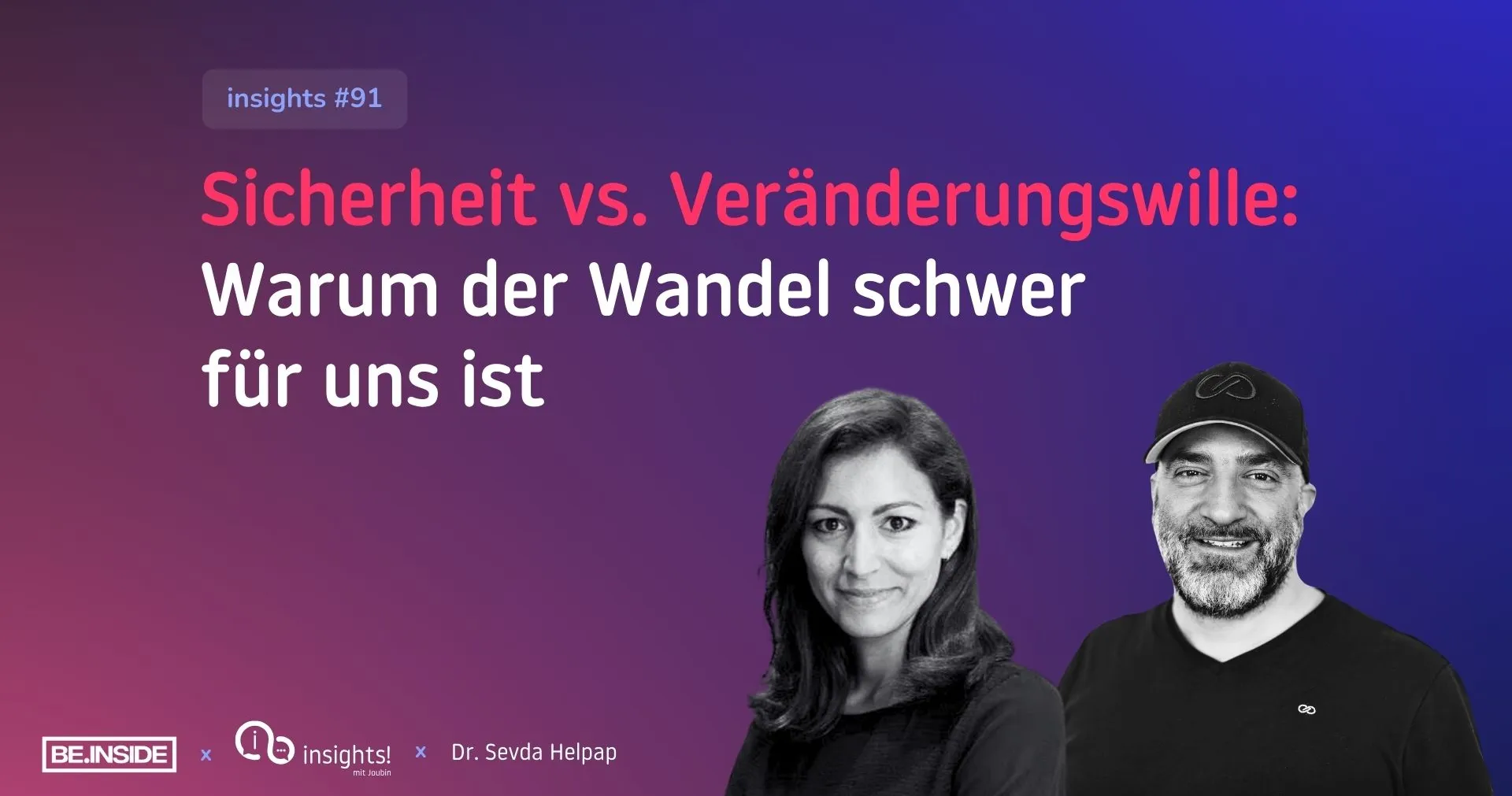
Perhaps we need to unlearn things in order to be able to learn again.
In this insights! episode, Joubin Rahimi talks to Dr Sevda Helpap, business psychologist with a doctorate, lecturer and Managing Director of Baumgartner & Co, about the challenges and opportunities in shaping change within organisations. Topics such as employee participation, self-organised teams, the importance of mindset shifts and building a culture of learning from mistakes are the focus. Sevda shares her practical experience and provides valuable insights into how transformations can be successfully implemented from within.
At a time when organisations need to become more agile and adaptable, one topic is particularly in focus: change management. But how can an organisation shape these changes so that employees not only go along with them, but actively contribute? Dr Sevda Helpap reveals the answer. Her insights revolve around shaping change processes – and she shows that successful change comes above all from the centre.
Why change is often unpopular – and what helps
"Nobody actually wants change," says Dr Helpap, and she's spot on. We humans are naturally security-oriented and love our familiar routines. The thought of change often causes resistance, even though change is considered inevitable in the modern working world. The solution? It must become clear, "What's in it for me?" – what do employees actually get out of it? As soon as the individual benefit of a change becomes apparent, willingness to help shape it also increases.
Change from the centre outwards
In the past, organisational change was often a top-down process: the leadership team develops a vision, assigns a team to it, and the change gets under way. But this approach is outdated and no longer works today. Instead, transformations must emerge from the centre of the organisation. Employees should not just be executors, but actively involved in the change processes themselves. The more decentralised the changes are conceived, the more sustainable they are. Hierarchical structures should therefore make room for more personal responsibility and self-organised teams.
Personal responsibility as the key to success
A crucial point for successful change is personal responsibility. Many organisations are still strongly hierarchical, but that doesn't have to be an obstacle. Responsibility can also grow within existing structures without abolishing all levels of management. What matters more is psychological safety: do employees feel safe enough to contribute ideas, take on responsibility and even make mistakes?
Unlearning in order to learn anew
"Perhaps we need to unlearn things in order to be able to learn again," says Dr Helpap. This sentence sums it up: old thought patterns and entrenched structures often need to be broken down first to make room for something new. But that also means responsibility can't just be given – employees also need to be willing to accept it. And that only works if trust and space are created for it.
Learning-from-mistakes culture: it's okay to fall flat on your face
Finally, it gets a bit philosophical: managing director Bastian Siebers once said, "Falling flat on your face is also a step forward." He's hit the nail on the head. Change always means making mistakes – and that's okay! A healthy culture of learning from mistakes is part of every successful change. Mistakes aren't the end, but a step in the right direction.
Want to listen to the full episode?
You'll find the podcast of the interview here:
Please accept the corresponding cookies to view this embedded content.
Would you rather watch the episode? No problem!
You'll find a recording of the interview here:
Please accept functional cookies to watch this video.
Prefer to read it?
Joubin Rahimi:
Thanks for joining a new episode of insights! My name's Joubin, Joubin Rahimi, and today Sevda Helpap is here. Hi Sevda.
Sevda Helpap:
Hi. Glad I could join.
Joubin Rahimi:
Yeah, brilliant. We're at BE.INSIDE today and you've also got the panel talk coming up.
Sevda Helpap:
Looking forward to it.
Joubin Rahimi:
That'll be great. Now, if you're not there, you're missing the whole thing. But maybe you could say a couple of sentences about yourself first.
Sevda Helpap:
Sure. I'm Sevda Helpap, I hold a doctorate in business psychology, and what's always driven me is really the question: how do we shape change? How do we shape change for people, for teams, for organisations. I first did that academically. I examined it scientifically, taught on it, did research, and at some point I thought: I want to get stuck in, I want to do this myself, and went into consulting, and for several years now I've been leading, as managing director, a consultancy that guides organisations through their change, their transformation towards new ways of working.
Joubin Rahimi:
We deliberately had really hard chairs and benches for all the talks. I allowed that. Right, another 90 minutes on those things. I also forgot to mention, we deliberately chose these chairs because with pain you learn better, apparently.
Sevda Helpap:
Is that so?
Joubin Rahimi:
Are people open to change? Is that true? That's what I wanted to ask you. Is that true?
Sevda Helpap:
I don't know about pain, but I definitely know you learn well when you have a good anchor, when you can relate it to yourself, when you hear the added value from it and really have learning nuggets where you have points to connect to. And that's why it's always good when learning isn't too comfortable, when there's plenty of interaction — and you have that today. You've got the round tables, you create movement. And I think that's a great learning environment.
Joubin Rahimi:
That was great. We'll take that feedback on board.
Sevda Helpap:
Exactly.
Joubin Rahimi:
Yeah, it can't be too comfortable. And you really only learn when you actually want to. But people don't want change, do they. Most people, I've learned, value security and love the same rhythm. So how do you get people to say: hey, this is cool.
Sevda Helpap:
Yes, I think that's an important point you're making, because sometimes it gets glorified, everyone into the change, everyone into the transformation, but honestly, deep down everyone finds that a bit annoying at first. Yes, and actually no one really feels like it, even if it's promoted that way, so to speak, because the change has to come. And I really think what's crucial there is also recognising what's in it for me, what's in it for us. So as an organisation too, it helps to sit down and say clearly what exactly we want to change and how you can take part in that. And I think what we often used to do is that very typical approach of: we have a vision, then we have a team, and then we implement it. And I'd say that top-down change approach is completely outdated — the changes that are actually effective are the ones that come from the middle, where employees themselves get involved in the transformation, so it's about thinking transformation in a much more decentralised way, not turning everything upside down, but letting it grow out of an evolution, letting teams act, giving more room, giving more scope, and also accepting that not everything runs uniformly.
Joubin Rahimi:
You said, from the middle.
Sevda Helpap:
Yes.
Joubin Rahimi:
So for you, the employee sits at the centre.
Sevda Helpap:
Definitely.
Joubin Rahimi:
So you have a different picture too, not a hierarchical one, but a …
Sevda Helpap:
A self-organised, networked organisational system, where transformation is a task for every team, not a single starting point and not a single vision, but where every team has to define for itself: how do we want to work? How do we want to shape that for ourselves? Which teams help us in our work? And so really seeing that as a mandate, and from there moving from the middle out into the organisation.
Joubin Rahimi:
Do I have to … I mean, a lot of companies are, I think, still stuck in these hierarchical thought patterns, let's say. Does that fundamentally have to change first before I can even get change moving quickly, or?
Sevda Helpap:
Well, the companies I mostly deal with are hierarchical organisations, and I think you do have to change something about the structures, but the more important thing is actually the view of people, the mindset. If we already change something there, then I can also work quite differently within hierarchical structures, because there's hierarchy and there's hierarchy. Yes, so there's a difference, even if you can't hear it in the word itself.
Joubin Rahimi:
No, absolutely. Hierarchy and hierarchy.
Sevda Helpap:
Exactly, exactly. And I think it comes down to giving trust in responsibility, in personal responsibility, leaving room for decision-making scope. You can do that within these structures too. You don't necessarily have to say: hey, we're now cutting all management levels and setting up some kind of circle system and doing everything completely differently — you can absolutely make sure, even within an existing system, that personal responsibility is lived and that this can emerge from the middle.
Joubin Rahimi:
So how do employees get to the point — not me, but how do employees get to the point where they say: I can decide for myself. Maybe I don't even want to, but I've understood that I probably have to. External influences too. But then you also always have to do things that you maybe weren't allowed to do for 10, 15 years.
Sevda Helpap:
Yes, and that's really fascinating. You started with learning, our conversation here, and I'd say maybe we have to unlearn things in order to be able to learn again. And one of these things to unlearn is precisely that attitude of "those up there" or "one should, would, could". Cross it out. I do, we are, how can we? And I think that has a lot to do with the mindset within the team, with the attitude of what I give as my area of responsibility. And that has a lot to do with giving and taking trust in responsibility. Someone can give it to me, but that doesn't mean I take it.
Joubin Rahimi:
Yes, of course.
Sevda Helpap:
And I think both of those, that's already interaction with one another. That's why I also think it's too short-sighted to only tweak leadership, because on the other side too, at team level, there also has to be resonance and also a take-up of responsibility. And so, I think, it really is an interplay of these changes, and also getting to the point where we really learn this and can carry this responsibility. And one aspect that comes with that very fundamentally is what's called safety culture, psychological safety, as it's often labelled. Do I feel safe enough to put forward a completely wild idea, or to do something completely different? Can I do that without facing consequences? And that really is the basis for it.
Joubin Rahimi:
And that's probably the biggest task for the owners, because that's probably where it starts.
Sevda Helpap:
Yes, absolutely. And that's why leadership, or culture, matters so much again, because it shapes the culture, saying: hey, am I allowed to help shape things here? Or will I get shot down? Or will I mess something up for myself? Do these beliefs linger, or can I actually get involved here? And really, whatever change I'm making, in the end it's always a cultural question, which serves as the basis for how boldly we can move forward and make it happen. And that's where I'd start too.
Joubin Rahimi:
And that's definitely a great closing line. Thanks for the summary.
Sevda Helpap:
Thank you.
Joubin Rahimi:
And if you have questions, just use the LinkedIn comment function, quite a fancy thing.
Sevda Helpap:
Yes, thanks.
Joubin Rahimi:
We reply too. And through that function you can get in touch with you and then of course dig much deeper into the topic. Because we benefit when organisations are flexible and try new things. And I think companies benefit from genuinely taking a step forward in today's world too. And one more thing I have to say: I'd actually already wrapped up, but this stuck with me too. Bastian Siebers said that falling flat on your face is also a movement forward.
Sevda Helpap:
Exactly.
Joubin Rahimi:
So: a culture of learning from mistakes is good too. Thanks Basti for that line. Thanks to you, Sevda, that was great.
Sevda Helpap:
My pleasure, thanks. Have fun.
Got questions or feedback?
Then feel free to contact us directly.
- Joubin Rahimi
Managing Partnersynaigy
Show phone numberShow mobile numberShow email address
Subscribe to the blog now and never miss any news
✔️free ✔️weekly news ✔️expert knowledge
Please accept the corresponding cookies to view this embedded content.