



insights! #84: Between hype and reality: what chatbots can really deliver in e-commerce
 Joubin RahimiManaging Partner · synaigy
3 min. reading time
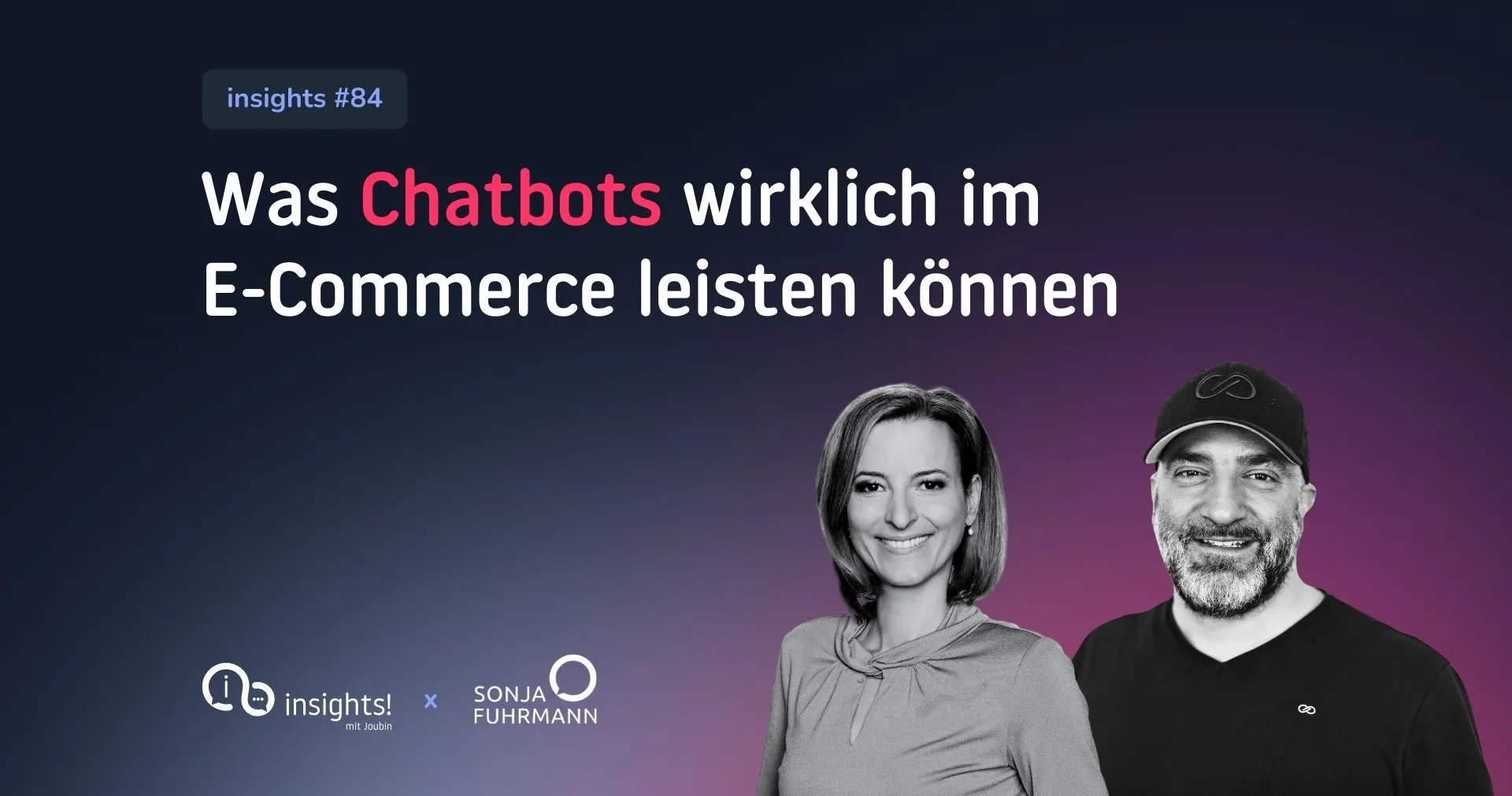
In this insights! episode, Sonja Fuhrmann, TV presenter, interviewed me about the future of chatbots and their current use in various industries. We discuss how chatbots are being used today, particularly in the car industry and the fashion sector, and take a look at the limits and possibilities of this technology. You'll also learn how chatbots can improve customer service and what developments are to be expected in the coming years.
Are chatbots the cool assistants of the digital age, or perhaps just programmed small talk after all?
Chatbots – the digital helpers of the future?
Are chatbots really the smart assistants we were promised, or do they remain stuck at the level of programmed small talk? At present, many chatbots primarily perform simple tasks such as answering standard questions or providing information. The future, however, holds more in store for us. Chatbots are evolving into comprehensive digital assistants that not only handle simple tasks but also enable complex interactions.
Where chatbots stand today – and where their limits lie
Today, chatbots are already being used in various industries to automate repetitive tasks and handle customer enquiries efficiently. In the automotive industry, for example, they help with vehicle configuration, while in the fashion sector they support efforts to reduce the number of returns. However, they still reach their limits when it comes to processing large volumes of data and integrating into complex processes. The challenge lies in further developing these systems so that they can take on increasingly demanding tasks without losing efficiency.
New customer interactions through chatbots
Chatbots offer an interesting opportunity to improve and personalise customer interaction. They are able to provide instant responses to customer enquiries, which is particularly beneficial in customer service. But how far can a chatbot go? While a good chatbot can support customers in their decision-making through skilful questioning, this also raises the question of when this tips over into manipulation. Much like a skilled salesperson, a chatbot can also influence customer behaviour – a balancing act that needs careful thought.
The future of conversational commerce
The development of conversational commerce is still in its early stages, yet the possibilities are immense. In the coming years, chatbots could evolve from simple text-based systems into highly advanced voice assistants and avatars. Integration into VR is also conceivable, where they could appear as personal advisors in virtual worlds. These technologies will fundamentally change the shopping experience, and companies that invest early in these developments could gain a decisive competitive advantage.
Chatbots have the potential to be more than just a technical gimmick – they could become one of the most important tools in e-commerce. While the technology is still young, it already offers diverse opportunities to improve the customer experience and optimise processes. Companies that engage intensively with chatbot implementation now could benefit significantly from these developments in the years ahead and position themselves sustainably in the market.
Would you like to listen to the full episode?
Here you'll find the podcast of the interview:
Please accept the corresponding cookies to view this embedded content.
Would you rather watch the episode? No problem!
Here you'll find a recording of the interview:
Please accept functional cookies to watch this video.
Would you rather read it?
Sonja Fuhrmann:
Are chatbots the cool assistants of the digital age, or perhaps just programmed small talk, Joubin?
Joubin Rahimi:
Right now it's certainly still a lot of programmed small talk, or small information providers, but it's going to be a digital assistant, or rather a manifestation of your digital assistant.
Sonja Fuhrmann:
Where are the limits at the moment?
Joubin Rahimi:
When it really comes down to a lot of information and clear recommendations. That's roughly where the line has to be drawn. And the more processes come into play, the more expensive it gets, so the limit there is money and integration into existing systems.
Sonja Fuhrmann:
How are companies already using conversational commerce today?
Joubin Rahimi:
We see that really nicely with cars and car manufacturers. There are lots and lots of these chatbots to answer questions around configuration. Funnily enough, they all always look a bit the same too. But de facto that's an area where it's used well. We also have things in the fashion sector, clothing and so on. But there it's harder, it's still trickier. People trust a chatbot less to answer style questions or other questions, although the aim is to use it to reduce size- and returns-related issues.
Sonja Fuhrmann:
Does that work?
Joubin Rahimi:
Depends on the data. So if you have good data, then yes, then you really can reduce returns, and the question is: how do I collect it? A quick aside: some measure shoes and even feet. That's the most elaborate approach, and others simply take the returns data - which shoes were delivered - plus the answers that go with it, to say this one's too wide, too loose, too narrow, too big for that size, and pass that recommendation on. That's less precise than the other approach, but I think the imprecise one is entirely sufficient in terms of price-performance, because it's a twentieth of the cost.
Sonja Fuhrmann:
I don't know if you've worked with chatbots at home before. Probably yes, I always found it, well, hit and miss. Would you say chatbots have actually improved customer service?
Joubin Rahimi:
I think the question is when … Chatbots do improve it, but as with any personal interaction, if the interaction is simply bad, then it doesn't help. There's also - a completely different example - chatbots in situations that aren't meant for the customer at all, but for the defaulting payer. Imagine you have an invoice that, for whatever reason, hasn't been paid, a reminder arrived, emails arrived, and then you get an automated call with a nice smooth computer voice, precisely with the information: this is outstanding. In ten days we'll initiate the official reminder procedure. That's obviously pretty harsh, but you also know you'd need to pay. And then a chatbot, in a real case, can also say: "Get in touch with us. It seems you're having payment difficulties. We'll find a solution." That's a bit away from the typical discussion, but that's another way these chatbots can be used, and it actually helps both sides.
Sonja Fuhrmann:
Yes, that's one type of benefit. What other concrete benefits do companies get from using chatbots?
Joubin Rahimi:
The main challenge is that in this world we have to make over 300, 400 decisions a day, quick decisions. And when you're about to buy something or decide on something, you often need a bit of support, a little nudge or a piece of background information. And that's where a chatbot really helps. One example where I'd have wished for one is a manufacturer of window seals. They had seven different variants, but which one should I choose? And because of that, I didn't buy that seal for a whole year, a whole season, because I couldn't get that question answered. The information was somewhere on the website, but I could have used a chatbot and said: Here, I've got windows like this. What would you recommend? And if it had maybe asked me a follow-up question, I'd have gone ahead. I wouldn't have called, because I thought: Ugh, do I really want to phone a call centre now.
Sonja Fuhrmann:
Right. But what about the notorious gut decisions? I don't know how you two decide. In the end, I decide intuitively. Don't chatbots kill that?
Joubin Rahimi:
They don't make a decision for you, or for either of us, in fact for none of us — they give you information, just like a good salesperson would too. I don't know what question's coming next. Is it manipulative?
Sonja Fuhrmann:
Where's the line to manipulation? Yes, exactly. Great minds think alike.
Joubin Rahimi:
If you set them up right, you can of course use all these questioning techniques to nudge someone towards a purchase. Even quite heavily. But of course, if the customer ends up unhappy, you get returns again, and no long-term customer satisfaction. It's tricky. Chatbots aren't the problem when it comes to manipulating people either. A really good salesperson — I'm not wearing glasses today — but I've bought four pairs of glasses. Yes, I'm susceptible to manipulation on that front. There was wine, there was beer. He was brilliant, and alongside the two pairs of prescription glasses he then sold me two pairs of sunglasses as well, one for my wife and one for me. And I'd only meant to leave with one pair of glasses. He did everything right, that salesperson. He completely manipulated me there, but in a likeable way. And I think that's the key. I'll go back there for my next pair of glasses.
Sonja Fuhrmann:
Right. How do you see conversational commerce developing over the coming years? What's going to happen there?
Joubin Rahimi:
I think we're still at the beginning. Five years ago we got to build something for a large clothing manufacturer, and let me briefly describe what we built, how long it took, and how long it would take now to get to that same point. We had six cases, as they were called. So there were six, seven million emails coming in, and six cases were handled. Returns, something broken, my checkout didn't work, so the price was calculated wrong. I've got a merchandise voucher. The value's not right. There were six cases like that, and first we had to understand these cases. We had 40 students sitting on it for a week, classifying emails, and then saying: "Okay, these are the cases," and to reach a high probability. We achieved a success rate of just under 82%, so a bit above, which was already great, because that 82% didn't need to be handled manually — including integration into the backend systems, so that a return slip gets created and so on, checking that it really is the customer writing in, that kind of thing. Just under 350 days for the whole thing, not counting the students. So horrendous, horrendous. That was a lot. I'd say integration now is significantly faster, maybe 100 days, but we also don't have 50 students any more, more like 10 person-days, and you'd already have that language model built. That's from back then to now, and it's not linear, it's a lot faster.
Sonja Fuhrmann:
Exponential.
Joubin Rahimi:
Exponential. And then the question is: Is the chatbot just a chat? Is it voice? Is it an avatar? Is it VR in my glasses? So these are topics that are coming very, very quickly.
Sonja Fuhrmann:
Right, so that's the next question: Which technologies will follow next in this space? You mentioned VR.
Joubin Rahimi:
And that'll be one of the next ones. So from — I just have text, which is the simplest form for a system — to understanding voice even better. We all know Alexa, Siri. Exactly. Where Alexa currently gets noticeably better results, in my view, but I think some others feel the same way, than Siri does, but that's going to move forward. And then I have voice, and then comes image, and then moving image.
Sonja Fuhrmann:
Right, so there's still room for improvement.
Joubin Rahimi:
There's room for improvement there, yes.
Sonja Fuhrmann:
But it could move faster than we think.
Joubin Rahimi:
That'll move faster than we think too, yes.
Sonja Fuhrmann:
Thank you very much, Joubin, for the conversation, and thank you all for your attention.
Joubin Rahimi:
If you still have questions, just leave a comment below or share your thoughts, and maybe also tell us where you think conversational commerce, or this whole chatbot thing, is heading.
Got questions or feedback?
Then feel free to contact us directly.
- Joubin Rahimi
Managing Partnersynaigy
Show phone numberShow mobile numberShow email address

Subscribe to the blog now and never miss any news
✔️free ✔️weekly news ✔️expert knowledge
Please accept the corresponding cookies to view this embedded content.