



#126 - Using the cloud sovereignly – when hyperscalers make sense and when they don't
Cloud isn't just cloud, and whoever relies on diversity instead of dependency acts sovereignly. Marc Achsnich from synaigy explains why companies today should look beyond hyperscalers. It's about control, responsibility and real digital independence. Europe has long had strong alternatives – like OVHcloud – and proves that innovation works without monopolies too. Find out what a sovereign cloud strategy looks like and why diversity is new stability.
 Joubin RahimiManaging Partner · synaigy
4 min read
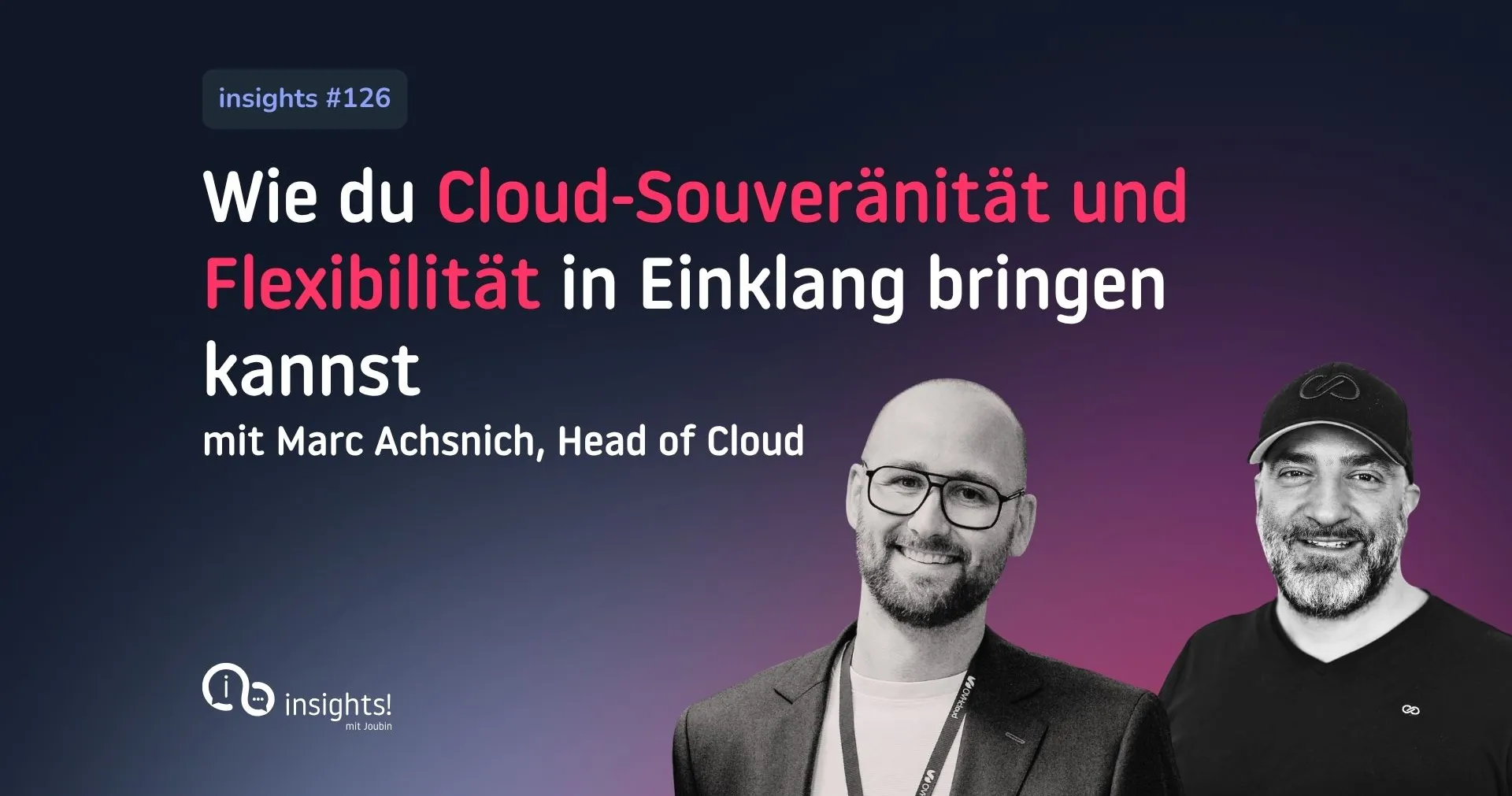
There's no such thing as the wrong cloud. Each has its strengths – what matters is not relying on just one. Diversity ensures everyone moves a little out of their comfort zone, and something better results in the end.
For years there's been an unchallenged belief in the big hyperscalers. AWS, Azure and Google dominate – technically strong, globally connected, innovation-driven. But this very dominance has its downsides: dependency, limited control and geopolitical risks. Anyone who seriously engages with the topic of digital sovereignty quickly realises: it's not just about technology, but about responsibility. For us, this shift in perspective happened early on. Instead of blindly relying on the biggest players, an awareness grew that European alternatives offer a genuine opportunity for our customers.
Change begins with the right question
The path to greater independence didn't begin with a grand master plan, but with a simple question from customers: why should retailers pay money to a US corporation for the privilege of selling their own products? This legitimate consideration led to rethinking the topic of cloud from a new perspective, namely not as pure infrastructure, but as part of a value chain that should be fair, transparent and future-proof. The result was an openness to alternatives that are more relevant today than ever. Providers like OVHcloud show that innovation can also emerge in Europe – powerful, scalable and, at the same time, in line with European data protection and compliance standards.
Sovereignty isn't a nice-to-have, it's a MUST!
Sovereignty is often equated with data security, but that falls short. It's about control over systems, freedom to decide and the ability to act independently when political or economic conditions change. Especially in times of rising geopolitical tension, this independence is coming back into focus. Companies that rely too heavily on individual providers make themselves vulnerable – both technically and economically.
Sovereignty, then, doesn't mean slowing progress down. It means shaping it deliberately — with a clear understanding of where data resides, who owns it, and who pulls the plug in an emergency.
Europe's cloud reality: stronger than many believe
OVHcloud is an example of how European providers have become alternatives to be taken seriously. The company combines technical maturity with economic appeal: broad service portfolios, flexible models and a pricing structure that even challenges the big hyperscalers. What's particularly interesting is its origin: starting out as a hardware manufacturer, OVHcloud developed step by step into a public cloud provider and today offers what many large corporations are looking for: transparency, fair pricing and full control. For synaigy, this is more than just a partnership. It's a statement in favour of diversity in the digital ecosystem. It's a commitment to the idea that innovation can work without monopoly structures too.
Three steps to a sovereign cloud strategy
Anyone wanting to set up their cloud strategy with sovereignty should start small but deliberate:
1. Stocktaking: Which data is critical, which is harmless? Only those who know this can decide which cloud makes sense.
2. Prioritisation: The cloud isn't an IT playground, it's a strategic topic. Decisions belong at management level.
3. Balance: Innovation must not lead to dependency. Those who foster diversity in their infrastructure remain capable of acting long-term
The future of the cloud doesn't lie in the size of a provider, but in the ability to intelligently connect multiple worlds. Sovereignty isn't a step backwards but progress with conviction. It's a sign that Europe can take on responsibility. Whoever fosters diversity today secures independence tomorrow. And that's precisely where the true strength of a modern cloud strategy lies.
Would you like to listen to the full episode?
Find the podcast of the interview here:
Please accept the corresponding cookies to view this embedded content.
Prefer to watch the episode? No problem!
You'll find a recording of the interview here:
Please accept functional cookies to watch this video.
Prefer to read?
Joubin Rahimi
Great to have you back for a new episode of insights! My name is Joubin, Joubin Rahimi, and joining me today: Marc Achsnich, a Fellow of TIMETOACT GROUP and, within synaigy, the person driving Managed Services and the topic of Cloud and Sovereign Cloud. Hi Marc.
Marc Achsnich
Hi Joubin.
Joubin Rahimi
And the nice thing today is, I'm more the unstructured type, Marc the structured one, and he asked me. Did you read the questions? No. But we still enjoy working together, and I did skim through them again. And we're keeping the intro light.
Marc Achsnich
I'm keen to see.
Joubin Rahimi
We've already covered quite a lot of ground together on the topic of cloud. And we had AWS, I think we've now had 15 years of AWS partnership, but we've moved part of it away from AWS. And you were significantly involved in that, it was one of the first activities. But how did you come to the topic of cloud and sovereignty?
Marc Achsnich
Yes, that's quite exciting. I think sovereignty wasn't really our core focus at the start. It was more a topic that came from our customers asking us: you're on AWS, that's our main competitor. Why do we actually have to pay you, or AWS, money just to be allowed to sell. And also at synaigy one of our guiding principles has always been that we stand for diversity in retail, or also that we say, if we can simply do something from Europe, then we should just try it. And that became a starting point where we thought, there's something to this, and we went looking to see whether there are simply alternatives that just aren't a hyperscaler.
Joubin Rahimi
Und wie war das damals? Vor wie vielen Jahren?
Marc Achsnich
I think that must have been five or six years ago, when we slowly started out and thought about: what is it we really need? What use cases do we have that need covering? And then took it a level deeper, because in the end the question is, Kubernetes for example, in theory everyone has it, but then the question is: what do you do with it? And what level do you actually need? And then you already noticed, and that's where the wheat gets separated from the chaff.
Joubin Rahimi
And, how exciting is it, we've also been an OVH partner since that time on one hand, and now we're also an award winner, I believe, at that point. I'd say Marc is also an MVP for OVHcloud. Why? Maybe you fell a little in love too.
Marc Achsnich
Yes, maybe that's one of the points too, because I said, because we love what we do. And maybe that's part of it, because I just enjoy reporting on what's ultimately possible with OVH or with Europe, because when you talk to a lot of people, it's always "that doesn't work, this doesn't work." And no matter what you have to do, it has to be a hyperscaler – and that's simply not the right answer any more these days.
Joubin Rahimi
And why is it so important that it's no longer a hyperscaler?
Marc Achsnich
I don't actually know whether it's necessarily that important or whether that's the right answer, because I don't think there's a wrong cloud per se. Every cloud is a valid player in its own right, has its individual strengths, but I think you don't always have to reach for just one. And that's diversity in retail again - the variety that matters simply ensures that everyone moves a little out of their comfort zone, and something better emerges from that.
Joubin Rahimi
And with Trump now in power for the second time. I think the first time round I asked myself: which mail system could we use instead? And found there's hardly a German or European mail system that springs to mind immediately. There are of course niche products. And now with Trump in power again, the topic of sovereignty is back on the agenda, and noticeably more intense and emotional in the discussion. With customers too, or is that more our service-provider view on it?
Marc Achsnich
I actually believe it comes from both directions. We've also had various customer enquiries where suddenly many exclusion criteria appeared, stating that EU providers are simply set as a must-have, because it has simply led to a climate of fear. There's also the Bitkom study from last July, I think it was, which said that over 96%, I believe it was, also simply fear negative impacts due to the government, or genuinely see an impact on their business. And fear naturally drives that kind of behaviour. In the end, the only question is: is that justified? And is it wise to act driven by fear, or not.
Joubin Rahimi
Or not, right, or not. Right, usually or not, yes. And are there certain patterns you'd say companies should follow to make the right decision here?
Marc Achsnich
Well, it always depends on what data you have, or what your USP ultimately is, because there are, as I said, plenty of cases where I'd agree AWS can be the right solution, because not everyone has highly sensitive data. Whether I'd personally endorse, for example, the Bundeswehr deciding to hand over its internal IT to Google is perhaps a different matter worth evaluating separately, but on the other hand there are simply so many use cases where it makes complete sense. Or you might say, I'll accept certain trade-offs, because there's something called a protection needs analysis. That means, on that basis, you look at what data you have and where you need to take action. And then there are plenty of areas where encryption or MFA or other measures are sufficient, and then a hyperscaler is entirely fine, and you get to use the innovation it offers too.
Joubin Rahimi
Where would you see OVHcloud, where's the sweet spot there?
Marc Achsnich
OVH has the advantage of having been on the market for quite a while and, relative to other providers, having a very broad portfolio. That is, OVH sees itself in the range of around 100 services one can choose from – not at the detail level an AWS actually offers, but around 80% of the use cases a normal customer needs are quite achievable. And that's one of the advantages. In terms of OVH's history, they started as a company that simply produced servers. That was Octave. When he founded the company 20, 25 years ago, it was a small hardware outfit that just made servers. Then they built a private cloud out of that, and then built that into the public cloud. So compared to the hyperscalers, they simply have the ability to offer bare metal at unbeatably low prices. If you go to an Azure now and want bare metal, you'll pay something four-figure for what you could otherwise get for, say, 100. And there you have the option to simply combine everything together. And that's something very few manage at this level.
Joubin Rahimi
And towards data security, and you said if highly sensitive data is involved, that's a case where you'd rather shift the weighting towards OVH, right?
Marc Achsnich
Yes, the right answer there is also, it depends. In the end the problem is that sovereignty is simply far more than data, because that's a completely different driver of it. If you only look at data, the hyperscalers are better. That might surprise you now, but it's simply because they've been dealing for much longer with what a provider can do so they don't see the data, because it's also the case there that AWS doesn't act maliciously. They know there's the Cloud Act and in some cases they have to hand over data. So what do they have to do then? Encrypt it so they simply can't do anything with it. And that's why they're simply far better at this level of data sovereignty than an OVH or a STACKIT or Informaniak, because those only started dealing with it later due to regulatory requirements, since by law they aren't allowed to do it anyway.
Joubin Rahimi
And where is OVHcloud's sweet spot?
Marc Achsnich
On one hand in the pricing structure. That means we've done studies, you get something offered at 60% less than what you'd build with the hyperscaler. And then of course the question is, depending on how big you get, you reach a situation where you're burning through the equivalent of a detached house every year. Whoosh. Yes, and that's the question, I think people are reluctant to do that.
Joubin Rahimi
Regarding cloud selection, I'd like to record a separate episode, because I think that's genuinely exciting to dig into as well. But if you could give a company three or four pointers when they say, okay, I need a multi-cloud or cloud strategy, what would that be?
Marc Achsnich
Get aware of your data. So think: what data do I have? Important to me? And is it something where I can accept issues or not? Other thing: make it a leadership priority. Think: how important is this to me? Something I really want to drive, so I can push it faster? Because in end, status could hit, kill switch could happen, then you've got the problem. So how long do I want to stay viable if something happens? And last, compare whether cost of vendor lock-in or innovations you can generate through it actually stand in proportion to what vendor lock-in cost you.
Joubin Rahimi
I'd say with these three points we're sending you home again. To shed some light on the way the question is framed. Thanks, Marc.
Marc Achsnich
Sure.
Joubin Rahimi
Thanks for watching and listening. And if you have questions or comments, post them below, message us on LinkedIn or via the usual channels on the website. Thanks for watching. Thank you, Marc.
Joubin Rahimi
Thanks, Joubin.
Have questions or feedback?
Then feel free to contact us directly.
- Joubin Rahimi
Managing Partnersynaigy
Show phone numberShow mobile numberShow email address

Subscribe to the blog now and never miss any news
✔️free of charge ✔️weekly news ✔️expert knowledge
Please accept the corresponding cookies to view this embedded content.