



Why should multi cloud be complemented with OVHcloud?
 Marc AchsnichTeam Lead · synaigy
6 min read
This blog post describes the concept of multi-cloud in cloud computing, where services and resources from different cloud providers are combined. We explain the benefits of a multi-cloud strategy and introduce various cloud providers such as Amazon Web Services, Microsoft Azure, Google Cloud Platform and OVHcloud. We then show you a possible scenario for integrating OVH services into an existing multi-cloud environment to ensure your data sovereignty.
What is a multi-cloud?
A multi-cloud is a concept in cloud computing where you use and combine services and resources from more than one cloud provider. Instead of limiting yourself to a single cloud platform, with a multi-cloud strategy you distribute various workloads, applications or data across several cloud providers. Multi-cloud can be seen as a next evolutionary stage of cloud computing, as it addresses the challenges and requirements that have arisen from the use of cloud technologies. We believe that OVHcloud is a perfect addition to your cloud strategy.
Why is a multi-cloud strategy beneficial?
A multi-cloud strategy offers a variety of advantages and can be a smart choice for several reasons. Below are the five most important reasons why you should consider adopting a multi-cloud environment:
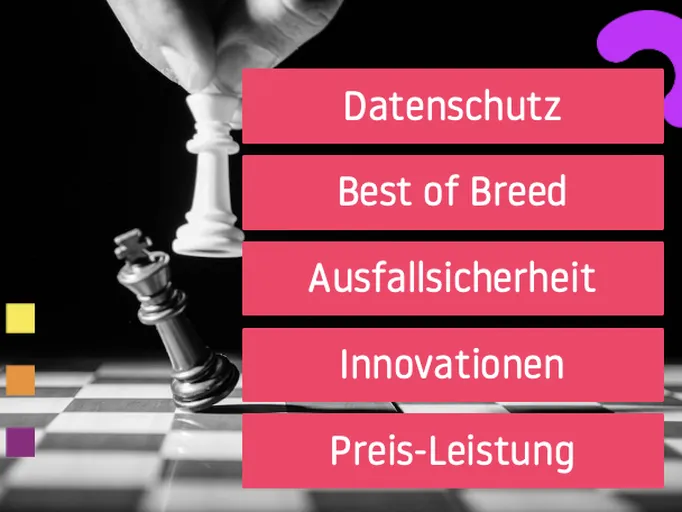
1. Data privacy
One of the most important considerations is data privacy. In many industries and regions, strict regulations and compliance requirements mandate that data be stored within specific jurisdictions or cloud environments. A multi-cloud strategy helps organizations meet these requirements more effectively by allowing data and services to be distributed according to regulatory and business needs.
2. Best-of-breed approach
Different cloud providers offer different strengths and specialized services. A multi-cloud strategy allows you to select the best capabilities from multiple providers to create an optimal solution for your specific requirements. For example, you might leverage the computing power of one provider, the analytics capabilities of another, and the security features of a third.
3. Resilience and redundancy
A multi-cloud strategy enables you to distribute services and data across multiple cloud providers. This reduces the risk of a single provider outage impacting your entire infrastructure. If one provider experiences a disruption, workloads can be seamlessly redirected to another provider, helping to maintain business continuity and minimize downtime.
4. Innovation and technology diversity
Using multiple cloud providers allows you to benefit from the latest technological advancements and innovations across the market. When a provider releases a unique feature or capability that is not yet available elsewhere, you can incorporate it into your infrastructure portfolio. This diversity can accelerate innovation and help create a competitive advantage.
5. Agile cost and performance management
A multi-cloud strategy reduces dependence on a single cloud provider, giving you greater flexibility to switch providers when technical or economic considerations make it advantageous. This helps preserve negotiating leverage and prevents vendor lock-in. As a result, services can be deployed where they offer the best value at a given point in time. To fully realize these benefits, a high degree of Infrastructure as Code (IaC) is essential, enabling provider transitions and workload deployments to be automated efficiently.
Potential cloud providers
Amazon Web Services (AWS)
AWS is widely regarded as a leading cloud platform for organizations that need to support large-scale workloads and user bases. With a portfolio of around 200 services, AWS offers one of the most comprehensive cloud ecosystems available. Notable services include AWS Lambda, which enables serverless application development, and Amazon Elastic Kubernetes Service (EKS), a fully managed Kubernetes platform for containerized workloads.
Microsoft Azure
Azure is Microsoft's public cloud platform and provides deep integration with Microsoft technologies, including Windows Server, Active Directory, and Microsoft 365. In addition, Microsoft has certified Azure data centers for running SAP workloads, making it a popular hosting platform for small and medium-sized businesses that rely on SAP environments.
Google Cloud Platform (GCP)
GCP offers powerful capabilities for machine learning, artificial intelligence, and data analytics, leveraging technologies developed and optimized by Google. Manufacturers of IoT products often choose GCP because of its highly scalable infrastructure, which is specifically designed to handle data-intensive and demanding workloads.
OVHcloud
OVHcloud is a European cloud provider headquartered in France and offers a broad range of cloud services for businesses. Thanks to its strong European presence, OVHcloud operates multiple data centers across the continent. The company places a strong emphasis on data privacy and security, enabling organizations to store and manage their data within Europe.
Use cases for OVHcloud
As Europe's leading cloud provider, OVHcloud offers organizations a secure and privacy-focused environment for hosting and managing their data. Its strong commitment to European data protection standards provides long-term confidence that services will remain compliant with evolving regulatory requirements.
Compared to the hyperscale cloud providers, OVHcloud does not offer as extensive a service portfolio. However, its services stand out in areas such as data privacy, data sovereignty, and regulatory compliance, while still delivering strong performance and reliability.
A multi-cloud approach means freedom, transparency and reversibility in a modern cloud infrastructure for us. We extend these values to all our customers and partners too."
OVHcloud services for your multi-cloud strategy
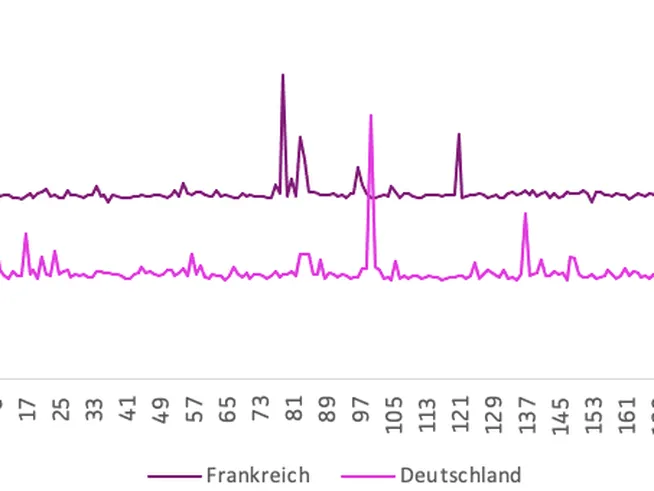
As the diagram shows, the direct connection to Germany is twice as fast as to France. Therefore, when building the multi-cloud architecture, location proximity should be considered alongside provider selection. Based on our experience, latency up to 5ms is easily achievable. In this context, we recommend a multi-cloud setup from AWS Frankfurt to OVH Frankfurt.
OVHcloud services for your multi-cloud strategy
As the diagram shows, the direct connection to Germany is twice as fast as to France. Therefore, when building the multi-cloud architecture, location proximity should be considered alongside provider selection. Based on our experience, latency up to 5ms is easily achievable. In this context, we recommend a multi-cloud setup from AWS Frankfurt to OVH Frankfurt.
Benefits of a multi-cloud strategy through the integration of OVHcloud services
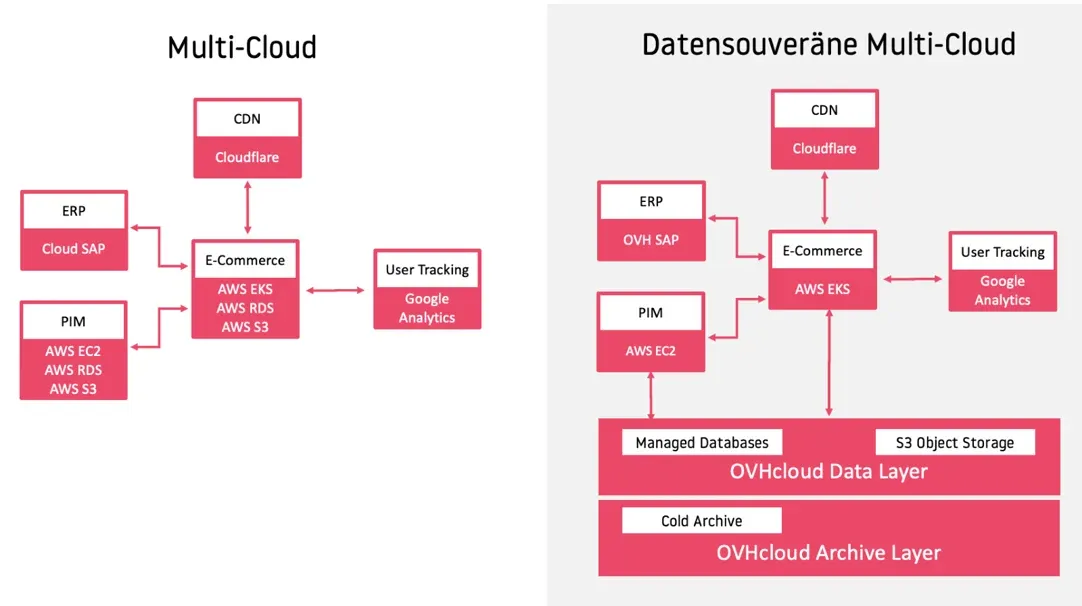
In the following scenario, we show how a multi-cloud setup can benefit from integrating OVH services.
OHVcloud is being integrated as a data and backup layer into the existing multi-cloud. The existing solutions for PIM and e-commerce are being extended so that AWS RDS and AWS S3 are replaced by OVH services "Managed Database" and "Object Storage". SAP can likewise be transferred to OVH as a migration project, in order to also be operated with data sovereignty.
Conclusion
OVHcloud offers you perfect complement to your cloud strategy. Especially regarding data sovereignty, OVHcloud can simplify your path to data-sovereign solution. We're glad to objectively assess your existing strategy and give recommendations, or develop concept of potential target architecture together with you.
Let's talk about your project.
Every project started with a simple conversation. Send us a quick note explaining what it's about. We'll figure out the rest together.
- Marc Achsnich
Team Leadsynaigy
Show email address

Subscribe to the blog now and never miss any news
✔️free of charge ✔️weekly news ✔️expert knowledge
Please accept the corresponding cookies to view this embedded content.