



Cloud Sustainability as an environmentally conscious revolution in cloud computing
 Marc AchsnichTeam Lead · synaigy
6 min. reading time

Cloud Sustainability refers to the cloud computing industry's commitment to acting in an ecologically, socially and economically sustainable way. This article looks at key aspects of Cloud Sustainability, such as environmental protection and the sustainable supply chain, and presents example measures taken by leading cloud providers such as OVHcloud and Amazon Web Services (AWS). Find out how these companies use renewable energy, reduce emissions and rely on recycling as well as ethical guidelines to make cloud infrastructure more environmentally friendly and sustainable. Discover the significance of Cloud Sustainability and how your organisation can benefit from a sustainable IT infrastructure.
Cloud Sustainability refers to the cloud computing industry's responsibility to act in an ecologically, socially and economically sustainable way. This means that cloud providers strive to implement environmentally friendly practices in their business operations, minimise the impact on society while remaining economically profitable.
Key aspects of Cloud Sustainability
Environmental protection
Cloud computing has grown strongly in recent years and is widely used in many companies and organisations. Cloud-based services offer many advantages, such as flexible and scalable infrastructure or rapid provisioning of resources. However, cloud computing also consumes considerable amounts of energy and thus contributes to the climate crisis.
It is important that cloud providers address sustainability, as they can play a significant role in global change. According to a 2022 study by Bitkom, cloud providers' data centres were responsible for around 3% of German electricity consumption.
Furthermore, according to the study, the forecast continues to rise. "In the event of a continuous data centre boom, the energy demand of data centres and smaller IT installations in Germany could more than double by 2030"
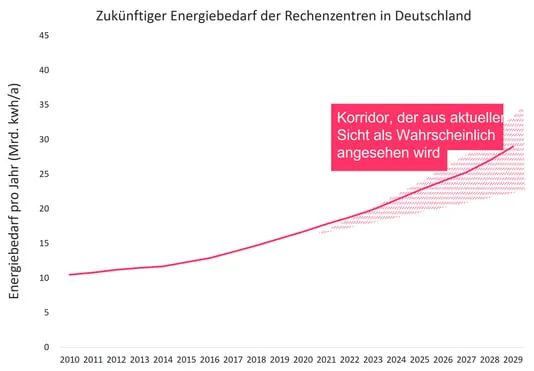
To combat climate change, it must therefore be ensured that cloud computing is sustainable and energy-efficient. This means that the energy sources used to support cloud services are renewable and that the cloud infrastructure itself is operated as efficiently as possible.
There are already many initiatives and efforts in the cloud industry to reduce energy consumption and the associated CO2 emissions. One example of this is the concept of "green cloud computing", in which renewable energy sources such as wind or solar power are used to support the energy supply of cloud data centres.

Supply chains
Supply chains play an important role for Cloud Sustainability, as the procurement of hardware and the provision of cloud services can have a significant environmental impact. Some of the key environmental impacts associated with the cloud computing industry are:
Manufacturing of hardware components: The manufacturing of hardware components required for cloud computing services requires the use of raw materials and energy and can be associated with significant environmental impacts. One way to reduce this impact is to ensure that the materials used come from more sustainable sources and that production is as energy-efficient as possible.
Energy consumption during data transmission: Transmitting large amounts of data over the internet requires a considerable amount of energy, especially when it takes place over long distances. It is important to ensure that data transmission is efficient and that renewable energy sources are used to operate data centres and cloud services.
Disposal of hardware: The disposal of hardware components that can no longer be used for cloud computing services can also be associated with significant environmental impacts if they are not properly recycled or disposed of. A sustainable supply chain should ensure that old hardware components are responsibly recycled or disposed of in order to minimise negative environmental impacts.
A sustainable supply chain in the cloud computing industry should ensure that hardware components are procured from more sustainable sources, that manufacturing is more energy-efficient, that data transmission is more efficient and that hardware is disposed of responsibly. In addition, cloud providers should check suppliers and partners for sustainability and environmental compatibility and ensure that supply chains are transparent and sustainable. A sustainable supply chain can thus make an important contribution to Cloud Sustainability.
Measures taken by cloud providers
Amazon Web Services (AWS) and OVHcloud are two leading cloud providers that are committed to sustainability and have already launched various initiatives to improve their environmental footprint.
OVHcloud
Use of 100% renewable energy in their data centres by 2030: OVHcloud has already equipped several data centres with renewable energy sources and is continuously expanding its use of renewable energy. In January 2021, OVHcloud took part in the launch of the Climate Neutral Data Centre Pact. The European Commission has supported this pact from the outset. This important initiative aims to ensure the climate neutrality of data centres by 2030.
Introduction of an in-house water cooling system to reduce electricity consumption.
OVHcloud has developed its own server hardware specifically designed to reduce energy consumption and extend service life. Thanks to new components, a service life of up to 9 years is achieved. This avoids further CO2 emissions during manufacturing.
The environment is always taken into account when expanding data centres. 24 of 33 data centres were housed in renovated buildings.
OVHcloud has formed a partnership with a logistics company to enable the delivery of hardware in an environmentally friendly way.
OVHcloud has required suppliers to sign a code of conduct that commits them to a responsible and comprehensive approach to compliance issues. Compliance with ethical, social and environmental rules and principles is an integral part of OVHcloud's development.
Focus on recycling and waste management: OVHcloud relies on a circular economy and works with partners to increase the recycling rate of electrical equipment and reduce waste. OVHcloud is also committed to reducing landfill waste to zero by 2025.
The key environmental indicators
OVHcloud measures a Power Usage Effectiveness of 1.28, with an ideal value of 1.
With a water consumption of 0.26 L/kWh IT, OVHcloud performs very well compared to the average of 0.24 to 1.8 L/kWh.
OVHcloud measures a ratio of 0.20 T CO2e/MWh of data centre CO2 emissions in relation to energy consumption
77% of the energy used is generated from renewable sources.
OVHcloud uses 25% reusable components.

AWS
Use of 100% renewable energy in their data centres by 2025: AWS relies on large solar and wind energy projects and has already signed several agreements to procure renewable energy. These include, among others, two projects in Germany (Wind Farm BR3 & Wind Farm Baltic Eagle)
Reducing emissions: AWS aims to be carbon neutral by 2040. To this end, AWS has launched a range of initiatives, including the use of renewable energy, energy efficiency measures and investment in low-carbon technology.
Reducing the water demand used to cool the data centres. AWS has committed to achieving a positive water balance by 2030.
Development of energy-saving processors:. AWS Graviton-based servers offer AWS the best performance per watt of energy consumption.
Use of energy-efficient technologies: AWS has introduced various technologies to reduce the energy consumption of its services, such as the use of spot instances and the automatic shutdown of unused resources.
Focus on recycling and waste management: AWS works with partners to increase the recycling rate of electronic devices and reduce waste.
Support for non-profit environmental organisations: AWS has launched a programme called "AWS Sustainability" that provides financial and technological support to non-profit organisations committed to environmental and climate protection.
Ethics and social responsibility: AWS has strict ethical guidelines for its suppliers, ensuring fair working conditions and respect for human rights.
The most important environmental indicators
AWS measures a Power Usage Effectiveness of 1.7, with an ideal value of 1.
With water consumption of 0.25 L/kWh IT, AWS performs very well compared to the average of 0.24 to 1.8 L/kWh.

Conclusion
Overall, cloud sustainability is an important topic. Companies and cloud providers must commit to a sustainable IT infrastructure in order to minimise environmental impact, reduce costs and ensure the sustainable use of IT infrastructure in the long term. If you are facing the choice of a cloud provider and need support or independent advice, we would be happy to help with our expertise. Get in touch with our team of experts.
Do you have questions or feedback?
Then feel free to contact us directly.
- Marc Achsnich
Team Leadsynaigy
Show email address

Subscribe to our blog now and never miss any news
✔️free of charge ✔️weekly news ✔️expert knowledge
Please accept the corresponding cookies to view this embedded content.