



#132 - How to recharge the connection between leadership and teams
The gap between delivery and management. Strategy rarely fails due to laziness, but due to the wrong "translation" to delivery. Clarity is key here. In this case, clarity means: clear priorities, measurable goals, clear responsibility. That's exactly what I discuss in the new insights! episode with Kevin Behrens (Strategy Fellow, TIMETOACT GROUP): how to turn big words into tangible execution and ensure delivery keeps pace.
 Joubin RahimiManaging Partner · synaigy
4 min read
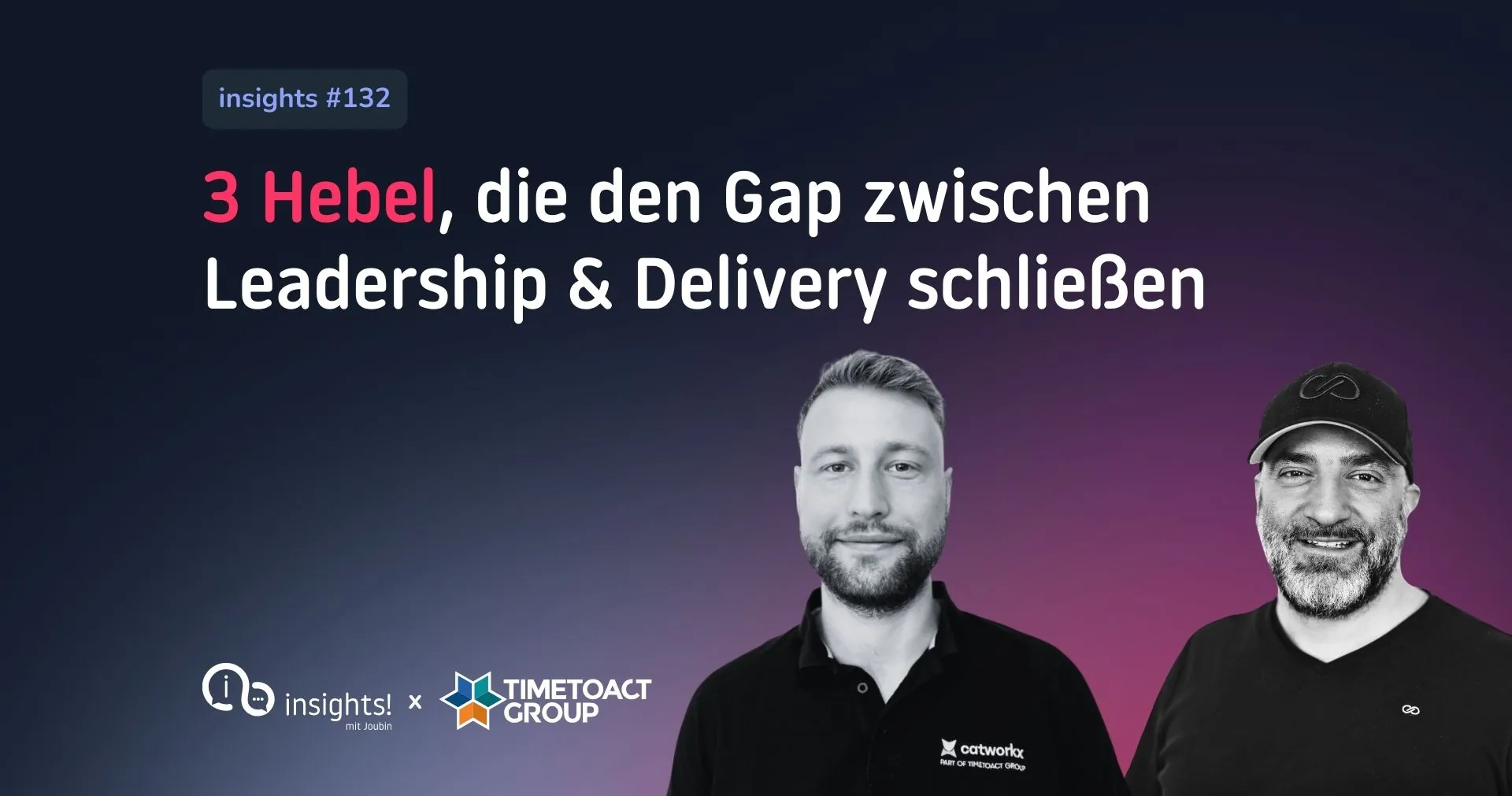
People are the central theme – people work with the tools, people work together, people achieve results."
In the new insights episode, Joubin Rahimi talks to Kevin Behrens (Strategy Fellow at TIMETOACT GROUP and Lead Architect at catworkx) about how strategy really makes it into execution. Core thesis: remote and tool-driven collaboration amplifies clarity — or, just as easily, ambiguity. There's often a gap between leadership and delivery, because big goals aren't translated cleanly. Kevin's focus: strategy has to be broken down into understandable, actionable goals so teams know day-to-day what they're working towards.
Remote reality: why tools don't deliver without people
Collaboration has changed: fewer corridor chats, more meeting links, boards and tickets everywhere. Sounds efficient, but it only is if you factor in the human side. Tools are amplifiers. They amplify clarity just as much as ambiguity. If goals are vaguely defined, the best Atlassian workflows won't help. The core is the human. Strategy happens in the head, value is created in the teams. The greater the distance between these points, the greater the friction loss. This is exactly where remote quickly tips from "nice" to "nebulous". Without regular translation work between leadership and the delivery team, a disconnect arises: teams don't know whether they're working on the most important topics, and management can't see whether progress is actually paying into strategic goals.
The real gap is the translation between the management level and the implementation level
Strategy often starts big: "We want to become market leader." That means nothing operationally to those implementing it. What does market leader actually mean in your context? More revenue? Higher margin? Best service quality? As long as this question remains open, teams interpret it differently. Result: everyone works hard, but not necessarily in the same direction.
Your task, therefore, isn't just to set the goal but to make it translatable. That means: sharpening terms, actively seeking out misunderstandings, removing grey areas. A simple test: does someone outside your area explain your goal the same way you do?
From vision to number: breaking down goals, the right way
"20% more reach among CIOs" is more tangible than "more thought leadership". Tangibility comes from metrics that guide behaviour. Define which signals indicate success (e.g. Visits from target companies, qualified leads, watch time on your content) and decide which activities are likely to move exactly these signals. Important: progress has two yardsticks. First, activity progress (did we complete the training, POCs, campaigns as planned?). Second, goal achievement (did ticking off that completion measurably bring us closer to the goal?). Anyone who only measures activities trains for a marathon – but never runs it. Anyone who only measures goals overlooks that good measures need time. The truth lies in the duo.
Watchlist for clearly formulated goals
Clear recipient: who exactly should understand what, and why?
Concrete target group: who are you optimising for?
Measuring point + timeframe: how do you recognise progress – and by when?
Activity backbone: which 2–3 measures are most likely to move the needle?
Fields of action instead of silo thinking
Think of strategy in terms of fields of action: areas where you bundle objectives, measures, budgets, skills and responsibilities. This allows work to be prioritised and resources to be visibly shifted to where they have the greatest leverage. Example: instead of building "AI" as a standalone empire, you place it under functional fields, such as "Operational Excellence" or "Customer Experience". There you define precise objectives such as "automate 20% of back-office processes" or "reduce service turnaround times by 30%". Technology becomes a means to an end, not an end in itself. This way you bring in the right people, not simply "everyone". It is also far more efficient.
OKRs? Yes – but only with a real connection to everyday work
OKRs can be perfect translator – if you dock them to your action fields. The O (Objective) describe wanted change state. The KRs (Key Results) make it measurable. Trick lie in "breaking R down": from company OKRs to division, to team, down to initiatives. Even more important: couple OKRs to rhythm. Without regular, short syncs they become quarterly folklore. One lean ritual enough: What brought us measurably closer to goal this week? What block? What we learn from?
Would you like to listen to the full episode?
Find the podcast of the interview here:
Please accept the corresponding cookies to view this embedded content.
Prefer to watch the episode? No problem!
You'll find a recording of the interview here:
Please accept functional cookies to watch this video.
Prefer to read?
Joubin Rahimi
Great to have you back for a new episode of insights! My name is Joubin Rahimi and today joining: Kevin Behrens. Hello Kevin.
Kevin Behrens
Hi, great that I get to be part of this. This is huge.
Joubin Rahimi
You're also one of the Fellows. You're even wearing the polo shirt for it. You're one of the Strategy Fellows with us, within TIMETOACT GROUP, but within catworkx you're Lead Architect.
Kevin Behrens
Right.
Joubin Rahimi
Let me ask you two, three things: What is a lead architect and what's your role?
Kevin Behrens
Exactly, I'm our lead architect for enterprise strategy and planning. That means the focus is mainly on both the methodological process side and tooling support with Atlassian tools. Ultimately, it's about how I actually get from my strategy to an executable implementation.
Joubin Rahimi
And in the pre-chat, Kevin and I naturally talked a bit about the topic, and you said you're good with tech, but much better with people.
Kevin Behrens
Exactly, I can... That's usually the interface. So people are actually the central topic. How do I implement topics? That has to be done by people. People also work with the tools, people work together, people achieve results. That's actually the central topic, really the people.
Joubin Rahimi
And since you're constantly with clients right now, what things do you notice that keep coming up, where you say that seems to be the current topic?
Kevin Behrens
That's actually the case right now, when I'm active at management level, we have a lot of remote work. That means a lot of work is done with tools. People sit less close together and can't talk about topics directly. That means tool-side support is often in the foreground.
Joubin Rahimi
So the coffee chats and so on by the coffee machine.
Kevin Behrens
Exactly, you very rarely have this informal exchange nowadays. Mostly it's very tool-supported by now. And what I then see, of course, is this disconnect between management or leadership and the actual implementation, all the people who also produce the value.
Joubin Rahimi
And where do you see the difference, or where's the divergence?
Kevin Behrens
That's actually the issue, that management leadership on one side says: "Okay, what's our strategy really? Where do we see ourselves as a company, with our services, with our products, in 5 to 10 years?", and then ultimately break the strategy down, often described as strategic fields of action, and then say: What are the goals behind that? What are the measures? How could we get there? And then I also have my teams who are in day-to-day business, in development, and there's simply a disconnect. The teams often don't know: What are the real strategic goals? Am I working on the right topics right now? And of course also the feedback loop, so management sees again: Am I getting the right results reflected back? Are we working with the teams on the highest-priority topics? Are we making the right progress? With goals there are always two measurements. Let me compare it to a marathon. If I decide to run a marathon, the activities, the measures, the training I've set myself, once I've completed that, I've achieved 100% of the work. That's also brought me closer to my goal. So have I also achieved the training goals with that?
Joubin Rahimi
Now let me ask, rather bluntly. This could be an awkward question for you or for the clients. What's actually the management team's job? Have they not got a handle on it?
Kevin Behrens
I’d say it’s less about whether they have their job under control, and more that there’s genuinely this interpersonal element: how do I break something down? They operate on quite different levels, and that’s often the case for us too – when we explain something in technical terms, it’s always a question of: who’s sitting across from me? Who’s the recipient? Do they understand what I’m saying? Am I speaking the right language? Am I using the right topics? And that’s often an issue too: how do I phrase it correctly so that people come along with me, so they understand what the goal is.
Joubin Rahimi
And firstly through the change in communication, no longer in the office but remote, is that already an issue, that it works much worse then?
Kevin Behrens
Exactly. In the past, it was often the case that people talked about it: hey, these are the goals now, at the coffee machine. Yes, we've made some progress. These are the successes. Nowadays that's often not shared in informal conversations any more, unless meetings are explicitly set up for that purpose. But otherwise, in everyday work, you pick up on very little of it. When people are busy, they're aware of little beyond what they're currently working on: what am I actually doing towards that goal right now? How do I contribute to it?
Joubin Rahimi
I've got two options, we can play either. One is you just give us three tips, so listeners can hear three tips on what really helped or which impulses helped well in the client situation. Or – you can choose – or you pick out some situation that was a real screw-up and say: how did it get better overall? You always learn well from both. And so we don't blow past 15 minutes, you can pick one. But I know Kevin can do both.
Kevin Behrens
I am just considering what the better option is. No, what a typical example is, I need to take some context out now, let me try to present it a bit more abstractly: In this area I want to become the biggest, the best, where from a management perspective it is of course quite clear what is required, what the goal is, where Werner then talked to people about it.
Joubin Rahimi
More revenue, higher AOV, exactly.
Kevin Behrens
What does that mean? Does that mean more revenue? Now it means hiring the most professional solutions, the most professional people. And then you actually notice how much room for interpretation there is. And that's already the first tip, simply to check with people who are as far removed as possible what they understand by that, and then, with the results, with the feedback, to make that concrete, and also to break down goals and measures from the strategic level down to the individual areas. Less silos, more cross-functional. Revenue would be one example, but of course what you can also do, typical example, let's say we take some website platform, with my ear, with this video, with my content I want to reach 20% more CIOs in future, or 20% more young people from start-ups. I can evaluate that, and then I can check, with the right metrics of course, have I achieved that? And that's ultimately how you break down a goal like that. I want the right thing, from a very rough goal. I want to reach a critical mass or my desired audience. What does that mean?
Joubin Rahimi
Do you also use OKRs in this context? Or do you see it with companies that they use OKRs? It's not only done in small area after all.
Kevin Behrens
Exactly, so from my point of view, strategy, especially when trying to digitalise it, essentially breaks down into three dimensions here. First there are the strategic fields of action. That's often where the categorisation comes from. AI is one such topic. AI would be a strategic field of action. We want to deploy AI in our organisation, and then, ultimately, within the strategic field of action, look at what the goals are. We want, for example, to automate or optimise 20% of our processes with AI. And what are the measures? We need to carry out a proof of concept. We want to deploy AI in the cloud with XY. What are the actual activities behind that? And then group that. And then I can allocate budgets to these fields of action, often too, and see how is the budget being used? Which skills? Which people do I even need for that? And can allocate that precisely, and can then ultimately check: am I working on the right prioritised fields of action? And what are the goals and measures, and how is progress going?
Joubin Rahimi
And the question I'm asking now isn't meant to be framed at all. Is it good to say AI is a field of action because it's a technology? Or shouldn't one rather say I want something in the business context and then consider doing it with AI? Right. I don't know what the answer is. That's really the crux of it.
Kevin Behrens
It's always a question of: from which perspective do I see this? Do I see it more from a technological perspective? Do I see it from a business perspective? AI is of course such an overarching topic where many still don't know: where do I plug this in? But it's really just like IT, it's embedded everywhere, and I'm actually more a fan of looking at it from a functional perspective. So in which areas? We often have this typical topic, many will know it, a strategic field of action called "Operational Excellence". Great fancy word, but what's actually behind it? Improving and optimising your operational business. And why wouldn't using AI ultimately be, you could say, a sub-field of action underneath that?
Joubin Rahimi
And I think that's a great way to close, because we keep having this discussion. Thanks for the insights, because I think if you say AI, then who do you invite? You have to invite everyone. If you say Operational Excellence, then you know who to invite. Exactly. As you can see, I'm learning something right here on the spot and I hope you are too, in front of the screen and radio receivers, as the licence fee people would surely say. Kevin, thanks for the insights.
Kevin Behrens
Thank you for letting me be part of it.
Joubin Rahimi
Very welcome. Questions, comments, post below, message Kevin or me directly. We here for you, glad to give input. Thanks, thank you too.
Kevin Behrens
Thank you.
Have questions or feedback?
Then feel free to contact us directly.
- Joubin Rahimi
Managing Partnersynaigy
Show phone numberShow mobile numberShow email address
Subscribe to the blog now and never miss any news
✔️free of charge ✔️weekly news ✔️expert knowledge
Please accept the corresponding cookies to view this embedded content.