

Content management systems for businesses compared
20 min read
Every business has different requirements for its own website. Some need an international corporate website. Others work with several campaign-driven microsites, and some businesses run complex portals that serve as international sales, contact or brand platforms.
They all have one thing in common: they use content management systems (CMS). These systems enable the creation, management and delivery of content – the foundation of digital communication. But which is the best system for your business? We've done the CMS comparison.
Straight to the key details:
TYPO3 Magnolia FirstSpirit
How do I find the right CMS for my organisation?
Choosing the right technology can bring valuable benefits. The CMS determines how the responsible staff from different departments and internationally distributed branches manage and control content. This means your CMS provides the foundation for online communication with customers, the public and other target groups.
The following criteria influence the choice of CMS:
Structure and processes of the organisation
Current system landscape within the organisation
Objective of the website and range of channels
Needs of the target group(s)
Management of multiple websites
Multilingualism
Nature of the content
Budget
TYPO3: The open-source CMS for organisations
TYPO3 is the second most widely used CMS in Germany. It has a very large community of developers and users. As a result, it is continuously and reliably developed further, closely following changing needs. A special feature of TYPO3 is that it is offered as an open-source CMS. This means no licence costs are incurred. In addition, your corporate website is regularly supplied with all important security updates through Long Term Support (LTS). The CMS can be adapted to your organisation's needs through more than 1600 extensions – TYPO3 extensions. If you have specific ideas and requirements regarding the functions of your website, the extensions help to realise them efficiently.
What does TYPO3 CMS Long Term Support cover?
TYPO3 Long Term Support (LTS) supplies the TYPO3 core with updates for at least 3 years, ensuring sustainable, long-term development of your TYPO3-based digital presence. The TYPO3 development roadmap always shows transparently which support phase a version is in, making it easier not only to plan but also to integrate newer TYPO3 versions. Alternatively, once LTS expires, Extended Long Term Support (ELTS) can be purchased to extend the lifecycle further.
Know-how and extensibility for adaptable solutions
interactive tools has more than 20 years of experience in the design and implementation of TYPO3 projects. This means we can ensure our clients benefit from the CMS's extensive extensibility. TYPO3 allows the rapid implementation of proven modules and solutions, as well as bespoke new developments. The CMS also offers numerous options for interface integration (APIs), enabling seamless integration of relevant third-party applications.
Responsiveness, multi-domain capability and internationalisation
The Bootstrap framework serves as the foundation for TYPO3 projects, enabling fast, responsive implementation. The framework allows work processes to be better planned and shortened in advance. The result is a user-friendly – i.e. fast – implementation of the website on all mobile devices. An important aspect, as more and more traffic happens on mobile. The CMS is also well suited to internationalisation. It's particularly important to bring together central control and regional independence. For globally operating businesses, translations are possible directly within the CMS. Content for multilingual websites can be managed centrally.
The benefits of TYPO3 at a glance:
No licence costs
At least three years of Long Term Support (LTS) for the TYPO3 core
Continuous development thanks to a large developer community
Individual customisation through more than 1600 extensions
Additional extensions can easily be programmed
Newsletters can be sent directly from the CMS
Management of multilingual websites and translations directly within the CMS
Continuous relaunch with TYPO3: ongoing optimisation of the website
Magnolia CMS: an efficient experience platform
Magnolia CMS has been successfully established on the market for many years. The company started in 2003 as an open-source project. Today, it is particularly well known for its licensed Enterprise Edition. Compared to alternative CMS platforms, Magnolia relies heavily on platform functionality, meaning content management, while central, is only one of many facets of the product. Thanks to its modularity via “apps”, its focus on content personalisation and its headless architecture, Magnolia is particularly well suited to digital strategies aimed at a digital experience platform. In doing so, the CMS integrates the necessary technical infrastructure via APIs into an easy-to-use interface. Extensibility and adaptability to future developments in B2B commerce are also a priority for Magnolia.
Headless CMS: more flexibility in the frontend
When it comes to architecture, Magnolia is fully committed to headless. This is designed to optimally implement marketing-driven digital strategies and roll them out efficiently across various touchpoints and channels. Content gains reusability, and editors control their publications with precision. In terms of usability, Magnolia therefore scores with preview functions that follow the credo "what you see is what you get" – different frontends are displayed in real time. Technically, Magnolia can be used with a frontend framework such as React, Angular or Vue.
Integrated A/B/n testing from the familiar interface
Magnolia offers an attractive feature for customer-oriented conversion optimisation with its integrated A/B/n testing. Editors and marketing experts at your business can create several variants of a piece of content and test, evaluate and optimise them against each other. In doing so, they don't need to leave the familiar CMS interface. Since conversion-optimised content can improve the ROI of your digital communication and marketing activities, Magnolia offers a feature with clear added value in e-commerce.
Future-oriented tech stack: more speed in development
To keep complexity manageable despite the DXP architecture, Magnolia structures its offering as a "Composable DXP". On three levels – infrastructure, management and experience – you can select components according to your requirements. Magnolia offers various deployment models, such as self-hosting, SaaS (Software-as-a-Service) and PaaS (Platform-as-a-Service). Depending on your business profile and the setup of your in-house IT, the DXP and deployment model can therefore be tailored individually. For developers, Magnolia relies on a headless-specific feature: the "Headless Accelerator". This includes a design system with pre-built UI components for the most popular frontend frameworks. Development can be accessed in your preferred IDE, and a command line enables the use of task automation. The feature is intended to free up development capacity for creative collaboration with marketing.
The benefits of Magnolia at a glance:
Strong integration of shops and marketing technologies
Diverse functions for omnichannel commerce: lead management with marketing
automation, CRM integration and A/B/n testingBasis for greater agility in your editorial team
Easy to use thanks to an intuitive browser-based CMS interface
Creative work in the headless CMS with editing modes and live preview
Enables efficient technical architectures
FirstSpirit: High-end technology for high demands
FirstSpirit is the flagship among enterprise CMS. It is particularly suited to organisations with a complex IT infrastructure, multiple business units or an international structure. Less complex websites, intranets, magazines or campaigns can also be implemented and managed at a very high level. Alongside its comprehensive flexibility, FirstSpirit's usability for your editorial team stands out.
Seamless integration via APIs
The stable CMS system architecture from manufacturer e-Spirit can be seamlessly integrated into existing IT infrastructures via interfaces (APIs). A standardised access interface enables the connection of existing applications and data sources. This makes it easy to integrate product information systems (PIS), online shops, portals, CRM systems or other applications. By separating the editorial system from the website, the system also meets the highest security standards.
Internationalisation of websites with the FirstSpirit CMS
FirstSpirit is particularly well suited to central editorial teams that want to manage content at a global level and across multiple business units. The internationalisation of websites is an important criterion for enterprise CMS – and this is exactly where FirstSpirit excels. The CMS enables professional multi-site management. This allows websites in different languages to be created and controlled from a central editorial team – and the CMS provides simple, intuitive editorial processes and workflows for this.
Furthermore, FirstSpirit is designed as a content hub. Through complementary products and models such as FirstSpirit CaaS (Content-as-a-Service), the CMS is connected to any number of digital touchpoints (e.g. Mobile apps via smart/connected devices in the Internet of Things, through to shops, portals or websites from third-party providers). This means content is made available without any further implementation effort, simply on demand. Do you have specific ideas or creative concepts for your corporate website? No problem!
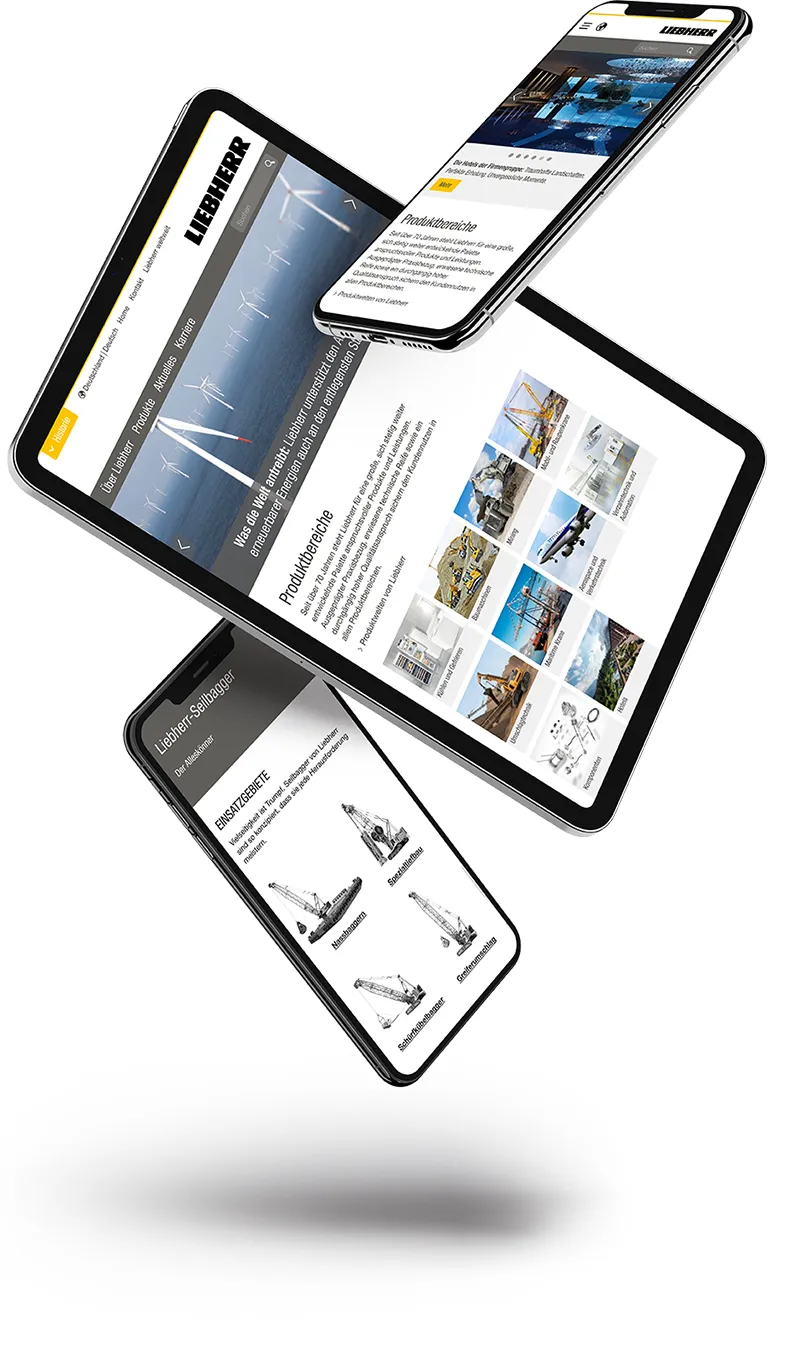
An individually extensible CMS
Thanks to modular approach, CMS can be extended as needed and enables tailored, customer-specific requirements. We have 13 years' expertise developing and implementing FirstSpirit and are "Advanced Partner" of manufacturer e-Spirit. Through licence costs, manufacturer e-Spirit enables centralised, controlled further development of system.

The benefits of FirstSpirit at a glance:
Enterprise content management, cross-media management, print management and media asset management from a single source
Based on Java and XML, flexibly configurable and adaptable to the needs of the organisation
Ready-to-use editorial environment that can be extended with bespoke applications as needed
Central information platform within the organisation: capable of seamless integration into existing IT infrastructures
Multi-domain and multi-site content management let you manage different country sites from a central editorial team and control them through specific approval processes
Dynamic, personalised content through the Dynamic Content Controller developed by interactive tools, which can be supplemented with user-related customer data
With Solr and Elasticsearch, two powerful search technologies are available
Our conclusion: analysis and consultancy are key to choosing the right CMS
To make a strategic decision on the right CMS, you first need to assess your resources, the requirements of your communications and your existing IT infrastructure. For complex, international structures, or for integrating a product information or CRM system, the three particularly powerful solutions TYPO3, Magnolia and FirstSpirit are well suited.
Choosing the right content management system depends on many factors. With 25 years of experience in developing, introducing and using content management systems, our experts are happy to advise you. They support you from requirements analysis through strategy and CMS selection to implementation and ongoing development. Get in touch with us!
Your contact
- Marian Gertheim
Consultingsynaigy
Show phone numberShow email address