



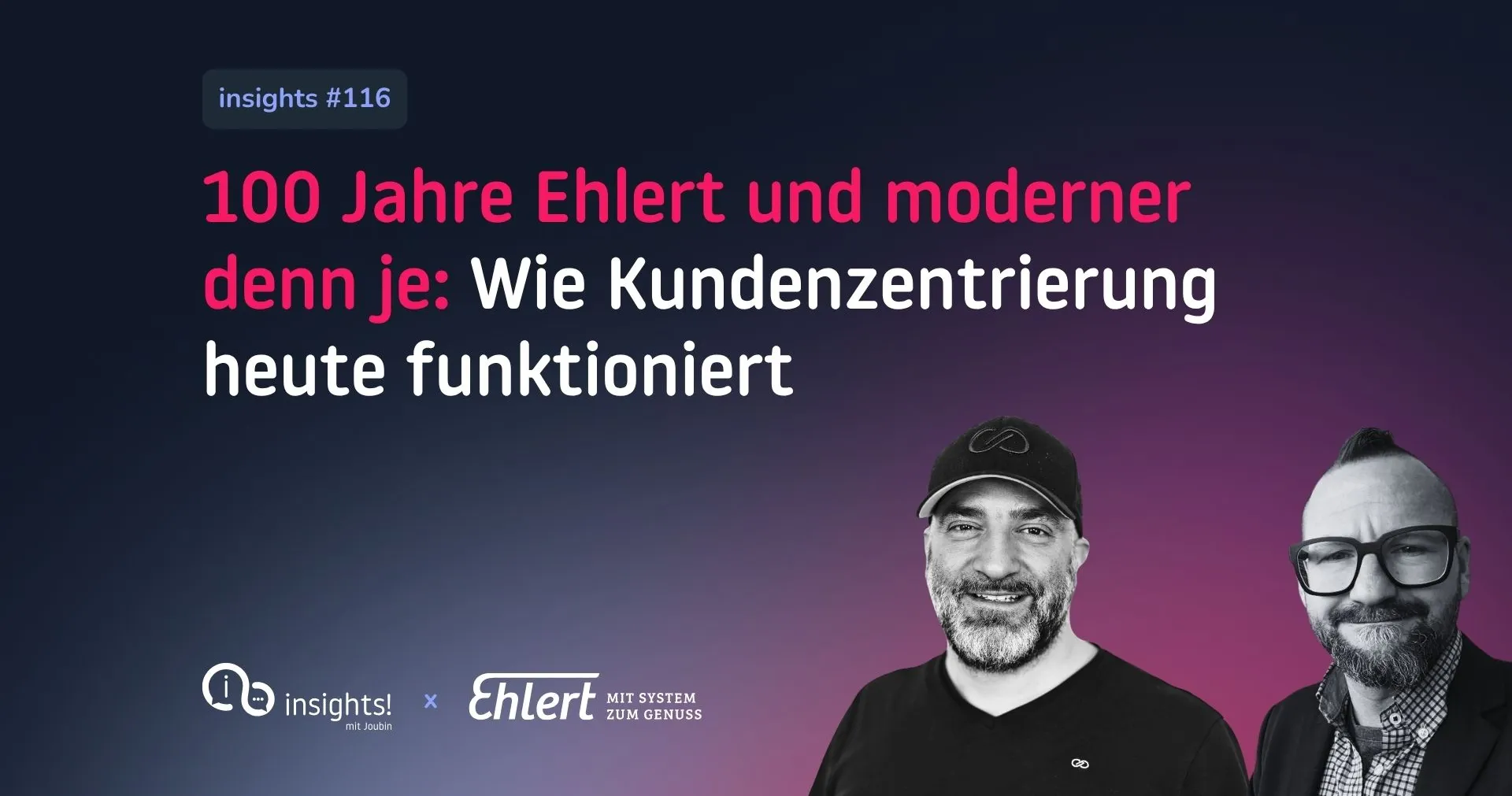
insights! #116: 100 years of Ehlert and not one bit outdated: what modern customer centricity looks like
In this episode of insights!, Joubin Rahimi talks with Philipp Ehlert about the challenges and opportunities in food wholesale. From smart logistics to genuine customer centricity to the sensible use of AI – a conversation full of plain talk, conviction and entrepreneurial foresight. Philipp shows why listening is sometimes more important than automating – and how sustainability can start right on your own doorstep.
 Joubin RahimiManaging Partner · synaigy
5 min. read
The core of every business is to meet a customer need in the best possible way. And yes, it hurts when you hear: wow, that feature you built with so much passion is completely useless. But that is exactly where the key lies: allow the pain in order to get better.
Philipp Ehlert, Managing Director of Gustav Ehlert GmbH & Co. KG, offers fascinating insights into the challenges and opportunities of a modern specialist wholesaler – between logistics, digitalization, customer centricity and social commitment. An inspiring look behind the scenes of a company that not only delivers, but also takes a stand.
“People will always eat” – and how!
Food is a basic need – so far, so familiar. But what does that actually mean for companies that operate exactly where raw materials become products? Philipp Ehlert, Managing Director of Gustav Ehlert GmbH & Co. KG, puts it charmingly: “We deliver everything – except the food itself.” Packaging, hygiene items, spices, cleaning – in short: everything that keeps food production running. But even if stomachs are rumbling, that does not mean the market is full. The journey from “production flat out” before the pandemic to today's more conscious consumption shows that this industry is changing too. The peak is over, reality is more sustainable – and that is actually a good thing.
Sustainability with real commitment
Ehlert does not just do business, it deliberately does good. Its commitment to the Tafel food bank in Gütersloh is not a PR exercise but entrepreneurship in action. What is no longer needed should not spoil – it should help. Customers who produce food are actively encouraged to donate surpluses. A quiet bridge between business and responsibility that everyone can and should join. What Ehlert does in concrete terms: • An annual Christmas donation to charitable organizations • Building a permanent donation partnership with the Tafel • Encouraging customers to pass on surplus food
Consolidation instead of comfort: structural change
Small businesses are having a hard time. Butchers, delicatessens, artisanal producers – there are fewer and fewer of them. The market is consolidating. For Ehlert that means: fewer customers, but bigger players. And that in turn means that strategic diversification is not an option but a necessity. The answer? Europe. The DACH region as a first step, neighboring countries next – everything that still makes logistical sense is being considered. The goal: a stable foundation for long-term business success.
The customer at the center – digitally too
What sounds banal is in truth an art: really understanding the customer. Not just in face-to-face conversation, but above all in the digital space. Ehlert describes very honestly how e-commerce changes the relationship level – and how important it is to actively close that gap. One aha moment: customers simply do not use many useful features – because they have no time to deal with them. The consequence? Training, simplification, understanding. “The features are meant to save time – but nobody has the time to get to grips with them.” It is not about re-educating customers, but about bringing them along. And if nobody uses a feature? Then it is allowed to go again – however much a developer's heart may scream.
AI as an enabler – not a cure-all
Philipp Ehlert takes a pragmatic view of AI. From order automation to long-term supply chain optimization – the potential is there, but it happens step by step. And yes, in marketing too, whenever that famous blank copywriter's screen is once again a little too empty.
“Sometimes you just need someone to get started. AI can be that someone.”
The big vision? A supply chain that responds intelligently to customer forecasts, weather, harvest fluctuations and geopolitical events – automatically and sustainably.
Training with an attitude
Anyone who trains apprentices carries responsibility. For Ehlert that means: examining, mentoring, encouraging – and sometimes pushing, too. Especially in e-commerce he feels the gap between theory and practice particularly clearly. The exams? “Not up to date.” The next generation? Often too shy to be bold and experiment. The solution? Trust, feedback – and a clear signal: you are allowed to grow here. Ehlert's appeal to apprentices: • Try things out. • Break out of the pattern. • Speak up when something strikes you. Because only those who know how the customer ticks can really develop good digital solutions. And you do not learn that in front of a screen, but in real contact.
The new automated high-bay warehouse is not just a construction project – it is an IT project. Driverless transport systems, intelligent material flow control, interface management – nothing runs without IT any more. And that is a good thing. What stands out: at Ehlert, budgeting is not rigid, investment is sensible. Not in projects because there is budget available – but because they make sense. Entirely without Excel dogma.
Would you like to listen to the full episode?
Here you can find the podcast of the interview:
Please accept the corresponding cookies to view this embedded content.
Would you rather watch the episode? No problem!
Here you can find a recording of the interview:
Please accept functional cookies to watch this video.
Would you rather read?
Joubin Rahimi
Fantastic that you are joining us again for a new episode of insights! My name is Joubin, Joubin Rahimi, and today's guest is Philipp Ehlert from Gustav Ehlert GmbH & Co. KG. Hello Philipp.
Philipp Ehlert
Hi Joubin.
Joubin Rahimi
Great that you are here. We already did an interview about, I think, two and a half years ago, quite a while back now, together with Intershop.
Philipp Ehlert
Could well be.
Joubin Rahimi
And maybe you would like to tell us a bit about the company and about yourself first, and then I will jump in with the first question.
Philipp Ehlert
All right. My name is Philipp Ehlert. I am actually 45 already, father of one child, and I work at Gustav Ehlert GmbH & Co. KG. Also a family business. We turned 100 last year, and we are essentially a specialist wholesaler for food production supplies. So everything you need to build, produce or process something edible, except the raw material itself. So no meat, no vegetables, no dough, but everything else you need: disposable clothing, packaging materials, cleaning agents.
Joubin Rahimi
We get our spices from you.
Philipp Ehlert
Spices, that's right. Although spices are not necessarily an entry product, but maybe we can talk about that briefly later. Anyway, I have been Managing Director since 2019, together with a colleague, and I handle everything that is sort of the ministry of the interior. So from HR to processes to IT, and together with a colleague a bit of e-commerce as well. Logistics has also become a big part of what we do. That is my job.
Joubin Rahimi
And that is very wide-ranging. I would like to come back to logistics, and to IT as well. How do you see the market at the moment? I mean, we all have to eat. Is it simply stable? We see automotive going down right now, shoes and clothing are difficult, other things are going up again.
Philipp Ehlert
Household appliances are going down right now too. We have a big manufacturer here in Gütersloh. The saying actually fits pretty well. People will always eat, yes. And if we open up the time frame a little, not just last year or the year before, but a bit before Corona, after Corona, maybe even during Corona, then we definitely had quite a production peak before Corona. Everything that could be produced was produced. Then came Corona and things dropped off a bit in food retail, because people simply did not do as much. On the other hand, the whole homemade topic, everyone wanting to cook at home, really picked up. Then the trades became quite strong again, and after Corona we had a real dip. We noticed that with our customers too. The production volume itself dropped extremely, and now we are on a slightly upward trajectory again, although I have to say that this is actually quite a good thing, because we have reined in what I would call overproduction, because it really was not that, but it felt a bit like it.
Joubin Rahimi
Did we eat less, or did we eat less meat?
Philipp Ehlert
It is not just meat. I think the mindset has shifted back towards saying: I will only buy what I can foreseeably eat, and I will not buy this because I fancy it and that because I fancy it too. A topic like inflation certainly plays a role there as well, where food is still a price driver, where people have simply gone back to saying: I will only take what I am really going to use, without it piling up.
Joubin Rahimi
Okay, I can understand that.
Philipp Ehlert
That naturally also has a positive effect on topics like food waste and other sustainability aspects. And personally, I actually think it is quite good that this is the case.
Joubin Rahimi
I also remember that we once asked when we could do something nice for you. As a thank you, you said, not for me, but for the Tafel food bank. Exactly. What do you do in that area?
Philipp Ehlert
Basically, Gustav Ehlert has made what we call a Christmas donation every year for, I don't even know, at least 50 years, and we always thought about it anew each year: who can we actually support, and how, and where? We have supported all kinds of different organizations, and about four or five years ago we came across the Tafel. Here in Gütersloh we have one of the Tafel's large logistics centers, which collects donated food and everything the Tafel stands for and distributes it to smaller Tafel branches in the Gütersloh district. We talked at length with the managing director there and realized: okay, this is where we can really apply leverage, through donations, but also, where possible, through customers, because our customers produce food and if they have something left over they can give it to the Tafel. We ourselves have nothing but spices that we can give, and we have a kind of donation partnership with them and keep encouraging people to support them, because they really do very, very important work, especially with regard to inflation and food security, I would say, for people who are no longer thinking about whether to grab this or try that, but rather: how do I make ends meet at all? Exactly.
Joubin Rahimi
And that affects families too. Exactly. It goes right across society. It is not simply the man sitting under the bridge, it goes much deeper than that. No, no, no. It is already much more far-reaching, isn't it?
Philipp Ehlert
People right in the middle of life, families in any case. And when it affects families, it always hits the children hardest. And as a company, as a family business, it is close to our hearts to do everything we can to help them.
Joubin Rahimi
A really important detour we have just taken. But to be able to do that, the business has to run properly, doesn't it? Yes, of course. If you do not earn anything, you cannot donate anything either. You said things went down a bit, up a bit. Is the market changing otherwise? Is the structure changing? Or is it staying the same for you?
Philipp Ehlert
No, particularly in Germany, and this is also a movement from north to south, we are dealing with a dying out of the food trades. The food artisan, whether that is a butcher or a fishmonger or a delicatessen, is increasingly disappearing from our customer base. Here in North Rhine-Westphalia they largely disappeared 15 or 20 years ago. There are still good businesses, individual good ones, but the market is consolidating really strongly. There are large suppliers who are now making sure that they either buy up companies that are disappearing from the market or expand production capacity in other parts of Germany, and it keeps concentrating further. And it is similar at a European level. There are countries where this is not yet so pronounced and there are countries where it is not the case at all yet. But fundamentally it is an issue, and it is also due to the fact that food has to remain affordable. To be affordable, we are talking about unit cost degression and efficient processes. And specialized large companies can simply guarantee that better, across the whole territory via food distribution, than small ones. That is simply a fact. That does not make the food itself better or worse, but everything around it has to be traded.
Philipp Ehlert
That is the case for us too. And that is exactly the challenge, and why this process keeps moving faster and faster.
Joubin Rahimi
And as a result you potentially have fewer customers, bigger ones, but fewer customers?
Philipp Ehlert
Yes, in Germany, yes. And that is why we say: okay, we want to move further or deeper into the European market, starting with neighboring countries, with German-speaking countries in focus first, so the DACH region in the classic sense, and then also tackle everything where transport and delivery can still be covered sensibly by us, simply in order to keep a solid foundation. Because if you make yourself dependent on one thing, and we know that from our customers and from other areas too, that is always bad, because at some point you are no longer master of your own business. Then you simply get steered.
Joubin Rahimi
What I find exciting is that on the one hand you say there will be fewer and bigger customers, but on the other hand you do not want to become dependent. You started out with us, not just with us, probably with other companies too, to put the customer more at the center. So rather to think about how you can help the customer beyond what your core business is. So keyword e-commerce and website and so on. Would you like to share the basic thinking behind it, why you think it makes sense to invest time and money there? It sounds so banal.
Philipp Ehlert
Yes, it does sound banal. The core of our business has always been the customer's need. Just to say it briefly again: we trade in consumables for food production. That means, when does someone shout that they need a new glove, or a new hairnet, or if in doubt new paper towels because they have emptied the pack? And that means we always had to be so good that we could supply them at exactly that moment, because before that they do not say anything. And that is the philosophy, and it is totally banal, as you say: the customer is at the center, knowing how the customer ticks and when I as a company have to be ready to meet the customer's need. Now, through the topic of larger companies and also through e-commerce, we have moved a bit away from our customers physically and on the relationship level. And that is something we did try to address, but it is tricky, because I am not going to re-educate the customer. I cannot tell them: listen, what we did before, you now have to do it this way so that it suits us. Very difficult topic. That does not work. So I have to make sure that the process I already solved well offline gets solved just as well online. Only now I do not necessarily speak face to face with the customer first, but anticipate it and make it available for a larger number of customers. And a lot of people go down that road, and of course we do that too, but they only value the data. What does the data tell me? And how can I somehow …? And then I am right back in this interpretation thing, because data as such is unambiguous, but what I make of it in my head is actually a completely subjective construction, and maybe also what I imagine, where I want to go, and then underpin it with numbers. So it is not quite that simple to say the number says this, therefore that logically follows as a consequence. And then we said: okay, if we have our customer as a source of information, as a source of inspiration, then let us simply ask them again. And asking customers what they think of you is always difficult. You are like that too, you think you did everything well.
Joubin Rahimi
And then it is already in the system.
Philipp Ehlert
It is in the system, exactly. Or that is precisely why it makes sense to ask: is it really the way I thought and hoped it would be? And am I actually meeting a need with it? Or is it just cool because I find it technically nice, because it happens to be possible? And so we did that, we surveyed our customers and have now entered into what I would call an offline-supported online optimization process. Because, again, the core of every business is to meet a customer need in the best possible way. And in this case it varies between different groups. And then I have to go in, I have to feel the pain and use that pain somehow to get better. And yes, it hurts when you hear: wow, that feature you built with so much passion is actually completely useless for the customer. Nobody uses it. No, exactly. Then you say: okay, get rid of it. You bleed. But yes, it is sweat and blood, and then it turns out well, or something like that.
Joubin Rahimi
You said you cannot re-educate the customer. We have grown in our collaboration, grown as a company too, also with the group. We now have SAP, and there were discussions about that as well, contracts and so on. And I found the internal discussion at our end exciting too. We said: I hope this is okay. Philipp, you do not have a stringent one with us. You have a plan, but not a stringent one where you could say it maps onto SAP, let me put it that way.
Philipp Ehlert
No, definitely not.
Joubin Rahimi
No, no, no, no, no. We are considerably more agile. We have to map that.
Philipp Ehlert
Yes, but that is difficult with such an inflexible system. That can also be a conclusion, when you say: I simply cannot cope. My customers want something completely different from what my structure currently allows. Then you have to make a cut.
Joubin Rahimi
Yes, and there you can say either in the system or, as we did, we have a mapping. So a human being does the mapping now.
Philipp Ehlert
That is fine too. If it is reasonably feasible, then it is good.
Joubin Rahimi
Absolutely. Yes, and that is okay for you too. But I found that really exciting, especially as an analogy. But what are things you found out where you say, this feature, you already went into features or certain topics where there was an aha moment where you say: I would not have expected that, or that completely confirmed what you thought?
Philipp Ehlert
Yes, what I find exciting, as an overall conclusion after the first customer surveys, was the theme: I do not know many of the features, because I have no time to deal with them, even though the features were actually intended to save time. That means planning in a kind of learning phase or similar things in order to say: okay, how do I get this closer to the customer, to make it clear to them that placing an order is easier, maybe also a bit apart from the fact that they shop privately, we all shop online privately, and to say: okay, how do I get there? And then topics that of course, I did not know that, I think that is really good. Something banal like an order template, which is a kind of wish list that you fill regularly, adjust and simply fire off, because that is also a learning for us from the customer conversations and from the customer need over 100 years. We have a relatively regular demand. It fluctuates a bit, but you can build core assortments for customers, purely from the data in fact, and they are 99 percent accurate. But that one percent, and you have to leave customers that freedom, they want to adjust individually. And they are very focused on saying: I do not want everything dictated to me automatically so that I only have to say yes or no, I really want the security of checking that I have everything, that it matches what I want for the coming week or the next two weeks.
Joubin Rahimi
Do you also have something like a Hello Fresh principle?
Philipp Ehlert
A delivery box, you mean?
Joubin Rahimi
Yes, you know Hello Fresh?
Philipp Ehlert
Yes, I was a customer once.
Joubin Rahimi
Exactly, same for me. And the interesting thing was that on Sunday we would send: here is what is coming now, and then it was: no, I still have to change something.
Philipp Ehlert
No, a box model like that, we once found out through a survey: do you fancy a kind of subscription model, a delivery model or something similar? And the response was: no, that does not work. We are not interested. We have to do it ourselves, because we bear the responsibility and then … Now you can philosophize about which customer size that is. Who would it be good for? In principle the option exists, we offer it and simply set up a standing order, so a kind of subscription order that repeats regularly. You can decide freely about it, you can adjust it freely, but it is used relatively little. It is also a process issue at the customer's end. They walk around, write something on a note, go through the storeroom, look, that is missing, that is missing, that is missing. They want to get it off their plate once, then it is out of their head and then they can concentrate on other things again. The things we supply are not value-adding products. They are relevant for production, but a product does not become better or worse because of them. Let us leave spices out of that.
Joubin Rahimi
I was just about to say.
Philipp Ehlert
They simply have to be there. They are tasty. Exactly, because in the end you need the gloves so that the food can be processed hygienically. That is completely legitimate and completely right, but the food itself does not get better at its core if I wash my hands. And that is why it is: do it quickly, out of your head, do not think about it any more. And that is exactly where we can deliver our added value: yes, we know what you want. Just say a word to us. We know exactly what you need. We write it down in the right quantity. We pick it and deliver it to you in the right quantity, and after that you do not have to worry about it. So once it is off the note, it is really out of your head too.
Joubin Rahimi
I would like to make a shift to AI. Yes. First of all quite generally, you also do logistics, you are responsible for IT overall, so lots of topics. Where do you see connecting points for AI?
Philipp Ehlert
Or where you can do things better with AI? Basically in everything that can be automated or mapped efficiently, whether that is order entry, which we also receive by email and as documents, actually an old issue. In a topic like inventory optimization, where you can connect different articles, follow-up articles and such things, connections that you cannot get out of the system in one go, in order to create a coherent demand forecast from them. My dream, I think I said this five or so years ago already, is actually to map the supply chain completely. So if our customers produce these and those products over the next four weeks, what will they need from us and how do we have to plan so that we can create the supply as efficiently as possible ourselves, partly from overseas or similar stories. How do local events, for example weather events, mixed harvests for spices, affect price and so on and so forth? So that you really have a proper global dashboard where you can monitor your supply chain sensibly, in order ultimately to secure supply more efficiently and also more environmentally friendly and sustainable. Because everything that is overproduced, everything I have to handle three times, everything I cannot place in line with the market, burdens the system. That would be my ideal scenario. And right now, quite trivially, for banal things: putting out a bit of social media, doing a bit of advertising for it, having texts written, everything where you always have to overcome a certain inhibition threshold, where you simply say: you start. I will finish it afterwards, but you start first. That is actually quite nice. You have a kind of Bert sitting there who simply gets going, and then I can engage with it without having to sit in front of a blank sheet of paper.
Joubin Rahimi
You also sit on examination boards for apprentices. First of all, why do you do that? You once told me you actually enjoy it. I think that is great and I think it is interesting to hear about. And the next question would be: have you also looked at how they approach the new topics and noticed differences?
Philipp Ehlert
Well, first of all I do it because I think, we train e-commerce management assistants ourselves, wholesale management assistants and warehouse logistics staff, so for me it goes without saying: if I train them, I would also like to be involved in examining. Not our own, but generally to see how we can help shape such an exam and see what is out there, what possibilities there are. Which cool people might you meet? And what does such an exam actually look like? Now I have to say that the exam for e-commerce management assistants is what is called a technical discussion. I do not know, maybe this is also an appeal to the chambers of commerce in this country: could we take another look at that exam? Because it works like this: they do a project during their training, usually in the last training phase, three or four months, some analysis, some process optimization, a marketing topic, whatever, then write a three-page A4 report on it, planning, implementation, evaluation and something, I would add a conclusion. And the only thing the exam consists of is that they present it briefly and then we talk about relevant topics from the training, and that is it. They cannot show anything, they have no presentation, they have no online access, they do … It is basically completely offline.
Joubin Rahimi
Okay.
Philipp Ehlert
Completely offline.
Joubin Rahimi
That is an e-commerce management assistant.
Philipp Ehlert
Yes, exactly. And it is unbelievable. I do not know, I do not think it is up to date. I also do not think the format of the exam is cool, because it is not a conversation. Look, I am 45. Someone is sitting there who, if they are old, is 30, if they are young, maybe 21. A conversation? It is called a technical discussion. It is question and answer. Totally silly. So much for the exam format. And I think the way people approach new topics like: how can we now create something productive or add value in the company with AI? That does not really come through vocational school either. So far it is the case that the vocational schools try out an incredible amount if they have the opportunity, which also has to be there, and say: look, for a presentation use this, for an analysis try that. Come on, we have this here, we can do that. So they do get exposure. And the transfer into the company is still another matter. As I said, they are very young, they are very shy, they do not come to such topics really enthusiastically, at least so far not so enthusiastically with us, but rather: hey, could we maybe take a look?
Philipp Ehlert
Come on, try things out. What are you going to break? And that is something I would like to say as an appeal in general: just try out more. Take more from school into the companies, because in the companies they may not know either, or they do not have the time to deal with it so intensively, and that is exactly what an apprenticeship is for, to pick something up, to try something out and not only to learn: how has it been done so far?
Joubin Rahimi
I think that appeal really needs to be made, not to unlearn the playful side.
Philipp Ehlert
Yes, please. Very, very urgently.
Joubin Rahimi
A very banal example: we have an Apple Watch and at some point I set up how the watch face looks. Now my son had to go somewhere else for a while. We said: okay, you get the watch and if anything happens, you call. He wore the watch, he did not even want to take it off at first. At night I took it off and looked at the watch face and it was completely changed. And now he first has to figure out: where do I set it back? Somehow I decide: I do not have the patience for it. Now I will just leave it as it is. I say: my son has set it up that way now, that is okay. I would probably work it out in five minutes, but I do notice: he has enthusiasm for doing it and for me it has no importance at all now.
Philipp Ehlert
Does it really matter that much?
Joubin Rahimi
Yes, and then I leave it that way. But the question is, with a watch face it does not matter. But there are other things where it does matter, right?
Philipp Ehlert
Yes, there are other things where it does matter. And there I would be delighted about the watch face. I would be glad if someone said: hey, if only they would tackle the small things, more in the sense of the person, you know? Simply trying things out and thinking a bit apart from this working brain that gets hammered into you during training: the process runs like this, we have always done it this way, or this has proven to be right for us so far. Okay? But do think outside of that. Just because I am training someone does not mean I have all the wisdom in the world. I can only tell them: so far we have done it this way, it worked quite well. If you can think of something better, let me know. If you notice something I do not see, let me know. None of this is set in stone, and it never should be. And there are certain things you do not see as a managing director, as a trainer, as, I don't know, a warehouse employee, or as a driver, because you rarely get to see them. That is not ill intent. If I then of course react peevishly and say: that really is ill intent, then I should not be surprised if nobody follows me. But just say it.
Joubin Rahimi
I did an apprenticeship too. I am a qualified IT specialist for application development. I still remember, and it shaped me for a very long time: we were always very structured. A good employee is someone who works through their tasks in a structured way. Prussian discipline, I would call it. But I have now realized that my strength lies somewhere else entirely. It was never discussed at all that there are different types of people and that you can achieve much more if you know what type you actually are. How is it now? Is that addressed, or is it still more Prussian diligence, which is not a bad thing? Discipline is great, but it is not everything.
Philipp Ehlert
No, no, no, absolutely not, absolutely not. Discipline is something you have to, well, everyone needs a bit of momentum and discipline now and then. There are tasks you have to push through even when you do not feel like it, and there are things. That is just how it is. But fundamentally, yes, you can also address that much more strongly these days. I try to do that with us too, not in a rigid scheme, but at least to look: okay, how do these people tick? Where might strengths lie, or weaknesses? What are tasks that can sensibly be delegated in the longer term so that people can work in a fulfilled way, or more fulfilled? I think there is more attention to that today. But I would also say you should not take only that as the yardstick or the basis, because as I said, there are also things we simply have to say. That is part of the truth too.
Joubin Rahimi
You have to learn that too.
Philipp Ehlert
You have to learn that too, and then you cannot say: I do not feel like doing that. With us the classic is always personal customer contact.
Joubin Rahimi
They do not feel like doing that?
Philipp Ehlert
Our apprentices do not feel like doing that. Wow.
Joubin Rahimi
For me that is always a highlight.
Philipp Ehlert
Yes. But maybe it is also a matter of getting used to it. It is this topic of getting out of your comfort zone. When do you learn, if not when you are outside your comfort zone? And getting out of it, or pulling someone out of it, is getting harder and harder. In the past, teachers gave you a nudge, not literally, but they would say: hmm, how is it now? These days you immediately provoke a parental uprising, or the parents stage the uprising, if you challenge your pupils too hard. And too hard is always relative. So there are a great many factors that mean relatively few people are pushed out of their comfort zone, that you are not pushed but have to do it yourself somehow. And we are all far too sluggish for that. Nobody likes to go out there on their own. And those are the things where I say: okay, then you also have to be honest enough to do it. It is part of the job. In job interviews it is always a topic too: you go through every department, you have to talk to people, you stand face to face with the customer in the shop, so that, to bring it back to the beginning, you know how your customer ticks. It is no use to you at all if they only tick online and you have no idea how they actually tick. You have to learn that.
Joubin Rahimi
Is that perhaps also due to Corona and social media and so on, so that young people see that as the usual channel, whereas we, we are the same age, tended to meet people in a club?
Philipp Ehlert
Yes, I really do not want to turn this into youth bashing. I think it is simply an expectation. If I am interested in an IT job or an e-commerce job or something and say I want to do an apprenticeship there, then I think the expectation is rather: I will have little to do with people and more with computers. And I think it is important to recognize that I only do the computer part in order to understand people better or to be able to meet needs better. And that is exactly the point: why do I even have to talk to people? And if they only place an order by phone and I say: yes, thanks, I understand, I have another question, then I can think about how to map that online so that I get better at it too. There is no other way.
Joubin Rahimi
How do you view the topic of trust? Everything is going digital, but customer contact remains. Of course through the digital side, but also through people who are still there at certain points. Is trust and building trust an important key, or is it not an important key in the customer relationship?
Philipp Ehlert
For a long-term customer relationship, trust is indispensable, I believe. And you need it too. Trust is not something someone has with their first order.
Joubin Rahimi
Or with the second. Well, the person has a bit of trust, yes. That the order will work out.
Philipp Ehlert
Yes, that it works. That I also get what I paid for and so on. That is definitely, because that also works via reputation, reputation management somehow. But you build trust by doing exactly that: you deliver the desired items in the appropriate quality at the desired time, in the right scope and so on and so forth, at the agreed price, reliably, again and again. And with us you always have, so to speak, on the subline the whole topic of documentation, tracking, traceability, specifications, all that food information and everything else, which you also deliver on the subline. And then the topic of helping when the customer is in trouble. I completely forgot to order. Could you quickly do it? Or I need a quick solution for this or that problem. And that is how you build trust in the long term. And I believe for customer lifetime value that is simply indispensable, because otherwise it is: ordered once, disappointed once, then gone. You can do that, but it costs an incredible amount of money and nerves and is no fun.
Joubin Rahimi
It is not sustainable either.
Philipp Ehlert
And that, I believe, is another important point. For example, we still have a classic field sales team, key account management, whatever you want to call it. People who go to the customer and talk to the customer on site, so to speak, and then bring that back into the company in order to build a future solution on it, digital if you like.
Joubin Rahimi
Okay. So yes, it is important, also on the long run.
Philipp Ehlert
On the long run above all. Otherwise I could also say I have some new customer acquisition model, keep bringing in new customers, serve them badly once and then move on and just churn my money that way.
Joubin Rahimi
But there are not that many customers out there.
Philipp Ehlert
No, in our area, no, that would not be a model for our industry. That is more a model you can run globally somehow, I don't know. And nobody would really enjoy it either. No. Basically taking people for a ride.
Joubin Rahimi
Exactly. I do not want to end on that note.
Philipp Ehlert
That would be a bad ending.
Joubin Rahimi
That would be a bad closing. You are building something else, aren't you? Oh yes. Exactly. You can see the progress on LinkedIn. There was a time-lapse, you posted a time-lapse. How important are construction projects versus digital projects? Do you compare them at all, or do you say they are completely different things?
Philipp Ehlert
Yes and no. Both types of project, or everything, it is an enterprise, we have to move forward somehow, put quite bluntly. And we have now reached a point where we simply do not have enough storage space any more, because we have to accommodate so many products and services these days that require a certain storage capacity. And we said: how do we move into the future? And the answer can only be to tackle processes again and automate them. We have wanted to for 20 years. Now they finally got the chance and we are tackling it by building an automated high-bay warehouse with conveyor technology, and then adding a project for driverless transport systems that will distribute goods autonomously within our facility. Quite simply because we, as a small, medium-sized family business, can no longer find enough people in the long run who are available for warehouse work in the way we need.
Joubin Rahimi
That is worth underlining. That is worth underlining again …
Philipp Ehlert
And we still have, our core business model is to supply consumables. That means they must not cost much either. So we have to see that we run the processes even more efficiently and that we also have to bridge certain lead times through worldwide sourcing of products. We are now building 6,500 pallet spaces, but foreseeably, within five years at the latest, we could add the next 6,500 to 18. That is just how it is. And no, we do not weigh them against each other. And besides, this is a digital project too.
Joubin Rahimi
Tell me more.
Philipp Ehlert
Well, we have to connect digitally, the material flow computer. I need pallet XYZ from the high-bay warehouse.
Joubin Rahimi
And also: what are the routes, which are the most efficient and so on?
Philipp Ehlert
Yes, although the manufacturer's material flow computer does that. They have their own internal logic, but it also has to be able to talk to ours. So we are currently building a proper interface communication and an interface with them. And then you are right back in a digital topic. Without IT nothing like this works any more today. It has not worked for the last 20 years, although I am still amazed: there are still cold calls, hey, do you need an ERP? Well, if you do not have one yet, then bye-bye. That is why we do not differentiate between them. We also do not budget like a classic company. I have 150,000 euros for digital projects with synaigy on the radar this year and once that is used up I stop doing anything. That would be nonsense. We look at what steps we actually want to take. In what order do they make sense? Please give me a quote, and then we say: okay, that fits in the sequence, that fits in terms of the quoted price, we can generate that from ongoing business, so we will do it.
Joubin Rahimi
There is even a book about it, Zero Budgeting is the name of the book, and it actually comes, well, in the end it describes how entrepreneurs think, but it is meant for large corporations, saying: you do what makes sense and what you can afford, and not what you have budgeted, because budgets, once they are there, often get burned through somehow. Rather: look at what makes sense.
Philipp Ehlert
That is exactly the core of it. Maybe that is also a reason why topics get blown up so much in large corporations. You have to do what makes sense, what will pay off in the future or pay off better than now, and then simply do it. Just do it, please.
Joubin Rahimi
Just do it, please, is …
Philipp Ehlert
The truck is broken, it does not drive any more, I have no budget left, but I need a truck, then you do not just leave it. Then it just stays put. No, do it, please.
Philipp Ehlert
Large corporations still manage that, although one does not know right now. That is true, if you look at the railways and other structures at the moment. Philipp, thank you so much for coming here to Dortmund.
Joubin Rahimi
My pleasure. Thank you also for simply doing things. This is unscripted. Our parent company is called TIMETOACT, which also means doing. So it is time to act, and that is so much more important than doing nothing, which does not move anything. And what I am taking away today is that even if you are in a market where you already have many customers, thinking about the customer is still central, because that is actually what you stand for. You are there for the customer. That is what I take away. I take away the doing. And I also take away that we all need to think much more often about sustainability right on our own doorstep. You do not always have to go far afield, but simply on your own doorstep, the Tafel idea, and involving your customers in it too. I find that heartwarming. Thank you for your time and thank you for the insights. And if you have questions, feel free to post them. Comments too. We are very happy to answer them.
Philipp Ehlert
Thank you very much.
Do you have questions or feedback?
Then feel free to contact us directly.
- Joubin Rahimi
Managing Partnersynaigy
Show phone numberShow mobile numberShow email address
Subscribe to the blog now and never miss any news
✔️free ✔️news every week ✔️expert knowledge
Please accept the corresponding cookies to view this embedded content.