



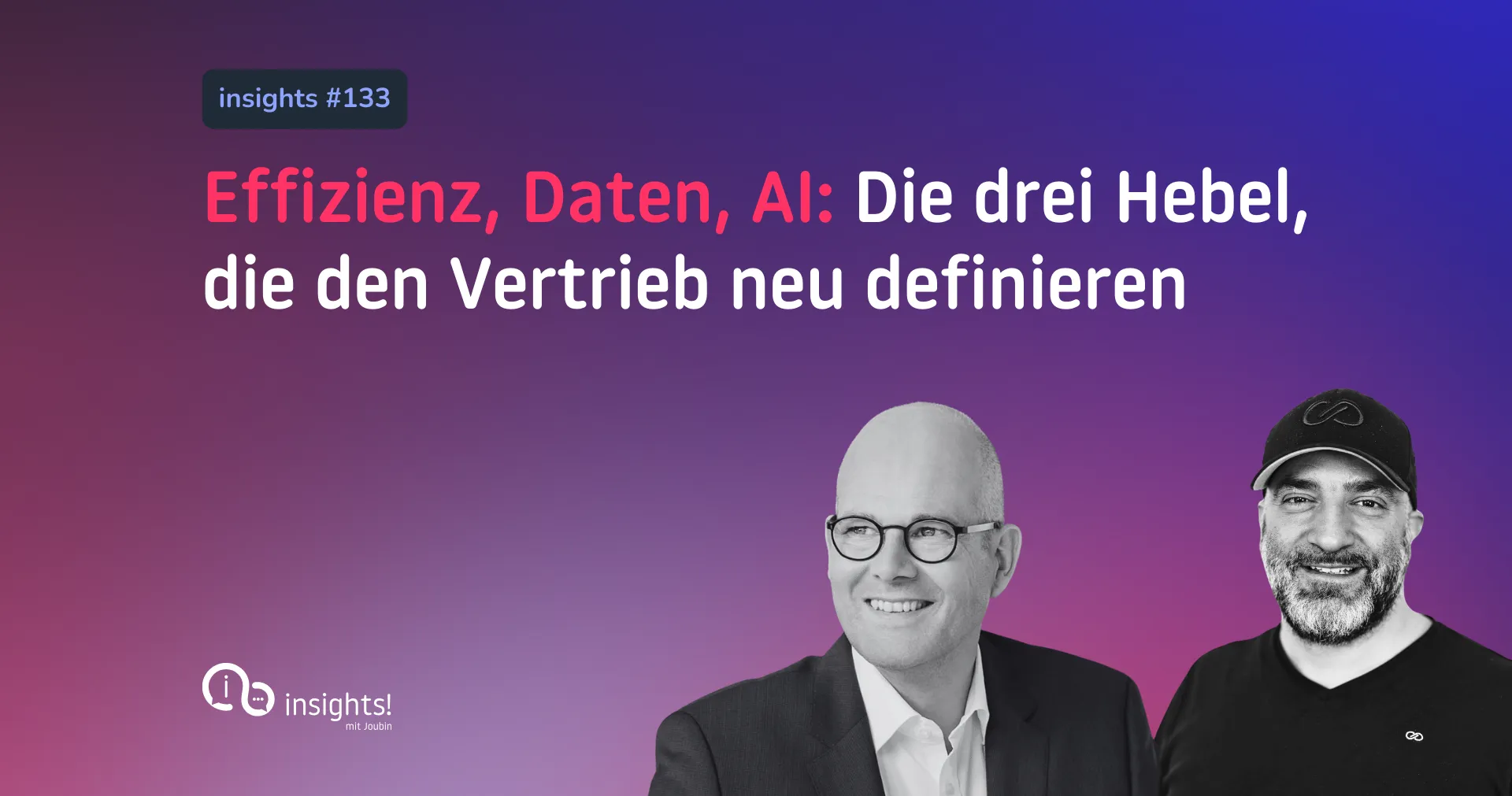
#133 - Data, AI, Efficiency: What's Really Moving Businesses Forward
In this episode you'll learn why sales is standing right at a historic turning point and how AI can make you not just faster, but strategically better. Gunther Hahn shows you how tenders get processed in days instead of weeks, why data is your sharpest sales tool, and why buyer and seller bots will soon trade with each other as a matter of course. High time to unlock your efficiency reserves.
 Joubin RahimiManaging Partner · synaigy
5 min read
We're cutting the time to quote in wholesale for our clients by more than 80 percent. A quote that used to take two to four weeks is now ready within a few days — and is often even better in quality and margin.
In this episode you'll learn why sales is standing right at a historic turning point and how AI can make you not just faster, but strategically better. Gunther Hahn shows you how tenders get processed in days instead of weeks, why data is your sharpest sales tool, and why buyer and seller bots will soon trade with each other as a matter of course. High time to unlock your efficiency reserves.
Why you need to act in sales now, and how AI gives you the decisive edge
Sales is changing faster than ever. Markets are shrinking, competitive pressure is rising, customers are digitalising their processes, and you're faced with the task of not just keeping pace, but actively steering the direction. This is exactly where the conversation with Gunther Hahn comes in, Principal Partner and AI thought leader at synaigy. His message is clear: if you don't set the course now, you'll be overtaken. This blog post sums up the key takeaways from the conversation and gives you the drive to shape the future of your sales yourself.
Market under pressure, and why you need to react faster now
The market is turning ever faster. Companies have only just rolled out complex ERP systems such as SAP, and no sooner is the foundation in place than the next trend is already looming. At the same time, margins are shrinking, ranges are growing, and competition for customers is getting fiercer.
You're constantly required to react faster and more flexibly, and with fewer staff. That's because experienced colleagues are gradually retiring. In concrete terms, that means:
Know-how disappears
Complexity increases
Technology understanding isn't evenly distributed
Without technological support, this balancing act becomes barely feasible. So the key question is: how can you relieve your team's load in a way that keeps it high-performing?
How you process tenders in record time – thanks to AI
A core problem in technical trade is processing bills of quantities. Thousands of line items, different formats, unclear product descriptions, changing requirements, and all of that under time pressure. Gunther's team solves this by integrating AI directly into the processing workflows. For you, that means: you submit a tender file, and the system classifies, matches and suggests suitable products. Instead of two to four weeks, pre-qualification often now takes just a few days. Why this is a real gamechanger • You respond to more tenders than ever before • You reduce wasted effort – no more calculating the same project three times over • You win back revenue you'd previously lost for lack of time Particularly clever: the system recognises similar items, assigns suitable alternatives, and even factors in pricing logic. Your chances of winning the bid go up. At the same time, you improve your margin.
The next evolutionary stage: when bots buy from each other
In the conversation, Gunther makes it very clear: we're close to the point where buyer and seller bots negotiate with one another. Routine orders will be handled fully automatically, including price determination and compliance checks.
For you, this means:
Purchasing and sales get automated
Processes are relieved entirely
Teams can focus more on strategic customers
And this isn't a future dream. It's already happening now, in early pilot models.
Data quality – the underrated foundation
Data is the fuel of every AI solution. Whether matching, pricing, routing or analysis: without good product data, even the best technology is useless to you. Gunther stresses that many retailers are still leaving huge potential untapped here. AI can: • fill in missing product data • detect faulty entries • harmonise ranges • standardise structures The better your data, the stronger your leverage in sales.
How you recognise the value of AI and avoid investing in the wrong projects
Many companies start with AI by way of a chatbot or a small tool gimmick. Gunther calls that "nice, but ineffective". The decisive step is: identify the real value. You do that by: 1. Understanding your brand and target groups 2. Analysing the entire sales funnel 3. Checking every touchpoint for whether AI can create concrete benefit there It's not about having AI. It's about using AI to solve a specific problem that saves you time, brings in revenue, or strengthens the customer relationship.
Three steps to get started now
You want to get started but don't know how? Then Gunther recommends these three steps:
Start not with concerns, but with opportunities
data protection matters – but it's no reason not to start.Bring people onto the team who understand technology and are keen on it
Without internal enthusiasm, you won't get an AI project off the ground.Try it out – small but concrete
identify a case, test a tool, measure the effect, scale later.
Want to listen to the full episode?
Here's where you'll find the podcast of the interview:
Please accept the corresponding cookies to view this embedded content.
Prefer to watch the episode instead? No problem!
Here's where you'll find a recording of the interview:
Please accept functional cookies to watch this video.
Would you rather read?
Joubin Rahimi
Fantastic to have you back for a new episode of insights! My name is Joubin Rahimi and joining me today is Gunther Hahn. Gunther is a Fellow of TIMETOACT GROUP and works at synaigy, and I'm really pleased that you're here in the studio with me today, dear Gunther.
Gunther Hahn
Thank you very much for the introduction, dear Joubin.
Joubin Rahimi
Of course. Would you like to say a couple of sentences about yourself?
Gunther Hahn
Yes, very happy to. So as you already said, I'm your colleague at synaigy, where I'm responsible as Principal Partner, really for three areas. I support sales, consulting, which is the main focus, and together we define new products, new services, because the market is changing and we're both very intensively engaged there.
Joubin Rahimi
Yes, and Gunther deals with the topic of not only AI, but also how you can become more efficient, in sales too. And bringing that front-line customer touch in, that football touch, so to speak. So what are the topics currently moving customers?
Gunther Hahn
I'd like to add to that. Before I joined synaigy, I spent the last years, meaning a long time, in technical specialist trade, wholesale, but also in B2B sales. That's why I believe I know my way around quite well there and can bring in many impulses. And yes, the world is really changing dramatically at this point. Of course, we currently also have one or another challenge in the market. We have many, many companies that, after years of effort, have more or less rolled out SAP or are still working on it, now have a stable, solid base structure, and suddenly a change happens in the market and companies now actually have to react and show flexibility and adaptability.
Joubin Rahimi
You say something different just suddenly happens in the market. What do you notice there, or what are the challenges?
Gunther Hahn
Yes, of course, it's nothing new that sales fundamentally isn't getting any easier in this period. We have various, let's say, market factors that are known, which is why the market simply no longer looks the way it used to. We have strong, strong displacement competition within the individual trades, really regardless of which trade, whether it's a manufacturer in the lighting sector, for example, or a wholesaler, sanitary, electrical building materials. A lot is changing there right now, and more and more players are fighting over an ever-shrinking pie. And that's naturally where it's an important topic to build up efficiency, even excellence, in order to position sales accordingly.
Joubin Rahimi
And since Gunther and I work together, I know you help companies with this too. What are typical projects, mechanisms, initiatives that successful companies undertake to move themselves forward?
Gunther Hahn
Imagine we have our company, let's take a mid-sized or large mid-sized business in production and distribution trade, wholesale as it's called. You have a range that's relatively large, a few hundred thousand to a few million items, and on the other side you have customers, and customers are digitalising too. Now the customer has a system, you as a wholesaler have a system, and there are still people, fewer and fewer people, responsible for the business, and you have to match. And that's becoming increasingly difficult. So what does the customer need in the optimal case, and what can be offered to the customer when, how and at what price.
Joubin Rahimi
Now one could say the employees know that, but I think the challenge is also demographics, as I understand it. So it's the experienced people's knowledge, and they're soon retiring. Is that such a big topic?
Gunther Hahn
That's a huge topic, because it also has to do with acceptance and change management. So for our topics, a customer comes with an order, approaches a company via a tender wanting it answered. The tender contains a few hundred, a few thousand line items, and for that I naturally need colleagues who have experience to translate these requested products into products that I have in my range and can offer. And for that I first need enormous experience, because such a deep view of the range, or also a view of the trade in general, really only the old hands have that. But as you know, it's often the case that the old hands find it a bit harder with completely new technology. And so we have on one hand fewer people who really have that depth, and at the same time they also have a certain reluctance towards technology. It's a multidimensional problem.
Joubin Rahimi
What's the solution you propose, that then gets implemented with you and the team?
Gunther Hahn
Yes, well fundamentally it's not our invention that AI suddenly became available. And bang. Something that took us all completely by surprise. So of course we first start with data. We need clean, good product data that we can then work with if needed. And then we take the tender, and the tender comes in in the most varied formats. Standard in the building materials trade, for example, is a GAEB file, and this GAEB file is transmitted digitally. It describes the construction project. It contains services, it contains products, it contains quantities, it describes the rooms, and I receive that and then have to match it with my range. We've developed a solution for that, and we're in the process of preparing or implementing the solutions for various applications, meaning for various customers. We read in this GAEB file, and at the very first stage we bring the information into the same data format. So we distinguish, are they product requirements? Are they service requirements? Or are they perhaps just delivery notes that the potential customer includes? We can classify that very precisely, read the file in, and then in the simplest sense we have a one-to-one match. So a customer is looking for a product, we have the same product in our database. Together we can, in the best case, identify and assign it via an EAN or a unique number. Or we need a vector search, a similarity search, where we match similar comparable products to the products being sought. And that's exactly where our solution is particularly strong, because we can say: "What are similar matches? Are similar matches similar items from the same manufacturer? Do we allow other manufacturers? Can we offer cheaper items? Can we do an uplift with more expensive items? Or what a lot of our customers particularly value about our solution now: we can position own brands. So a customer is looking for, say, a plasterboard panel, and we have exactly the same product, which isn't one-to-one what's stated in the tender, in our own-brand range. The margin on that is twice as high.
Joubin Rahimi
And even cheaper for the customer?
Gunther Hahn
Can be cheaper for the customer. Then we can assign it and include it directly in the tender.
Joubin Rahimi
So you'd say this service, processing these bills of quantities, what's the real added value? Can you break it down? How much time do you save? Do you save on staff, or do you have the potential to do something else with it?
Gunther Hahn
Yes, well, that's a brutal lever you're touching on there. We know companies, I actually have concrete requirements from the market in mind right now. It's a relatively large company, has various brands, they receive 50,000 project enquiries per year, 50,000. Of these 50,000, they can only answer 30,000, because for 20,000 there simply isn't the time or the expertise, or they take too long and it's no longer relevant. To answer a specification document like that, which can run to several thousand lines, an experienced employee needs two, three, four weeks. Sometimes external quotes still need to be obtained from the manufacturer, sometimes I can check directly in my own database. Putting it together takes time, ties up capacity, and the likelihood of implementation isn't 100% either. Then a lot of these enquiries also come in double or triple. Trade one, trade two, trade three approach you about the same site, you quote three times. Ideally three people are all quoting. Yes, of course. We all start from zero again. And our system, which we're positioning in the market here, is simple, we do that in shadow processing. That means we read in the specification documents and then the next day we already have a certain matching in place.
Gunther Hahn
And for us it's also really important, and we call this "human in the loop", that we integrate the specialists into our solution. We have various steps for that. As I said, the matching, there are one-to-one matches, a vector search, i.e. a similarity search, right through to assisted research on the internet. Or we sometimes bring in specialist databases too, but that's trade- or range-specific, then across the various stages. And that's where we can really, really, really, really reduce the time, i.e. go-to-market, by probably more than 80%, because one or two days for internal processing is passed on externally, incidentally also fully automated. Then maybe another two or three days are added, but then within three person-days and three working days, I have a fully calculated quote.
Joubin Rahimi
Instead of two weeks in that case?
Gunther Hahn
If it even gets processed at all. And also because I'm much faster, the matches are much better qualified, the quote is perhaps cheaper thanks to a better view of the margin, either for the customer or more margin-rich for the retailer. That's why it's so, so, so much more successful than not doing it.
Joubin Rahimi
That was already an impressive first process. What other topics are moving sales in this environment?
Gunther Hahn
Well, of course we have, as I already mentioned at the start, product data. And product data, if I'm now a wholesaler, a retailer, and have 100,000 or a few million articles in the database that need synchronising. We also use AI there again, by the way. And to fill gaps, to identify faulty data, to make data complete, there are so, so, so, so many applications. So data is one topic. Then probably the next or the one after that will be a huge topic, where it's no longer company talking to company one, company two, but there'll be an automation of that whole path. So an actual buyer bot and a seller bot will be activated. They'll then talk to each other. And then, this is also the case in another example, that for companies we can steer purchases that fall below a certain threshold amount completely automatically, bringing a lot of efficiency into procurement. That's a big, big, big topic right through to compliance and sustainability topics.
Joubin Rahimi
That's actually two cases in one, the buyer and also the seller, that this is automated or almost fully automated or within a framework. If you look ahead to the future, how do you think, or how must companies change globally? A bit of a helicopter view.
Gunther Hahn
Well, I think we're at the point right now where many companies are actually facing the AI-or-not-AI question and discussing it. Many companies are now starting with: we allow some colleagues to use OpenAI here or activate a co-pilot, and maybe we also build a chatbot. But honestly, that's nowhere near enough. I think the key consideration is how can I combine AI technology, and this is really important, with data competence or data excellence, how can I combine them so that in the end real economic added value can arise for me? And that's what we need to get into. That's also a topic where there are currently a lot of customer enquiries, identifying exactly this added value. So not saying we can do AI, "we offer you a great AI solution", but rather "look for the added value and find the solution with the appropriate technology".
Joubin Rahimi
How do you look for the added value? Put simply, first of all: "look for the added value". Where do I discover this potential?
Gunther Hahn
I have to start right at the beginning. I actually start with the brand. Then I also start with: who is the customer? Who is the target group? How does the company interact between target group and company? How does that fit? To then say: where can I support that with digital services. So I do it like this. That always means sales funnel or customer journey for me. So really going through it point by point and saying: what service do I need? What can I sensibly digitalise or sensibly support with AI? And then optimise the touchpoints accordingly.
Joubin Rahimi
In a nutshell, where you can improve the customer experience and at the same time gain efficiency, that's where you have the greatest potential. That's how I'd summarise it.
Gunther Hahn
Yes, customer experience, but also against the backdrop of digitalising the entire business relationships and the entire business processes. That's probably more of a philosophical discussion, whether it's customer experience when one system talks to another system. But I think when...
Joubin Rahimi
That'd be worth its own episode. Agent experience.
Gunther Hahn
Yes, but that's where it's heading. You can see that, small digression, on websites too. End-consumer websites and web shops now have a really noticeable share of AI bot traffic, and how do I deal with that as a website. But next episode. That's certainly a topic at the moment where there's still a really good opportunity for positioning, and far too few companies think about that area, i.e. the automation of procurement processes.
Joubin Rahimi
Great, thanks. And I'd like to close with a question to you: what are sensible first steps, one, two, three steps, that companies should take who are now standing before this and saying: I haven't yet got stuck into the topic of efficiency gains with AI. What would be the first three steps where you'd say: do that. That's already a good start.
Gunther Hahn
So first of all, data and AI is actually always a combination for me, to be understood as an opportunity and not as a problem situation, please don't start the topic with data protection. That's important and everything can be solved. But data protection is such a barrier to be swung around, it urgently needs to be assessed within the company and then decided upon. So you need to build a good consensus around it and then simply face the opportunities that come with courage. Then, of course, it's important that I need a competent point of contact with whom I can go this path. I need competent, flexible, motivated colleagues who also understand the topic and want to go along this path. And then, I believe, the most important step is to start trying, to say: Where can I? Which tool can I use how? Where can I take one more step? Where can I achieve one more result, in order to then check these cases, once identified, whether they bring me something, so as to then later do it properly. Then, doing it data-autonomously in the private cloud or similar, so that it's simply data-secure and can also be rolled out.
Joubin Rahimi
And ultimately Gunther says: It's time to act, so simply put, it's time to act. And with this call to action I'd also like to close today's insights! session. Thank you, Gunther, for the insights. If you're still interested, feel free to leave comments below, get in touch directly with Gunther Hahn. He doesn't hide on LinkedIn, and I look forward to the discourse, because ultimately it's not just about the individual company, we all need to take a small step forward so that we can continue to have a great future here. Thank you, Gunther, for giving our customers so much valuable input. Thanks for listening and watching.
Gunther Hahn
Thank you very much, Joubin. My pleasure.
Do you have questions or feedback?
Then feel free to contact us directly.
- Joubin Rahimi
Managing Partnersynaigy
Show phone numberShow mobile numberShow email address

Subscribe to the blog now and never miss any news
✔️free of charge ✔️weekly news ✔️expert knowledge
Please accept the corresponding cookies to view this embedded content.