



insights! #73: Shared values, shared success
 Joubin RahimiManaging Partner · synaigy
4 min. read
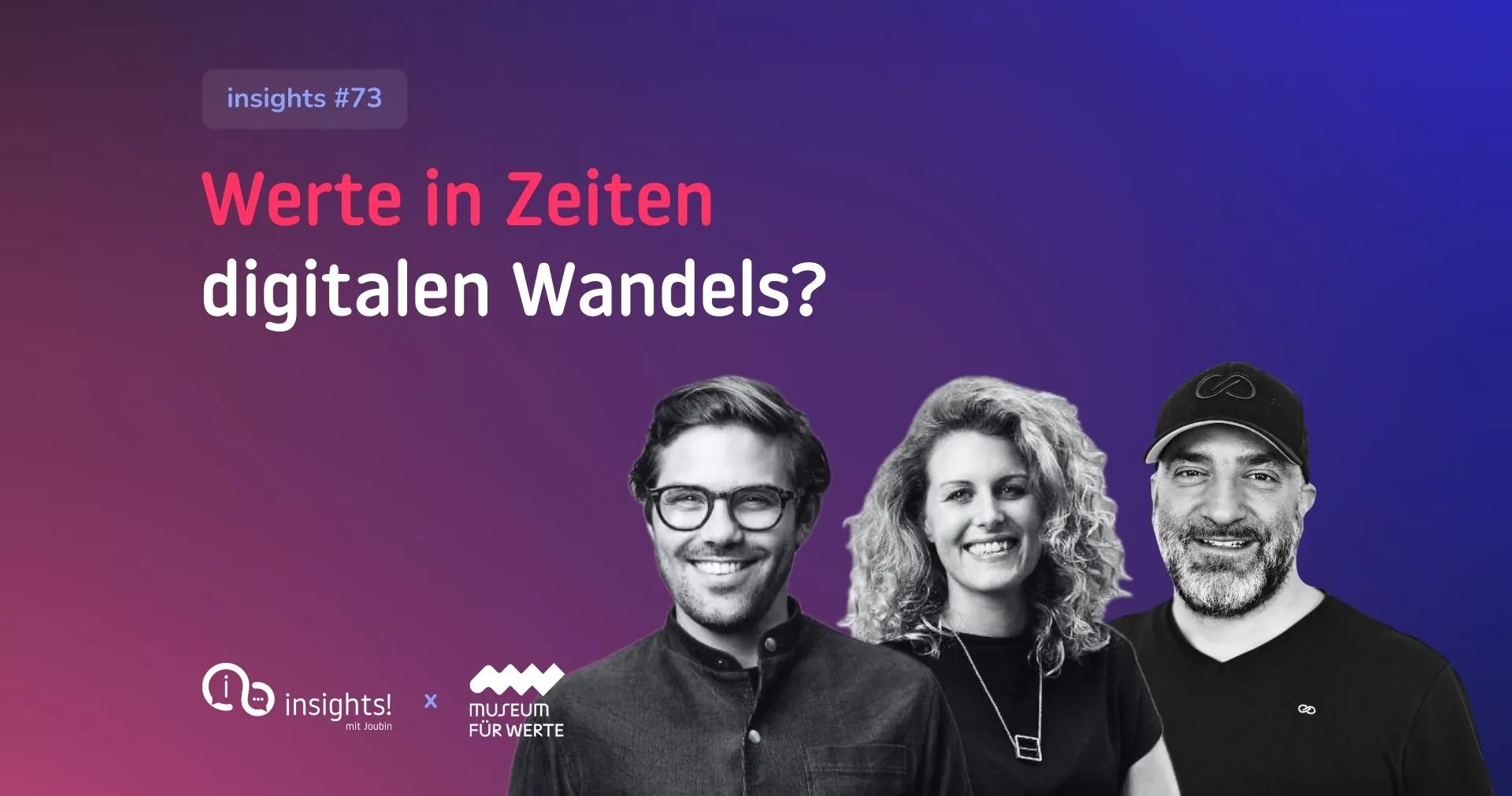
In this insights! episode, Laura Ludwig and Jan Stassen, founders of the Museum für Werte, explore the importance of values and organisational culture in times of digital change. They stress the need not only to look outward but also to reflect inward and embed one's own values in technology and product development. The interview highlights that both collective and individual values play an important role, and that successful companies must consciously engage with their identity to develop a tailored growth strategy built on their strengths and potential.
Values are not only a guide for our actions, but also a mirror of our identity.
What do values have to do with the rapid digitalization of our world? Quite a lot, if you listen to the fascinating insights of Laura Ludwig and Jan Stassen from the Museum für Werte. In their conversation, they open our eyes to a central truth: in a time when everything is becoming faster and more technical, it is our values that show us the way.
The hidden anchor in the digital storm
Technology is advancing relentlessly and is fundamentally changing our lives. But while the digital revolution makes many things easier for us, it also challenges us to stay in touch with what really matters. The Museum für Werte has made it its mission to preserve this anchor in a fast-spinning world and to make it visible.
Instead of blindly following technological progress, Laura and Jan invite us to pause and reflect: which values give us orientation in these times? And how can we actively integrate these values into our daily actions and decisions? These questions are of central importance not only for individuals, but for companies as well.
Values as a compass for companies
In a world where innovation is often equated with speed, the inward view easily fades into the background. Yet this is precisely where the key to sustainable success lies. Companies that clearly define and live their own values are better equipped to meet the challenges of digital transformation.
Laura and Jan emphasize that values are not rigid rules but living principles that help us make decisions in uncertain times. They serve as a compass that points us in the right direction when the future is uncertain. And this is not only about individual values, but also about collective values that hold a community or an organization together.
Technology and ethics: a critical symbiosis
One of the most fascinating topics that comes up in the conversation is the relationship between technology and values. Digitalization has the potential to improve our lives, but it also carries risks when ethical considerations are neglected. The example of Amazon, which deployed an artificial intelligence that discriminated against applicants, shows how important it is to integrate values into technological development.
This is one of the greatest challenges of our time: how can we make sure that our technological progress is aligned with the values we stand for as a society? This question is not merely theoretical — it has concrete consequences for our lives and our future.
Looking inward as a success factor
Perhaps the most important impulse the Museum für Werte offers is the call to look inward. At a time when everything around us is changing so quickly, it is crucial not to lose touch with our own values. Because in the end, it is these values that help us keep our bearings in a complex and often chaotic world and make meaningful decisions.
The Museum für Werte teaches us that values are not just something we preach, but something we have to live — in our personal lives just as much as in the business world. They are the foundation on which we can build our future, even in a world that spins faster than ever before.
Do you want to listen to the full episode?
Here you can find the podcast of the interview:
Please accept the corresponding cookies to view this embedded content.
Would you rather watch the episode? No problem!
Here you can find a recording of the interview:
Please accept functional cookies to watch this video.
Would you rather read?
Joubin Rahimi:
Today he'll learn three things, and the first one is why my values should not be the company's values.
Laura Ludwig:
Then, when things are spinning fast on the outside, why it's also worth looking inward.
Jan Stassen:
And why context-free methods can't always necessarily work in context-sensitive environments like your organization.
Joubin Rahimi:
So take a look at the episode and enjoy the content.
Joubin Rahimi:
Great that you're joining us again for a new episode of insights!. My name is Joubin Rahimi, and my guests today are Laura Ludwig and Jan Stassen from the Museum für Werte. Great to have you here.
Laura Ludwig:
Thank you very much for having us. Thank you.
Joubin Rahimi:
Very happy to. It's great, first of all. We met completely by chance on a trip organized by NFQ, and it was inspiring. The trip, but also the conversations with you. And that's why I'm all the more pleased to be doing this interview with you today. But maybe just say two or three sentences about yourselves and the Museum für Werte and what drives you.
Laura Ludwig:
Yes, gladly. I'm Laura Ludwig, I'm Managing Director of the Museum für Werte, and together with Jan I was able to start this wonderful journey six years ago.
Jan Stassen:
Exactly. I'm Jan, Jan Stassen, and I'm part of the museum, and I studied at the Universität der Künste. And that got us thinking about what role values and the body actually play in our lives, and how you can actually lead with them, and what it means for society.
Joubin Rahimi:
Really big topics, and you ask yourself: what does that mean for e-commerce and for digitalization in that context? You could say Museum für Werte — where are the KPIs, where
Is the data? And of course, through our conversation, I've sharpened my own opinion on it as well. But do you have an initial thought on it? Why is the topic of digitalization, the topic of values, so incredibly exciting?
Jan Stassen:
Yes. I think it's really important to engage with it, for the following, for a great many reasons. Technology and digitalization in general are first of all an accelerating facet. They accelerate our life together enormously and have a great many effects on how we actually shape life with one another. That's one side, but on the other side digitalization also changes the way we work with each other and how we spend time with each other. And that's why for us it's a really fascinating question, that technology comes a bit from the outside, from the rational. And over the last decades we have engaged with that extremely intensely, at least that's how it feels to us. That means we believed that the more we follow it, and the more we follow this image of external engagement, of research, the clearer our picture of the world becomes — while at the same time somewhat forgetting what is actually happening on the inside of our being. And in order to be successful, I think you have to keep a balance in that. That means when we talk about values, it always also means: who am I in the context of others? So who am I in the context of my environment, and how can I shape that productively? And values are extremely relevant for that, especially in such fast-spinning cultures as technology. Do the values then spin fast too, or precisely not? They change more slowly. On that, we can simply send you a short video as inspiration for your listeners about the Culture Map that we created together with Christian Welzer, Professor Dr. Christian Welzer. I think you've already seen it—
Joubin Rahimi:
I have seen it, awesome.
Jan Stassen:
—how values have changed worldwide over the last 50 years. So culture, facets and the values within them. So they do change, just more slowly than our everyday life, which is influenced by technology, does.
Laura Ludwig:
You asked whether values are important for digitalization and for change. Well, I have a very personal connection to that, because that's how I found my way to the Museum für Werte. For a long time I worked as a product manager in a digital company, and there, from the inside of the organization, I questioned a great deal — why we actually think so little about letting values flow into the development of technologies. And I strongly believe that we can do that more and that we should do it more. By now, I think the world has turned a bit, it has arrived and it's already being applied. But back then I questioned that very strongly, and along the way I got to know Jan, and we talked about it a lot. And then I found my way out of technology and moved to the entrepreneurial side.
Joubin Rahimi:
That alone would be worth another podcast. But back to letting values flow into a product. The first thing that might come to some people's minds is sustainability. A green product, so CO2-neutral or CO2-avoiding, or counteracting it. But our software products consume CO2 per se, even when they're just running. But did you mean values like that, or are you also thinking of other values in that context?
Laura Ludwig:
Among other things. So of course you can build in values that generate the output. That we are more sustainable, that we develop technologies that help us to be more sustainable and thereby contribute to major crises such as climate change. But there are also values that you can implement for the encounter between people in the interface of technology, in the machine-human interaction, and thereby bring it back into the real world. And there are, I believe, very, very many different ways to let values flow back into this development.
Jan Stassen:
And here's an example, you may know it, Joubin, but maybe not all listeners: Amazon at one point had all its applicants trained, or evaluated and rated, by an AI. What happened there, of course, is that the past applicants who were hired were the statement, or the basis, for guiding this training or this evaluation afterwards. That means the training data carried a certain bias within it, and that then worked retroactively — they installed and applied this AI, and it was extremely racist. And the more you had been skiing, the more likely it was that you got a job at Amazon. And then Amazon of course wrote: no, that's not who we are, that's not really who we are. They dropped it again. And in that, culture and its connection to technology becomes extremely fascinating to see, or visible: you are like that, you're not yet consciously like that, you're subconsciously like that, and AI or technology suddenly makes such processes transparent or visible, and then it becomes really painful. You can see it right now with Gemini as well, which suddenly spits out images that mainly show POCs, or, or, or. Because it then gets over-regulated. That means technology only replicates what it observes in the world. And now that's suddenly thrown back at us, at ourselves, this mirror. And now we have to learn to deal with it. And technology plays an important role in that too: what does it actually reflect of and with the world?
Joubin Rahimi:
It isn't generating anything yet. So yes. AI means it's typically a replica, but a relatively fast one, so. One impulse we also had when we were in Bangkok and had those conversations was, among other things, that when I as a company grow quickly, or new cultures come into the company, the question is: how can I take everyone along on that path? And there he also understood that values are a great medium, for that too, or for much, much more. But so that everyone pulls in the same direction. Did I understand that correctly?
Jan Stassen:
Fundamentally, first of all, the important distinction that doesn't exist in German, just for clarification. And it's also why we say this is extremely relevant for organizations. In German there is no difference between individual values, the ones that are important to you, Joubin, personally, that you shape your everyday life with, and the ones we agree on as a community. Those are collective values — you can imagine it in a football club, where we agree: we want to be on time here and we always want to give our all. But that doesn't mean that in private you always want to be happy too, that it's your main value; but you can agree on it, an agreement. And this difference is first of all really important. That's why individual values are actually like situation-independent decision aids. That means no matter where you are as a person, you can make decisions based on them and they become a bit clearer. Especially in times that are changing extremely, where this question of what happens next comes up. And the future is plannable, it's unplannable. So you need a kind of north star that gives you this inner clarity. Values are extremely helpful for that. And this north star is something you can also carry in front of you as an organization. And that's why collective values are important too, or extremely important. And what many companies — at least in our observation, and I'm also extremely curious what your listeners say — what we encounter is that a great many companies write values down for themselves, but no employee actually understands what their own values are and how they can contribute to us living and internalizing these collective values, so that a connection arises between me as an individual and us as a collective, and it's not always only the collective that gets talked about in the third person singular. "One should show more performance here" — instead you also say: what exactly does it mean here and what do I have to do with it? And imagining and internalizing this connection is, I think, extremely important.
Joubin Rahimi:
So as you say, the separation between private and company, or groups or scenarios or community values, that's important. Is that more common in other countries, or are there other terms for it, or not? Do they do it — does America generally do it differently in that respect, for example? I don't know.
Jan Stassen:
Yes, values always have something to do with identity, too. And of course every country deals with it very differently. Yes, and there are countries that are much more collectivist, meaning the individual comes much further down the list. I don't know whether you know Hofstede — he's a famous researcher who once studied SAP with 70,000 work colleagues and broke down parameters for how culture actually works. And that's why values are also expressed very differently within that, and what they actually mean and how you live by them. Values are a fairly modern idea, one that has really only existed since the Enlightenment, and that's why it's an extremely widespread vocabulary especially in Western countries. That's not the case in other countries, but the advantage of values is, first of all, that when you hear it, no matter where we are, everyone has an opinion about it, no matter how politically right, center or left I am, no matter how religious or non-religious. No matter where I come from, I have an opinion about it. And then it's basically all the same to us whether you write down as a company that your value is "colorful flowers 3000". As long as you all understand the same thing by it and understand it as a vocabulary, as your own lived vocabulary, it serves its purpose. Because it's not about interpretive authority — does respect mean something entirely categorical? — but about a community, a shared agreement that helps us make certain decisions. And that's the path, in the end.
Joubin Rahimi:
Let me write down three notes for the summary. Does Germany also have its challenges because of the past, in the sense of identity? I spent a long time in Greece and also in Poland and Austria. There the identity — especially the Greeks have a completely different identity in relation to their country. And I also had the impression, and it was only three companies, that these companies, the Greek companies, also had a completely different culture among their employees. They really were passion for the business. At IBM that was a claim, and there they lived it. It wasn't IBM back then, and I found that really exciting. But do you think we have it a bit harder in Germany because we still have to get past this stage? Or am I building a bridge that isn't there?
Jan Stassen:
Well, I definitely think — I have a strong opinion on this, let's start there. You were with us in the workshop, and there's an exercise on identity, and that was the first thing you did there, basically. I won't say exactly what happens there, in case more people take part, so that they can enjoy it. But what happens there, or what we can observe in it, is for example that in Germany national identity of course ranks much, much further down than in other countries. There are cultural spheres and cultural movements where certain things are ultimately important to you, for people from certain faiths, or for example for people of Jewish faith, or for Israel language is an extremely important factor. You notice that immediately, right? For people from Turkey who come to Germany, the mother tongue is an extremely important factor of identity. Yes, and it's less about which city I'm from or which — because people have often moved around a lot. So in Germany you really see a big difference between the areas, and these differences also work with each other. That's the exciting part. That means you have a team from all over the world, which is totally cool, super inspiring, while at the same time the interpretive authority over what matters to me in it is completely different. Because for one person what matters is: I really want to get home on time, because I'd like to spend a lot of time with my child; and the other one thinks: I want to really achieve something here, for my family too, but I want to build a real career. I'm really building something up. And the motivation is ultimately the same. It's just that for one the consequence is to go home earlier and for the other it's to stay even longer and put in even more. And then it gets judged on a factual level. But the motives behind it are actually the same. And that's really fascinating, and it happens constantly.
Joubin Rahimi:
So I'd like to take that thought to our typical customers. Those are mid-sized companies, so German Mittelstand companies, which are often quite large quite quickly, quickly at a billion euros in revenue. So not the Mittelstand as it's defined in SMB, but often hidden champions, and that's our typical customer, where we also talk at managing-director and owner level. What would you give them to take away if you look at the next ten years from your perspective? So what do you think you would contribute as an impulse that could be helpful for the leaders and decision-makers over that longer horizon?
Laura Ludwig:
In times of upheaval, where we have to get used to a great many new things and have to deal with them very consciously and mindfully, definitely the inward view — really engaging with values, not being so strongly driven from outside as was perhaps the case until recently, but really being able to live the complexity that comes at us from outside on the inside as well. And, yes, being able to bear it. Learning to bear it.
Jan Stassen:
Yes, that's the first thing. I'd say exactly the same.
Joubin Rahimi:
May I ask a question?
Jan Stassen:
Yes.
Joubin Rahimi:
I find the inward view really exciting, because at the moment the trend is customer experience, thinking about what the customer wants. Do you mean moving away from that, or rather away from the market? Or how do you mean this inward view? Or is there no conflict at all?
Jan Stassen:
There's no conflict at all. Here's a bit of an image for it. And for the people who know him: Dirk Baecker, sociologist. It's a bit like this — the speed of change on the outside keeps increasing. And as long as you can't mirror it on the inside, it's a bit like taking the escalator backwards. You go down, you descend. That means you're welcome to keep orienting yourself outward and looking at what's happening out there. But as a leader you have to manage for your team to be able to process that internally as well, so that this speed of change is mirrored internally too. Learning and development and all the processes that are now playing a bigger role and becoming more important, because of course you don't want to replace people as quickly as things change out there, as new roles emerge; instead you need this culture and this inner willingness to change. That, I think, is extremely important, and that's why it doesn't conflict with, yes, we also have to look at what's happening out there — it just has to be balanced. And what we're also observing at the moment is that this lighthouse looks a great deal outward and in doing so actually forgets what's happening inside the organization. Then a few training courses get done quickly. But it's only half-hearted. It's something that doesn't happen on an inner level, but only on a symptom level. And it has to be really lived inwardly for it to work.
Joubin Rahimi:
Then the topic isn't at all: I now have to optimize more processes, automate them. On the one hand we can look at it from the technological perspective and very factually — a process takes ten minutes. If I can reduce it to one minute, I can do the same thing ten times over. With the same apparatus. So he's saying that falls far too short. I'm just repeating it, feel free to correct me. That falls far too short, because people have to change, and for them to be able to change — for us to be able to change in such a community, in the company community — I have to understand what is happening, and for that I need a different mindset than saying: you've completed your training, that's great, you can do that for 30 years until retirement.
Laura Ludwig:
And it's a nice effect: when we automate something that used to take ten minutes and now only takes one, then we have nine more minutes in the team and in the organization to think about things that help us in the long term, that move us forward, that drive cultural development, that perhaps also direct our view outward to social issues and give us time for such things.
Jen Stassen:
And I found your direction of movement really interesting just now. You said we change processes and thereby what happens and doesn't happen internally. And then that influences individuals. So you go from the outside in — not outside in the sense of external, but from structures to individuals. And I think what we have to learn over time is that we have to flip that a bit. Only once I understand what role I play in such an organization, how I behave in it, what kind of culture emerges from that, can we then update processes together. And this prescribing works in part, but at some point there's a bit of a rebellion movement — I don't think I need to tell you that. What has simply happened in a great many transformation processes and other things is that people sit things out, because they get told something from above. There's this quote I can't get out of my head. There was a quote: it's like a man who was sad because he had no feelings, but doesn't understand that sadness is a feeling. That's how companies write down values, new values, because they believe they don't have any. Yes, you do, they're all inherently there. You have to work with what you have and not with what you don't have. And that happens really often. Look outward — at Nike, they have such cool values, we need those now. Bullshit. You have everything. You just need to articulate it, you just have to phrase it. And as a leader, the actual skill then lies in looking at it and saying: what's happening here, what do I want to see more of? What do I want to support here that's already happening anyway, and what do I want to see less of? What do I want to let us grow out of bit by bit, and how can I cultivate and support this process? That's a bit of the challenge.
Joubin Rahimi:
I already have the next question in my head, because I think everyone is now taking away: I want to grow, or I have internationalization, or I have to achieve something different with the same team, with the same budget, or my market is changing and so we have to change. That's where you play a big role with the topic of values and looking inward. So, awesome. How would you say a company should proceed successfully? Well, you've both already said a few things. But which steps are they? So for the factually oriented ones, the blue ones in the Biostructure Analysis. Okay, rational: which five steps, ten steps do you typically have? They can always vary.
Jan Stassen:
If you're asking now, if it's asked concretely. If I understand it correctly: how do I shape growth?
Joubin Rahimi:
We're always in a growth market or a market of change. So never shrinking, at most changing, typically.
Jan Stassen:
Okay, when it comes to growth. What's going through my head right now is probably that there isn't just one linear idea. How do you proceed one-to-one now? What exactly is the sequence? Because I think one thing I always have to say about it is that what I find really dangerous in digitalization processes is this: there are methods that believe they are context-free but go into context-sensitive environments. That means you take the Spotify model and try to implement it at Adidas, and in doing so you make the thinking error I just tried to articulate, namely to say: hey, what works there works for us too. Yes, that's why I'd now cautiously say: hey, 10 ways to be ahead of your competition — but everyone knows those 10 ways, so then you're no longer ahead. You have to find your own way in it, and that's why the first important thing to understand is: what distinguishes us here? What special quality distinguishes us here? And what can I actually work with that's already there? What can I articulate that's already there, and what can I capitalize on? So what can I exploit — which of these strengths can I exploit — and deal with that consciously? And in that, an old strategic way of thinking mixes in, which actually … or a direction of thinking, thought figures. There used to be this Porter marketplace: I look at what works out there and then throw all my resources at it, I try to throw them at that market. Then at some point it shifted; in the 80s and 90s there was the resource-based view. That one actually understood: I first have to look at what I have and what I can do the most with. And the last one, since the 2000s, where there are various formulations, which basically says entrepreneur-based view, so saying: which potentials can I actually exploit with the resources I have? Trying to connect both worlds and to move within that is, I think, a good step. I just can't give you those five steps; I can only say that you have to look at your organization: where do you stand right now, and what can you capitalize on?
Joubin Rahimi:
That's already three steps.
Jan Stassen:
Yes, and of course they're not as model-like as people often hope, and so on — like design thinking. Now first we do this, we go outside, and so on.
Joubin Rahimi:
Yes, you also gave us an impulse, which I found really exciting too, but it's only one tool. We have the values within our group, and they emerged from 23 statements. The best statement is "Keep the Assholes out", and we had that at our core really, really early on, in that we said: we as leaders, managing directors, co-owners always have a right to propose a new employee, a new colleague. And the colleagues themselves have a right of veto. So like in the Roman Empire. The plebs. "Keep the Assholes out" — there's no causal connection there. Of course we could make a great story out of it. But it wasn't like that; we simply all don't want to work with assholes, neither among suppliers, nor customers, nor internally. That's our noble goal. The question of what the definition of an asshole is, is always difficult too, but we say: if you think for one another, then you're already a long way from that. Put positively. We have these guidelines, and then we have these three values, Deliver, Care, Drive, which — just as you say, and I find that really exciting too — everyone has something different in mind for, as you said. If we can define what it really means to us, in our collaboration too, out of ourselves. Then you write it on a wall, and it becomes clearer for everyone else too. That's where we want to be in terms of values, and what does that mean for my work? And I also found that a great impulse from you, which for us was simply a really clever little … that would probably be a spoiler.
Jan Stassen:
Just as a half-sentence on that: yesterday it struck me again — I had a talk yesterday from one of these hidden champions, and there too various values are important in the organization, and one of them is freedom. Then I simply asked: how free are you to make decisions yourselves? Then, among just under 50 managers, there was an embarrassed silence. Okay, what do you understand by freedom? Everyone somehow looked in different directions over Zoom and everyone was a bit embarrassed. Of course it's a big word to start with. It sounds totally great, but if you cascade it further down, the task is also: how do we deal with decisions here when it comes to the term freedom? Am I allowed to — are there safe-to-fail experiments here, so am I allowed to make a lot of small decisions myself, or do I have to ask Joubin everything, or do I have the feeling that I always have to ask Joubin, who is actually annoyed at being asked? That happens really often too.
Joubin Rahimi:
Exactly, we have: power belongs to the one who does — although this notion of power is always so negative, but strength, energy belongs to those who do. That's also how synaigy came about, and other companies too. Yes, awesome. We've now talked a lot about companies. To close, I'd like to come back to the Museum für Werte. For your — I see it as a topic close to your heart. This heartfelt topic: what experiences have you taken away from projects you've been able to do where you say: that was simply something that has to be shared, the world has to know that. Like an aha moment for me, or: I already knew that beforehand, but it's so clear that everyone else has to know it too. So I'm opening it up to a completely free answer. You've certainly gathered a lot of wonderful experiences, and I'm curious, we're curious.
Laura Ludwig:
I was just about to say, I don't even know where to start and which experience I would somehow single out.
Jan Stassen:
This is getting exciting, let's see what you say.
Laura Ludwig:
I think we've really learned so much over the last six years, and our wish is really to give everything we learn out into the world in its entirety and to share it with everyone. Because there were a great many exciting moments and a great many exciting projects and processes that we went through. Exactly. The Museum für Werte runs values processes with civil society in different cultural forms of expression. And we try to bring innovative things together, to think about values in a completely new way, and to let the most diverse target groups meet each other. And I think that's one thing where I believe I get the most out of it. When we define which target groups we bring together, and what an absolute explosion happens there of new reflections, realizations, emotions, empathy, support for and with each other.
Jan Stassen:
Yes, the idea. My question, of course, was what stuck with you at our workshop. There are a great many small anecdotes, and Laura already said it: we basically make such undiscussable topics socially discussable — like values: how do you talk about them? And for a long time the idea somewhat held that you somehow have values, that everyone has to have them, that they're also somewhat fixed; we somewhat forgot that they're a matter of negotiation, that we also have to negotiate them. And as a society we're noticing that extremely right now — not only since the AfD and Potsdam and Correctiv and other initiatives dealing with it, but also how our society is threatening to dissolve or to slip away or to split apart. We only know that much. And can we lift it onto a level where it's about people themselves? So. And first have an encounter on that level and develop an understanding for one another. And those are extremely beautiful encounters. A small one: we did an exhibition in Chemnitz, and there was a woman in her early to mid-70s, mid-70s, who came up to me, and it was a bit about entrepreneurship after the fall of the Wall and how people built up companies there. There were really moving stories among them, and she founded the Frauenbrücke. That's an initiative that creates encounters and exchange between West and East German women. And she came up to me with a tear in her eye and said: I've seen your exhibition, I've seen the things you're doing. Now I'm at peace with handing over my initiative. And it was so intense, I just stood there, I didn't even know how to react, I was so moved by it, because creating this connection between people — that she said: we've had trouble finding a next generation the whole time, but what you're doing here now as the next generation, as the ones who are coming next, is really moving, really beautiful. And we have an enormous number of these encounters, which are also totally absurd. We were in Lübeck, there was an exhibition, and we received an object there, a small ibis, a small statue, and a woman attributed a story to it about how 35 years earlier she had watched someone steal this figure. A woman with a pram in a world shop stole this figure, and the owner of this shop watched her, didn't expose her, this woman, but placed a second figure next to it in order to show: I saw that, that's not cool. But I'm not going to expose you here, and I don't know what your circumstances are, whether you're doing well or badly, whether you have money or don't have money — but I wanted to show you with this, and placed a second figure next to it. And this woman watched it and found this situation so beautiful that she bought this figure, still has it 35 years later, and writes it down under the value of respect; for her it was an incredibly respectful way of dealing with someone, and so on and so forth. We publish it in the local press in Lübeck, someone calls us and says: I have to meet this woman. Yes, I was part of this story. To this day we don't know whether she was the one who stole it or the one who watched it. We don't know. In any case, they meet. The man who had owned the shop was already dying. And they all met each other again. Yes, and stories like that happen to us all the time, where people have some kind of encounters, and a kind of shimmering system, a background hum of exchange and encounter takes place. And we do that in different countries and different cultures. That's extremely beautiful to see. We were also in the USA or in Tunisia or in various countries, and it's incredibly moving.
Joubin Rahimi:
About those incredible moments — the question, if I ask it the right way, is: you do it for the city of Lübeck, for example. What does the city of Lübeck expect from it? So how do such moments pay off for a city? It might be a nasty question or a steep ramp. But how does that pay off for the city of Lübeck?
Laura Ludwig:
In Lübeck some very beautiful things happened. We worked together for ten months in a kind of city values process with communities that come from really the most diverse districts, from the most diverse contexts. And what was totally clear and totally beautiful to see after these ten months is that connections emerged that wouldn't have emerged that way if the people hadn't opened up to each other in this manner and spent time with each other around values. And values are only a means to an end in that. As Jan said, it's something everyone has an opinion about, everyone has a perspective on a feeling and on actions, on how you carry them over into action and how these actions happen. And that's somehow the beautiful thing in these city and community processes. You notice how people who actually have nothing to do with each other and who would never meet in everyday life and actually don't share anything with each other can suddenly share something, and share it sustainably too.
Jan Stassen:
And my counter-question would be a bit: there's a lot, for example in the tech world, of companies that have community developers or do community development for the organization and so on — and why don't we do that for cities? Community development for cities? So why isn't it just as natural that we have to shape a community together in organizations in order to make them productive: we talk about the things that are important to us and about corporate culture, and we don't do that in cities? And there we did it over ten months. Actually with the same process and the same sequences that we would also choose in organizations, just at a completely different scale. There we drew 65 hairdressers and taxi drivers into conversations with each other, who then made sure that people were asked about their values. We went into hospices, into youth welfare institutions, and simply did it on a huge order of magnitude. And then you notice that a kind of background hum emerges, and not everyone is involved in it, but everyone has heard of it at some point. And everyone has an opinion about it, and then a completely different thing starts up between people. And that's actually a community-building format that I think we would need in other environments too. And of course filter bubbles play a role there. And how many people do you really still meet in the city? And now at the checkout everything is paid electronically, or you basically do self-checkout, which makes sure that this continues. So the question is what it would be if you thought in your world: what would our KPI be now? Would it be connections made, our CM?
I don't know, we can think about that some more.
Joubin Rahimi:
It really blew me away, because I say: we have our purpose, where we say we take the positive power of digitalization to help companies be fit for the future. Not out of the thought that we have such a hyper-concentration with Amazon and co. And from my point of view, in Europe we've missed out on a great, great deal. Logically also, I think, because we're simply doing well per se. Compared with the whole world. We saw that in Thailand too, and through the other stories we were able to hear, and that we then tend to be, even the motivated ones, often in a mode of protecting what we have. The world outside is then changing very, very fast. And I think that's why I find the initiative — not I think, I know — that's why I find the initiative so exciting, because surely it's not just about the connection. You learn something from each other. We have that too with our Behind Closed Doors format, where we simply bring C-level people and VIPs and entrepreneurs together so that they can exchange ideas and learn from each other. But if in Germany we had a tighter framework of values than we have now — it's very, very far apart, in very different directions. We can see how we're hardly moving. And broken down to school: my daughter asked me about the four-day week. Where does she get that from? In fourth grade. She doesn't hear it from me, in that context. Personally, I'd love to have a four-day week. But I think in the overall context, not necessarily only in terms of weeks and times and days, but in terms of goals and changes. And what can I learn? That's where I find the format great, and also what he presented. But that's something where I say everyone should get in touch with you too. I'm basically doing the spoiler now, or pointing to the website. You have so incredibly much more there, and that was great. And you briefly asked me what I took away from the workshop. I was sitting with — well, I won't name any names, but.
Jan Stassen:
Go ahead and start, we'll cut it out.
Joubin Rahimi:
But it was very varied. I was basically more the older one. I was another ten years older, and then we had two very young people with us, and there, just in terms of mindset, they were — I found that great — they really wanted to push forward, and with the right mindset you can achieve anything. On the other hand I said: yes, from a certain age you also have a certain challenge, because you no longer have unlimited time and your body can't do everything anymore. So I probably won't become a jet pilot. And the costs of becoming one are so high that I can't achieve it. It was exciting, though, because of course it also shows that time is our most valuable asset. Time is the most valuable asset of all. And you can do so much with it. And this situation simply showed that, because the saying that with the right mindset you can achieve anything applies much, much more to the younger ones than to the older ones. But even there you can still do a lot. So if I started doing yoga now, I'd be considerably more flexible in a year, and that would certainly be really good. In that respect, mindset is definitely a question. That was, was, was great. And then also the part about how cultures change, so also in our process of how we expand within the whole group. What does it mean when we work with people from Lithuania or Eastern Europe? What does it mean when we work with people from Southeast Asia? From Africa? Where do they come from culturally, where do they stand? How has that changed as well? Where have we changed? I found that a great insight, because over the long run it can simply be a building block for a decision. How does a company grow in that context? I found that awesome. And the third thing is you two. I found you awesome, right at the very beginning: that everyone who came first heard the task from someone and then had to give it to someone themselves. And you packed in a lot of little ideas that were great and that simply loosened the whole thing up. But in that role you didn't know at the start who has which walls. Do you open up? Are you playing bullshit bingo now, or does it just become a cool story like the one we had? That was also something where I learned from the methodology. But I also play that personally in the amateur league and in the Champions League. It was awesome.
Laura Ludwig:
But it's really lovely that you say that, methodically, because I think that's something where we all — and sometimes these are really small and very banal things you have to do so that there are conversation starters, so that there are moments that open people up and say: talk to each other and something good will come of it. That's one of the most important things we somehow carry through all our projects, and also the most beautiful moments in the end. I remember this moment where a father was in our exhibition with his son, and it was designed to be very interactive, but also a lot of reading and a lot of consuming. And at the end he came to us and said: Thank you very, very much for this moment. I didn't know how much my 12-year-old son already knows about values and what a strong opinion he already has about them. And those are methods that triggered the two of them talking about it like that.
Joubin Rahimi:
That's amazing — by the way, you also did that with my daughter and me. We talked about clothing and so on, and then also about what clothing means. Is Prada a great brand or not? Because someone at school said you have to wear Prada, and she found that odd, because she says: I don't care what someone is wearing, what matters to me is what the person is like. She doesn't understand it at all. We started talking about values. I'm sitting across from a grown woman who, I thought, already very clearly has her own idea and can articulate it. So with fewer distorting factors in that sense, because we're younger, maybe have had fewer experiences. But I found that awesome. So you also have an effect within society and with every single individual. And that's just great.
Jan Stassen:
They have so many assumptions in their heads, about what we supposedly said or how we perceived it. There's this lovely sentence: only when I heard what you had understood did I know what I had said. We always run around outside and say: belief is completely clear. When someone comes from a different background, with a different basic understanding, then we understand things completely differently. And meeting each other with a funny, not-too-serious but sincere manner dissolves, I think, a great deal of this underlying tension that we all have by now. Nobody dares to say anything anymore, everyone is wearing masks because the boss wants it, and I'm wearing a tie and I have to show it through clothing too, or whatever. But you don't need that with this. Absolutely.
Joubin Rahimi:
And that's a great cue. That way you can often get to know people all over again. Where do they stand in this construct of values? So do I have to decide differently because I'm the boss? Or am I doing it for other reasons? I think you've only ever gotten to know me in a white shirt. Because I simply find it really comfortable when it's warm. White shirt, no matter whether you're in a temple or going out somewhere in the evening. It always worked somehow, I don't have to think about it. So out of simplicity. And today a sweater, or I often wear the T-shirt, that's my thinking. But out of that, clothing — well, sometimes I have to put on a suit because we have a meeting with managing directors or something. That is exciting, isn't it? I have to keep inviting my employees. Then I thought: yes, they need you, that's what's missing in all of this. Thank you. So if anyone is interested — you said you actually want to do much more in the direction of the Museum für Werte. But it could also be that a company says: I'm interested. Are you still taking on clients? I'm asking bluntly. Can they get in touch with you?
Jan Stassen:
Fundamentally, definitely. We — on the structure, perhaps. Exactly, there's the non-profit organization through which we got to know each other, the Museum für Werte. And then we do a great deal, we research, and we also research together with various universities. Right now on these topics that have a certain background — that's the one thing. And then we have another company with which we actually do or offer completely normal consulting services and work things out together. It's called Tech. That's an acronym for The Art of the Body Change. And there we actually use these social, cultural and digital technologies, a bit of what we've just touched on: encounter formats, conversation formats, but also really digital technologies, like making feelings visible in a room. And people are very welcome to get in touch there. Exactly, then we look at whether we can really do it, whether we can really help. We're not an all-fits-one solution that we somehow offer, and we're also not a huge organization that does everything from A to Z; instead we find that out very precisely in conversations, just as we do with you.
Joubin Rahimi:
Great, thank you, and I'm glad if everyone who watched simply comments, has thoughts on it or also writes direct messages. We sometimes get that — more direct messages than comments. So, thank you, you spoke straight from my heart. I'm also glad about impulses and I'm glad about other points of view. You are too, I'm sure? Very much so. We learn from it. So that's again a very strong call to simply comment on it in order to have a discourse. That's very, very important to me, because that's how we all grow. So, first of all, thank you for your time. It was great again, great! One look is enough for me, and I hope much more for everyone else who tuned in. Thank you also for the time you gave Wolly and me in Thailand.
Laura Ludwig:
Thank you. Thank you very, very much.
Joubin Rahimi:
My pleasure.
Do you have questions or feedback?
Then feel free to contact us directly.
- Joubin Rahimi
Managing Partnersynaigy
Show phone numberShow mobile numberShow email address

Subscribe to the blog now and never miss any news
✔️free ✔️news every week ✔️expert knowledge
Please accept the corresponding cookies to view this embedded content.